| Concept | Key idea and formula (using × and /) |
|---|---|
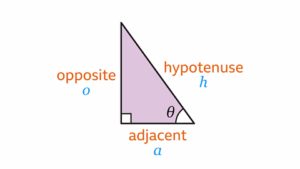
| Basic trig ratios | In a right-angled triangle: sin θ = opposite / hypotenuse, cos θ = adjacent / hypotenuse, tan θ = opposite / adjacent. |
| Sine rule | For any triangle with sides a, b, c opposite angles A, B, C: a / sin A = b/sin B = c/sin C. |
| Cosine rule (sides) | c2 = a2 + b2 − 2 × a × b × cos C. |
| Cosine rule (angles) | cos C = (a2 + b2 − c2) / (2 × a × b). |
| Area of a triangle | Area = (1/2) × a × b × sin C, where C is included angle between sides a and b. |
📌 Using sine, cosine and tangent in right-angled triangles
In a right-angled triangle, trigonometric ratios relate the lengths of the sides to the angles.
Always start by:
- Identifying the right angle.
- Marking the side opposite the angle θ as opposite, the side touching θ (but not the hypotenuse) as adjacent, and the longest side as hypotenuse.
- Choosing sin, cos or tan depending on which sides are involved
https://www.bbc.co.uk/bitesize/articles/zyjtfdm
📐 IA Spotlight
- Investigate triangulation methods to estimate heights or distances you cannot measure directly (for example, height of a building, width of a river) using sine and cosine rules.
- Collect real data using a clinometer or phone sensor and compare theoretical distances against measured ones, discussing sources of error.
🌐 EE Focus
- Explore the history and development of trigonometry in ancient cultures (Indian, Chinese, Greek, Islamic) and how triangle methods evolved.
- Study error propagation when using trig rules to approximate long distances or heights in navigation and surveying.
Worked example 1 — finding a side
A ladder leans against a wall, making an angle of 70° with the horizontal.
The ladder is 5 metres long. Find the height the ladder reaches on the wall.
- The ladder is the hypotenuse. The height on the wall is opposite the 70° angle.
- Use sin: sin 70° = opposite/hypotenuse.
- Let h be the height. Then sin 70° = h/5.
- So h = 5 × sin 70°.
- Using calculator: sin 70° ≈ 0.9397.
h ≈ 5 × 0.9397 ≈ 4.70 m.
Worked example 2 — finding an angle
In a right-angled triangle, the side opposite θ is 7 cm and the adjacent side is 10 cm. Find θ to the nearest degree.
- Known: opposite and adjacent → use tan.
- tan θ = opposite / adjacent = 7/10 = 0.7.
- θ = tan−1(0.7) ≈ 34.99°.
- To nearest degree, θ ≈ 35°.
🧮 GDC Tips
- Check your calculator angle mode (degrees for IB SL questions unless stated otherwise).
- Use the built-in sin−1, cos−1, tan−1 functions to find angles from ratios.
- Store intermediate results to avoid rounding too early when using values again (for example, use the answer memory).
📌 The sine rule — non-right-angled triangles
The sine rule applies to any triangle where you know:
- Two angles and one opposite side (A A S or A S A situations), or
- Two sides and a non-included angle, when side is opposite that angle (S S A).
In this SL topic the ambiguous case is not examined.
Relationship: a / sin A = b / sin B = c / sin C.
You usually pick two of these fractions and form an equation.
Worked example 3 — sine rule to find a side
In triangle ABC, A = 40°, B = 75°, and side a (opposite A) is 8 cm. Find side b.
- Use a / sin A = b/sin B.
- 8/sin 40° = b/sin 75°.
- Rearrange: b = sin 75° × (8/sin 40°).
- Compute: sin 75° ≈ 0.9659; sin 40° ≈ 0.6428.
- b ≈ 0.9659 × (8/0.6428) ≈ 0.9659 × 12.44 ≈ 12.02 cm.
📌 The cosine rule — non-right-angled triangles
The cosine rule is used when you have:
- Two sides and the included angle (S A S) → find the third side.
- All three sides (S S S) → find an angle.
Side form: c2 = a2 + b2 − 2 × a × b × cos C.
Angle form: cos C = (a2 + b2 − c2)/(2 × a × b).
📝 Paper 1 & Paper 2 Tips
- Always draw a clear, labelled diagram with angles and sides marked before choosing a rule.
- Write down the formula first, then substitute values — this gains method marks even if arithmetic slips occur.
- Round angles at the very end; use unrounded values in later calculations.
- Check whether your answer is reasonable: angles should add to about 180°; side opposite larger angle should be longest.
Worked example 5 — using cosine rule to find a side
In triangle X Y Z, sides adjacent to angle Z are 7 cm and 10 cm, and angle Z is 50°. Find side z opposite angle Z.
- Let a = 7, b = 10, C = 50°, c = z.
- c2 = a2 + b2 − 2 × a × b × cos C.
- c2 = 72 + 102 − 2 × 7 × 10 × cos 50°.
- c2 = 49 + 100 − 140 × cos 50°.
- cos 50° ≈ 0.6428 → 140 × 0.6428 ≈ 89.99.
- c2 ≈ 149 − 89.99 ≈ 59.01.
- c ≈ √59.01 ≈ 7.68 cm.
Worked example 6 — using cosine rule to find an angle
Triangle A B C has sides a = 6 cm, b = 8 cm, c = 9 cm. Find angle C to the nearest degree.
- Use cos C = (a2 + b2 − c2) / (2 × a × b).
- cos C = (62 + 82 − 92) / (2 × 6 × 8).
- cos C = (36 + 64 − 81) / 96 = 19 / 96 ≈ 0.1979.
- C = cos−1(0.1979) ≈ 78.6° → C ≈ 79°.
📌 Area of a triangle using ½ a b sin C
For any triangle, if you know two sides and the included angle between them, the area can be found without dropping a perpendicular.
Area = (1/2) × a × b × sin C, where C is the angle between sides a and b.
Worked example 7 — area from two sides and an included angle
A triangle has sides 9 cm and 12 cm with an included angle of 40°. Find its area.
- Area = (1/2) × 9 × 12 × sin 40°.
- (1/2) × 9 × 12 = 54.
- sin 40° ≈ 0.6428.
- Area ≈ 54 × 0.6428 ≈ 34.71 cm2.
📌 Choosing the correct rule — quick strategy
- Right angle present → use basic sin, cos, tan.
- Triangle is non-right-angled and you know A A S or A S A or S S A (with side opposite known angle) → sine rule.
- Triangle is non-right-angled and you know S A S or S S S → cosine rule.
- Need area with two sides and included angle → use (1/2) × a × b × sin C.
🔍 TOK Perspective
Trigonometry is based on axioms and definitions about triangles and angles. How universal are these ideas?
When explorers used trigonometry to estimate the size and shape of Earth, how did assumptions and measurement tools influence what was accepted as knowledge?
❤️ CAS Ideas
- Run a “map-making” or orienteering activity for younger students where they locate points by measuring angles and distances.
- Create a mural or digital artwork based on triangular patterns, labelling the trig relationships used.
🧠 Examiner Tip
Examiners frequently see answers where students select the wrong rule or forget to indicate which side corresponds to which angle.
Always state clearly: “using the sine rule” or “using the cosine rule” and match labels (a opposite A, b opposite B, c opposite C). Clear diagrams and formula statements are an easy way to secure method marks.