6.1 INTRODUCTION TO THE ATMOSPHERE
📌 Definitions Table
| Term | Definition |
|---|---|
| Biosphere | The global system that includes all living organisms and their interactions with the atmosphere, lithosphere, and hydrosphere. |
| Greenhouse Effect | The natural process where greenhouse gases trap heat in the Earth’s atmosphere, maintaining suitable temperatures for life. |
| Stratification | The layering of water in lakes or oceans due to differences in temperature, salinity, or density, which limits mixing. |
| Tricellular Model of Atmospheric Circulation | A model describing three large-scale circulation cells (Hadley, Ferrel, Polar) in each hemisphere that distribute heat and moisture globally. |
| Sublimation | The phase change of a substance directly from solid to gas without passing through the liquid state (e.g., ice to vapor). |
| Rice Paddies | Flooded fields used for growing rice, often associated with methane emissions due to anaerobic decomposition. |
- 🧠 Exam Tips:
In climate-related terms, always connect process to environmental function or impact (e.g., “traps heat,” “distributes moisture”).
For rice paddies, mention greenhouse gas link when relevant to climate change questions.
📌 Atmospheric Composition and Function
- The atmosphere forms the boundary between Earth and space
- It is the outer limit of the biosphere
- The atmosphere supports life on Earth
Atmospheric gases and their redistribution
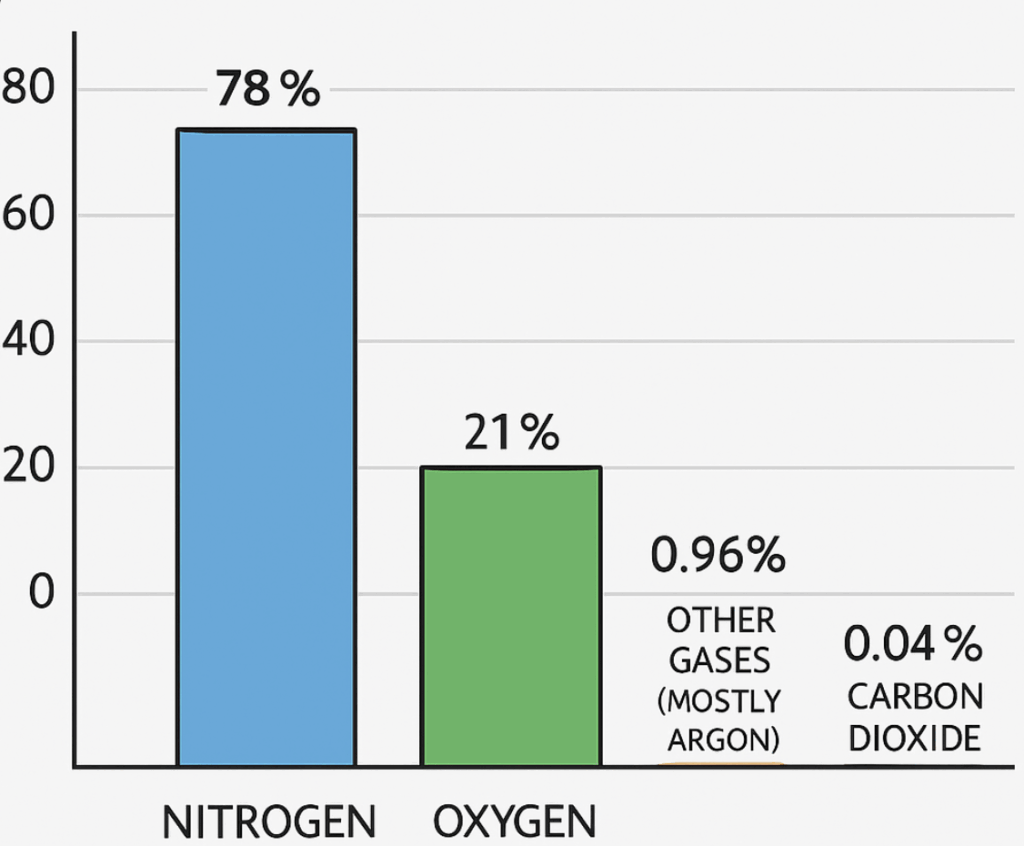
- The atmosphere is mainly composed of nitrogen (about 78%) and oxygen (about 21%)
- These two gases make up the majority of the atmosphere and play vital roles in supporting life on Earth
- The atmosphere contains smaller amounts of other gases, including:
- Carbon dioxide
- Argon
- Water vapour
- Various trace gases
- Carbon dioxide, although present in relatively low concentrations (around 0.04%), is essential for:
- Photosynthesis in plants
- Maintaining the greenhouse effect
- Argon is an inert gas that does not participate in chemical reactions but contributes to the overall composition of the atmosphere
- Water vapour plays an important role in:
- Photosynthesis in plants
- The Earth’s weather patterns
- The formation of clouds and precipitation
- Trace gases, such as methane, ozone, and nitrous oxide, are present in even smaller quantities
- However, they still have significant impacts on climate and atmospheric chemistry
Redistribution through physical processes
- Gases in the atmosphere are moved around by various physical processes, including:
- Wind: the main mover of gases, caused by differences in air pressure
- Convection: warm air rises and cool air sinks, creating vertical movement
- Diffusion: gases spread from areas of high concentration to areas of low concentration
- Turbulence: irregular air flow caused by obstacles like mountains and buildings
- Jet streams: fast-flowing, narrow air currents in the upper atmosphere
Atmospheric layers
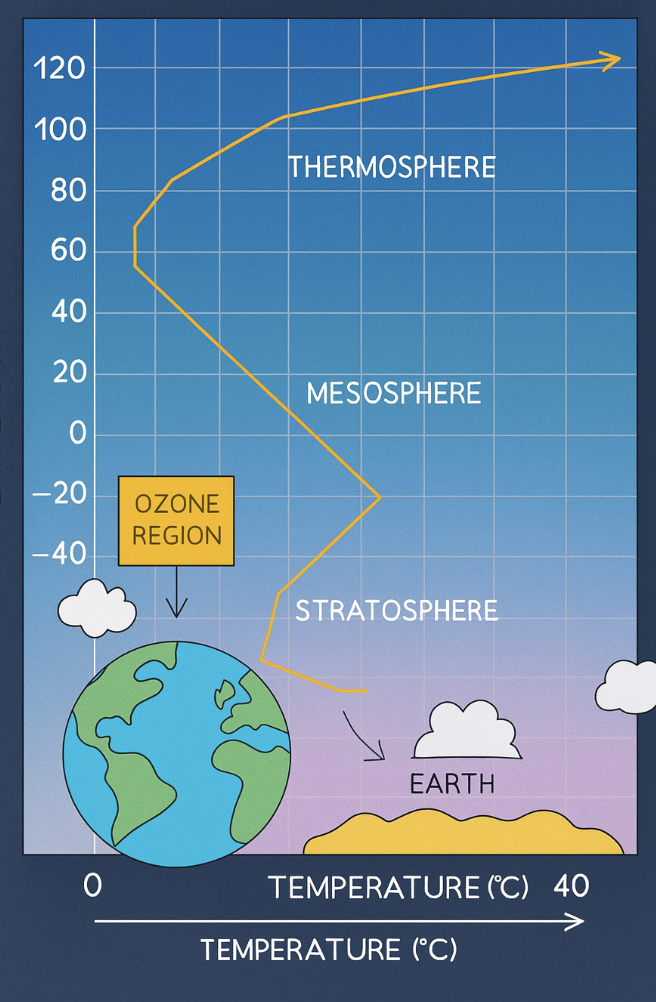
- Atmospheric stratification:
- The atmosphere is divided into layers based on temperature changes
- The key layers for living systems are the troposphere and the stratosphere
- Troposphere:
- The lowest layer, extending up to about 10 km from the Earth’s surface
- Weather phenomena, such as clouds, precipitation, and gas mixing, occur here
- Contains the highest concentration of water vapour, carbon dioxide and other important trace gases
- Stratosphere:
- Located above the troposphere, extending from about 10 to 50 km above the Earth’s surface
- Contains the ozone layer, which absorbs and blocks most of the Sun’s harmful ultraviolet (UV) radiation
- Importance of inner layers:
- Various reactions in the troposphere and stratosphere are vital for maintaining the balance of gases, regulating climate and supporting life
- In the troposphere, chemical reactions involving pollutants, greenhouse gases and particles impact air quality and climate
- In the stratosphere, chemical reactions involving ozone maintain the ozone layer and protect organisms on Earth from harmful UV radiation
Differential heating and the tricellular model
- Differential heating of the atmosphere:
- The Sun heats the Earth and its atmosphere unevenly
- The equator receives more direct sunlight, making it warmer
- The poles receive less direct sunlight, making them cooler
- This results in an effect known as the tricellular model of atmospheric circulation
- This model explains how heat is distributed from the equator to the poles
Atmospheric systems
- The atmosphere is a highly dynamic system
- It plays a crucial role in the Earth’s climate and weather patterns
- As with other systems, the atmospheric system is made up of storages, flows, inputs and outputs
- Storages:
- The atmosphere acts as a storage for gases
- These gases are present in different concentrations
- These concentrations can vary over time due to natural and human activities
- This includes greenhouse gases like carbon dioxide and methane
- These gases contribute to the greenhouse effect and influence the Earth’s temperature
- Flows:
- Within the atmosphere, there are constant flows of gases and particles
- These flows are driven by processes such as air currents, weather patterns and atmospheric circulation
- These flows contribute to the movement and redistribution of gases and other substances within the atmosphere
- Inputs:
- The atmosphere receives inputs from various sources
- Natural inputs include:
- Gases emitted from volcanic eruptions
- Gases emitted from plants and other living organisms
- Dust particles from desert regions
- Anthropogenic inputs, resulting from human activities, include:
- Greenhouse gases (e.g. from fossil fuel combustion and livestock)
- Air pollutants from industrial processes
- Aerosols from combustion
- Outputs:
- Gases maybe be removed from atmospheric systems through natural processes like respirationand photosynthesis
- Pollutants and aerosols can be removed from the atmosphere through, e.g. precipitation and dry deposition
- Exchanges and interactions with other Earth systems:
- The atmosphere interacts with other components of the Earth system
- This includes the biosphere (plants, animals, and microorganisms), hydrosphere (oceans, lakes, and rivers), and lithosphere (landmasses and rocks)
- It exchanges gases and particles with these systems through various mechanisms
- E.g. the exchange of carbon dioxide occurs through photosynthesis by plants and respiration by organisms
- These interactions involve the exchange of gases, energy and particles
- This shapes climate patterns, weather events and overall Earth system dynamics
- The atmosphere interacts with other components of the Earth system
📌 The Greenhouse Function
- Greenhouse gases (GHGs) and aerosols play an important role in Earth’s climate by trapping heat in the atmosphere
Greenhouse gases and aerosols
- GHGs: gases in the atmosphere that trap heat
- Key GHGs:
- Water vapour
- Carbon dioxide
- Methane
- Nitrous Oxides
- Key GHGs:
- Aerosols: tiny particles or droplets in the atmosphere
- Key aerosols:
- Black carbon
- A type of aerosol produced from incomplete combustion of fossil fuels, wood and other biomass
- Found in emissions from, e.g. diesel engines, cooking stoves and open burning of vegetation
- Absorbs sunlight and warms the atmosphere
- Can darken snow and ice surfaces, reducing their reflectivity and accelerating melting
- Black carbon
- Key aerosols:
Key Greenhouse Gases
| Name of GHG | Sources | Other Information |
|---|---|---|
| Water vapour | Evaporation from oceans, lakes and riversTranspiration from plantsSublimation from ice and snowCombustion of fossil fuels | Most abundant GHGConcentration varies with temperatureAmplifies effects of other GHGsPositive feedback loop: warmer atmosphere holds more water vapour, leading to more warming and greater evaporationIt is often excluded from climate models due to its dynamic levels and essential role in life, meaning it cannot be mitigated against |
| Carbon dioxide | Burning fossil fuels: coal, oil and natural gas (e.g. vehicle emissions)Deforestation (when forests are cleared or burned, the carbon stored in trees is released back into atmosphere as carbon dioxide)Industrial processes (e.g. cement production) | Significant contributor to the greenhouse effect due to high concentration and long lifespan in the atmosphere |
| Methane | Agriculture: livestock digestion (e.g. from large-scale cattle farming)LandfillsNatural gas extraction (methane leaks)rice paddiesWetlands | More effective at trapping heat than carbon dioxide (over 20 times more potent over 100 years)Found in much lower concentrations than carbon dioxide, so overall warming effect is less |
| Nitrous oxides | Agricultural practices (use of synthetic and organic fertilisers)Fossil fuel combustionIndustrial processes | Potent GHG with a warming effect nearly 300 times that of carbon dioxide per moleculeFound in much lower concentrations than carbon dioxide, so overall warming effect is less |
What is the greenhouse effect?
- The Sun emits energy in the form of solar radiation
- This includes visible light and ultraviolet rays
- This solar radiation enters the Earth’s atmosphere
- Some thermal energy is reflected from the Earth’s surface
- Most thermal energy is absorbed and re-emitted back from the Earth’s surface
- This energy passes through the atmosphere
- Some thermal energy passes straight through and is emitted into space
- However, some thermal energy is absorbed by greenhouse gases
- This causes thermal energy to be re-emitted in all directions
- These gases act like a blanket
- They allow sunlight to pass through while preventing a significant amount of the infrared radiation from escaping back into space
- This reduces the thermal energy lost into space and traps it within the Earth’s atmosphere
- This keeps the Earth warm
- This process is known as the greenhouse effect
- The greenhouse effect is a naturally occurring phenomenon
- The greenhouse effect is important to ensure that Earth is warm enough for life
- Without the greenhouse effect, the average temperature would be much colder, making the planet uninhabitable
- For example, the average surface temperature of Earth is about 15 °C
- Without the greenhouse effect, it would be about -18 °C