Water stored beneath Earth’s surface in soil pore spaces and rock formations.
Aquifers
Underground layers of permeable rock or sediment that store and transmit groundwater.
Steady State
A condition in which the inputs and outputs of a system are balanced, maintaining stability over time.
Natural Surface Discharge
The release of groundwater to the surface via springs, rivers, or seepage.
Subsurface Flow
The lateral movement of water beneath the surface, often through soil layers toward streams or aquifers.
Evapotranspiration
The combined process of water evaporation from land and transpiration from plants.
Erosion
The physical removal of soil or rock by wind, water, or gravity, often accelerated by human activity.
🧠 Exam Tips:
For hydrological terms, include movement or storage of water and specify where it occurs (surface, subsurface, underground).
Use systems language (e.g., input, flow, storage) where applicable.
📌 Hydrological Cycle
The hydrosphere includes all Earth’s water, such as oceans, rivers, lakes and atmospheric moisture
Fresh water only makes up a small fraction (approximately 2.5% by volume) of the Earth’s water storages
Of this fresh water, approximately 69% is stored in glaciers and ice sheets and 30% is stored as groundwater
The remaining 1% of freshwater is in rivers, lakes and the atmosphere
All water is part of the hydrological cycle
Gravity and solar radiation both influence the movement of water in the hydrosphere
The Sun’s heat causes water to evaporate from oceans, lakes, and rivers
Water vapour cools and condenses into clouds, releasing heat
Gravity pulls condensed water back to Earth via the process of precipitation (rain, snow, sleet, or hail).
Gravity causes water to flow over land into rivers and streams (runoff) and drain through soil
Rivers flow downhill due to gravity, moving water from inland back to the oceans
Components of the hydrological cycle
The global hydrological cycle is a closed system
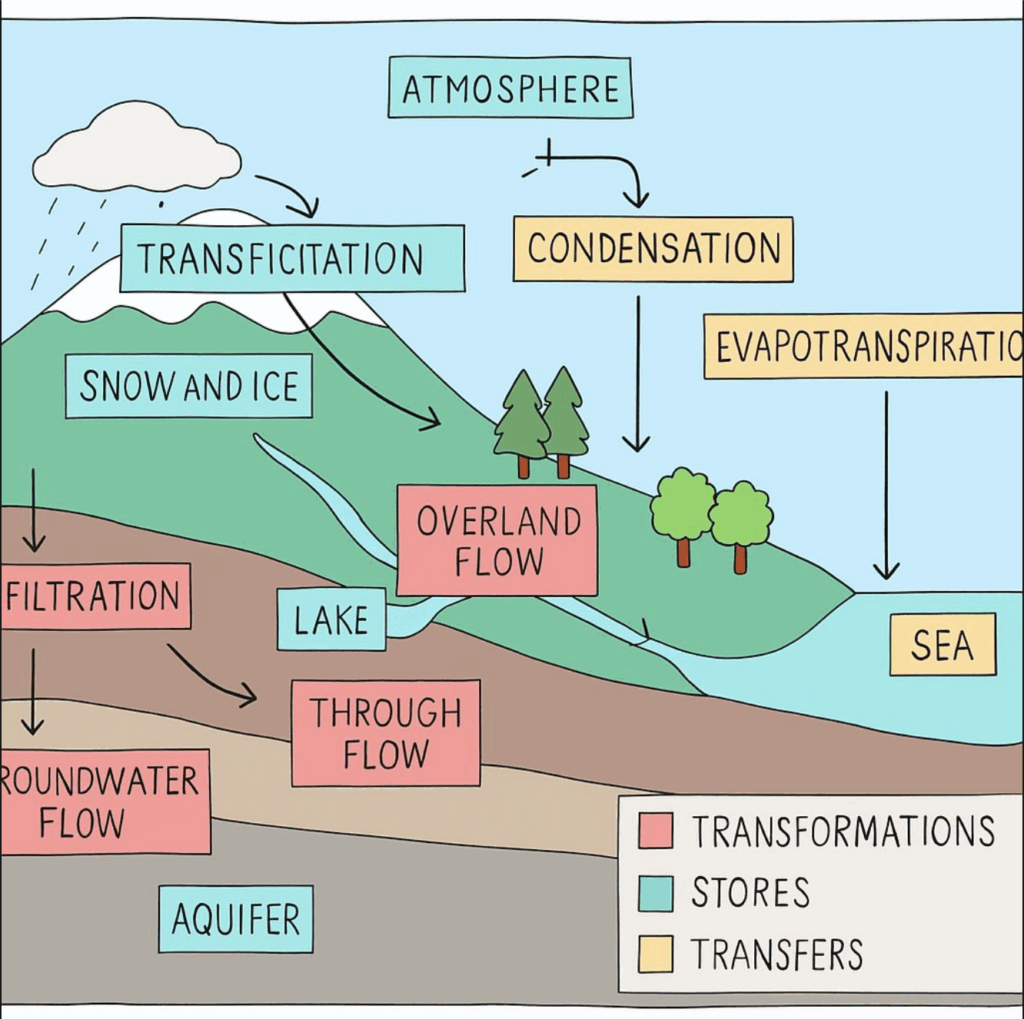
Within the hydrological cycle, there are stores and flows
The hydrological cycle is a series of processes in which water is constantly recycled through the system
The cycle also shapes landscapes, transports minerals and is essential to life on Earth
The main stores occurring within the hydrological cycle are:
Oceans
Glaciers and ice caps
Groundwater and aquifers
Surface freshwater (rivers and lakes)
Atmosphere
The main flows occurring within the hydrological cycle are:
Transformations: processes where the state or form of water changes, e.g.
Evaporation (the sun evaporates surface water into vapour)
Condensation (water vapour condenses and precipitates)
Transfers: movements of water from one location to another without changing state, e.g.
Water runs off the surface into streams and reservoirs or beneath the surface as ground flow
These flows move the water on Earth from one store to another (river to ocean or ocean to atmosphere)
Image source: savemyexams.com
Flows in the hydrological cycle include the following:
Flows in the Hydrological Cycle
Flow
Type
Description
Evaporation
Transformation
The process by which liquid water changes into a gaseous state (water vapour) and enters the atmosphere from water bodies such as oceans, lakes, and rivers
Transpiration
Transformation
The process by which plants absorb water from the soil through their roots and release it as water vapour through tiny openings called stomata in their leaves
Evapotranspiration
Transformation
The combined process of water vaporisation from the Earth’s surface (evaporation) and the release of water vapour by plants ( transpiration)
Sublimation
Transformation
The direct transition of water from a solid state (ice or snow) to a vapour state without melting first
Condensation
Transformation
The process by which water vapour in the atmosphere transforms into liquid water, forming clouds or dew, as a result of cooling
Melting
Transformation
The process by which solid ice or snow changes into liquid water due to an increase in temperature
Freezing
Transformation
The process by which liquid water changes into a solid state (ice or snow) due to a decrease in temperature
Advection
Transfer
The wind-blown movement of water vapour or condensed/frozen water droplets (clouds)
Precipitation
Transfer
The process of water falling from the atmosphere to the Earth’s surface in the form of rain, snow, sleet, or hail
Surface run-off
Transfer
The movement of water over the Earth’s surface typically occurs when the ground is saturated or impermeable, leading to excess water
Infiltration
Transfer
The process of water seeping into the soil from the surface, entering the soil layers and becoming groundwater
Percolation
Transfer
The downward movement of water through the soil and underlying rock layers, eventually reaches aquifers or groundwater reservoirs
Streamflow
Transfer
The movement of water in streams, rivers, or other water bodies, driven by gravity and the slope of the land, ultimately leads to oceans or lakes
Groundwater flow
Transfer
The movement of water through the pores and spaces in underground soil and rock layers, often moving towards rivers, lakes or oceans
📌 Human Impacts on the Hydrological Cycle
Human activities have significant impacts on the hydrological cycle
They alter the natural processes of surface run-off and infiltration
These activities include:
Agriculture (specifically irrigation)
Deforestation
Urbanisation
Impact of agriculture and irrigation
Irrigation is the process of artificially supplying water to crops
It has a direct impact on the hydrological cycle by modifying the water distribution and availability in a region
Increased irrigation leads to:
Artificially high evapotranspiration rates
This is because more water is supplied to plants than would occur naturally
This results in increased atmospheric moisture levels
This can lead to localised increases in precipitation downwind of irrigated areas, altering rainfall patterns in the region
Excessive irrigation can also result in increased surface run-off
Water is applied faster than the soil can absorb it
This causes water to flow over the soil surface, carrying sediments, fertilisers, and pesticides
This leads to water pollution and nutrient imbalances
Impact of deforestation
Deforestation refers to the clearing or removal of forests
This is primarily for agriculture, logging or urban development purposes
Forests play a crucial role in the hydrological cycle
They act like natural sponges
They absorb rainfall and facilitate infiltration
This helps to recharge groundwater and maintain stream flows
When forests are cleared, surface runoff increases significantly
Without the tree canopy and vegetation to intercept and slow down rainfall, more water reaches the ground surface
This leads to higher surface runoff rates
Deforestation also reduces evapotranspiration rates
As trees are removed, there is less transpiration and evaporation occurring
This results in reduced moisture release into the atmosphere
Overall, deforestation disrupts the balance between surface run-off and infiltration
This can lead to increased erosion, reduced groundwater recharge and altered stream flow patterns
Impact of urbanisation
Urbanisation involves the transformation of natural landscapes into urban areas with buildings, roads and infrastructure
Urban development significantly alters the hydrological cycle by:
Replacing permeable surfaces (such as soil and vegetation) with impermeable surfaces(concrete, asphalt)
Impermeable surfaces prevent infiltration
This leads to reduced groundwater recharge
Instead of infiltrating into the soil, rainfall quickly becomes surface run-off
This results in increased flooding and diminished water availability during dry periods
Urban areas typically have efficient drainage systems designed to quickly remove excess water
This further accelerates surface run-off
This can overload natural water bodies and cause downstream flooding
Urban areas often experience higher temperatures due to the urban heat island effect
This effect is caused by the concentration of buildings and paved surfaces
It can lead to increased evaporation rates
This can alter local precipitation patterns
Steady state of water bodies
Understanding the steady state of a water body involves analysing the balance between inputs and outputs
This balance ensures that the water level remains constantover time
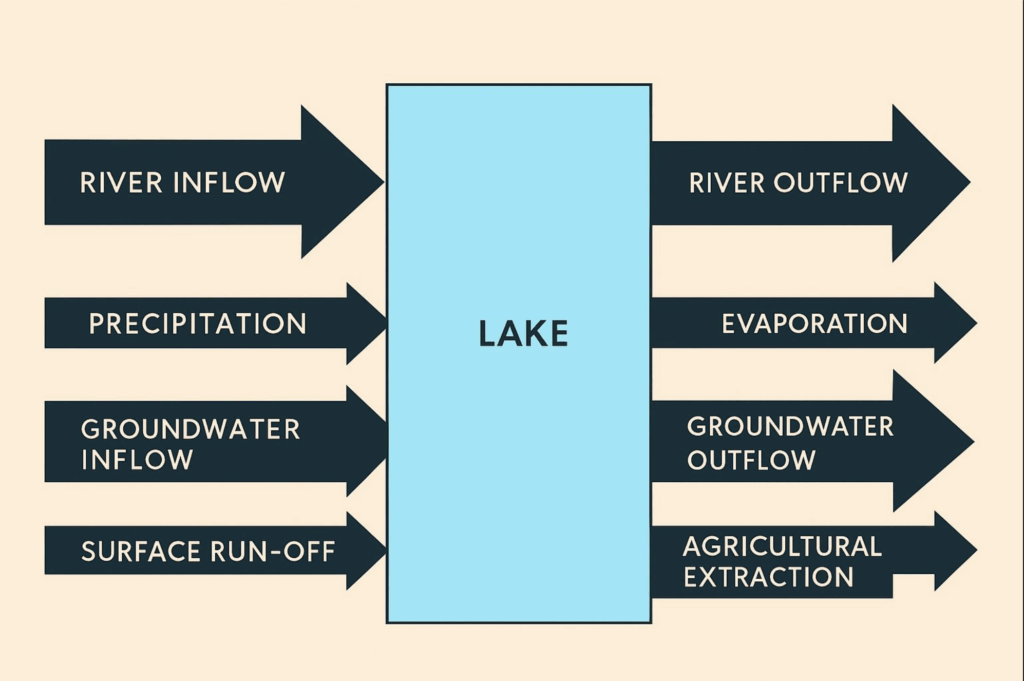
Flow diagrams of inputs and outputs
Flow diagrams visually represent the water inputs and outputs for a water body
Inputs: e.g.
Precipitation: rain, snow, or other forms of water falling directly into the water body
Surface run-off: water flowing over the land into the water body
Groundwater Inflow: water moving into the water body from underground sources
Outputs: e.g.
Evaporation: water turning into vapour and leaving the water body
River outflow: water leaving the water body through rivers or streams
Groundwater outflow: water moving out of the water body into underground aquifers
Agricultural extraction: water that is extracted for irrigation
For example, a lake that is at a steady state may have the following inputs and outputs:
This is an example of sustainable water harvesting
Sustainable harvesting means taking water from a water body at a rate that does not exceed the rate of natural replenishment
Assessing the total inputs and outputs of a water body can help calculate sustainable rates of water harvesting
This ensures the harvested water amount does not disrupt the steady state
If total outputs are greater than total inputs, then the water body will decrease in size
This may be due to unsustainable water harvesting for agriculture or for domestic and industrial purposes, e.g. water used in drinking, cleaning, heating and cooling systems, and manufacturing processes
Water may be extracted faster than it can be naturally replenished
For example, an aquifer that is being unsustainably harvested (and therefore is not at a steady state) may have the following inputs and outputs: