3.1 BIODIVERSITY AND EVOLUTION
📌 Definitions Table
| Term | Definition |
|---|---|
| Resilience | The ability of an ecosystem to recover from disturbance and return to its original state while maintaining function and structure. |
| Heritable Characteristics | Traits encoded in DNA that can be passed from parents to offspring, influencing evolution through natural selection. |
| Adaptive Features | Traits that enhance an organism’s survival or reproduction in a specific environment. |
| Natural Selection | The process where organisms with favorable heritable traits survive and reproduce more successfully, leading to evolution. |
| Selection Pressure | Environmental factors that affect survival and reproduction, driving natural selection and adaptation. |
| Species Diversity | A measure of biodiversity that includes both the number of species (richness) and their relative abundance (evenness) in an area. |
| Species Richness | The number of different species present in a given area, regardless of their population sizes. |
| Biodiversity | The variety of life in all its forms, including genetic, species, and ecosystem diversity, within a given area. |
| Habitat Diversity | The range of different habitats or ecosystems in a given area, contributing to overall biodiversity. |
| Genetic Diversity | The variation of genes within a species population, contributing to adaptability and resilience. |
- 🧠 Exam Tips:
For diversity terms, use “variety” and specify what is being measured (genes, species, habitats).
Always distinguish between species richness vs. species diversity — a common exam point.
📌 Biodiversity and Resilience
Why is biodiversity important?
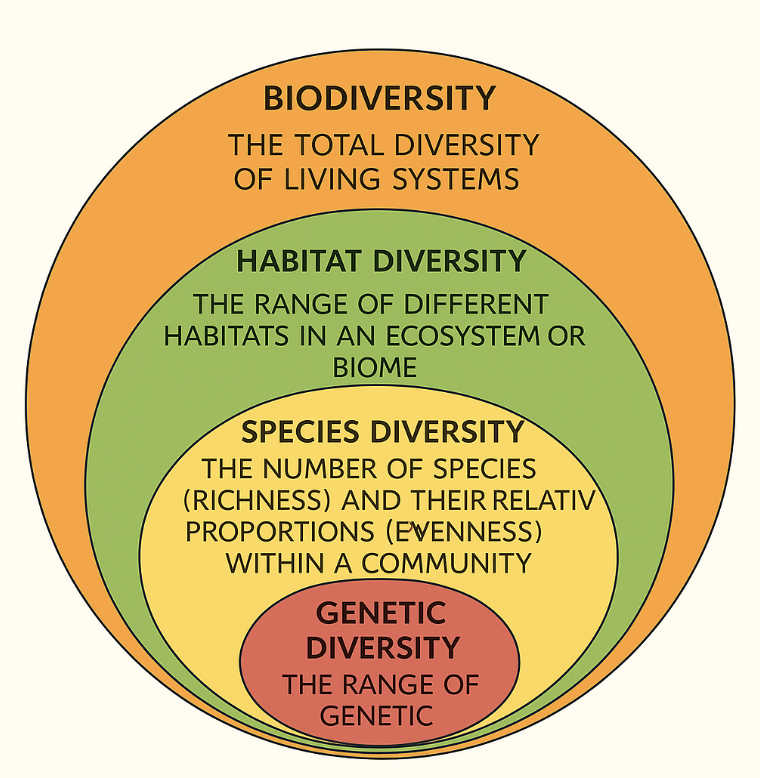
- Biodiversity can be thought of as a study of all the variation that exists within and between all forms of life
- Biodiversity looks at the range and variety of habitats, species and genes within a particular region
- It can be assessed at three different levels:
- The number and range of different ecosystems and habitats
- The number of species and their relative abundance
- The genetic variation within each species
- Biodiversity is very important for the resilience of ecosystems
- This is because biodiversity allows them to resist changes in the environment and avoid ecological tipping points
Habitat diversity
- This is the range of different habitats within a particular ecosystem or biome
- If there is a large number of different habitats within an area, then that area has high biodiversity
- A good example of this is a coral reef
- They are very complex with lots of microhabitats and niches to be exploited
- If there is only one or two different habitats then an area has low biodiversity
- Large sandy deserts typically have very low biodiversity
- The conditions are basically the same throughout the whole area
Species diversity
- An ecosystem such as a tropical rainforest that has a very high number of different species would be described as species-rich
- Species richness is the number of species within an ecosystem
- Species diversity looks at the number of different species in an ecosystem, and also the evenness of abundance across the different species present
- The greater the number of species in an ecosystem and the more evenly distributed the number of organisms are among each species, then the greater the species diversity
- Ecosystems with high species diversity are usually more stable than those with lower species diversity as they are more resilient to environmental changes
- For example in the pine forests of Florida, the ecosystem is dominated by one or two tree species
- If a pathogen comes along that targets one of the two dominant species of trees, then the whole population could be wiped out and the ecosystem it is a part of could collapse
Genetic diversity
- Genetic diversity is the diversity of genes found within different individuals of a species
- Although individuals of the same species will have the same set of genes, these genes can take a variety of different forms
- This makes it possible for genetic diversity to occur between populations of the same species
- Genetic diversity within a single population also occurs
- This diversity is important as it can help the population adapt to, and survive, changes in the environment
- This could include changes in biotic factors such as new predators, pathogens and competition with other species
- Or the changes could be abiotic factors like temperature, humidity and rainfall
📌 Evolutionary Processes
- Biodiversity arises from evolutionary processes
- Evolution is the cumulative change (i.e. the overall change over time) in the heritable characteristics of a population or species
- Natural selection is the name of the mechanism that drives this evolutionary change
- Natural selection occurs continuously and can take place over billions of years
- The result of this process of natural selection is the biodiversity of life on Earth we see today
Natural selection
- In any environment, the individuals that have the best adaptive features are the ones most likely to survive and reproduce
- This results in natural selection:
- Individuals in a species show a range of variation caused by differences in genes (genetic diversity)
- When organisms reproduce, they produce more offspring than the environment is able to support
- This leads to competition for food and other resources, which results in a “struggle for survival“
- Individuals with characteristics most suited to the environment have a higher chance of survival and more chances to reproduce
- Therefore, the genes resulting in these characteristics are passed on to offspring at a higher rate than those with characteristics less suited to survival
- This means that in the next generation, there will be a greater number of individuals with the better adapted variations in characteristics
- This theory of natural selection was put forward by Charles Darwin and became known as “survival of the fittest”
Example of natural selection
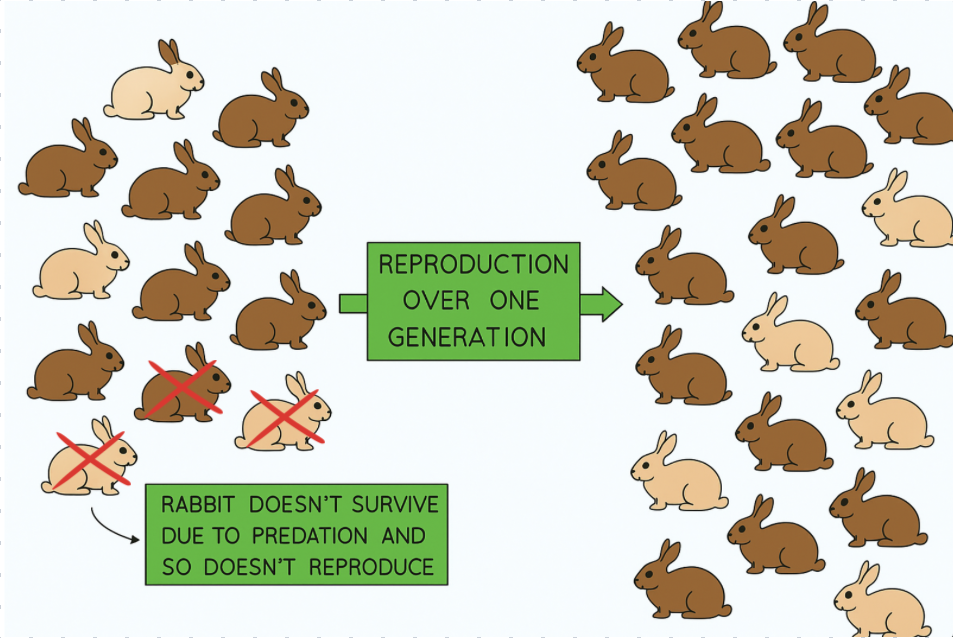
- Imagine a population of rabbits shows variation in fur colour
- The rabbits have natural predators like foxes
- This acts as a selection pressure
- Rabbits with a white coat do not camouflage as well as rabbits with brown fur
- This means predators are more likely to see white rabbits when hunting
- As a result, rabbits with white fur are less likely to survive than rabbits with brown fur
- The rabbits with brown fur therefore have a selection advantage
- This means they are more likely to survive to reproductive age and be able to pass on their genes to their offspring
- Over many generations, the frequency of the gene for brown fur will increase and the frequency of the gene for white fur will decrease
- Remember that organisms better suited to their environments are more likely to survive
- However, this does not mean their survival is guaranteed
- Organisms that are less suited to an environment are still able to survive and potentially reproduce within it
- However, their chance of survival and reproduction is lower than the individuals that are better-adapted
- Also, it is important to be aware that an environment, and the selection pressures it exerts on an organism, can change over time
- When a change occurs then a different characteristic may become more advantageous
- Finally, remember that all organisms (not just animals) experience selection pressures as a result of the environment they are in
Speciation
- Speciation is the generation of new species through evolution
- It occurs when populations of a species become isolated and adapt to their environments in different ways
- Over time, these populations become so different that they can no longer interbreed with each other to produce fertile offspring
- When they cannot interbreed in this way, they are considered separate species
📌 Assessing Biodiversity
Species diversity
- Species richness is the number of species in a community or defined area
- In some cases, it can be a useful measure to compare the biodiversity of different areas
- However, in other cases, species richness can be a misleadingindicator of diversity
- This is because it does not take into account the number of individuals of each species
- Once the abundance of each species in an area has been recorded, the results can be used to calculate the species diversity for that area
- Species diversity looks at the number of different species in an area but also the species evenness
- Species evenness is the evenness of abundance across the different species (i.e. their relative abundances)
- Species diversity looks at the number of different species in an area but also the species evenness
Species richness vs species diversity
- Species diversity is a much more informative measurement than species richness and conservationists often favour the use of species diversity as it takes into account both species richness and evenness
- For example:
- Area 1 and Area 2 both contain four tree species
- However, Area 2 is actually dominated by one species and in fact, one of the species is very rare (only one individual)
- Although the two areas have exactly the same species richness, Area 1 has a higher species evenness (and therefore a higher overall species diversity) than Area 2
- This example illustrates the limitations of using just species richness on its own
Simpson’s diversity index
- Biological communities can be described and compared through the use of diversity indices
- These are mathematical tools used to quantify the diversity of species within a community
- These indices provide a measure of the variety of species present, as well as their relative abundances
- They can be used to compare different communities or to track changes in diversity over time
- A commonly used diversity index is Simpson’s index
📌 Biodiversity Management
Importance of biodiversity management
- Biodiversity refers to the variety of life on Earth, including ecosystems, habitats, species and genetic diversity
- Managing biodiversity is crucial for many reasons, including:
- Ecosystem stability—biodiversity maintains ecosystem resilience to environmental changes
- Medicine and pharmaceuticals—many medicines are derived from biodiversity, offering potential treatments for various diseases
- Cultural and spiritual significance—biodiversity holds cultural and spiritual importance, preserving traditional knowledge
- Economic benefits—biodiversity contributes to tourism and livelihoods, supporting local economies
- Climate regulation—ecosystems help mitigate climate change by sequestering carbon dioxide
- Pollination and food security—biodiversity, especially pollinators, is essential for crop pollination and food production.
Gathering knowledge of biodiversity
- Effective biodiversity management requires comprehensive knowledge at both global and regional levels
❤️ CAS Tip: Design a biodiversity awareness campaign or species ID workshop in your community.
Global biodiversity data collection
- International organisations:
- Organisations like the IUCN (International Union for Conservation of Nature) and WWF (World Wildlife Fund) gather data globally
- For example, the IUCN Red List categorises species based on their extinction risk
- Organisations like the IUCN (International Union for Conservation of Nature) and WWF (World Wildlife Fund) gather data globally
Regional biodiversity data collection
- National and local agencies:
- Government-funded agencies, such as Natural England in the UK, collect data on local species and habitats
- For example, Natural England conducts surveys on bird populations to monitor their status
- Government-funded agencies, such as Natural England in the UK, collect data on local species and habitats
- Citizen science:
- Involves public participation in scientific research
- Volunteers collect data on local wildlife, which is then used by scientists
- For example, the Big Butterfly Count in the UK engages the public in counting butterfly species
- Voluntary organisations:
- NGOs like The Wildlife Trusts (UK) work on local biodiversity projects
- For example, the Wildlife Trusts have a long-term hedgehog monitoring programme
- NGOs like The Wildlife Trusts (UK) work on local biodiversity projects
Training for data collection
- Indigenous people:
- Indigenous communities often possess detailed traditional knowledge of local ecosystems
- Training helps integrate their knowledge with scientific methods
- For example, indigenous rangers in Australia are trained to monitor and protect native species
- Parabiologists:
- These are local people trained to assist in biological research
- They bridge the gap between local communities and scientific researchers
- They may be used to gather information for use in conservation management
Biodiversity management strategies
- There are many different biodiversity management strategies but the main categories are:
- The creation of protected areas
- The restoration of existing but damaged habitat
- The implementation of sustainable management strategies
- Protected areas:
- Creating parks, reserves and conservation areas
- For example, the establishment of marine protected areas to safeguard coral reefs
- Creating parks, reserves and conservation areas
- Habitat restoration:
- Restoring degraded ecosystems to their natural state
- For example, rewilding projects involve the restoration of ecosystems by reintroducing native species to their original habitats
- Restoring degraded ecosystems to their natural state
- Sustainable practices:
- Encouraging sustainable agriculture, forestry and fishing
- For example, certification schemes like Fair Trade promote sustainable farming practices
- Encouraging sustainable agriculture, forestry and fishing