SL 5.4 — Tangents and Normals
| Key Concept | Explanation |
|---|---|
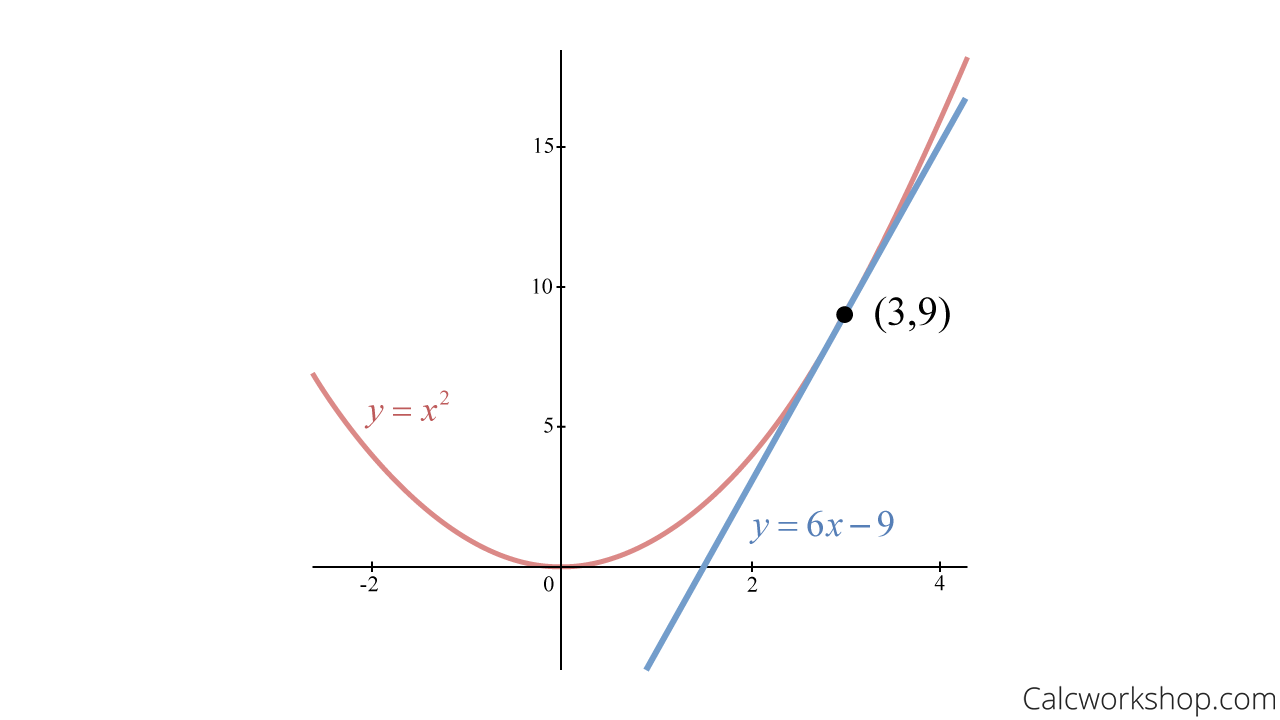
| Tangent Line | A line that touches a curve at exactly one point and has the same slope as the curve at that point. |
| Normal Line | A line perpendicular to the tangent at the point of contact. Its slope is the negative reciprocal of the tangent slope. |
| Slope at a Point | Given by the derivative f'(x). At x = a, slope = f'(a). |
📌 1. Tangents at a given point
To find the tangent line at a point x = a on a curve y = f(x), we use the derivative to obtain the slope.
The tangent line matches the curve’s instantaneous direction.
- Slope of tangent: m = f'(a)
- Point on curve: (a, f(a))
- Equation: y – f(a) = f'(a)(x – a)
🌍 Real-World Connection
Tangents are used in physics to calculate instantaneous velocity, and in economics to determine marginal cost, marginal profit or elasticity. Many objects in physics change constantly, to find the velocity at a certain instant we could calculate the slope of its distance function at a certain point.
📌 2. Normals at a given point
Normals are perpendicular to tangents. They appear frequently in optics (reflection angles), physics, and engineering.
- Slope of tangent = m
- Slope of normal = -1/m
- Equation: y – f(a) = -(1/m)(x – a)
📌 3. Technology (GDC) Approaches
Most GDCs allow you to compute slopes, derivatives, and tangent equations instantly.
- Graph f(x) → Analyse → “dy/dx” at x = a.
- in the run matrix tab you could use a derivatice function to find slope.
- Some calculators provide tangent line equations directly.
- Normals must be written manually using slope = -1/(dy/dx).
🧠 Examiner Tip
- Always show the derivative and the substitution step even if the GDC computes the tangent.
- Write the tangent/normal equation clearly in y = mx + c form unless the question specifies otherwise.
📌 4. Example (Common IB Exam Style)
Find the equation of the tangent and normal to the curve f(x) = x² – 3x + 1 at x = 2.
Step 1: Use GDC → Graph → Derivative at x = 2
Slope = 1
Step 2: Find point
f(2) = 2² – 3(2) + 1 = -1 → point (2, -1)
Tangent: y + 1 = 1(x – 2) → y = x – 3
Normal slope: -1
Normal: y + 1 = -1(x – 2) → y = -x + 1
❤️ CAS Link
Students can model physical behaviours such as running pace or motion patterns, using tangents to represent instantaneous change and normals to analyze direction of correction or stabilization.