| Content | Guidance, clarification and syllabus links |
|---|---|
|
Laws of exponents with rational exponents.
Solving exponential equations, including ones where logs are needed. Solving logarithmic equations. Using logarithms to solve exponential equations, and exponentials to solve logarithmic equations. Graph of \(y = a^x\), \(a > 0\), \(a ≠ 1\) and its inverse \(y = \log_a x\). |
Extension of laws of exponents to rational exponents \(x^{p/q}\).
Students should be able to solve exponential and logarithmic equations analytically where possible. Use of technology to solve more complex exponential and logarithmic equations. The relationship \(x^{p/q} = \sqrt[q]{x^p} = (\sqrt[q]{x})^p\) should be understood. Link to exponential and logarithmic functions in topic 2. |
📌 Introduction
Building on the foundations of SL 1.5, this topic extends the laws of exponents to include rational exponents and develops more sophisticated techniques for solving exponential and logarithmic equations. Rational exponents provide a unified way to express both powers and roots, while advanced logarithmic techniques enable us to solve complex exponential equations that arise in real-world applications.
The inverse relationship between exponential and logarithmic functions becomes crucial for solving equations where the unknown appears as an exponent. This topic also introduces the graphical representation of exponential and logarithmic functions, highlighting their inverse relationship through reflection across the line \(y = x\). These concepts form the mathematical foundation for modeling exponential growth and decay phenomena across multiple scientific disciplines.
📌 Definition Table
| Term | Definition |
|---|---|
| Rational Exponent |
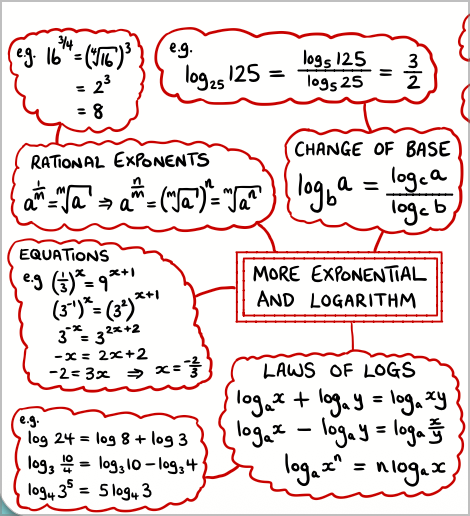
An exponent that can be expressed as a fraction \(\frac{p}{q}\) where p and q are integers, \(q ≠ 0\) \(x^{p/q} = \sqrt[q]{x^p} = (\sqrt[q]{x})^p\) |
| Principal Root |
For \(x^{1/n} = \sqrt[n]{x}\), the principal nth root is the positive root when x > 0 Example: \(16^{1/4} = 2\) (not -2) |
| Exponential Equation |
An equation where the unknown appears as an exponent Examples: \(3^x = 27\), \(2^{x+1} = 5^{x-2}\) |
| Logarithmic Equation |
An equation involving logarithms of the unknown Examples: \(\log_2(x + 3) = 5\), \(\log x + \log(x – 1) = 1\) |
| Inverse Functions |
\(f(x) = a^x\) and \(g(x) = \log_a x\) are inverse functions Their graphs are reflections of each other across \(y = x\) |
| Domain and Range |
For \(y = a^x\): Domain = ℝ, Range = (0, ∞) For \(y = \log_a x\): Domain = (0, ∞), Range = ℝ |
| Asymptote |
\(y = a^x\) has horizontal asymptote \(y = 0\) \(y = \log_a x\) has vertical asymptote \(x = 0\) |
| Exponential Growth/Decay |
If a > 1: exponential growth If 0 < a < 1: exponential decay |
📌 Properties & Key Formulas
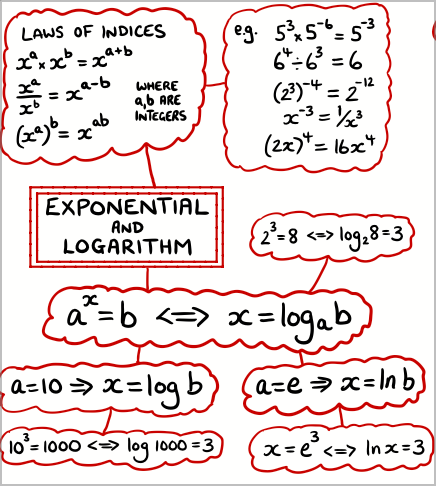
- Rational Exponents: \(x^{p/q} = \sqrt[q]{x^p} = (\sqrt[q]{x})^p\) where \(x > 0\)
- Negative Fractional Exponents: \(x^{-p/q} = \frac{1}{x^{p/q}} = \frac{1}{\sqrt[q]{x^p}}\)
- All Exponent Laws Apply: \(x^{a/b} \times x^{c/d} = x^{(ad+bc)/(bd)}\)
- Solving Exponential Equations: If \(a^f(x) = a^g(x)\), then \(f(x) = g(x)\)
- Taking Logarithms: If \(a^x = b\), then \(x = \log_a b\)
- Exponential Form: If \(\log_a x = y\), then \(a^y = x\)
- One-to-One Property: If \(\log_a f(x) = \log_a g(x)\), then \(f(x) = g(x)\)
- Change of Base for Solving: \(\log_a x = \frac{\log x}{\log a} = \frac{\ln x}{\ln a}\)
Special Exponential and Logarithmic Values:
- \(x^{1/2} = \sqrt{x}\), \(x^{1/3} = \sqrt[3]{x}\), \(x^{3/2} = x\sqrt{x}\)
- \(8^{2/3} = (\sqrt[3]{8})^2 = 2^2 = 4\)
- \(27^{-1/3} = \frac{1}{\sqrt[3]{27}} = \frac{1}{3}\)
- \(\log_a(a^x) = x\) and \(a^{\log_a x} = x\)
- \(\log_a 1 = 0\), \(\log_a a = 1\)
- \(\log 1 = 0\), \(\log 10 = 1\), \(\ln 1 = 0\), \(\ln e = 1\)
Remember: \(x^{p/q}\) requires \(x > 0\) for real solutions when q is even. Also, always check solutions in the original equation.
📌 Common Mistakes & How to Avoid Them
Wrong: \(8^{2/3} = \frac{8^2}{3} = \frac{64}{3}\)
Right: \(8^{2/3} = (\sqrt[3]{8})^2 = 2^2 = 4\) or \(8^{2/3} = \sqrt[3]{8^2} = \sqrt[3]{64} = 4\)
How to avoid: Remember \(x^{p/q} = \sqrt[q]{x^p} = (\sqrt[q]{x})^p\), not division.
Wrong: Solving \(\log(x – 5) = 2\) and accepting \(x = 105\) without checking
Right: Check: if x = 105, then \(\log(105 – 5) = \log(100) = 2\) ✓
How to avoid: Always verify that arguments of logarithms are positive in your final answer.
Wrong: \(\log(x^2 – 9) = 2\log(x – 3)\)
Right: \(\log(x^2 – 9) = \log[(x-3)(x+3)] = \log(x-3) + \log(x+3)\)
How to avoid: Factor expressions before applying log laws; \(\log(a + b) ≠ \log a + \log b\).
Wrong: From \(4^x = 2^{x+3}\), concluding \((2^2)^x = 2^{x+3}\), so \(2x = x + 3\), thus \(x = 3\)
Right: This is actually correct! But check: \(4^3 = 64\) and \(2^{3+3} = 2^6 = 64\) ✓
How to avoid: Always substitute your solution back into the original equation to verify.
Wrong: \((-8)^{2/3} = [(-8)^2]^{1/3} = 64^{1/3} = 4\)
Right: \((-8)^{2/3}\) is undefined in real numbers for most purposes
How to avoid: Restrict domains to positive numbers for fractional exponents unless specifically dealing with complex numbers.
📌 Calculator Skills: Casio CG-50 & TI-84
Rational Exponents:
1. Use parentheses: 8^(2/3) gives correct result
2. Use fractional form: 8^(2÷3) also works
3. Alternative: 8^(0.6666…) gives decimal approximation
4. For roots: 8^(1/3) or use [SHIFT] [x√] for cube roots
Solving Exponential Equations:
1. Use [MENU] → “Equation/Func” → “Solve”
2. Enter equation like: 2^X – 5^(X-1) = 0
3. Or use [MENU] → “Graph & Table” to find intersections
Advanced Logarithms:
1. Natural log: [ln] key
2. Common log: [log] key
3. General base: log₂(8) = ln(8)/ln(2)
4. Check solutions by substitution
Graphing Functions:
1. Graph Y₁ = 2^X and Y₂ = log₂(X) to see inverse relationship
2. Use [SHIFT] [MENU] to access transformation options
Rational Exponents:
1. Use [^] with parentheses: 8^(2/3)
2. Alternative notation: 8^(2÷3) using [÷] key
3. For roots: [2nd] [√] for square root, or [MATH] → [4:∛(] for cube root
Solving Equations:
1. [MATH] → [0:Solver] for single equations
2. Enter: 0 = 2^X – 16
3. Or use intersect method with graphs
Logarithm Functions:
1. [LOG] for base 10
2. [LN] for natural logarithm
3. Change of base: LOG(8)/LOG(2) for log₂(8)
4. Store intermediate results: [STO→] [ALPHA] [A]
Graphical Analysis:
1. [Y=] to enter functions
2. [ZOOM] → [6:ZStandard] for good viewing window
3. [2nd] [CALC] → [5:intersect] to find solutions
4. Use [TRACE] to verify solutions
Always verify solutions:
• Substitute back into original equations
• Check domain restrictions (no negative logs)
• Use different methods to confirm results
Common calculator pitfalls:
• Order of operations with parentheses
• Rounding errors in intermediate steps
• Incorrect window settings for graphs
Professional techniques:
• Store exact fractions when possible
• Use multiple approaches (algebraic, graphical, numerical)
• Keep more decimal places in intermediate calculations
📌 Mind Map
📌 Applications in Science and IB Math
- Physics: Radioactive decay with half-life calculations, Newton’s law of cooling
- Chemistry: Chemical reaction kinetics, pH calculations with buffer systems
- Biology: Population growth models, enzyme kinetics, allometric relationships
- Economics: Compound interest with continuous compounding, inflation models
- Engineering: Signal processing, exponential filtering, control system analysis
- Geology: Carbon dating, earthquake magnitude scales, geological time
- Medicine: Drug concentration decay, dosage calculations, epidemiological models
- Computer Science: Algorithm complexity analysis, information theory, data compression
Excellent IA Topics:
• Carbon dating accuracy and mathematical modeling
• Comparing different population growth models (exponential vs logistic)
• Mathematical analysis of music and logarithmic frequency scales
• Investment strategies: comparing different compounding methods
• Drug dosage optimization using exponential decay models
• Earthquake prediction using logarithmic magnitude relationships
• Sound intensity and decibel scale mathematical analysis
• Cooling/heating curves and Newton’s law applications
IA Structure Tips:
• Collect real data and fit exponential/logarithmic models
• Use advanced calculator features for complex curve fitting
• Compare different bases and their effects on modeling accuracy
• Investigate limiting behaviors and asymptotic properties
• Include sensitivity analysis for parameter variations
• Connect mathematical results to practical implications
• Use graphical analysis to support analytical findings
📌 Worked Examples (IB Style)
Q1. Simplify: \(27^{2/3} – 8^{-1/3} + 16^{3/4}\)
Solution:
Step 1: Evaluate \(27^{2/3}\)
\(27^{2/3} = (\sqrt[3]{27})^2 = 3^2 = 9\)
Step 2: Evaluate \(8^{-1/3}\)
\(8^{-1/3} = \frac{1}{8^{1/3}} = \frac{1}{\sqrt[3]{8}} = \frac{1}{2}\)
Step 3: Evaluate \(16^{3/4}\)
\(16^{3/4} = (\sqrt[4]{16})^3 = 2^3 = 8\)
Step 4: Combine results
\(27^{2/3} – 8^{-1/3} + 16^{3/4} = 9 – \frac{1}{2} + 8 = 17 – \frac{1}{2} = \frac{33}{2}\)
✅ Final answer: \(\frac{33}{2}\) or 16.5
Q2. Solve for x: \(4^{x+1} = 2^{3x-1}\)
Solution:
Step 1: Express both sides with the same base
Since \(4 = 2^2\), we have:
\((2^2)^{x+1} = 2^{3x-1}\)
Step 2: Simplify the left side using power law
\(2^{2(x+1)} = 2^{3x-1}\)
\(2^{2x+2} = 2^{3x-1}\)
Step 3: Since the bases are equal, equate the exponents
\(2x + 2 = 3x – 1\)
Step 4: Solve for x
\(2 + 1 = 3x – 2x\)
\(3 = x\)
Step 5: Verify
LHS: \(4^{3+1} = 4^4 = 256\)
RHS: \(2^{3(3)-1} = 2^8 = 256\) ✓
✅ Final answer: x = 3
Q3. Solve for x: \(\log_2(x + 1) + \log_2(x – 3) = 3\)
Solution:
Step 1: Apply the product law of logarithms
\(\log_2[(x + 1)(x – 3)] = 3\)
Step 2: Convert to exponential form
\((x + 1)(x – 3) = 2^3 = 8\)
Step 3: Expand and solve the quadratic
\(x^2 – 3x + x – 3 = 8\)
\(x^2 – 2x – 3 = 8\)
\(x^2 – 2x – 11 = 0\)
Step 4: Use quadratic formula
\(x = \frac{2 \pm \sqrt{4 + 44}}{2} = \frac{2 \pm \sqrt{48}}{2} = \frac{2 \pm 4\sqrt{3}}{2} = 1 \pm 2\sqrt{3}\)
Step 5: Check domain restrictions
We need \(x + 1 > 0\) and \(x – 3 > 0\), so \(x > 3\)
\(x = 1 + 2\sqrt{3} ≈ 4.46 > 3\) ✓
\(x = 1 – 2\sqrt{3} ≈ -2.46 < 3\) ✗
✅ Final answer: \(x = 1 + 2\sqrt{3}\)
Q4. Solve for x: \(5^{2x} – 6 \cdot 5^x + 5 = 0\)
Solution:
Step 1: Make a substitution to create a quadratic
Let \(u = 5^x\), then \(5^{2x} = (5^x)^2 = u^2\)
The equation becomes: \(u^2 – 6u + 5 = 0\)
Step 2: Solve the quadratic
\((u – 5)(u – 1) = 0\)
So \(u = 5\) or \(u = 1\)
Step 3: Substitute back
Case 1: \(5^x = 5 = 5^1\), so \(x = 1\)
Case 2: \(5^x = 1 = 5^0\), so \(x = 0\)
Step 4: Verify both solutions
For \(x = 1\): \(5^2 – 6 \cdot 5^1 + 5 = 25 – 30 + 5 = 0\) ✓
For \(x = 0\): \(5^0 – 6 \cdot 5^0 + 5 = 1 – 6 + 5 = 0\) ✓
✅ Final answer: x = 0 and x = 1
Q5. A radioactive substance decays according to \(N(t) = 100e^{-0.05t}\). Find when 25g remains.
Solution:
Step 1: Set up the equation
We want \(N(t) = 25\), so:
\(25 = 100e^{-0.05t}\)
Step 2: Divide both sides by 100
\(0.25 = e^{-0.05t}\)
Step 3: Take the natural logarithm of both sides
\(\ln(0.25) = \ln(e^{-0.05t})\)
\(\ln(0.25) = -0.05t\)
Step 4: Solve for t
\(t = \frac{\ln(0.25)}{-0.05} = \frac{-1.386}{-0.05} = 27.7\) years
Step 5: Verify
\(N(27.7) = 100e^{-0.05(27.7)} = 100e^{-1.385} = 100(0.25) = 25\) ✓
✅ Final answer: 27.7 years
Key solving strategies:
• Express exponential equations with common bases when possible
• Use substitution for exponential equations that become quadratic
• Apply logarithm laws carefully and check domains
• Convert between exponential and logarithmic forms as needed
• Use technology to verify complex solutions
• Be aware of extraneous solutions introduced during solving
📌 Multiple Choice Questions (with Detailed Solutions)
Q1. What is the value of \(64^{-2/3}\)?
A) \(\frac{1}{16}\) B) \(-\frac{1}{16}\) C) \(\frac{1}{4}\) D) \(-4\)
📖 Show Answer
Step-by-step solution:
1. \(64^{-2/3} = \frac{1}{64^{2/3}}\)
2. \(64^{2/3} = (\sqrt[3]{64})^2 = 4^2 = 16\)
3. Therefore: \(64^{-2/3} = \frac{1}{16}\)
✅ Answer: A) \(\frac{1}{16}\)
Q2. If \(3^{2x} = 27^{x-1}\), what is the value of x?
A) 3 B) -3 C) \(\frac{3}{2}\) D) \(-\frac{3}{2}\)
📖 Show Answer
Solution:
Express both sides with base 3: \(27 = 3^3\)
\(3^{2x} = (3^3)^{x-1} = 3^{3(x-1)} = 3^{3x-3}\)
Equate exponents: \(2x = 3x – 3\)
Solve: \(3 = 3x – 2x = x\)
✅ Answer: A) 3
Q3. What is the domain of \(f(x) = \log_2(x – 4)\)?
A) \(x > 0\) B) \(x > 4\) C) \(x \geq 4\) D) \(x \neq 4\)
📖 Show Answer
Solution:
For logarithms to be defined, the argument must be positive.
We need: \(x – 4 > 0\)
Therefore: \(x > 4\)
✅ Answer: B) \(x > 4\)
📌 Short Answer Questions (with Detailed Solutions)
Q1. Solve for x: \(\log_3(2x – 1) = 2\)
📖 Show Answer
Complete solution:
Step 1: Convert to exponential form
\(\log_3(2x – 1) = 2\) means \(3^2 = 2x – 1\)
Step 2: Solve for x
\(9 = 2x – 1\)
\(10 = 2x\)
\(x = 5\)
Step 3: Check domain
Need \(2x – 1 > 0\): \(2(5) – 1 = 9 > 0\) ✓
✅ Answer: x = 5
Q2. Express \(x^{3/4}\) in radical form and evaluate when x = 16.
📖 Show Answer
Complete solution:
Radical form:
\(x^{3/4} = (\sqrt[4]{x})^3\) or \(x^{3/4} = \sqrt[4]{x^3}\)
Evaluation when x = 16:
Method 1: \(16^{3/4} = (\sqrt[4]{16})^3 = 2^3 = 8\)
Method 2: \(16^{3/4} = \sqrt[4]{16^3} = \sqrt[4]{4096} = 8\)
✅ Answer: \((\sqrt[4]{x})^3\); when x = 16, value is 8
📌 Extended Response Questions (with Full Solutions)
Q1. The population of bacteria in a culture grows according to \(P(t) = 1000 \cdot 2^{0.3t}\), where t is time in hours.
(a) What is the initial population? [1 mark]
(b) How long does it take for the population to double? [3 marks]
(c) What is the population after 12 hours? [2 marks]
(d) When will the population reach 50,000? [4 marks]
📖 Show Answer
Complete solution:
(a) Initial population:
At t = 0: \(P(0) = 1000 \cdot 2^{0.3(0)} = 1000 \cdot 2^0 = 1000\)
(b) Time to double:
Need \(P(t) = 2000\):
\(2000 = 1000 \cdot 2^{0.3t}\)
\(2 = 2^{0.3t}\)
\(2^1 = 2^{0.3t}\)
\(1 = 0.3t\), so \(t = \frac{10}{3} = 3.33\) hours
(c) Population after 12 hours:
\(P(12) = 1000 \cdot 2^{0.3(12)} = 1000 \cdot 2^{3.6}\)
\(P(12) = 1000 \times 12.13 = 12,130\)
(d) When population reaches 50,000:
\(50000 = 1000 \cdot 2^{0.3t}\)
\(50 = 2^{0.3t}\)
Take log base 2: \(\log_2 50 = 0.3t\)
Using change of base: \(t = \frac{\log_2 50}{0.3} = \frac{\ln 50}{0.3 \ln 2} = \frac{3.912}{0.208} = 18.8\) hours
✅ Final Answers:
(a) 1000 bacteria
(b) 3.33 hours
(c) 12,130 bacteria
(d) 18.8 hours