Category: caterscam.github.io

caterscam.github.io

  • 3.2 – Sources of Finance

    πŸ’Ό UNIT 3.2: SOURCES OF FINANCE

    Understand how organisations acquire the money they need to start up, operate, and expand. Explore both internal sources (from within the business) and external sources (from outside), evaluating the advantages, disadvantages, and appropriateness of each option for different business contexts.

    πŸ“Œ Definition table

    Term Definition
    Internal Sources Funds generated from within the organisation; typically cheaper and allow retention of control but limited in amount (e.g., retained profits, personal savings, asset sales).
    External Sources Funds obtained from outside the business; allow larger sums but involve interest costs, loss of control, or dilution of ownership (e.g., bank loans, equity investment, grants).
    Retained Profits Profits earned by the business that are kept in the organisation rather than distributed to shareholders as dividends; reinvested for growth and expansion.
    Debt Finance Money borrowed from external sources that must be repaid with interest; includes bank loans, mortgages, and bonds; creates fixed payment obligations.
    Equity Finance Money invested in the business by owners or external investors in exchange for ownership stake; no repayment obligation but dilutes existing ownership.
    Venture Capital Money invested by venture capitalists in high-risk startup companies with growth potential; typically large sums in exchange for significant equity stake and management control.
    Crowdfunding Raising capital by soliciting small contributions from many people, typically via online platforms; can be reward-based, debt-based, or equity-based.
    Divestment/Asset Sale Selling non-core assets or subsidiary companies to raise cash; a one-time internal source when the business needs liquidity.

    πŸ“Œ Internal vs. external sources of finance

    All sources of finance fall into two broad categories: internal sources (generated within the business) and external sources (obtained from outside the business). The distinction is critical because internal and external sources have different characteristics, advantages, disadvantages, and appropriateness depending on the business situation.

    πŸ“Œ Internal sources of finance

    Internal sources of finance are funds generated from within the organisation. These include money the business already has or can generate from its own operations and assets. Internal sources are typically cheaper (no interest payments) and allow the business to retain control, but may be limited in amount.

    1. Personal funds (owner’s savings)

    Personal funds are money provided by the owner(s) from their own savings or borrowed from family and friends. This is the most common source of finance for sole traders and partnerships starting a business.

    • Advantages: No interest payments; funds are free. Complete control; owner doesn’t answer to external financiers. Quick to access; no lengthy application processes. No legal obligations or restrictions on how money is used.
    • Disadvantages: Limited in amount; most individuals have limited savings available. High personal risk; the owner risks their own money and personal wealth. May deplete personal financial reserves. Insufficient for capital-intensive businesses requiring large investments.

    2. Retained profits / retained earnings

    Retained profits (also called retained earnings) are profits earned by the business that are not distributed to shareholders as dividends. Instead, they are “ploughed back” into the business to fund expansion, pay down debt, or invest in new projects. Retained profits are an extremely important source of finance for established, profitable businesses.

    • Advantages: Free; no interest rates or costs associated with retained profits. Full control; no external creditors or shareholders to answer to. Improves financial position; using profits to invest strengthens the balance sheet. Increases borrowing capacity; banks view profitable businesses as lower risk. Tax efficient; profits can be retained without double taxation.
    • Disadvantages: Only available to profitable businesses; start-ups cannot use this source. May be insufficient; the business might need more capital than annual profits provide. Disappoints shareholders; retaining profits means lower dividends. Slow; expanding solely through retained profits is gradual. Opportunity cost; money reinvested could be returned to shareholders.

    3. Sale of assets (divestment)

    Sale of assets (also called divestment) involves selling non-core assetsβ€”equipment, buildings, investments, or subsidiary companiesβ€”to raise cash. Businesses typically sell assets when restructuring, relocating, or needing emergency cash.

    • Advantages: Free; no ongoing interest or cost obligations. Full control; owner keeps all proceeds. May dispose of unnecessary assets; reduces clutter and storage costs. One-time, transparent transaction.
    • Disadvantages: Limited; few businesses have significant non-core assets to sell. One-time only; once assets are sold, this source is exhausted. Time-consuming; finding buyers and negotiating sales takes time. May realise below market value if urgent. May impair operations; selling productive assets harms future operations.

    🌍 Real-World Connection

    Startups rely heavily on personal funds and family/friends investment because they lack retained profits. Once profitable, companies like Apple, Microsoft, and Amazon relied increasingly on retained profits to fund expansionβ€”this is why they hoard cash and shareholders often push for dividends. Mature companies might sell non-core assets as part of strategic restructuring. Understanding internal sources explains why profitable companies have strategic flexibility that unprofitable ones lack.

    πŸ“Œ External sources of finance: short-term

    External sources of finance are funds obtained from outside the organisation. External sources are critical when internal sources are insufficient. They allow businesses to access capital beyond what owners have available, but involve interest costs, loss of control, or dilution of ownership.

    1. Bank overdraft

    A bank overdraft allows a business to spend more money than it has in its bank account up to an agreed limit. It’s a short-term borrowing facility primarily for managing cash flow fluctuations.

    • Advantages: Flexible; can borrow only when needed, up to the agreed limit. Only pay interest on amount actually borrowed. Quick to arrange; existing customers can get overdraft facilities quickly. Good for short-term cash flow management; ideal for seasonal businesses.
    • Disadvantages: Expensive; overdraft interest rates are higher than loan rates. Revocable on demand; the bank can withdraw the facility at any time. Not suitable for long-term financing; overdrafts are for temporary gaps. Can trap businesses in debt; easy access encourages overuse.

    2. Trade credit (supplier credit)

    Trade credit is when suppliers allow businesses to pay for goods later (typically 30-60 days after purchase). It’s an implicit short-term loanβ€”the business gets goods now and pays later.

    • Advantages: Free; no interest is charged (though discounts may be given for early payment). Automatic; standard practice in business; no formal agreement needed. Improves cash flow; businesses get working capital without paying upfront. Wide availability; most suppliers offer trade credit to creditworthy customers.
    • Disadvantages: Limited; supplier credit depends on supplier willingness and business creditworthiness. Damages relationships if abused; paying late strains supplier relationships. May incur penalties; late payment charges or lost early-payment discounts. Creates obligation; payables accumulate and must be managed.

    πŸ“Œ External sources of finance: long-term

    1. Bank loans

    Bank loans are funds borrowed from banks, repaid over a fixed period (3-25 years) with interest. Loans are secured (often requiring collateral like property or equipment) or unsecured. They’re the most common external finance for established businesses.

    • Advantages: Large sums; can borrow substantial amounts for major investments. Predictable; fixed interest rate and repayment schedule. No loss of control; borrower remains the owner. Relatively lower interest than overdraft. Tax deductible; interest payments reduce taxable profit.
    • Disadvantages: Requires collateral; may need to pledge assets as security. Lengthy application process; banks require financial statements and business plans. Personal guarantees; owners may have to personally guarantee the loan. Fixed obligations; must repay regardless of business performance. Covenants may restrict operations.

    2. Share capital (equity finance)

    Share capital is money invested in the business by shareholders in exchange for ownership (equity). New shares can be sold to raise capital. Unlike loans, shares don’t require repayment but give investors ownership stake and voting rights.

    • Advantages: Large sums; can raise substantial capital. No repayment obligation; unlike loans, shares don’t require repayment. Improves balance sheet; equity strengthens financial position. Flexibility; no fixed payment obligations like loan interest. Brings expertise; new shareholders may offer strategic advice and connections.
    • Disadvantages: Dilutes ownership; existing owners’ stakes reduced by new shares issued. Loss of control; new shareholders have voting rights and influence. Dividends; shareholders expect returns on investment. Disclosure requirements; public companies must disclose financial information. Complex process; issuing shares requires legal and regulatory compliance.

    3. Venture capital (VC)

    Venture capital is money invested by VC firms in high-risk startup companies with high growth potential. VCs take significant equity stakes and actively manage portfolio companies to achieve rapid growth, aiming for eventual sale or IPO.

    • Advantages: Large capital; VCs provide millions for scaling startups. No repayment; like equity investment, not a loan. Strategic guidance; VCs bring experience and industry connections. Network access; VCs introduce startups to potential customers and employees. Credibility; VC backing signals quality to other investors and customers.
    • Disadvantages: Significant ownership dilution; VCs demand large stakes (30-50%+). Loss of control; VCs demand board seats and influence operational decisions. High expectations; VCs expect rapid growth and high returns. Loss of privacy; VC firms require detailed reporting and transparency. Only for specific businesses; VCs invest in high-growth sectors.

    ❀️ CAS Link

    In developing economies, many entrepreneurs can’t access traditional bank loans due to lack of collateral or credit history. Microfinance institutions provide small loans to poor entrepreneurs, often with group lending (peer pressure encourages repayment). Create a case study examining how microfinance enables entrepreneurship in developing countries. Investigate organisations like Grameen Bank (founded by Muhammad Yunus, Nobel Prize winner) or Kiva. This service activity explores how access to finance affects development and opportunity, revealing global economic inequalities.

    πŸ” TOK Perspective

    When a company faces financial crisis, bankruptcy law must decide: who gets priorityβ€”creditors (who lent money) or owners/shareholders (who invested equity)? Creditors typically have priority: secured creditors get assets first, then unsecured creditors (like employees owed wages), then equity holders get what’s left (often nothing). This raises ethical questions: Should employees be prioritized over banks? Should small creditors be treated differently from large institutional creditors? Different countries have different priorities reflecting different values.

    πŸ“Œ Alternative sources of finance

    1. Crowdfunding

    Crowdfunding raises capital by soliciting small contributions from many people, typically via online platforms. Types include reward-based (backers receive products/rewards), debt-based (loans via platforms), and equity-based (investors receive ownership stake).

    • Advantages: Accessible; suitable for small businesses and individuals excluded from traditional finance. Market validation; successful crowdfunding proves customer demand before production. Community building; backers become engaged customers and brand advocates. No collateral required; unlike bank loans, crowdfunding doesn’t require assets.
    • Disadvantages: Unpredictable; success depends on campaign quality and timing. Public failure; unsuccessful campaigns are visible to everyone. Fulfillment obligation; reward-based campaigns require delivering promised rewards. Platform fees; platforms typically take 5-10% of funds raised.

    2. Government grants and subsidies

    Governments often provide grants, subsidies, or tax breaks to businesses they want to encourage (e.g., green energy, startups, regional development). Unlike loans, grants don’t require repayment.

    • Advantages: No repayment; free money from government. Supports policy goals; government prioritises sectors they want to develop. Credibility; government support signals viability to other investors.
    • Disadvantages: Complex application; requires extensive paperwork and compliance. Limited; available only for specific sectors or business types. Reporting requirements; businesses must prove grant money was used as intended.

    🌍 Real-World Connection

    Apple started with Steve Jobs’ and Steve Wozniak’s personal savings. Now uses retained profits (enormous cash reserves) plus debt financing. Facebook used personal funds initially, then angel investment, then venture capital (raised Β£500M+ from VCs), now self-funded with profits. Kickstarter campaigns demonstrate reward-based crowdfunding for creative projects. Tesla combined VC, public equity offerings (IPO), and corporate bonds to finance massive capital investments. Each company’s finance strategy reflects its stage, profitability, and investor expectations.

    🌍 Real-World Connection

    During financial crises (2008, 2020 COVID), banks restrict lending, venture capital dries up, and businesses struggle to access external finance. Small businesses especially sufferβ€”they can’t access crowdfunding or grants easily. This creates a “credit crunch” where even profitable businesses fail due to lack of working capital. Large companies with cash reserves or government backing survive; small businesses without accessible finance collapse. This explains why governments intervene during crisesβ€”stimulating finance availability is essential to business survival.

    πŸ“Œ Choosing appropriate finance sources: context matters

    There’s no single “best” source of finance. The appropriate choice depends on business context:

    • Startups (no history, high risk): Personal funds, friends/family, angel investment, crowdfunding, government grants. Banks won’t lend without collateral or track record. VCs may invest if high-growth potential.
    • Growing businesses (profitable, needing expansion capital): Retained profits, bank loans (now possible with profitability track record), venture capital, equity investment. Trade credit from suppliers. Overdrafts for working capital gaps.
    • Mature profitable businesses: Retained profits (primary source), bank loans (favourable rates due to creditworthiness), bonds (large companies), public equity (if very large). May divest non-core assets if restructuring.
    • Crisis situations (unprofitable, cash-strapped): Overdrafts (expensive but available), asset sales (emergency liquidity), government grants/subsidies (if eligible), equity investment (if anyone willing). Bank loans unlikelyβ€”too risky.
    • Businesses needing rapid growth (tech, biotech): Venture capital (despite ownership dilution). Equity investment. Growth capital from private equity firms. Rarely bootstrapped from retained profits aloneβ€”too slow.

    🧠 Examiner Tip

    When exam questions ask “Should the business use debt or equity finance?” or “Which finance source is most appropriate?” the answer is “It depends on context.” Strong answers consider: (1) Business stageβ€”startups vs. mature? (2) Urgencyβ€”how quickly needed? (3) Risk toleranceβ€”willing to dilute ownership? (4) Collateralβ€”do they have assets to pledge? (5) Costβ€”what’s affordable? (6) Controlβ€”willing to lose management autonomy? Weak answers pick one source without considering trade-offs. Strong answers balance considerations and explain why one option is more suitable than others in that specific context.

    πŸ“Œ Key takeaways: finance sources as strategic choice

    Unit 3.2 on Sources of Finance demonstrates that how businesses raise money profoundly affects their structure, strategy, and stakeholder relationships:

    Internal vs. external trade-off: Internal sources preserve control but may be limited. External sources provide capital but involve costs (interest), loss of control (debt covenants), or dilution of ownership (equity). Balancing internal and external is a key strategic decision.

    Stage-dependent choice: Startups face different options than mature businesses. This partly explains why entrepreneurs seek venture capital despite ownership dilutionβ€”VCs accept risk that banks won’t. As businesses mature and become profitable, internal sources become increasingly important, reducing external dependence.

    Cost vs. control vs. risk: Every finance source involves trade-offs. High-cost finance (overdrafts) is flexible but expensive. Low-cost finance (equity) dilutes ownership. No-cost finance (personal savings) is limited. Understanding these trade-offs is essential to making sound finance decisions.

    Global inequalities reflected: Access to different finance sources depends on location, creditworthiness, and collateral. Wealthy entrepreneurs in developed countries have access to venture capital, banks, and capital markets. Poor entrepreneurs in developing countries often can’t access any formal finance, limiting opportunity. This reflects broader economic inequality where geography shapes opportunity.

    πŸ“ Paper 2

    Paper 2 questions on Unit 3.2 typically test understanding of different sources of finance, advantages and disadvantages of each, and appropriateness for different business contexts. Data-response questions often present case studies involving specific organisations and their finance decisions. You may be asked to evaluate whether a business should use debt or equity finance, analyse why a particular finance source is appropriate for a given context, or recommend suitable sources for a specific business scenario. Command words like “analyse,” “evaluate,” and “recommend” require connecting theory to real business scenarios with specific evidence. Always address multiple perspectives (finance function, management, investors, employees) for comprehensive answers.

  • SL 5.8 β€” Approximating areas: the trapezoidal rule

    The trapezoidal rule approximates the area under a curve (or between data points) by summing trapezoids of equal width. It’s useful when the exact integral is difficult, or when you have tabulated data instead of a function.

    Term / Concept Definition / Short explanation
    Trapezoidal rule (n subintervals) For interval [a,b] split into n equal parts of width h=(bβˆ’a)/n,
    area β‰ˆ h[ (1/2)f(a) + f(x1) + … + f(xnβˆ’1) + (1/2)f(b) ].
    Equal width requirement In SL use, intervals are usually equal width; if data spacing is unequal, apply trapezoid formula piecewise with each width.
    Error note The trapezoidal rule is exact for linear functions; error depends on curvature (second derivative). For smooth functions, refine (increase n) to reduce error.

    πŸ“Œ How to apply the trapezoidal rule

    1. Identify interval [a,b] and number of subintervals n (or use data points given).
    2. Compute width h = (b βˆ’ a)/n.
    3. Evaluate f at the endpoints and interior points (or use given table values).
    4. Compute area β‰ˆ h Γ— [ (1/2)f(a) + Ξ£ f(xi) (i=1..nβˆ’1) + (1/2)f(b) ].
    5. If data spacing is irregular, compute each trapezoid area individually: (width)k Γ— (f(left)+f(right))/2 and sum.

    Worked example β€” trapezoidal rule

    Approximate the area under f(x) = x3 on [0, 2] using the trapezoidal rule with n = 4.

    1. Find h: h = (2 βˆ’ 0)/4 = 0.5.
    2. Compute f at nodes: xi = 0.0, 0.5, 1.0, 1.5, 2.0 β†’ f = 0, 0.125, 1, 3.375, 8.
    3. Apply trapezoidal formula:

      Area β‰ˆ h Β· [ (1/2)f(x0) + f(x1) + f(x2) + f(x3) + (1/2)f(x4) ]

      = 0.5 Β· [ 0/2 + 0.125 + 1 + 3.375 + 8/2 ] = 0.5 Β· 8.50 = 4.25.

    4. Exact integral (for comparison): ∫02 x3 dx = (1/4)x4|02 = 4. Error = 0.25 (overestimate).

    🧠 Tip

    Keep the node table short and present h β†’ node values β†’ bracket sum β†’ multiply by h. Use more subintervals (larger n) to reduce error.

    Trapezoidal Rule

    🧠 Paper tip

    • Write h explicitly and list the function values used β€” examiners expect the formula and the substitution shown.
    • If given a table, verify whether spacing is equal; if not, compute trapezoid areas individually and state why.

    🌍 Real-world connection

    Approximating areas is used in environmental science β€” estimating lake area from survey cross-sections β€” and in physics to estimate displacement from discrete velocity-time measurements when an analytic velocity function is unavailable.

    GDC tip: Many calculators and graphing tools have a numeric integral or trapezoid function β€” when using technology show the input (a, b, n) and state the numeric result; still show the formula on paper for method marks.

    πŸ”— Connections

    • Physics: displacement β‰ˆ area under v(t) from sampled velocity data.
    • Numerical methods: trapezoidal rule is a basic quadrature technique β€” compare with Simpson’s rule to discuss accuracy.
    • Paper tip (connected): when asked to estimate area from a table always state whether you used equal-width trapezoids or handled unequal widths individually.

    πŸ“ Final examiner note

    Keep answers concise: show the trapezoidal formula, the h value, the list of f(x) used, the arithmetic, and a short interpretation of the approximation (mention whether more subintervals would increase accuracy).

  • 3.1 – Introduction to Finance

    πŸ’Ό UNIT 3.1: INTRODUCTION TO FINANCE

    Understand why businesses need finance, the distinction between different types of expenditure, and the fundamental role of the finance function in starting up, operating, and expanding organisations. Explore capital and operational spending, and how finance enables business success.

    πŸ“Œ Definition Table

    Term Definition
    Finance Business function responsible for managing an organisation’s money; includes acquiring capital, managing cash flow, budgeting, financial reporting, investment decisions, and risk management.
    Capital Expenditure Spending on fixed assets (non-current assets) that benefit the business for more than one year; investment in long-term productive capacity.
    Operational Expenditure Spending on day-to-day running costs necessary for current operations; recurring expenses that benefit the business within the current trading period.
    Working Capital Money available to fund day-to-day operations; ensures the business can pay current obligations (wages, rent, supplier invoices).
    Cash Flow Movement of money in and out of the business; essential to ensure sufficient liquid funds exist to meet short-term obligations.
    Liquidity Ability of the business to pay its short-term obligations; concerns whether cash and easily-convertible assets are sufficient for immediate needs.
    Fixed Assets Long-term assets (non-current) intended for use in business for more than one year; includes property, equipment, vehicles, technology infrastructure.
    Depreciation Accounting process of recording decrease in fixed asset value over time; spreads capital expenditure cost across the asset’s useful life.

    πŸ“Œ The Role of Finance in Business

    Finance (or the Finance function, also called Finance & Accounts) is the business function responsible for managing an organisation’s money. Finance is essential to every business, regardless of size, sector, or business model. Without effective financial management, even the most brilliant ideas and innovations cannot be successfully executed. Finance is not merely a support functionβ€”it is central to strategic decision-making and business survival.

    • Acquiring Capital: The finance function is responsible for raising capitalβ€”securing money needed to start, operate, and expand the business. This involves identifying appropriate sources of finance (internal and external), negotiating terms, and ensuring the business has sufficient funds for its needs.
    • Managing Cash Flow: Finance manages the movement of cash in and out of the business. Cash flow management ensures that the organisation has sufficient liquid funds (cash available to spend) to meet short-term obligations. Even profitable businesses can fail if they run out of cash.
    • Bookkeeping and Record-Keeping: Finance maintains accurate financial records. Bookkeeping involves recording all financial transactionsβ€”sales, purchases, payments, receiptsβ€”in a systematic way. These records serve multiple purposes: they enable the preparation of financial statements, provide evidence for tax purposes, and support internal decision-making.
    • Budgeting and Planning: Finance develops budgetsβ€”financial plans that estimate future revenues and expenditures. Budgeting helps the organisation plan its spending, allocate resources to priorities, and set targets for different departments.
    • Financial Analysis and Reporting: Finance prepares financial statements (profit and loss accounts, balance sheets, cash flow statements) that show the organisation’s financial performance and position. These statements are analysed using financial ratios to assess profitability, liquidity, efficiency, and leverage.
    • Investment and Capital Allocation Decisions: Finance evaluates investment opportunities and determines how to allocate capital. Finance uses investment appraisal techniques (payback period, average rate of return, net present value) to evaluate which projects will generate the best returns.
    • Risk Management: Finance identifies and manages financial risks. These might include: currency risks (if the business operates internationally), interest rate risks (if the business has variable-rate debt), credit risks (if customers don’t pay), and operational risks. Finance implements strategies to mitigate these risks.

    🧠 Examiner Tip:

    Many students treat finance as a purely administrative functionβ€”just recording transactions and preparing statements. In reality, finance is strategic. Finance decisions (whether to borrow or issue shares, whether to invest in growth, how to price products, whether to acquire competitors) directly determine business success. In exam answers, link finance to strategy: How does a financial decision support (or undermine) the business’s strategic objectives?

    πŸ“Œ Why Do Businesses Need Finance?

    All businessesβ€”from one-person sole traders to multinational corporationsβ€”require finance for numerous purposes:

    • Starting Up: Entrepreneurs need finance to cover start-up costs: acquiring premises, purchasing equipment, hiring initial staff, conducting market research, and developing products. Without sufficient start-up capital, many promising ideas never get off the ground.
    • Operating Day-to-Day: Businesses need working capital to fund daily operations: paying employee salaries, purchasing inventory or raw materials, paying rent and utilities, servicing debt, paying taxes. Without sufficient working capital, businesses cannot operate.
    • Expanding and Growing: To grow, businesses need capital to: open new locations, enter new markets, increase production capacity, acquire competitors or complementary businesses, and develop new products or services. Growth is not automaticβ€”it requires investment.
    • Research & Development: Innovation requires investment. Businesses developing new products, technologies, or services need finance to fund R&D activities. Without R&D investment, businesses struggle to stay competitive.
    • Marketing and Advertising: Building brand awareness and attracting customers requires marketing investment. Finance must fund advertising campaigns, market research, promotional activities, and brand development.
    • Debt Servicing: Businesses that have borrowed money must repay loans and pay interest. Finance must ensure sufficient cash to meet debt obligations. Failing to service debt can result in penalties, damage to credit rating, legal action by lenders, and ultimately bankruptcy.
    • Replacing Depreciated Assets: Equipment, vehicles, buildings, and machinery wear out over time. Finance must budget for replacing these assets when they become obsolete or worn beyond repair.
    • Managing Risk and Uncertainty: Finance must protect against unforeseen events: insurance (protecting against accidents, theft, liability claims), contingency reserves (funds set aside for emergencies), and hedging strategies. The COVID-19 pandemic illustrated why financial reserves matter.

    🌍 Real-World Connection

    Netflix transformed from DVD rental to streaming through strategic finance decisions.

    In 2007, Netflix invested heavily in streaming technology (capital expenditure) while maintaining its DVD rental service. This pivot required significant funding for R&D, infrastructure, and content licensing, raised through debt and equity.

    Without this financial backing, the transition would have failed. Today, content creation is treated as operational expenditure, proving that finance strategy and business strategy are inseparable.

    πŸ“Œ Types of Business Expenditure: Capital vs Operational

    All business spending falls into two fundamental categories: capital expenditure and operational expenditure (also called revenue expenditure). Understanding this distinction is critical because it affects financial statements, tax treatment, cash flow analysis, and financial decision-making. The difference lies in the nature and duration of the benefit the expenditure provides.

    πŸ“Œ Capital Expenditure (CapEx)

    Capital expenditure is spending on fixed assets (also called non-current assets)β€”assets that the business intends to use for more than one year to generate future earnings. Capital expenditure represents investment in the long-term productive capacity of the business.

    • Property and buildings: Purchasing or building offices, factories, retail stores, warehouses.
    • Machinery and equipment: Industrial equipment, manufacturing machines, computers, point-of-sale systems, kitchen equipment in restaurants.
    • Vehicles: Company cars, delivery vans, trucks, aircraft for airlines.
    • Technology and IT infrastructure: Computer systems, software licenses (if multi-year), networks, servers.
    • Furniture and fixtures: Office furniture, shelving, display cases (if permanently installed).
    • Land: Purchasing land for future expansion or development.
    • Renovations and improvements: Renovating leased premises, upgrading facilities (lasting improvements).

    πŸ“Œ Key Characteristics of Capital Expenditure

    Characteristic Description
    Time horizon Provides benefits for more than one year (usually years or decades).
    Amount Usually large, one-off expenditures (though some capital projects involve multiple smaller purchases).
    Accounting treatment Recorded as an asset on the balance sheet, not expensed immediately. Depreciated over the asset’s useful life.
    Financial impact Increases total assets on the balance sheet. Reduces profit gradually through depreciation expense on the P&L account.
    Cash flow impact Major cash outflow in the period of purchase (large, immediate impact on cash available).
    Tax treatment Not immediately deductible. Depreciation is deducted gradually over the asset’s life, spreading tax benefits over multiple years.
    Collateral value Fixed assets can often be used as collateral (security) for loans, increasing borrowing capacity.

    πŸ“Œ Operational Expenditure (OpEx) / Revenue Expenditure

    Operational expenditure (or revenue expenditure) is spending on items necessary for the day-to-day running of the business. These are recurring costs that must be paid regularly to keep the business operating. Benefits are usually short-term (within the current trading period).

    • Wages and salaries: Employee compensation for work performed.
    • Raw materials and inventory: Costs of goods purchased for resale or manufacture.
    • Rent and utilities: Payments for premises and services (electricity, water, gas).
    • Insurance: Annual insurance premiums for liability, property, or other coverage.
    • Advertising and marketing: One-off or recurring marketing expenses.
    • Office supplies: Paper, pens, stationery, cleaning supplies.
    • Repairs and maintenance: Fixing broken equipment, painting, routine maintenance (not major replacements).
    • Fuel and transport: Vehicle fuel, delivery costs, shipping.
    • Professional services: Fees for accountants, lawyers, consultants.
    • Interest on loans: Payments to creditors for borrowed money.
    • Telephone and internet: Communication service costs.
    • Training and staff development: Short courses, workshops for employee skill-building.

    πŸ“Œ Key Characteristics of Operational Expenditure

    Characteristic Description
    Time horizon Benefits consumed within the current trading period (usually one year or less).
    Frequency Recurring, regular expenditures (monthly, quarterly, annual).
    Amount Often smaller, regular amounts (though total can be large).
    Accounting treatment Recorded as an expense on the profit and loss account in the period incurred.
    Financial statement impact Reduces profit directly in the period incurred. Does not appear as an asset on the balance sheet.
    Cash flow impact Regular outflows that directly impact cash available for operations.
    Tax treatment Fully deductible in the period incurred, immediately reducing taxable income for that year.
    Planning horizon Relatively predictable and budgeted routinely.

    πŸ“Œ Critical Distinction: Capital vs Operational Expenditure

    The fundamental distinction between capital and operational expenditure is: Does the benefit last more than one year? If yes, it’s capital expenditure; if no, it’s operational expenditure. Some items can be ambiguous and require judgment.

    • Repairs vs. improvements: A repair (fixing broken equipment) is operational; an improvement that extends the asset’s life or increases its capacity is capital. Example: Patching a factory roof is operational; replacing the entire roof is capital.
    • Software: One-time software purchase or development is capital (generates value over years); monthly software subscriptions are operational.
    • Training: Training consumables and short courses are operational; expensive training programs developing new capabilities that last years might be capital.
    • Vehicles: Purchasing a vehicle is capital; fuel and maintenance are operational.

    🧠 Examiner Tip:

    In exam questions about capital expenditure, remember that large, immediate cash outflows can create liquidity problems. A business might be profitable (in terms of profit), but if it makes a major capital purchase, cash balances might drop dangerously. Strong answers evaluate both short-term cash implications and long-term strategic implications of capital spending decisions.

    🌍 Real-World Connection

    A software company’s capital expenditure is typically modest (office computers, servers, development tools). Its main costs are operational (developer salaries, cloud infrastructure).

    In contrast, an airline’s capital expenditure is enormous (aircraft cost Β£100-400 million each), and its operational expenditure is also huge (fuel, crew, maintenance).

    A retailer’s capital expenditure might be store renovations and fixtures; operational expenditure is inventory and wages. Different industries have different capital/operational ratios, affecting financial strategy and leverage capacity.

    πŸ“Œ Finance Considerations by Business Type

    While the fundamental finance principles apply to all businesses, different business types have distinct financial challenges and priorities. Understanding these differences is crucial for analysing case studies.

    • Sole Traders and Partnerships: Sole traders and partnerships typically have limited access to finance because lenders perceive them as higher risk. Financing is usually personal (owner’s savings, family loans). Working capital is critical because there’s no financial buffer if cash dries up. Many sole traders operate with minimal capital, relying on retained profits to grow.
    • Private Companies: Private companies (limited liability companies with shares held by a small group) have greater access to finance than sole traders but less than public companies. They can retain profits and access bank loans, but cannot issue shares publicly. Financial reporting is less transparent.
    • Public Companies: Public companies (listed on stock exchanges) have the greatest access to finance because they can issue shares publicly. However, they face intense scrutiny: financial statements are public; shareholders expect dividends and growth; quarterly earnings matter enormously. Financial discipline is critical.
    • Not-for-Profit Organisations: Not-for-profit organisations (charities, NGOs, government agencies) have fundamentally different finance goals. They seek financial sustainability (covering costs), not profit maximisation. Funding comes from donations, grants, or government funding. Financial accountability is critical.

    🌍 Real-World Example:

    A local plumbing sole trader and a major construction multinational have vastly different finance operations. The sole trader operates from cash flowβ€”payment from customers directly funds next month’s operations and wages. The multinational negotiates large government contracts (with 90-day payment terms), requires capital to purchase heavy equipment, and uses sophisticated financial instruments to hedge currency risks. Both are in “construction,” but their finance functions are fundamentally different. This is why case studies matterβ€”the finance approach must fit the business type and context.

    ❀️ CAS Link:

    Interview a small business owner (sole trader or small company) about their finance challenges. How do they raise capital? How do they manage cash flow? What financial decisions keep them awake at night? Reflect on how finance is integral to their business survival and growth. If possible, also interview someone from a larger organisation. Compare and contrast their financial challenges and strategies. This real-world exploration brings Unit 3 concepts to life.

    πŸ“Œ Key Takeaways and Exam Application

    Unit 3.1 is a foundational unit that introduces finance concepts and terminology used throughout Unit 3. For exam success, ensure you can:

    • Explain the role of finance: Articulate why finance is central to business success, not peripheral. Connect finance decisions to business objectives and strategy.
    • Distinguish capital from operational expenditure: Correctly classify expenditures and explain the implications of each classification (accounting treatment, cash flow, tax, financing).
    • Evaluate finance decisions in context: When answering case study questions, consider the business type, stage of development, and financial position. Finance strategies that work for a public company might bankrupt a sole trader.
    • Link to later units: Understand that Unit 3.1 provides the foundation for later units (sources of finance, costs and revenues, financial statements, ratios, cash flow, investment appraisal, budgets). Master Unit 3.1 concepts to succeed in subsequent topics.
    • Appreciate strategic importance: In essays and case studies, demonstrate that finance is not just about numbersβ€”it’s about strategic choices that determine whether businesses succeed or fail.

    🧠 Common Exam Mistakes to Avoid:

    (1) Treating all spending the same: Not distinguishing between capital and operational expenditure, or confusing the accounting treatment of each. (2) Ignoring context: Recommending finance strategies without considering the business type, size, industry, or financial position. (3) Missing strategic linkage: Treating finance as administrative rather than strategic; failing to connect finance decisions to competitive advantage and business objectives.

    πŸ’Ό IA Spotlight:

    An IA could examine how finance strategy shapes business strategy. Choose an organisation and trace how financing decisions (What sources of finance did it use? How did capital structure affect strategy?) influenced its strategic choices. For example: Did Apple’s decision to retain profits rather than pay dividends enable its innovation strategy? How did Uber’s access to venture capital enable its aggressive expansion strategy? Or examine an organisation that faced finance constraintsβ€”how did limited finance restrict its strategic options? This analysis demonstrates understanding that finance is not merely administrative but truly strategic.

    πŸ“ Paper 2:

    Paper 2 questions on Unit 3.1 typically test understanding of why businesses need finance, the distinction between capital and operational expenditure, and the role of finance in different business types. Data-response questions often present case studies involving specific organisations and their financial challenges. You may be asked to evaluate capital investment decisions, analyse how finance constraints affect strategy, or assess appropriate finance strategies for different business contexts. Command words like “analyse,” “evaluate,” and “recommend” require connecting theory to real business scenarios with specific evidence from the case. Always address multiple perspectives (finance function, management, investors, employees) for comprehensive answers.
  • SL 5.7 β€” Optimisation problems in context

    Optimisation uses calculus to find best values (maximise or minimise) of functions that model real problems:
    maximise profit, minimise cost, maximise volume for given surface area, minimise material used, etc.

    Term / Concept Definition / Short explanation
    Objective function The function to be optimised (e.g., Profit P(x), Cost C(x), Volume V(x)).
    Constraint Equation(s) that link variables (e.g., fixed surface area, budget, material length). Used to eliminate extra variables.
    Feasible domain The allowed x-values after constraints (often xβ‰₯0 or a closed interval). Endpoints must be checked.
    Stationary point Point where derivative = 0; candidate for local max/min. Classify using second derivative or sign test.

    πŸ“Œ Key steps when solving an optimisation problem

    1. Interpret the word problem carefully β€” define variables with units (e.g., x = radius in cm).
    2. Write the objective function to maximise/minimise in terms of the variables.
    3. Use constraints to eliminate extra variables so objective depends on a single variable.
    4. Determine the feasible domain (often x β‰₯ 0 or an interval).
    5. Differentiate, solve f'(x)=0 to get candidate points; evaluate endpoints if domain closed.
    6. Classify each candidate (f”(x) or first derivative sign test) and interpret with units and context.

    🧠 Paper tip

    • Show modelling steps clearly: variable definitions, equation derivation, elimination of extra variables, differentiation, solution, classification, interpretation with units.
    • When a closed interval exists, always check endpoints as well as stationary points for absolute optima.
    • If technology is allowed, present GDC output (equation, root finding) but still write short reasoning β€” examiners expect a mix of technology and clear math reasoning.

    πŸ“Œ What each concept means in real life (important to state in answers)

    • Objective function β€” usually a measurable business/physical quantity (profit in currency, cost in currency, volume in m3, surface area in m2). Always write the units when you give the final answer.
    • Constraints β€” reflect physical limits: fixed material, fixed perimeter, budget, legal limits. Explain why a constraint is realistic (e.g., “we only have 20 m of fencing”).
    • Feasible domain β€” ensures answers make sense (negative dimensions are impossible); if the domain is closed, absolute max/min may occur at endpoints β€” check them.
    • Optimal point interpretation β€” translate back: “radius = 5 cm gives maximum volume of 392 cm3” β€” explain practical implications (e.g., cost saved, material reduction).

    🌍 Real-world connection

    Packaging design: minimise surface area for a given volume to reduce material use and cost; manufacturers use optimisation to balance strength vs material cost. In economics, firms use optimisation to set production where marginal cost = marginal revenue to maximise profit.

    🌐 EE / Research ideas

    Study the environmental impact of packaging design optimization β€” balance material vs protection. Combine optimisation with a life-cycle analysis for an Extended Essay.

    Optimisation β€” Examination Questions

    πŸ“Œ Multiple Choice Questions

    MCQ 1.
    What is the correct role of a constraint in an optimisation problem?

    • A. It defines the objective function
    • B. It restricts the feasible values of variables
    • C. It identifies the stationary point directly
    • D. It replaces differentiation
    Show Answer

    Correct answer: B

    Constraints represent physical or practical limits (such as fixed material or volume)
    and are used to restrict the feasible domain and eliminate extra variables.


    MCQ 2.
    Why must endpoints be checked in optimisation problems with a closed domain?

    • A. Endpoints are always stationary points
    • B. Endpoints may give absolute maxima or minima
    • C. Endpoints simplify differentiation
    • D. Endpoints remove the need for constraints
    Show Answer

    Correct answer: B

    When the feasible domain is closed, the maximum or minimum value
    can occur at an endpoint rather than at a stationary point.


    MCQ 3.
    Which condition confirms a local maximum?

    • A. fβ€²(x)=0 and fβ€³(x)>0
    • B. fβ€²(x)=0 and fβ€³(x)<0
    • C. fβ€²(x)>0
    • D. fβ€³(x)=0
    Show Answer

    Correct answer: B

    A negative second derivative indicates the curve is concave down,
    confirming a local maximum.

    πŸ“Œ Short Answer Questions

    Question 1.
    Why is it important to state units when interpreting an optimal solution?

    Show Answer

    Units give physical meaning to the result and show understanding of context.
    For example, stating β€œx = 5” alone is insufficient, but β€œx = 5 cm” confirms
    the solution is realistic and dimensionally correct.


    Question 2.
    Explain why optimisation problems are usually reduced to a single variable.

    Show Answer

    Differentiation can only be applied to functions of one variable at this level.
    Constraints are therefore used to eliminate extra variables so that calculus
    can be applied correctly.

    πŸ“Œ Long Answer Questions

    Question 1.
    A rectangular enclosure is built using 40 m of fencing on three sides
    (the fourth side is a wall).

    1. Define suitable variables.
    2. Form the objective function for the area.
    3. Find the dimensions that maximise the area.
    Show Full Solution

    Step 1: Let x be the width (two sides) and y be the length.

    Constraint: 2x + y = 40 β†’ y = 40 βˆ’ 2x.

    Step 2: Area A = xΒ·y = x(40 βˆ’ 2x) = 40x βˆ’ 2x2.

    Step 3: Differentiate: Aβ€²(x) = 40 βˆ’ 4x.

    Set Aβ€²(x)=0 β†’ x = 10.

    Step 4: y = 40 βˆ’ 2(10) = 20.

    Conclusion: Maximum area occurs when width is 10 m and length is 20 m.


    Question 2.
    A cylindrical can must hold 1000 cm3 of liquid.

    1. Express height in terms of radius.
    2. Form the surface area function.
    3. Find the radius that minimises surface area.
    Show Full Solution

    Volume constraint: Ο€r2h = 1000 β†’ h = 1000/(Ο€r2).

    Surface area S = 2Ο€r2 + 2Ο€rh.

    Substitute h: S(r) = 2Ο€r2 + 2000/r.

    Differentiate: Sβ€²(r) = 4Ο€r βˆ’ 2000/r2.

    Set Sβ€²(r)=0 β†’ r3 = 500/Ο€.

    This value gives the minimum material usage.

    πŸ“± GDC Tips

    • TI-Nspire CX II: Define the objective function in Graphs, use Menu β†’ Analyze β†’ Derivative β†’ Zero to locate stationary points.
    • TI-Nspire CX II: Use the Table feature to check endpoint values when a domain is restricted.
    • Casio fx-CG50 / CG100: Enter function in GRAPH, use G-Solv β†’ Min/Max to find optimal values.
    • Casio fx-CG50 / CG100: Always verify constraints by checking domain limits manually.

    πŸ“ examiner notes

    • Clarity wins marks: define variables, show elimination of extra variables, state feasible domain, show derivative algebra, and write clear final interpretation with units.
    • Check endpoints and include brief discussion of practical constraints (manufacturing tolerances, minimum thickness, etc.).
  • SL 5.6 β€” Stationary points, local maxima & minima

    Stationary points occur where the instantaneous rate of change (the derivative) is zero: f'(x) = 0.
    These points can be local maxima, local minima, or points of inflection with horizontal tangent.

    Term / Concept Definition / Short explanation
    Stationary point Point x = c where f'(c) = 0 (horizontal tangent). Must check classification using tests.
    Local maximum A point where f(c) is greater than nearby values. Occurs when derivative changes + β†’ βˆ’ (first derivative) or f”(c) < 0 (second derivative test).
    Local minimum A point where f(c) is less than nearby values. Occurs when derivative changes βˆ’ β†’ + (first derivative) or f”(c) > 0.
    Point of inflection (horizontal tangent) Stationary point where concavity changes sign (f” changes sign). The tangent is horizontal but the point is neither max nor min.
    First derivative test Examine sign of f'(x) either side of the stationary point to classify it.
    Second derivative test If f”(c) > 0 β†’ local min; f”(c) < 0 β†’ local max; if f”(c)=0 test inconclusive (use first derivative test).

    πŸ“Œ 1. Finding stationary points

    1. Compute f'(x).
    2. Solve f'(x) = 0 for candidate x-values (stationary points).
    3. Classify each candidate using either the first derivative test (check sign change of f’ around the point) or the second derivative test (compute f”(c)).
    4. Include endpoints of domain when identifying absolute extrema on a closed interval.

    πŸ” TOK Perspective

    Stationary points are mathematical predictions about local behaviour β€” consider limitations: are assumptions (smoothness, differentiability) justified when modelling physical systems? How does measurement noise affect detection of stationary points?

    πŸ“Œ 2. First derivative test & second derivative test

    First derivative test (most reliable when you can evaluate sign): check sign of f'(x) just left and right of x = c:

    • If f’ changes from + to βˆ’ β†’ local maximum at c.
    • If f’ changes from βˆ’ to + β†’ local minimum at c.
    • If f’ does not change sign β†’ not a max/min (possible horizontal inflection).

    Curve sketching

    🌍 Real-world connections (when each case occurs)

    Local maximum (application):

    Example β€” profit optimization: if P(x) is profit for producing x units, a local maximum stationary point gives the production level where marginal profit = 0 and profit is locally highest. Use when marginal cost/revenue curves meet.

    Local minimum (application):

    Example β€” engineering stress: if S(x) is stress vs design parameter x, a local minimum of S may indicate the safest design locally. Designers look for minima of cost, stress or error functions.

    Horizontal inflection (application):

    Example β€” kinematics: displacement s(t) may have a horizontal tangent (velocity 0) at turnaround point; if curvature changes sign it indicates motion changing acceleration pattern (e.g., from speeding up to slowing down) β€” not necessarily a max/min of displacement in a larger domain.

    🧠 Examiner Tip

    • Always state: (1) derivative f'(x), (2) solutions f'(x)=0, (3) classification (first/second derivative test) and (4) coordinates (x, f(x)) β€” this full structure earns method marks.
    • If f”(c)=0 do not panic β€” explicitly perform sign check on f'(x) around c (show small table of signs or use sample points).

    Second derivative test (faster when f” is easy to evaluate):

    • Compute f”(c). If f”(c) > 0 β†’ local minimum (concave up).
    • If f”(c) < 0 β†’ local maximum (concave down).
    • If f”(c) = 0 β†’ constant change; use first derivative test or higher derivatives.

    Second Derivative Test: Meaning, Types & Formula with Examples

    Worked example 1 (polynomial)

    Let f(x) = x3 βˆ’ 3x2 βˆ’ 9x + 5.
    1) f'(x) = 3x2 βˆ’ 6x βˆ’ 9 = 3(x2 βˆ’ 2x βˆ’ 3) = 3(xβˆ’3)(x+1).
    2) Solve f'(x)=0 β‡’ x = 3, x = βˆ’1 (stationary candidates).
    3) f”(x) = 6x βˆ’ 6. Evaluate: f”(3)=12 >0 β†’ local minimum at x=3. f”(βˆ’1)=βˆ’12 <0 β†’ local maximum at x=βˆ’1.
    4) Compute values if needed: f(3)=33βˆ’3Β·32βˆ’9Β·3+5 = 27βˆ’27βˆ’27+5 = βˆ’22 (local min value = βˆ’22). f(βˆ’1)=βˆ’1βˆ’3βˆ’(βˆ’9)+5 = 10 (local max value = 10).

    Worked example 2 (horizontal inflection)

    f(x) = x3. f'(x) = 3x2. Stationary candidate: x=0 because f'(0)=0. f”(x) = 6x so f”(0)=0 (test inconclusive). Check sign of f’ either side: for x<0 f’ >0? (3x2 always β‰₯0), actually f’β‰₯0 both sides (nonnegative) and function changes from negative to positive values; x=0 is a point of inflection with horizontal tangent (not a max/min).

    πŸ“± GDC Tips β€” Stationary Points

    • TI-Nspire CX II (Graphical / CAS):Enter the function f(x) in the Graphs application.
      Open Menu β†’ Analyse Graph β†’ Calculus β†’ d/dx to display the derivative curve.
      Stationary points occur where this derivative graph crosses the x-axis.
    • To find exact stationary x-values, use
      Menu β†’ Analyse Graph β†’ Zero on the derivative graph,
      or use the CAS command solve(fβ€²(x)=0, x).
      Record all solutions within the given domain.
    • To classify the stationary point, evaluate the second derivative:
      Menu β†’ Analyse Graph β†’ Calculus β†’ dΒ²/dxΒ²,
      then substitute the stationary x-value.
      If the result is positive β†’ minimum, negative β†’ maximum.
    • If the second derivative is zero, plot fβ€²(x) and check sign changes visually
      (or test values on either side of the point) to determine whether the point is
      a maximum, minimum, or horizontal point of inflection.
    • Casio fx-CG50 / CG100:Enter the function in the GRAPH menu.
      Use G-Solv β†’ d/dx to compute the gradient at points,
      or use G-Solv β†’ Root on the derivative to find where fβ€²(x)=0.
    • After locating stationary x-values, use G-Solv β†’ Min or G-Solv β†’ Max
      to confirm classification, but always support your answer
      with derivative reasoning in written solutions.
    • For IB exams, explicitly state when GDC is used
      (e.g. β€œStationary points found using GDC”)
      and still show the analytical derivative to earn full method marks.

    πŸ“ IA Spotlight

    • IA idea: fit a polynomial or smoothing function to experimental data (e.g., speed vs time) and find stationary points to discuss turning points or peaks β€” always discuss error and model choice.
    • Show both algebraic work and technology output (plots, tables), and discuss whether stationary points are robust to small changes in data.

    Stationary Points β€” Practice & Examination Questions

    πŸ“Œ Multiple Choice Questions (MCQs)

    MCQ 1.
    A stationary point occurs at x = c when:

    • A. f(c) = 0
    • B. fβ€²(c) β‰  0
    • C. fβ€²(c) = 0
    • D. fβ€³(c) = 0
    Show Answer

    Correct answer: C

    A stationary point occurs where the gradient of the curve is zero, meaning the tangent is horizontal.
    This condition is mathematically expressed as fβ€²(c) = 0.


    MCQ 2.
    If fβ€²(x) changes from positive to negative at x = a, the stationary point at x = a is:

    • A. A local minimum
    • B. A local maximum
    • C. A point of inflection
    • D. Undefined
    Show Answer

    Correct answer: B

    A change in the derivative from positive to negative indicates the function increases before x = a
    and decreases after x = a, which defines a local maximum.


    MCQ 3.
    If fβ€²(c) = 0 and fβ€³(c) = 0, then:

    • A. The point must be a minimum
    • B. The point must be a maximum
    • C. The test is inconclusive
    • D. The function has no stationary point
    Show Answer

    Correct answer: C

    When the second derivative equals zero, the second derivative test cannot classify the stationary point.
    Further analysis using the first derivative test or higher derivatives is required.

    πŸ“Œ Short Answer Questions

    Question 1.
    Explain why fβ€²(x) = 0 does not always indicate a maximum or minimum.

    Show Answer

    The condition fβ€²(x) = 0 indicates a horizontal tangent, but this alone does not determine the nature
    of the stationary point. The curve may change concavity without changing direction, resulting in
    a horizontal point of inflection rather than a maximum or minimum.

    To classify the point, additional tests such as the first derivative sign test or second derivative
    test must be applied.


    Question 2.
    State one advantage of the first derivative test over the second derivative test.

    Show Answer

    The first derivative test remains valid even when the second derivative equals zero.
    It directly examines changes in the sign of the gradient, making it reliable for identifying
    horizontal points of inflection where the second derivative test fails.

    πŸ“Œ Long Answer / Explainer Questions

    Question 1.
    Let f(x) = x3 βˆ’ 6x2 + 9x + 1.

    1. Find the stationary points.
    2. Classify each stationary point.
    3. State the coordinates of each point.
    Show Full Solution

    Step 1: Find the derivative

    fβ€²(x) = 3x2 βˆ’ 12x + 9

    Step 2: Solve fβ€²(x) = 0

    3x2 βˆ’ 12x + 9 = 0
    x2 βˆ’ 4x + 3 = 0
    (x βˆ’ 1)(x βˆ’ 3) = 0

    Stationary points at x = 1 and x = 3.

    Step 3: Second derivative test

    fβ€³(x) = 6x βˆ’ 12

    fβ€³(1) = βˆ’6 < 0 β†’ local maximum
    fβ€³(3) = 6 > 0 β†’ local minimum

    Step 4: Coordinates

    f(1) = 1 βˆ’ 6 + 9 + 1 = 5
    f(3) = 27 βˆ’ 54 + 27 + 1 = 1

    Local maximum at (1, 5)
    Local minimum at (3, 1)


    Question 2.
    The displacement of a particle is given by s(t) = t4 βˆ’ 4t2.

    1. Find when the particle is stationary.
    2. Determine the nature of each stationary point.
    3. Explain the physical meaning of each result.
    Show Full Solution

    Step 1: Velocity function

    v(t) = sβ€²(t) = 4t3 βˆ’ 8t

    Step 2: Solve v(t) = 0

    4t(t2 βˆ’ 2) = 0
    t = 0, ±√2

    Step 3: Acceleration

    a(t) = vβ€²(t) = 12t2 βˆ’ 8

    a(0) = βˆ’8 β†’ local maximum
    a(±√2) = 16 > 0 β†’ local minima

    Step 4: Interpretation

    At t = 0, the particle momentarily stops and changes direction, reaching a maximum displacement.
    At t = ±√2, the particle reverses direction again, corresponding to minimum displacement values.

  • SL 5.5 β€” Integration (Anti-differentiation & Definite Integrals)

    Integration is the inverse process of differentiation and is used to reconstruct a function from its rate of change.
    In IB Mathematics, integration is applied to find antiderivatives, determine functions using boundary conditions,
    and calculate accumulated quantities such as area, displacement, and total change.

    Concept IB Definition & Role
    Indefinite integral An indefinite integral represents the family of all antiderivatives of a function and always includes an arbitrary constant.
    It is written as ∫ f(x) dx = F(x) + C.
    Constant of integration (C) The constant C appears because differentiation removes constant values.
    Different values of C represent parallel curves with the same rate of change.
    Definite integral A definite integral represents the signed accumulation of a function between two limits.
    When the function is positive, it corresponds to area under the curve.
    Fundamental Theorem of Calculus This theorem links differentiation and integration by stating that the definite integral can be evaluated using an antiderivative.

    πŸ“Œ 1. Antiderivatives and indefinite integrals

    • An antiderivative of a function f(x) is a function F(x) such that Fβ€²(x) = f(x).
    • Indefinite integrals represent an infinite family of functions rather than a single curve.
    • The constant of integration must always be included unless additional information is provided.
    • Failing to include +C is considered a conceptual error in IB examinations.
    • Indefinite integrals are primarily used to reconstruct equations from given rates of change.

    Power rule for integration

    • The power rule applies to all polynomial terms where the exponent is not βˆ’1.
    • The exponent increases by one during integration.
    • The coefficient is divided by the new exponent.
    • The constant of integration must be appended at the end.
    • This rule forms the foundation of almost all basic IB integration problems.

    🧠 Examiner Tip

    • Always write +C unless the question explicitly states β€œfind the particular solution”.
    • Marks are often awarded for method even if arithmetic errors occur later.
    • Using differentiation to check your answer strengthens accuracy and confidence.

    πŸ“Œ 2. Using boundary conditions

    • Boundary conditions allow a specific function to be determined from an indefinite integral.
    • A boundary condition provides a known value of the function at a specific input.
    • Substituting this value allows the constant of integration to be calculated.
    • This process converts a general solution into a unique solution.
    • Boundary conditions commonly appear in kinematics and modelling questions.

    πŸ“ IA Spotlight

    • Boundary conditions are essential when reconstructing models from real-world data.
    • They allow predictions to be anchored to observed values.
    • Discussing assumptions behind boundary conditions strengthens IA evaluation.

    πŸ“Œ 3. Definite integrals and area

    • A definite integral calculates accumulated change between two bounds.
    • The Fundamental Theorem of Calculus allows evaluation using antiderivatives.
    • If the function lies above the x-axis, the result represents area.
    • If the function crosses the x-axis, negative contributions must be considered.
    • IB questions often require splitting integrals at intercepts.

    🌍 Real-World Connection

    • Velocity–time graphs use integration to calculate displacement.
    • Economics uses integration to measure total cost or revenue from marginal functions.
    • Physics uses definite integrals to calculate work done by variable forces.

    πŸ” TOK Perspective

    • Integration assumes continuity in real-world phenomena.
    • This raises questions about modelling discrete data with continuous mathematics.
    • To what extent do mathematical assumptions shape knowledge claims?

    πŸ“Œ Exam-Style Questions

    Multiple Choice Questions

    MCQ 1.
    Which statement best explains the purpose of the constant of integration?A. It corrects numerical errors

    B. It represents lost information during differentiation

    C. It ensures continuity

    D. It adjusts limits

    Answer: B

    Explanation: Differentiation removes constants, so integration must reintroduce them.

    MCQ 2.
    What does a definite integral represent?A. Gradient

    B. Area or accumulation

    C. Instantaneous change

    D. Curvature

    Answer: B

    Short Answer Questions

    SAQ 1. Why must +C be included in indefinite integrals?

    Because infinitely many functions share the same derivative, and the constant accounts for this family.

    SAQ 2. Why is integration considered an accumulation process?

    It combines infinitely small contributions over an interval to produce a total quantity.

    Long Answer / Explainer Questions

    LAQ 1.
    A particle moves with velocity v(t)=3tΒ²βˆ’6t.
    (a) Find the displacement function.
    (b) Given s(1)=4, find the position function.
    (c) Interpret the result.

    (a) Integrating gives s(t)=tΒ³βˆ’3tΒ²+C.
    (b) Substituting s(1)=4 gives C=6.
    (c) The constant represents the initial position of the particle.

    LAQ 2.
    Explain how definite integrals are used to calculate total distance travelled when velocity changes direction.

    The velocity function must be analysed for sign changes.
    The interval is split at points where velocity equals zero.
    The absolute values of the integrals are summed to obtain total distance.

  • SL 5.4 β€” Tangents and Normals to Curves

    SL 5.4 β€” Tangents and Normals

    Key Concept Explanation
    Tangent Line A line that touches a curve at exactly one point and has the same slope as the curve at that point.
    Normal Line A line perpendicular to the tangent at the point of contact. Its slope is the negative reciprocal of the tangent slope.
    Slope at a Point Given by the derivative f'(x). At x = a, slope = f'(a).

    πŸ“Œ 1. Tangents at a given point

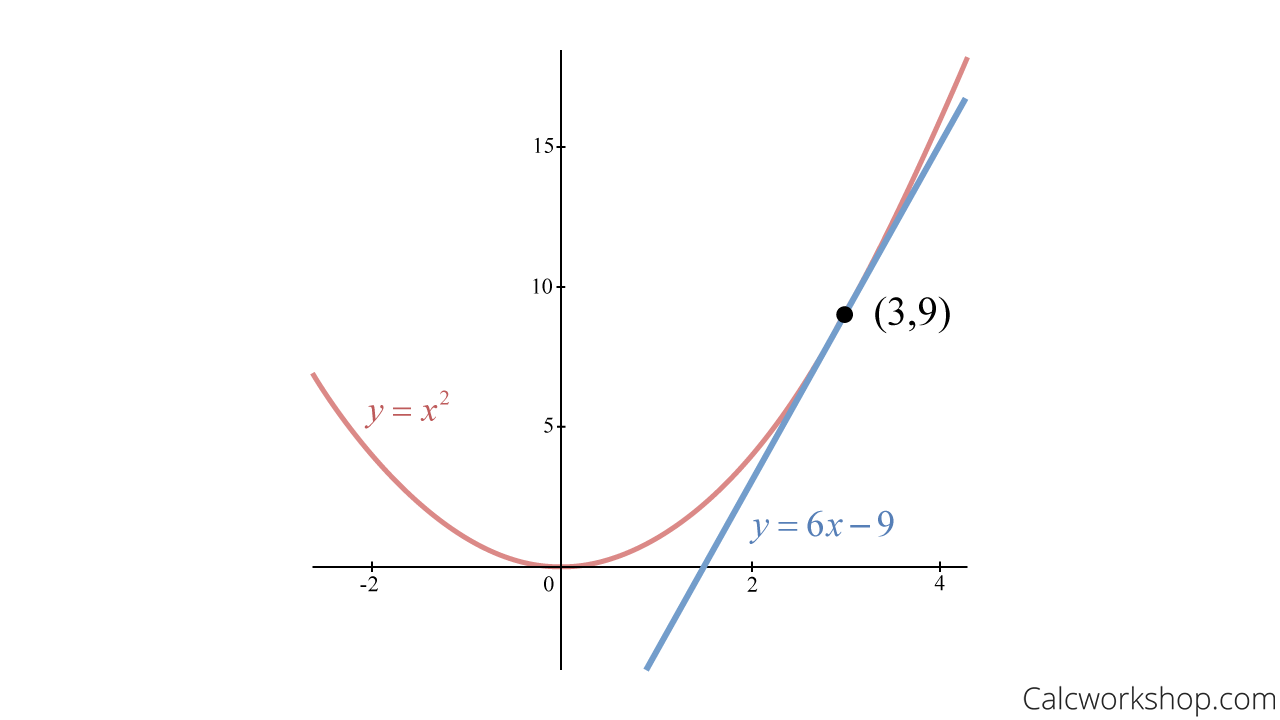
    To find the tangent line at a point x = a on a curve y = f(x), we use the derivative to obtain the slope.
    The tangent line matches the curve’s instantaneous direction.

    • Slope of tangent: m = f'(a)
    • Point on curve: (a, f(a))
    • Equation: y – f(a) = f'(a)(x – a)

    Equation Of Tangent Line (How To Find Em w/ Examples!)

    🌍 Real-World Connection

    Tangents are used in physics to calculate instantaneous velocity, and in economics to determine marginal cost, marginal profit or elasticity. Many objects in physics change constantly, to find the velocity at a certain instant we could calculate the slope of its distance function at a certain point.

    πŸ“Œ 2. Normals at a given point

    Normals are perpendicular to tangents. They appear frequently in optics (reflection angles), physics, and engineering.

    • Slope of tangent = m
    • Slope of normal = -1/m
    • Equation: y – f(a) = -(1/m)(x – a)

    Normal Line: Definition & Example - Statistics How To

    πŸ“Œ 3. Technology (GDC) Approaches

    Most GDCs allow you to compute slopes, derivatives, and tangent equations instantly.

    • Graph f(x) β†’ Analyse β†’ β€œdy/dx” at x = a.
    • in the run matrix tab you could use a derivatice function to find slope.
    • Some calculators provide tangent line equations directly.
    • Normals must be written manually using slope = -1/(dy/dx).

    🧠 Examiner Tip

    • Always show the derivative and the substitution step even if the GDC computes the tangent.
    • Write the tangent/normal equation clearly in y = mx + c form unless the question specifies otherwise.

    πŸ“Œ 4. Example (Common IB Exam Style)

    Find the equation of the tangent and normal to the curve f(x) = xΒ² – 3x + 1 at x = 2.

    Step 1: Use GDC β†’ Graph β†’ Derivative at x = 2
    Slope = 1

    Step 2: Find point
    f(2) = 2Β² – 3(2) + 1 = -1 β†’ point (2, -1)

    Tangent: y + 1 = 1(x – 2) β†’ y = x – 3

    Normal slope: -1
    Normal: y + 1 = -1(x – 2) β†’ y = -x + 1

    ❀️ CAS Link

    Students can model physical behaviours such as running pace or motion patterns, using tangents to represent instantaneous change and normals to analyze direction of correction or stabilization.

  • SL 5.3 β€” Power rule & basic derivative rules

    Term / concept Definition / short explanation
    Power rule If f(x)=a xn with n ∈ β„€ and constant a, then f'(x)=a n xn-1.
    Sum rule Derivative of a sum is the sum of derivatives: (f+g)’ = f’ + g’.
    Constant multiple rule (cΒ·f)’ = cΒ·f’ for constant c; constants factor out of differentiation.
    Constant function If f(x)=k (constant), then f'(x)=0 for all x (horizontal line).

    πŸ“Œ 1. Statement of the rule (power rule)

    Let f(x)=axn where a is a constant and n is an integer (n ∈ β„€).
    Then the derivative is:

    f'(x) = a(nxn-1)

    This single formula covers:

    • positive integer powers (x3, x2 etc.),
    • zero power: x0=1 so derivative of aΒ·1 is 0,
    • negative integer powers (e.g., xβˆ’1) β€” treat n negative and apply same algebraic rule.

    Example 1 β€” simple polynomial

    f(x)=4x3 βˆ’ 5x2 + 7x βˆ’ 9.

    Apply power rule + sum & constant multiple rules termwise:
    f'(x)=4Β·3x2 βˆ’5Β·2x +7Β·1 βˆ’ 0 = 12x2 βˆ’10x +7.

    πŸ“Œ 2. Negative powers & constant functions (explicit)

    Negative powers: if f(x)=axβˆ’2, treat n=βˆ’2:

    f'(x)=a(βˆ’2)xβˆ’3= βˆ’2axβˆ’3.

    Constant functions: if f(x)=k then f'(x)=0. Example: derivative of 5 is 0.

    🧠 Examiner tip

    • Write each term on its own line when differentiating a polynomial β€” this avoids sign mistakes.
    • Always simplify exponent answers and clearly show constants multiplied.
    • If asked for f'(x) at a point, compute derivative formula first, then substitute the x-value (show both steps).

    πŸ“Œ 3. Short worked examples (with explanation)

    Example 2 β€” negative power

    Let g(x)=6xβˆ’1. Then g'(x)=6Β·(βˆ’1)xβˆ’2= βˆ’6xβˆ’2 = βˆ’6/x2.

    Example 3 β€” derivative at a point

    For f(x)=x3βˆ’3x2+2 (as earlier), f'(x)=3x2βˆ’6x. Evaluate at x=2:
    f'(2)=3Β·4 βˆ’ 12 = 0. So instantaneous rate of change at x=2 is 0 (stationary).

    🌍 Real-world connection

    Engineers and scientists use polynomial fits to approximate behaviour; the power rule gives the rate-of-change of these approximations (e.g., velocity as derivative of position polynomial model).

    πŸ“ IA spotlight

    • Choose a dataset where a polynomial model is plausible (e.g., trajectory data). Fit a polynomial, differentiate the fitted polynomial to estimate instantaneous rates and discuss limits of the model.
    • Include discussion of whether integer-power assumption is justified and limitations when using negative powers near x=0.

    πŸ“Œ 4. Quick reference & common pitfalls

    • Power rule formula: d/dx [a xn] = a n xn-1 (n integer).
    • Sum & constant rules: differentiate term-by-term; constants drop out (derivative 0).
    • Watch signs: when n negative, nβˆ’1 is more negative β€” simplify carefully (use fraction notation if clearer).
    • Undefined at 0: negative powers produce singularities at x=0 β€” mention domain restrictions if asked.

    πŸ”— Connections (integrated)

    • Paper tip (already above): always show derivative formula first, then substitute numbers β€” examiners expect that order.
    • IA & real-world: fit polynomials, differentiate to interpret rates; discuss domain limits when negative powers present.
    • TOK: reflect on how mathematical rules (like power rule) are tools that assume differentiability β€” ask what is lost when models ignore singularities or discontinuities.
  • SL 5.2 β€” Increasing & decreasing functions

    Core Concept IB AI HL Definition & Application
    Increasing function For f increasing on interval I, if x1 < x2 in I, then f(x1) ≀ f(x2) (strictly increasing if <). AI HL requires analytical proof using derivatives for real-world modelling.
    Decreasing function For f decreasing on I, if x1 < x2 in I, then f(x1) β‰₯ f(x2) (strictly if >).
    Essential for optimization problems in applications.
    Derivative test f'(x) > 0 β‡’ increasing; f'(x) < 0 β‡’ decreasing; f'(x) = 0 β‡’ stationary point. Sign analysis drives decision-making in HL applications.
    Critical points Solutions to f'(x) = 0 or points where f'(x) undefined. These identify optimization opportunities.

    πŸ“Œ 1. Formal Definitions & Real-World Context

    • Precise definition: f is increasing on (a,b) if βˆ€ x1, x2 ∈ (a,b) with x1 < x2, then f(x1) ≀ f(x2)
    • Strictly increasing: f(x1) < f(x2) β€” no horizontal segments
    • AI HL focus: Behaviour analysis for profit maximization, population growth modelling
    • Interval notation: Always specify: “increasing on (-∞, 2) βˆͺ (4, ∞)”
    • Modelling principle: Real functions change monotonicity only at critical points

    🧠 Examiner Tip

    • Always write “since f'(x) > 0 for all x in interval…
    • HL marks: (1) correct derivative, (2) critical points, (3) complete sign chart, (4) real-world interpretation
    • Never rely on “graph shows increasing” β€” zero application marks
    • Test one value per interval and state sign explicitly

    πŸ“Œ 2. First Derivative Test β€” HL Procedure

    1. Differentiate: Compute f'(x) with chain/quotient/product rules
    2. Solve: f'(x) = 0 β†’ identify all critical points
    3. Partition: Domain using critical points + domain restrictions
    4. Test: Evaluate f'(x) sign in each subinterval
    5. Interpret: Link to optimization (max profit when f’ changes – to +)

    🌍 Real-World Connection

    • Business: Revenue R(q) increasing when marginal revenue MR(q) > 0
    • Environment: Pollution P(t) increasing during industrial growth phase
    • Finance: Investment growth when rate of return > 0
    • Medicine: Drug concentration C(t) increases then decreases in bloodstream

    πŸ“Œ 3. HL Applications & Complex Cases

    • Optimization: Local max (profit peak) when f’ changes + to –
    • Constant functions: f'(x) = 0 everywhere β†’ neither strictly increasing nor decreasing
    • Discontinuities: Vertical asymptotes partition analysis intervals
    • Parametric: For r(t) = (x(t), y(t)), analyse dx/dt and dy/dt signs
    • Modelling validation: Check if predicted intervals match real data trends

    πŸ“ IA Spotlight

    • HL RQ: “Using calculus, optimize [real company] production for maximum profit”
    • Data modelling: Fit cubic/quartic to actual revenue data, find critical points
    • Evaluation: Compare predicted optimum with industry reports
    • HL strength: Multiple critical points + second derivative confirmation
    • Visuals: Sign diagrams + actual vs predicted revenue graphs

    πŸ” TOK Perspective

    • Does mathematical certainty about monotonic intervals transfer to real-world predictions?
    • How do computational approximations affect our confidence in optimization results?
    • Can graphical intuition ever replace rigorous derivative analysis in applications?

    πŸ“ Paper 2 HL Strategy

    • 10-14 marks: Complex derivative + multiple critical points + economic interpretation
    • Time: 18 minutes maximum
    • Always include sign diagram β€” method marks even if arithmetic errors
    • State context: “Profit increases when MR > 0, i.e. on (0, 150) units”

    πŸ“± GDC Tips

    • TI-Nspire CX II: Calculus > Derivative > f'(x) > solve(f'(x)=0,x)
    • Casio fx-CG50: RUN-MATRIX > CALC > d/dx > solve f'(x)=0
    • Sign testing: Evaluate f'(test value) directly on calculator
    • Table mode: Generate f'(x) table across critical points

    πŸ“Œ HL PRACTICE QUESTIONS

    Multiple Choice Questions

    Q1. If f'(x) = 2(x-1)(x+3), on which interval is f(x) decreasing?

    A. (-∞, -3) B. (-3, 1) C. (1, ∞) D. (-3, ∞)

    Answer: B
    Critical points: x = -3, 1. Test x = 0: f'(0) = 2(-1)(3) = -6 < 0 so decreasing on (-3, 1).

    Q2. f has f'(3) = 0 and f'(x) > 0 for x β‰  3. Then x=3 is:

    A. Local maximum B. Local minimum C. Point of inflection D. Neither

    Answer: D
    No sign change across critical point β†’ neither local max nor min (like f(x) = x3).

    Q3. For f(x) = ln(x) + x, f'(x) = 1/x + 1 > 0 for all x > 0. Thus:

    A. Decreasing on (0,∞) B. Increasing on (0,∞) C. Constant D. Undefined

    Answer: B
    f'(x) > 0 everywhere in domain β†’ increasing on entire domain.

    Q4. Number of intervals to test for f'(x) = (x+1)2(x-2):

    A. 2 B. 3 C. 4 D. 1

    Answer: B
    Critical points x = -1 (double root), x = 2 β†’ intervals: (-∞, -1), (-1, 2), (2, ∞).

    Short Answer Questions

    SAQ 1: Explain why f'(x) = 0 doesn’t guarantee a turning point. πŸ“±
    Consider f(x) = x3. Then f'(x) = 3x2 = 0 at x = 0, but f'(x) > 0 for x β‰  0, so no sign change β†’ point of inflection.
    SAQ 2: Why test intervals separately? πŸ“±
    Critical points divide domain where derivative sign may change. f'(x) can only change sign at roots, so monotonicity constant within each interval.

    Long Answer Questions

    LAQ 1 (14 marks): Comprehensive analysis of f(x) = x3 – 6x2 + 9x

    (a) Find f'(x) and all critical points [3 marks]

    f'(x) = 3x2 – 12x + 9 = 3(x2 – 4x + 3) = 3(x-1)(x-3)
    Critical points: x = 1, x = 3

    (b) Complete sign chart and state monotonicity intervals [5 marks]

    (-∞,1) x=1 (1,3) x=3 (3,∞)
    + 0 0 +

    Increasing: (-∞,1) βˆͺ (3,∞); Decreasing: (1,3)

    (c) Classify turning points [3 marks]

    x=1: + to – β†’ Local maximum, f(1) = 4
    x=3: – to + β†’ Local minimum, f(3) = 0

    (d) Business interpretation [3 marks]

    If f(x) = profit, produce between x=1 and x=3 units to minimize losses (decreasing phase), optimal at x=1 (max profit).

    LAQ 2 (16 marks): Analyse f(x) = (x2 + 1)/(x-2) completely

    (a) State domain and find f'(x) [4 marks]

    Domain: x β‰  2
    f'(x) = [2x(x-2) – (x2+1)(1)]/(x-2)2 = (x2 – 6x – 1)/(x-2)2

    (b) Solve f'(x) = 0 and identify analysis points [3 marks]

    x2 – 6x – 1 = 0 β†’ x = 3 Β± 2√2 β‰ˆ x1 = -0.83, x2 = 6.83
    Points: x β‰ˆ -0.83, x = 2 (asymptote), x β‰ˆ 6.83

    (c) Sign analysis across all intervals [5 marks]

    (-∞,-0.83) -0.83 (-0.83,2) 2 (2,6.83) 6.83 (6.83,∞)
    0 + βˆ… 0 +

    (d) Monotonicity + optimization conclusion [4 marks]

    Decreasing: (-∞,-0.83) βˆͺ (2,6.83)
    Increasing: (-0.83,2) βˆͺ (6.83,∞)
    Local max xβ‰ˆ-0.83; local min xβ‰ˆ6.83


  • SL 5.1 β€” Limits & introduction to the derivative

    πŸ“Œ 1. Understanding Limits

    • A limit describes the value that a function approaches as the input variable gets closer to a particular value.
    • Limits focus on behaviour near a point, not necessarily the function’s value at that point.
    • A function may have a limit at x = a even if f(a) is undefined or different from the limit value.
    • Limits allow mathematicians to describe smooth change and form the foundation of calculus.
    • They are essential for defining continuity and derivatives rigorously.

    🌍 Real-World Connection

    Limits model real phenomena such as instantaneous speed, where average speed over smaller and smaller time intervals approaches a single value.

    πŸ“Œ 2. One-Sided Limits & Existence of Limits

    • A left-hand limit describes function behaviour as x approaches a value from smaller inputs.
    • A right-hand limit describes function behaviour as x approaches a value from larger inputs.
    • A two-sided limit exists only if both one-sided limits exist and are equal.
    • If one-sided limits differ, the function has a jump discontinuity.
    • Checking one-sided limits is essential in piecewise functions and graph-based questions.

    🧠 Examiner Tip

    • Always explicitly state both one-sided limits before concluding that a limit exists.
    • Writing β€œdoes not exist” without justification loses method marks.

    πŸ“Œ 3. Continuity & Types of Discontinuities

    • A function is continuous at x = a if the limit exists and equals the function value.
    • A removable discontinuity occurs when the limit exists but the function value is missing or incorrect.
    • A jump discontinuity occurs when left and right limits exist but are not equal.
    • An infinite discontinuity occurs when the function approaches infinity near a vertical asymptote.
    • Continuity is a prerequisite for differentiability.

    πŸ“ IA Spotlight

    In the IA, continuity can be used to justify model validity. Students should explain why a model behaves smoothly near important threshold values.

    πŸ“Œ 4. Derivative as a Limit

    • The derivative is defined as the limit of the average rate of change.
    • It measures how fast one variable changes relative to another at an instant.
    • Geometrically, the derivative represents the gradient of the tangent line.
    • Physically, it represents quantities such as velocity and acceleration.
    • The derivative connects algebraic expressions to graphical behaviour.

    fβ€²(a) = limhβ†’0 [f(a+h) βˆ’ f(a)] / h

    πŸ” TOK Perspective

    Is it valid to describe real-world change using infinitely small quantities, or does this idealisation distort reality?

    πŸ“Œ PRACTICE QUESTIONS

    🧠 Multiple Choice Questions

    MCQ 1. What does limx→3 f(x) = 5 mean?

    A. f(3) = 5
    B. f(x) equals 5 near x = 3
    C. f(x) approaches 5 as x approaches 3
    D. The function is continuous at x = 3

    Answer: C

    The definition of a limit concerns approach behaviour, not function value or continuity.

    MCQ 2. A limit does not exist if:

    A. The function is undefined at the point
    B. One-sided limits are unequal
    C. The graph has a hole
    D. The function is continuous

    Answer: B

    Unequal one-sided limits indicate a jump discontinuity.

    MCQ 3. Which situation guarantees continuity at x = a?

    A. f(a) exists
    B. The limit exists
    C. lim f(x) = f(a)
    D. The function is defined nearby

    Answer: C

    Continuity requires both existence of the limit and equality with the function value.

    MCQ 4. The derivative represents:

    A. Average rate of change
    B. Area under a curve
    C. Instantaneous rate of change
    D. Total change

    Answer: C

    ✏️ Short Answer Questions

    SAQ 1. Explain why a function can have a limit at a point where it is undefined.

    A limit describes approach behaviour. Even if f(a) is undefined, values of f(x) near a can approach a single number.

    SAQ 2. State two interpretations of the derivative.

    The derivative represents the gradient of the tangent line and the instantaneous rate of change.

    Long Answer / Explainer Questions

    Q7.
    The function f is defined by
    f(x) = (xΒ² βˆ’ 4)/(x βˆ’ 2).

    (a) Investigate the behaviour of f(x) as x approaches 2 using algebraic methods.
    (b) State whether the limit of f(x) as x approaches 2 exists and justify your answer.
    (c) Explain why f is not continuous at x = 2, even though the limit exists.
    (d) Describe how the function could be redefined to make it continuous at x = 2.

    Full Worked Solution:

    (a) Algebraic investigation of the limit

    We begin by factoring the numerator:

    xΒ² βˆ’ 4 = (x βˆ’ 2)(x + 2)

    Substituting into the expression for f(x):

    f(x) = (x βˆ’ 2)(x + 2) / (x βˆ’ 2)

    For all x β‰  2, the factor (x βˆ’ 2) cancels, giving:

    f(x) = x + 2

    (b) Existence of the limit

    Since f(x) simplifies to x + 2 for all values of x except 2, we evaluate the limit by substitution:

    limx→2 f(x) = 2 + 2 = 4

    Therefore, the limit exists and is equal to 4.

    (c) Continuity at x = 2

    Although the limit exists, the original function f(x) is undefined at x = 2 because the denominator becomes zero.

    Since continuity requires:

    • the function value to exist, and
    • the function value to equal the limit,

    f is not continuous at x = 2.

    (d) Redefinition for continuity

    To make the function continuous at x = 2, define:

    f(2) = 4

    This fills the removable discontinuity and ensures that the function value matches the limit.

    Conclusion:

    This example illustrates a removable discontinuity, where algebraic simplification reveals the underlying behaviour of the function near the point.

    Q8.
    The displacement s of a particle moving in a straight line is given by s(t) = tΒ² βˆ’ 3t, where t is measured in seconds.

    (a) Explain how the concept of a limit can be used to define the instantaneous velocity of the particle at time t.
    (b) Use first principles to find the instantaneous velocity of the particle at t = 2.
    (c) Interpret the meaning of your result in the context of motion.
    (d) Comment on the relationship between average velocity and instantaneous velocity.

    Full Worked Solution:

    (a) Limit-based definition of velocity

    Instantaneous velocity cannot be measured directly because it refers to motion at a single instant.

    Instead, we calculate the average velocity over a small time interval h:

    Average velocity = [s(t + h) βˆ’ s(t)] / h

    The instantaneous velocity is defined as the limit of this average velocity as h approaches 0.

    (b) First-principles calculation

    Given s(t) = tΒ² βˆ’ 3t, compute s(2 + h):

    s(2 + h) = (2 + h)Β² βˆ’ 3(2 + h)

    = 4 + 4h + hΒ² βˆ’ 6 βˆ’ 3h

    = hΒ² + h βˆ’ 2

    Now compute the difference quotient:

    [s(2 + h) βˆ’ s(2)] / h

    = [(hΒ² + h βˆ’ 2) βˆ’ (βˆ’2)] / h

    = (hΒ² + h) / h

    = h + 1

    Taking the limit as h approaches 0:

    limh→0 (h + 1) = 1

    Thus, the instantaneous velocity at t = 2 is 1 m/s.

    (c) Interpretation

    This result means that at exactly 2 seconds, the particle is moving forward at a speed of 1 metre per second.

    It represents the slope of the tangent to the displacement–time graph at t = 2.

    (d) Average vs instantaneous velocity

    Average velocity depends on the chosen time interval, whereas instantaneous velocity is a single, well-defined value obtained by letting the interval shrink to zero.

    Limits allow this transition from discrete measurement to continuous description.

    Conclusion:

    This question demonstrates how limits form the conceptual bridge between algebraic functions and physical motion.