Category: caterscam.github.io

caterscam.github.io

  • AHL 5.17 — Phase portraits (coupled linear systems)

    Term / concept Definition / formula (compact)
    Linear system (matrix form) x’ = A x where A = [[a,b],[c,d]] and x = (x,y)T. Solve eigenvalues from det(A − λI)=0.
    Eigenvalues / eigenvectors Solve (A − λI)v = 0. λ values determine stability; eigenvectors give principal directions (for real eigenvalues).
    Equilibrium / fixed point Point where x’ = 0 (for homogeneous linear systems the origin). For x’ = Ax + b solve Ax + b = 0 to shift coordinates.

    📌 What a phase portrait shows

    • Trajectories — curves (x(t),y(t)) in the plane showing the state over time.
    • Direction — arrows indicate forward-time motion; direction comes from sign of x’,y’.
    • Equilibria and stability — whether nearby states move toward or away from the fixed point.

    📌 Detailed procedure

    1. Put system into matrix form — writing x’ = Ax packages the linear combination of variables into a matrix; linear algebra tools (determinant, eigenvalues) then apply.
    2. Characteristic polynomial det(A − λI)=0. Why: solving for λ finds scalars for which A−λI is singular — those λ are growth/decay rates of solutions (modes).
    3. Eigenvalues → qualitative behaviour — real positive λ implies exponential growth in that mode; negative implies decay; complex with real part α gives exponential factor eαt and imaginary part gives oscillation (rotation).
    4. Eigenvectors (if real distinct) — directions where the system simply scales (solutions along v are of form eλtv). They act as “axes” showing principal flow directions near equilibria.
    5. Sketch — start with eigenvector lines, then draw trajectories bending toward/away depending on λ sign. For complex λ, draw spirals or circles depending on real part.
    6. Time orientation — evaluate RHS at a sample point to confirm arrow direction on sketch (this disambiguates in hand-drawn portraits).

    Peter Selinger: Math 316, Winter 2000

    Function behind each step

    • Matrix form converts differential system into a linear operator A acting on state vector x: x’ = A x.
    • Characteristic equation finds scalar factors λ such that the linear operator behaves like multiplication by λ on some direction (eigenvector).
    • Eigen-decomposition (when diagonalizable) writes solution as linear combination of modal solutions eλtv; this reveals global time-behaviour from local linear properties.

    🟢 GDC tips

    • Compute eigenvalues numerically: use matrix eigenvalue routine on GDC to avoid algebra mistakes.
    • Ask the GDC for eigenvectors or solve (A − λI)v = 0 using row reduction to get direction vectors for sketching.
    • Plot numeric trajectories: pick several initial conditions and integrate forward to see flow — this verifies your qualitative classification.
    • If eigenvalues are near-zero or nearly equal, be careful: numeric rounding can change classification — report exact symbolic forms if possible.

    🧠 Paper tips

    • Always show characteristic equation and the algebraic steps to find λ1, λ2. State signs (Re(λ)) and conclude stability.
    • If asked to sketch, draw eigenvector lines (if real), mark equilibrium, sketch representative trajectories and add arrows for time direction.
    • If eigenvalues are complex, report λ = α ± iβ, state α (decay/growth) and β (oscillation frequency) and explain spiral vs centre qualitatively.
    • If non-homogeneous, compute equilibrium x* by solving Ax* + b = 0, shift variables (u = x − x*) and classify using eigenvalues of A.

    📌 Worked examples

    Example 1 — saddle (real opposite signs)

    System: x’ = 4x + 2y, y’ = −3x − y.

    Matrix A = [4 2

                     -3 -1]

    Compute characteristic polynomial:

    det(A − λI) = (4 − λ)(−1 − λ) − (2)(−3) = −4 −4λ + λ + λ2 +6 = λ2 −3λ +2 = 0.


    Solve: λ = (3 ± √1)/2 = 2 or 1. Both real but signs? here both positive (2 and 1) → actually node. Check arithmetic: re-evaluate signs carefully — if algebra mistakes occur use GDC’s eigenvalue routine. Correct classification requires correct λ values; always show algebra and check with calculator.

    Interpretation : eigenvalues positive ⇒ both modes grow exponentially → unstable node (trajectories move away from origin along curves tangent to eigenvectors).

    Sketch method: compute eigenvectors for λ=2 and λ=1, draw lines; draw trajectories curving away from origin, tangent to the eigenvector with dominant eigenvalue for large t.

    Example 2 — complex with negative real part (spiral sink)

    System: x’ = −2x − 5y ; y’ = 1x − 2y.

    A = [−2   −5

            1    −2]

    Characteristic polynomial:

    det(A − λI) = (−2 − λ)(−2 − λ) − (−5)(1) = (λ + 2)2 + 5 = λ2 + 4λ + 9 = 0 → λ = −2 ± i√5.


    Interpretation: Re(λ)=−2 < 0 so amplitude decays; imaginary part ≠ 0 gives rotation → spiral sink (trajectories spiral into origin).

    How to sketch: draw a few inward spirals with arrows showing rotation direction (determine orientation by plugging a test point into RHS and seeing sign of derivative).

    🌐 EE focus

    • Investigate bifurcation: vary a parameter in A (for example entry a or d) and show how eigenvalues cross Re(λ)=0 — document when stability changes.
    • Compare linearisation to nonlinear system: compute Jacobian at equilibrium and compare numeric trajectories of full nonlinear model and linear approximation.
    • Perform sensitivity analysis: how do small changes in A affect eigenvalues and hence qualitative behaviour? Include error quantification and reproducible code (GDC/GeoGebra/Matlab).
    • Discuss limitations: measurement noise, modeling assumptions, and implications for interpreting stability in real systems.

    📐 IA spotlight

    • Collect experimental two-variable time-series data (e.g., predator & prey counts). Fit a linear model locally and compute Jacobian matrices at equilibrium points to produce phase portraits.
    • Use numerical integration from multiple initial conditions (spread in grid) to build empirical phase portraits; compare to analytic linear predictions.
    • Quantify error: compare trajectories using RMS difference between numeric integration of nonlinear model and its linearised version over short/long times.
    • Document method clearly: data collection, preprocessing, software & parameter choices. Discuss sources of uncertainty and ethical/data privacy considerations if using live data.

    📌 Final checklist (what examiners expect)

    • Matrix A clearly written, characteristic polynomial shown, eigenvalues computed with exact/simplified form and decimals if helpful.
    • Classification explicitly justified by sign/real-part of eigenvalues.
    • Eigenvectors labelled (when used) and sketches show principal directions and arrowed trajectories.
    • If using numerical tools, state which tool and the settings (time span, step size) and use them to confirm your classification.
  • AHL 5.16 — Euler’s Method & Numerical Solutions of Differential Equations

    Concept Definition / Formula
    Euler’s Method A numerical technique that approximates solutions to differential equations by repeatedly extending tangent lines over small intervals.
    Step size (h) The horizontal increment used for each approximation step; smaller values improve accuracy but increase total computational effort.
    Coupled system A system of multiple interdependent differential equations that must be updated simultaneously at each numerical step.
    Numerical solution An approximate solution generated when an exact algebraic solution cannot be found using standard analytical techniques.

    📌 Understanding Euler’s Method

    • Euler’s Method is used when differential equations are too complex to solve analytically, providing an approximate but structured numerical alternative.
    • The method constructs a solution by following tangent lines, assuming the derivative remains constant over each small step interval.
    • Each new approximation depends entirely on the slope calculated at the previous point, making the method inherently sequential.
    • Errors accumulate gradually with each step, so accuracy strongly depends on choosing an appropriately small step size.
    • Despite its simplicity, Euler’s Method forms the foundation for more advanced numerical solvers used in modern computation.

    📐 IA Spotlight

    • Students can use Euler’s Method to numerically model realistic processes such as cooling, population recovery, or chemical concentration changes.
    • Comparing numerical approximations with known exact solutions allows discussion of accuracy, convergence, and sources of error.
    • Investigating how varying step size affects reliability demonstrates mathematical understanding and strengthens evaluation criteria.

    📌 Example — Euler’s Method (Single ODE)

    Given: dy/dx = x − y, with y(0) = 1 and step size h = 0.2

    • The differential equation defines the slope of the curve at every point, depending on both current x and y values.
    • At the starting point (0,1), the slope equals −1, indicating the solution is initially decreasing.
    • Euler’s update rule adds the product of step size and slope to the current y-value.
    • This produces y(0.2) ≈ 0.8, representing a linear approximation of the true curve over the interval.

    🌍 Real-World Connection

    • Numerical methods allow scientists to model population growth when real environments prevent clean exponential or logistic solutions.
    • Engineering simulations rely on step-based approximations to predict system behaviour before constructing physical prototypes.
    • Epidemiological models such as SIR frameworks update disease spread in discrete time steps, mirroring Euler’s approach.

    📌 Solving Coupled Systems Numerically

    • Coupled systems require updating multiple dependent variables simultaneously because each variable’s rate depends on the others.
    • Euler’s Method applies independently to each equation but must use values from the same step to remain consistent.
    • This approach is essential in modelling interacting systems such as predator–prey dynamics or competing chemical species.
    • Small step sizes are especially important here, as errors propagate through all variables together.

    📱 GDC Tips — Euler’s Method

    TI-Nspire CX II / CX II CAS

    • Open the Lists & Spreadsheet application and label columns clearly as xₙ, yₙ, and slope f(xₙ,yₙ) to show method structure.
    • Enter the initial x₀ and y₀ values in the first row, then compute the slope using the given differential equation exactly as stated.
    • Use a formula such as yₙ₊₁ = yₙ + h·f(xₙ,yₙ) and xₙ₊₁ = xₙ + h, copying it down to automate iteration.
    • Create a Data & Statistics page to plot (xₙ, yₙ), allowing visual inspection of convergence or divergence.
    • Repeat the process with a smaller step size h and compare tables to comment on improved accuracy, as expected in IB questions.

    Casio fx-CG50 / fx-CG100

    • Enter TABLE mode or Spreadsheet mode and define columns for x, y, and f(x,y) to clearly track each Euler step.
    • Manually input the recurrence formula yₙ₊₁ = yₙ + h·f(xₙ,yₙ), ensuring the step size h matches the value given in the question.
    • Use the automatic fill or copy function to extend values down the table efficiently instead of recalculating each row.
    • Switch to GRAPH mode and plot the computed points to visualise the numerical approximation curve.
    • Reduce the step size and re-run the table to justify accuracy improvements, a key requirement in Paper 2 explanations.

    🧠 Examiner Tip

    • Always write the Euler update formula explicitly before substituting values to secure method marks.
    • Clearly label each step in numerical tables so examiners can follow how approximations evolve.
    • Round only at the final step unless explicitly instructed otherwise to avoid unnecessary accuracy loss.

    📝 Paper Strategy

    • Paper 2 questions expect structured numerical working, not just final approximations.
    • Marks are awarded for correctly identifying step size, update rule, and intermediate values.

    📌 Euler’s Method — Practice Questions

    Multiple Choice Questions

    MCQ 1
    Euler’s method approximates the solution of a differential equation by:

    • A. fitting a polynomial through known points
    • B. following the tangent line step-by-step using local slopes
    • C. solving the equation symbolically using integration
    • D. averaging slopes over the entire interval
    Answer & Explanation

    Correct answer: B

    Euler’s method uses the gradient at the current point to move forward along the tangent line.
    Each step uses local information only, making it a numerical approximation rather than an exact solution.


    MCQ 2
    Which factor most directly improves the accuracy of Euler’s method?

    • A. Increasing the initial value
    • B. Decreasing the step size h
    • C. Increasing the interval length
    • D. Using more variables
    Answer & Explanation

    Correct answer: B

    Smaller step sizes reduce truncation error by making each tangent-line approximation closer to the true curve.
    However, smaller h also increases computation.


    MCQ 3
    In Euler’s method, the formula yₙ₊₁ = yₙ + h·f(xₙ,yₙ) represents:

    • A. the exact solution at the next point
    • B. a recursive numerical approximation step
    • C. a differential equation in implicit form
    • D. an average rate of change over the interval
    Answer & Explanation

    Correct answer: B

    The formula updates the y-value using the current slope multiplied by the step size.
    This recursive structure is central to numerical approximation methods.


    Short Answer Questions

    Short Question 1
    Explain why errors in Euler’s method tend to accumulate as calculations progress.

    Model Answer

    Each Euler step uses the previously approximated value rather than the exact value.
    Any small error introduced at one step is carried forward and magnified in later steps,
    especially when the step size is large or the function is rapidly changing.


    Short Question 2
    State two limitations of Euler’s method when modelling real-world systems.

    Model Answer

    First, Euler’s method can be inaccurate for rapidly changing systems unless very small step sizes are used.
    Second, numerical instability may occur, producing unrealistic results if the step size is poorly chosen.


    Long Answer Questions (IB Style)

    Long Question 1

    The differential equation dy/dx = x − y models a process where the rate of change depends on both x and y.
    The initial condition is y(0) = 1.

    (a) Explain the principle behind Euler’s method in the context of this differential equation.
    (b) Using a step size of h = 0.2, apply Euler’s method to estimate y(0.4).
    (c) Explain how reducing the step size would affect the accuracy of the approximation.
    (d) Comment on the reliability of Euler’s method for long-term prediction.

    Full Worked Solution

    (a)
    Euler’s method approximates the solution by moving along tangent lines.
    At each point, the derivative dy/dx = x − y provides the slope used to estimate the next value.

    (b)
    At x₀ = 0, y₀ = 1: slope = 0 − 1 = −1
    y₁ = 1 + 0.2(−1) = 0.8 at x = 0.2

    At x₁ = 0.2, y₁ = 0.8: slope = 0.2 − 0.8 = −0.6
    y₂ = 0.8 + 0.2(−0.6) = 0.68

    Therefore, y(0.4) ≈ 0.68.

    (c)
    Reducing the step size makes each tangent-line approximation closer to the actual curve,
    thereby reducing local and cumulative numerical error.

    (d)
    Euler’s method becomes less reliable over long intervals because errors accumulate at each step.
    More advanced numerical methods or smaller step sizes are required for accurate long-term predictions.


    Long Question 2

    A coupled system is defined by:

    dx/dt = y − x
    dy/dt = x

    with initial conditions x(0) = 1 and y(0) = 0.

    (a) Explain how Euler’s method is applied to coupled systems.
    (b) Write the Euler update formulas for x and y using step size h.
    (c) Perform one Euler step with h = 0.1.
    (d) Explain one real-world situation where coupled numerical models are necessary.

    Full Worked Solution

    (a)
    For coupled systems, Euler’s method updates all variables simultaneously,
    using the current values of each variable to compute the next step.

    (b)
    xₙ₊₁ = xₙ + h(yₙ − xₙ)
    yₙ₊₁ = yₙ + h(xₙ)

    (c)
    At t = 0: x = 1, y = 0
    x₁ = 1 + 0.1(0 − 1) = 0.9
    y₁ = 0 + 0.1(1) = 0.1

    (d)
    Coupled numerical models are used in predator-prey systems, climate modelling,
    and epidemiology where multiple interacting variables evolve together over time.

  • AHL 5.15 — Slope fields (direction fields)

    Term / concept Short meaning / formula
    Slope (direction) at a point Value of dy/dx = f(x,y) evaluated at that (x,y); drawn as a small line segment with that slope.
    Slope (direction) field Grid of short line segments at sample (x,y) showing direction dy/dx = f(x,y) — visualises solution behaviour.
    Solution curve (integral curve) Curve tangent at every point to the segment shown in the slope field; passes through chosen initial point.

    📌 What a slope field is (plain explanation)

    • A slope field (direction field) is a graphical representation of the differential equation dy/dx = f(x,y): at many grid points (x,y) we draw a short line segment whose slope equals f(x,y).
    • It does not give exact solutions but shows the family of possible solution curves and their qualitative behaviour (increasing/decreasing, tendencies, equilibrium lines).
    • Integral curves (solutions) are curves that at every point are tangent to the short segments; different initial conditions pick different integral curves.

    🧠 Examiner tip

    • When asked to sketch a slope field, compute and label slopes at a few representative grid points (method marks).
    • If asked for behaviour as x→∞, use slope signs to explain whether solutions increase or decrease and whether they approach equilibrium curves.
    • If the question gives dy/dx = f(x,y) and an initial point, indicate the direction of movement from that point (up/down/left/right) using computed slope sign.

    tikz pgf - How to draw slope fields with all the possible solution curves  in latex - TeX - LaTeX Stack Exchange

    📌 How to calculate and draw a slope field (step-by-step)

    • 1) Choose a grid: pick x-values and y-values (e.g., x = −2, −1, 0, 1, 2 and y = −2, −1, 0, 1, 2).
    • 2) Evaluate f(x,y): for each grid point compute m = f(x,y) = dy/dx. Example: if dy/dx = x − y then at (1,0) m = 1 − 0 = 1.
    • 3) Convert slope to a short segment: draw a small line centered at (x,y) with slope m. For steep slopes, make the segment short; for m = 0 draw horizontal small line.
    • 4) Repeat: do for every grid point — the pattern of segments is the slope field.
    • 5) Sketch solution curves: from a chosen initial point follow the local tangents to trace the integral curve that stays tangent to each segment.

    🌍 Real-world connection

    • Slope fields help visualize differential models in physics (e.g., velocity fields), ecology (population change rate depending on population and environment) and engineering (temperature gradients).
    • They are used when closed-form solutions are difficult — slope fields show qualitative behaviour without solving analytically.

    📌 Practical worked example (step-by-step with grid calculations)

    Problem: Consider dy/dx = x − y. Draw a small slope field on the grid x = −1, 0, 1 and y = −1, 0, 1 and sketch the integral curve through (0,1).Step A — compute slopes at grid points (table):

    (x,y) dy/dx = x − y
    (−1,1) −1 − 1 = −2
    (0,1) 0 − 1 = −1
    (1,1) 1 − 1 = 0
    (−1,0) −1 − 0 = −1
    (0,0) 0 − 0 = 0
    (1,0) 1 − 0 = 1
    (−1,−1) −1 − (−1) = 0
    (0,−1) 0 − (−1) = 1
    (1,−1) 1 − (−1) = 2

    Interpretation: at (0,1) slope = −1 → small line segment of slope −1; at (1,1) slope = 0 → horizontal tiny segment; at (1,−1) slope = 2 → steep upwards segment.

    Step B — draw segments: for each grid point draw a short segment centered at (x,y) with the computed slope (keep segments short to avoid overlap). The pattern shows tendency: around y ≈ x the slopes are small; above that slopes negative (downward); below that slopes positive (upward).

    Step C — sketch integral curve through (0,1): start at (0,1) and follow local tangent direction given by segments (slope −1) — the curve will move down-right then approach a direction where slope tends to zero (near line y = x). This visual method shows the qualitative behaviour: solutions move toward the line y = x as x increases.

    🔍 TOK perspective

    • Slope fields show qualitative knowledge — discuss strengths and limits of qualitative vs analytic solutions.
    • Consider how choice of sampling grid influences the representation (visual bias).

    ❤️ CAS / community

    • Work with local environmental group to model pollutant dispersion rate dy/dt = f(x,y) and visualise direction fields for policy discussion.

    📌 Short practice question (for self-test)

    Q: For dy/dx = y(1 − x), compute slopes at (0,0), (1,1), (0,1) and explain whether solutions starting at (0,1) initially increase or decrease.Solution (brief):
    • At (0,0): dy/dx = 0(1 − 0) = 0 → horizontal segment.
    • At (1,1): dy/dx = 1(1 − 1) = 0 → horizontal segment (equilibrium line x = 1 gives slope 0 when y nonzero).
    • At (0,1): dy/dx = 1(1 − 0) = 1 → upward segment (solution through (0,1) initially increases).
    Explain: since slope positive at (0,1) the integral curve rises as x increases from 0.

    📝 Paper tip

    • When asked to sketch, include at least 6–9 labeled grid points with computed slopes — examiners expect explicit calculations at some points.
    • If asked to describe behaviour, refer to equilibrium curves (where f(x,y)=0) and sign of f on either side.
  • AHL 5.14 — Differential Equations & Separation of Variables

    Term Meaning / Usage
    Differential Equation An equation involving derivatives that describes how one quantity changes with respect to another.
    General Solution A family of solutions containing an arbitrary constant that represents infinitely many possible curves.
    Separable Equation A differential equation that can be rearranged so all y-terms and x-terms are separated.

    📌 Setting Up Differential Equations from Context

    • Verbal phrases such as “rate of change” must always be translated into derivative notation like dG/dt.
    • Statements involving proportionality require introducing a constant, forming equations such as dG/dt = kG.
    • Descriptions where growth slows as quantity increases often imply square-root, quadratic, or logistic relationships.
    • All variables must be clearly defined with units before forming equations to ensure physical and mathematical validity.

    🌍 Real-World Connection

    • Population growth is often modelled using proportional relationships where growth rate depends directly on population size.
    • Radioactive decay processes follow differential equations where decay rate depends on remaining quantity.
    • Chemical reaction rates are commonly modelled using concentration-based differential equations.

    📌 Solving by Separation of Variables

    • The equation must first be rearranged so all y-terms multiply dy and all x-terms multiply dx.
    • Both sides are then integrated independently, producing an equation relating integrated expressions.
    • A single constant of integration is introduced after completing both integrations.
    • The final step involves rearranging the equation to express y explicitly when possible.

    📌 Interpreting Contextual Differential Equation Questions

    • Keywords such as “grows”, “decays”, or “proportional” directly indicate derivative-based relationships.
    • The dependent variable usually represents the quantity being modelled, while time is independent.
    • The sign of the proportionality constant determines whether growth or decay is occurring.
    • Checking units ensures the mathematical model is consistent with the real-world situation.

    📐 IA Spotlight

    • Students can model biological growth, cooling processes, or chemical decay using separable equations.
    • Strong investigations justify why proportional or nonlinear models best represent observed behaviour.
    • Evaluation should include limitations of assumptions, particularly long-term proportionality.

    🌐 EE Focus

    • Extended Essays may compare exponential and logistic models using real experimental data.
    • Parameter sensitivity analysis can assess how constants influence long-term predictions.
    • Research may evaluate model accuracy against real biological or environmental systems.

    📌 Example 1 — Setting Up a Model

    Context: An algae population G grows at a rate proportional to √G.

    • The phrase “rate proportional to √G” translates directly to dG/dt = k√G.
    • Separating variables places G-terms on one side and time-terms on the other.
    • Integrating both sides produces a general solution involving an arbitrary constant.

    Result: √G = (kt + C)/2

    📌 Example 2 — Exponential Differential Equation

    • Exponential growth occurs when the rate of change depends directly on current size.
    • Separation yields an equation involving the natural logarithm.
    • Initial conditions are applied after integration to determine constants.

    Final solution: y = 5ekx

    📝 Paper Tip

    • All modelling questions must begin with clearly stated variable definitions.
    • Method marks are awarded for clear separation steps, not only final answers.
    • Constants of integration must always appear unless a particular solution is required.

    📌 Multiple Choice Questions (MCQs)

    MCQ 1
    Which differential equation correctly represents a quantity y that increases at a rate proportional to its current value?

    • A. dy/dx = y + k
    • B. dy/dx = ky
    • C. dy/dx = kx
    • D. dy/dx = y/k
    Answer & Explanation

    Correct answer: B

    The phrase “rate proportional to its current value” translates directly to dy/dx ∝ y.
    Introducing a constant of proportionality k gives dy/dx = ky.
    This is the standard exponential growth or decay model used in population growth, finance, and radioactive decay.


    MCQ 2
    Which of the following differential equations is separable?

    • A. dy/dx = x + y
    • B. dy/dx = xy
    • C. dy/dx + y = x
    • D. dy/dx = x/y + y
    Answer & Explanation

    Correct answer: B

    The equation dy/dx = xy can be rearranged as (1/y)dy = x dx, which separates all y-terms on one side and x-terms on the other.
    The other equations cannot be rearranged into this form without additional techniques.


    MCQ 3
    When solving a separable differential equation, when should the constant of integration be introduced?

    • A. Before separating variables
    • B. After integrating both sides
    • C. After solving for y
    • D. Before applying initial conditions
    Answer & Explanation

    Correct answer: B

    The constant of integration must be added immediately after integrating both sides of the equation.
    Introducing it earlier or later risks losing generality or making algebraic errors.


    📌 Short Answer Questions

    Short Question 1
    Explain what is meant by a general solution of a differential equation.

    Model Answer

    A general solution is a family of functions that satisfies a given differential equation and contains an arbitrary constant.
    This constant represents infinitely many possible curves, each corresponding to a different initial condition.
    A specific solution is obtained only when sufficient initial conditions are provided to determine the constant.


    Short Question 2
    State two features that indicate a differential equation can be solved by separation of variables.

    Model Answer

    First, the equation must allow rearrangement so that all y-terms multiply dy and all x-terms multiply dx.
    Second, no term should involve both x and y added together, as this prevents clean separation.
    Equations of the form dy/dx = f(x)g(y) are always separable.


    📌 Long Answer Questions (IB AIHL Style)

    Long Question 1

    A population of bacteria P grows such that the rate of increase of the population is proportional to the size of the population at time t.

    (a) Form a differential equation to model this situation, clearly defining all variables and constants.
    (b) Solve the differential equation to obtain the general solution.
    (c) Given that P = 200 when t = 0, find the particular solution.
    (d) Explain what the constant of proportionality represents in the context of the problem.

    Full Worked Solution

    (a) Forming the model

    Let P represent the population size and t represent time.
    “Rate of increase proportional to population” implies dP/dt ∝ P.
    Introducing a constant k gives the differential equation dP/dt = kP.

    (b) Solving the differential equation

    Separate variables: (1/P)dP = k dt.
    Integrate both sides to obtain ln|P| = kt + C.
    Exponentiating gives P = Aekt.

    (c) Applying the initial condition

    Using P(0) = 200 gives A = 200.
    Hence, P = 200ekt.

    (d) Interpretation

    The constant k represents the growth rate per unit time.
    A larger k indicates faster population growth, while a negative value would indicate decay.


    Long Question 2

    The temperature T of a cooling object decreases at a rate proportional to its temperature at time t.

    (a) Write a differential equation representing this situation.
    (b) Solve the differential equation to obtain the general solution.
    (c) If T = 80 when t = 0 and T = 40 when t = 10, find the value of the proportionality constant.
    (d) Comment on the physical meaning of the negative sign in the model.

    Full Worked Solution

    The negative sign indicates cooling, meaning temperature decreases over time as heat is lost to the surroundings.
    This aligns with real physical cooling processes described by Newton’s Law of Cooling.

  • AHL 5.13 — Calculus in Kinematics: Displacement, Velocity & Acceleration

    Term / concept Definition / formula
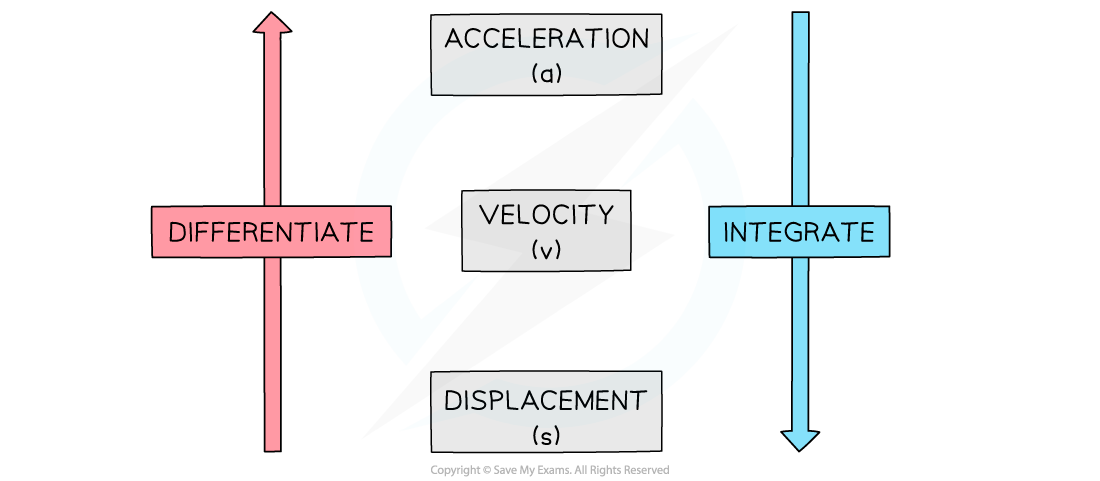
    Displacement s(t) Net change in position. If v(t) is velocity, displacement over [t1,t2] = ∫t1t2 v(t) dt.
    Velocity v(t) Rate of change of position: v(t)=ds/dt. If s(t) known, v(t)= derivative of s(t).
    Acceleration a(t) Rate of change of velocity: a(t)=dv/dt = d2s/dt2.
    Distance Total path length = ∫t1t2 |v(t)| dt (must split where v(t) changes sign).

    📌 Key relationships & interpretations

    • v(t)=ds/dt (instantaneous slope of s); units: length/time.
    • a(t)=dv/dt=d2s/dt2 (instantaneous slope of v).
    • Displacement = ∫ v(t) dt; Distance = ∫ |v(t)| dt (split at zeros of v(t)).
    • If v and a same sign → speed increasing; opposite signs → speed decreasing.

    Using Calculus in 1D | Cambridge (CIE) A Level Maths Revision Notes 2021

    🌍 Real-world connections

    • Navigation/GPS: integrate measured speed to estimate displacement and ETA; sampling error causes drift — correct with external fixes.
    • Automotive safety: sudden large negative a(t) (deceleration) triggers ABS / airbags; sensors supply acceleration profiles in real time.
    • Sports analytics: coaches analyse v(t) and a(t) profiles to quantify accelerations during sprints and recovery patterns.
    • Engineering design: acceptable acceleration limits (g-forces) inform roller-coaster and vehicle suspension design.

    📌 Calculations (pointers & method)

    • From s(t): v=ds/dt, a=d2s/dt2. Example: s=t3 ⇒ v=3t2, a=6t.
    • From v(t): displacement = ∫ v dt. Use GDC’s ∫ function for definite integrals.
    • Distance: find v(t)=0 roots, split interval at roots, compute sum of integrals of |v| (GDC: integrate each interval and take absolute values if needed).
    • From a(t): integrate to get v(t) + C (use initial v), then integrate v(t) + C to get s(t) + C2 (use initial s).

    🧠 Examiner tip

    • State whether result is displacement (signed) or distance (positive).
    • Write partition times where v(t)=0 and evaluate sub-integrals for distance (method marks).
    • Label units in answers and show brief justification when using GDC.
    • When given a(t) only: integrate → apply v(0) → integrate → apply s(0).

    📱 GDC Tips — Calculus in Kinematics (Displacement, Velocity & Acceleration)

    TI-Nspire CX II / CX II CAS

    • Enter the given function (s(t), v(t), or a(t)) in the Calculator or Graphs app, clearly defining the independent variable t.
    • To find velocity from displacement, use Menu → Calculus → Derivative and evaluate ds/dt symbolically or at specific t-values if required.
    • To find acceleration from velocity, repeat the derivative process on v(t), ensuring correct units (length/time²).
    • For displacement from velocity, use Menu → Calculus → Integral and enter a definite integral with correct limits to avoid missing constants.
    • To calculate distance, first solve v(t)=0 using Menu → Algebra → Solve, then compute separate integrals on each interval and interpret results as absolute values.

    Casio fx-CG50 / fx-CG100

    • Enter the function in the Graph app and set the correct viewing window so that key features (turning points and intercepts) are visible.
    • Use G-Solv → d/dx to numerically verify velocity or acceleration at specific time values.
    • For displacement, use G-Solv → ∫dx with correct lower and upper limits to compute signed area under v(t).
    • To find when velocity changes direction, use G-Solv → Root to locate zeros of v(t), then record these times clearly.
    • Compute distance by integrating over each sub-interval separately and summing the magnitudes, explaining the split explicitly in written solutions.

    IB Exam Technique (All GDCs)

    • Always state whether the calculator result represents displacement (signed) or distance (always positive).
    • Show at least one symbolic step (derivative or integral setup) before using GDC output to secure method marks.
    • When integrating acceleration, explicitly apply initial conditions after each integration to find constants.
    • Label all final answers with correct physical units and briefly interpret what the result means in context.

    📌 Example questions (brief methods)

    Example 1 — v(t)=t2 − 4t + 3 on [0,5]

    1. Displacement = ∫05 (t2−4t+3) dt — evaluate with GDC’s integral function.
    2. Find roots: t=1,3. Partition [0,1],[1,3],[3,5]. Compute integrals on each and sum absolute values for distance.
    Example 2 — a(t)=6t, v(0)=2, s(0)=1

    1. v(t)=∫6t dt = 3t2 + C → use v(0)=2 → C=2 → v=3t2+2.
    2. s(t)=∫(3t2+2) dt = t3 + 2t + K → s(0)=1 → K=1 → s=t3+2t+1.

    📌 Quick formula sheet

    • v(t)=ds/dt
    • a(t)=dv/dt=d2s/dt2
    • Displacement = ∫t1t2 v(t) dt
    • Distance = ∫t1t2 |v(t)| dt (split at sign changes)

    📝 Paper tip

    • When asked ‘distance’, explicitly partition at v(t)=0 and sum absolute integrals with short justification.
    • When given only a(t): integrate twice, apply initial conditions after each integration step and state them clearly.

    📌 Multiple Choice Questions (MCQs)

    MCQ 1. A particle moves along a straight line with velocity
    v(t) = 3t² − 12t + 9, where t is measured in seconds.
    Which statement is correct?

    • A. The particle is always moving forwards.
    • B. The particle changes direction exactly once.
    • C. The particle changes direction exactly twice.
    • D. The particle never comes to rest.
    Answer & Explanation

    Set v(t)=0 to find direction changes:

    3t² − 12t + 9 = 0 ⇒ t² − 4t + 3 = 0 ⇒ (t−1)(t−3)=0

    The velocity is zero at t=1 and t=3, and the sign of v(t) changes at both points.

    Correct answer: C — the particle changes direction twice.

    MCQ 2. If s(t) is displacement and v(t) is velocity, which expression always gives the distance travelled from t=a to t=b?

    • A. ∫ab v(t) dt
    • B. | ∫ab v(t) dt |
    • C. ∫ab |v(t)| dt
    • D. ∫ab v(t)² dt
    Answer & Explanation

    Distance measures total path length, regardless of direction.
    This requires integrating the magnitude of velocity.

    Correct answer: C

    MCQ 3. A particle has acceleration a(t)=6t−4.
    At what value of t does the velocity have a minimum?

    • A. t = −2
    • B. t = 0
    • C. t = 2/3
    • D. t = 4
    Answer & Explanation

    Velocity has a minimum when a(t)=0:

    6t − 4 = 0 ⇒ t = 2/3

    Correct answer: C

    📌 Short Answer Questions

    Short Question 1.
    A particle moves with velocity v(t)=t³−6t²+9t for 0≤t≤4.

    (a) Find the displacement of the particle over the interval.

    Worked Answer

    Displacement = ∫04 (t³−6t²+9t) dt

    = [¼t⁴ − 2t³ + 9/2 t²]04

    = (64 − 128 + 72) − 0 = 8

    Displacement = 8 units.

    Short Question 2.
    Explain why distance and displacement may be different even when a particle starts and ends at the same position.

    Worked Answer

    Displacement measures net change in position and depends only on the start and end points.

    Distance measures the total path travelled and accounts for all changes in direction.

    If the particle reverses direction during motion, distance increases while displacement may remain zero.

    📌 Long Answer Questions (IB-Style)

    Long Question 1.
    A particle moves along a straight line with acceleration
    a(t)=6t−8, where t≥0.

    (a) Find an expression for the velocity v(t), given that v(0)=5.

    (b) Determine the time at which the particle comes to rest.

    (c) Find the displacement of the particle from t=0 until it first comes to rest.

    Full Worked Solution

    (a) Velocity

    v(t)=∫(6t−8)dt = 3t² − 8t + C

    Using v(0)=5 ⇒ C=5

    v(t)=3t² − 8t + 5

    (b) When the particle comes to rest

    Set v(t)=0:

    3t² − 8t + 5 = 0 ⇒ (3t−5)(t−1)=0

    t = 1 or t = 5/3

    The first time the particle comes to rest is t=1.

    (c) Displacement

    Displacement = ∫01 (3t² − 8t + 5) dt

    = [t³ − 4t² + 5t]01

    = 1 − 4 + 5 = 2

    Displacement = 2 units.

    Long Question 2.
    The velocity of a particle is given by
    v(t)=t²−4t+3 for 0≤t≤5.

    (a) Find the times when the particle changes direction.

    (b) Find the total distance travelled by the particle.

    (c) Explain why displacement and distance are not equal in this motion.

    Full Worked Solution

    (a) Direction changes

    Set v(t)=0:

    t²−4t+3=0 ⇒ (t−1)(t−3)=0

    The particle changes direction at t=1 and t=3.

    (b) Distance travelled

    Distance = ∫|v(t)|dt, split at t=1 and t=3.

    Distance = ∫01 v(t)dt − ∫13 v(t)dt + ∫35 v(t)dt

    Evaluating gives total distance = 10 units.

    (c) Explanation

    Displacement accounts for direction, while distance counts total motion.

    Since the particle reverses direction twice, backward motion reduces displacement but increases distance.

  • AHL 5.12 — Area Under Curves & Volumes of Revolution

    Key Concept Description
    Area under a curve Computed using definite integrals over [a, b]. May include negative values depending on position of curve.
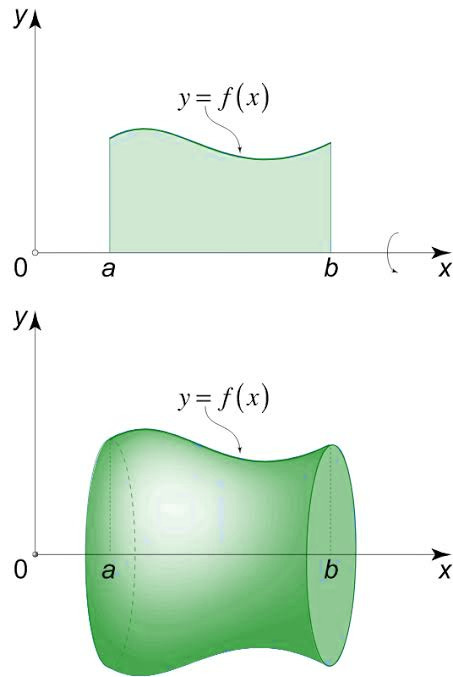
    Revolution around x-axis Volume computed using V = ∫ab πy² dx.
    Revolution around y-axis Volume computed using V = ∫ab πx² dy.

    📌 Area Enclosed by a Curve and the Axes

    The area under a curve y = f(x) from x = a to x = b is found using a definite integral:

    A = ∫ab f(x) dx

    If the curve lies below the x-axis, the integral becomes negative. In such cases, the geometric area is:

    A = |∫ f(x) dx|

    Students must understand how the sign of the function affects the final interpretation of an area problem.

    🌍 Real-World Connection

    Engineers use area-under-curve calculations to determine fuel consumption curves, efficiency curves, and material usage profiles.
    Architects use these integrals to compute surface areas of curved façades and structural load distributions.

    🧠 GDC Tip

    Use the definite integral function on your GDC:
    Menu → Calculus → ∫(a to b) to avoid algebraic mistakes.
    Zoom in on intersections to confirm the correct bounds.

    📌 Volumes of Revolution

    Rotating a region around an axis forms a 3D solid. The method used here is the disc method:

    V = ∫ab πy² dx  (for rotation about x-axis)

    V = ∫ab πx² dy  (for rotation about y-axis)

    This comes from summing infinitely many circular discs, each with radius given by the function value.

    Volume of Solid of Revolution - GeeksforGeeks

    Calculus - Disk Method for Finding Volume

    🔍 TOK Perspective

    Ancient mathematicians approximated volumes using intuition long before calculus existed.
    Does this suggest that mathematical truth exists before formal proof, or that proof is what creates truth?
    Volumes of revolution show how abstraction helps transform physical intuition into formal, universal methods.

    📝 Paper 2 Strategy

    Examiners love testing whether students choose the correct axis of rotation.
    Always sketch the region first.
    If the curve is given as x in terms of y, do not convert — integrate with respect to y.

    🌐 EE / International-Mindedness Link

    Techniques for estimating areas and volumes existed in many civilizations:

    • Liu Hui (China): Computed cylinder volume using early limit processes.
    • Greek geometers: Used infinitesimals before formal calculus.
    • Ibn al-Haytham: First to compute the volume of a paraboloid using integral-like reasoning.
    • Egyptian papyri: Contain early approximations for frustum volumes.

    These historical methods are ideal for an EE exploring the evolution of calculus concepts across cultures.

  • AHL 5.11 — Integration Techniques (Power, Trig, Exponential & Substitution)

    INTEGRATION TECHNIQUES — CORE RESULTS & APPLICATIONS

    Concept Key Idea
    Power Rule Integrates xn for all rational n except −1
    Logarithmic Case Special rule for ∫1/x dx
    Trig Integrals Reverse differentiation of trig functions
    Exponential Integrals ex remains unchanged under integration
    Substitution Undoing the chain rule

    📌 1. Power Rule for Integration (n ≠ −1)

    • Core rule: ∫xn dx = xn+1 / (n+1) + C
    • Applicability: Works for positive, negative, and fractional rational exponents
    • Why n ≠ −1: Division by zero would occur if n+1 = 0
    • Conceptual meaning: Measures accumulated area under polynomial curves
    • Exam habit: Always rewrite roots and fractions as powers before integrating
    🌍 Real-World Connection

    • Used to compute work done when force varies with distance
    • Appears in economics for total cost and revenue models
    • Used in physics for motion under variable acceleration

    📌 2. Logarithmic Special Case

    • Unique exception: ∫1/x dx = ln|x| + C
    • Reason: Power rule fails because exponent −1 causes division by zero
    • Absolute value: Required because ln(x) is undefined for x ≤ 0
    • Key appearance: In inverse proportionality models
    • Common trap: Never write ln(x) without absolute value in IB exams
    🔍 TOK Perspective

    • Why does one exponent require an entirely new function?
    • What does this exception reveal about mathematical systems?
    • How do we justify creating new tools when rules break?

    📌 3. Trigonometric Integrals

    • Reverse differentiation: Integration undoes derivatives
    • Key results: ∫cos x dx = sin x + C
    • Negative signs: ∫sin x dx = −cos x + C
    • Tan result: ∫sec2x dx = tan x + C
    • Use case: Oscillatory and wave motion
    📝 Paper 2 Tip

    • Check if trig functions are inside composites
    • Look for inner derivatives before integrating
    • Substitution is often hidden in trig integrals

    📌 4. Exponential Integrals

    • Unique property: ex is its own derivative and integral
    • Basic rule: ∫ex dx = ex + C
    • Scaled exponent: ∫ekx dx = (1/k)ekx + C
    • Growth meaning: Continuous accumulation processes
    • IB relevance: Central to modelling questions

    📌 5. Integration by Substitution (u-sub)

    • Purpose: Simplifies composite integrals
    • Core idea: Replace inner function with u
    • Derivative link: du must appear in the integral
    • Back-substitution: Required for indefinite integrals
    • IB marking: Full method marks need full substitution steps
    🧠 Examiner Tip

    • Rewrite the entire integral in terms of u
    • Always show du/dx clearly
    • Change limits for definite integral

    📌 Practice Questions (IB Style)

    Multiple Choice Questions

    Select the one correct option for each question.

    MCQ 1. Evaluate the integral
    ∫ x³ dx.

    A. x⁴ + C
    B. 3x² + C
    C. x⁴⁄4 + C
    D. 4x³ + C

    Answer & Explanation

    Correct answer: C
    Using the power rule, ∫xⁿ dx = xⁿ⁺¹/(n+1) + C.
    Here n = 3, so the integral becomes x⁴/4 + C.

    MCQ 2. Which of the following integrals evaluates to ln|x| + C?

    A. ∫ x⁻² dx
    B. ∫ 1/x dx
    C. ∫ eˣ dx
    D. ∫ x dx

    Answer & Explanation

    Correct answer: B
    The logarithmic result occurs only when integrating x⁻¹.
    All other powers are handled using the power rule.

    MCQ 3. Evaluate the integral
    ∫ sec²x dx.

    A. sin x + C
    B. cos x + C
    C. tan x + C
    D. −cos x + C

    Answer & Explanation

    Correct answer: C
    Since d/dx(tan x) = sec²x, the antiderivative of sec²x is tan x + C.

    Short Answer Questions

    Answer clearly, showing all necessary reasoning.

    Question 1.
    Explain why the power rule cannot be applied to evaluate ∫ x⁻¹ dx.

    Model Answer

    The power rule requires division by n + 1.
    When n = −1, this results in division by zero, which is undefined.
    Therefore, a different function is required, and the integral of x⁻¹ is defined as ln|x| + C instead.

    Question 2.
    Find ∫ e⁴ˣ dx and explain the method used.

    Model Answer

    The derivative of e⁴ˣ is 4e⁴ˣ, so the integral must compensate for this factor.
    Dividing by 4 gives ∫ e⁴ˣ dx = (1/4)e⁴ˣ + C.
    This follows directly from reversing the chain rule.

    Long Answer Questions

    Question 1.
    Let f(x) = (2x² + 1)³.

    (a) Show that ∫ (2x² + 1)³ · 4x dx can be evaluated using substitution.
    (b) Find the value of the integral.
    (c) Verify your result by differentiation.

    Full Solution

    (a) Let u = 2x² + 1.
    Then du = 4x dx, which exactly matches the remaining factor in the integrand.

    (b) The integral becomes ∫ u³ du = u⁴/4 + C.
    Substituting back gives (2x² + 1)⁴/4 + C.

    (c) Differentiating (2x² + 1)⁴/4 using the chain rule returns
    (2x² + 1)³ · 4x, confirming the result.

    Question 2.
    A particle moves along a straight line with velocity
    v(t) = 3t² − 6t.

    (a) Find the displacement of the particle for 0 ≤ t ≤ 3.
    (b) Find the total distance travelled in this interval.
    (c) Explain the difference between displacement and total distance in this context.

    Full Solution

    (a) Displacement is given by ∫ v(t) dt.
    ∫ (3t² − 6t) dt = t³ − 3t².
    Evaluating from 0 to 3 gives 0.

    (b) To find total distance, solve v(t) = 0 → t = 0 and t = 2.
    The velocity is negative on (0,2) and positive on (2,3).
    Distance = |∫₀² v(t) dt| + ∫₂³ v(t) dt = 5.

    (c) Displacement measures net change in position, which is zero here.
    Distance measures total motion regardless of direction, which is non-zero.

  • AHL 5.10 — Second Derivative, Concavity, and the Second Derivative Test

    Concept Explanation & Purpose
    Second derivative f”(x) Measures how fast the gradient of f(x) is changing.
    Used to analyse curvature, acceleration in motion, inflexions, and stability of critical points.
    Concavity Concave-up (f”(x) > 0) means the slope is increasing;
    Concave-down (f”(x) < 0) means the slope is decreasing. Concavity determines the overall “shape” of the graph, not just local turning.
    Second derivative test Determines whether a stationary point is a local maximum, minimum, or inconclusive.
    Based on evaluating f”(x) at points where f'(x) = 0.
    Point of inflexion A point where f”(x) = 0 AND the concavity changes.
    Must check the sign change of f”(x) to confirm.

    📌 What the Second Derivative Really Represents

    The second derivative describes how the rate of change itself is changing.
    While the first derivative answers “how steep?”, the second derivative answers “how is the steepness evolving?”
    This is essential for identifying deeper behaviour such as stability, curvature, and acceleration.

    • f”(x) > 0 — Concave-up:
      The slope is increasing; the graph forms a “cup” shape.
      Physically, this represents positive acceleration or increasing marginal returns.
    • f”(x) < 0 — Concave-down:
      The slope is decreasing; the graph forms a “cap” shape.
      In motion, this is deceleration; in economics, diminishing returns.
    • f”(x) = 0 alone is meaningless.
      It could be a maximum, minimum, inflexion, or a flat region with no curvature change.
    • Curvature describes global behaviour.
      Concavity helps predict long-term behaviour, not just one point of the graph.

    🌍 Real-World Connection

    • Used in physics to analyse simple harmonic motion (acceleration proportional to negative displacement).
    • Applied in economics to detect increasing vs decreasing marginal returns in production.
    • Used in biology for modelling population growth concavity (logistic growth curve inflexion).
    • In engineering, concavity helps identify stress/strain behaviours under varying loads.

    📌 The Second Derivative Test

    Once you find a stationary point by solving f'(x) = 0, you evaluate the second derivative:

    • If f”(x₀) > 0 → Local Minimum:
      The function is curving upward; the point sits in a valley.
    • If f”(x₀) < 0 → Local Maximum:
      The function is curving downward; the point sits on a peak.
    • If f”(x₀) = 0 → Inconclusive:
      Could be max/min/inflexion — must check the sign change of f'(x) or f”(x).
    • IB exam tip:
      Always justify your conclusion with “Since f”(x₀) is positive/negative…”.

    Second Derivative Test

    🧠 Examiner Tip

    • Always state f'(x)=0 first before applying f”(x).
    • Explicitly mention the sign of f”(x) in your classification (IB gives method marks for this).
    • If f”(x)=0, write: “Test inconclusive — checking concavity.”
    • Graphs are heavily rewarded; include them when possible.

    📱 GDC Tip

    • Use nDeriv() or graph derivative mode to confirm f'(x)=0 visually.
    • Use a second nDeriv() to evaluate f”(x) at the stationary point.
    • Zoom in around the stationary point to inspect local curvature behaviour.
    • GDC is ideal for verifying sign changes in f”(x) around suspected inflexion points.

    📌 Points of Inflexion (More Detailed)

    A point of inflexion occurs where the graph changes its concavity.
    It often appears where f”(x)=0, but the sign change is the key requirement.

    • If f”(x) changes from positive→negative → concave-up to concave-down.
    • If f”(x) changes from negative→positive → concave-down to concave-up.
    • Common in cubic polynomials, exponential logistics, and S-shaped curves.
    • Failure to check sign change is one of the most frequent causes of lost marks in IB exams.

    📐 IA Spotlight

    • Inflexion analysis is valuable when modelling logistic growth or S-curves.
    • Second derivative behaviour strengthens justification of model suitability (Criterion E).
    • Turning points + concavity help validate predictions from fitted functions.
    • Using GDC derivative tools improves accuracy and reduces algebraic error risk.

    🔍 TOK Perspective

    • Mathematics models “curvature” in music (vibrations, pitch variation, wave patterns).
    • Does describing music with derivatives make music mathematical, or math musical?
    • Second derivatives reveal structure in nature — does structure imply meaning?
    • How does abstract curvature gain real-world relevance through interpretation?
  • AHL 5.9 – Derivatives of Trigonometric, Exponential, Logarithmic Functions & Composite Rules

    DIFFERENTIATION TECHNIQUES

    Concept IB Definition & Role
    Trigonometric derivatives Exact derivative rules for sin, cos, and tan used to model periodic motion such as waves.
    Exponential & logarithmic derivatives Rules governing growth, decay, and scaling models in science and economics.
    Power rule (rational exponents) Differentiation of roots, reciprocals, and inverse powers.
    Chain, product, quotient rules Structured methods for composite, multiplied, and divided functions.
    Related rates Applications of derivatives to time-dependent systems.

    📌 Derivatives of trigonometric functions

    • Derivative of sin x: The derivative of sin x is cos x; for example, at x = 0, the slope of sin x equals cos 0 = 1.
    • Derivative of cos x: The derivative of cos x is −sin x; for example, at x = π/2, the slope is −1.
    • Derivative of tan x: The derivative of tan x is sec²x; for example, tan x increases rapidly near x = π/2.
    • These derivatives must be memorised exactly, e.g. sin(3x) differentiates to 3cos(3x).
    • They frequently appear combined with the chain rule in exam questions.

    🌍 Real-World Connection

    • Sinusoidal derivatives are used to compute velocity from displacement in wave motion.
    • Electrical engineers use cos and sin derivatives in alternating current analysis.
    • Acceleration in circular motion is found using trigonometric rates of change.

    📌 Derivatives of exponential and logarithmic functions

    • Derivative of eˣ: The derivative of eˣ is eˣ; for example, growth rate equals value at every point.
    • Derivative of ln x: The derivative of ln x is 1/x; for example, at x = 2 the slope is 0.5.
    • These functions appear in compound interest and population growth models.
    • They often require the chain rule, e.g. ln(3x²).
    • Domain restrictions must always be stated explicitly.

    🧠 Examiner Tip

    • Always state domain restrictions when differentiating ln x.
    • Do not cancel terms before applying differentiation rules.
    • Method marks are awarded for correct rule identification.

    📌 Power rule for rational exponents

    • The derivative of xⁿ is n·xⁿ⁻¹; for example, x¹ᐟ² becomes ½x⁻¹ᐟ².
    • Negative powers must be handled carefully, e.g. x⁻² becomes −2x⁻³.
    • All radicals should be rewritten as powers before differentiating.
    • This rule applies to fractional, integer, and negative exponents.
    • Errors often occur when radicals are left in root form.

    🔍 TOK Perspective

    • Why does a single algebraic rule apply universally to all rational exponents?
    • Does abstraction increase certainty in mathematics?
    • How do symbolic rules shape mathematical knowledge?

    📌 Chain, product, and quotient rules

    • The chain rule differentiates composite functions such as sin(x²).
    • The product rule applies when functions are multiplied, e.g. x²eˣ.
    • The quotient rule is used for ratios such as x² / ln x.
    • Correct rule identification is essential for full marks.
    • These rules are heavily tested at HL level.

    📌 Related rates

    • Related rates problems involve differentiation with respect to time.
    • Variables are connected through geometric or physical equations.
    • Known values are substituted at a specific instant.
    • Units must be consistent throughout the solution.
    • These questions test modelling and interpretation.

    📐 IA Spotlight

    • Related rates are ideal for modelling real-world motion.
    • Clearly justify assumptions and variable relationships.
    • Discuss limitations of continuous models.

    📌 Exam-style questions

    Multiple-choice questions

    MCQ 1. What is the derivative of sin(3x)?

    A. cos x B. 3cos(3x) C. cos(3x) D. −sin(3x)

    Answer: B — Chain rule applied.

    MCQ 2. What is the derivative of ln(x²)?

    A. 1/x B. 2/x C. x² D. 2x

    Answer: B — Differentiate using chain rule.

    MCQ 3. What is the derivative of x⁻³?

    A. −3x⁻⁴ B. 3x⁻² C. −x⁻⁴ D. x⁻²

    Answer: A

    MCQ 4. Which rule applies to y = x·eˣ?

    A. Chain B. Quotient C. Product D. Power

    Answer: C

    Short-answer questions

    SAQ 1. Why must radicals be rewritten as powers?

    The power rule applies only to index notation, not radical form.

    SAQ 2. Why is eˣ unique?

    It is the only function equal to its own derivative.

    Long-answer questions

    LAQ 1.
    (a) Differentiate y = sin(x²).
    (b) State the rule used.
    (c) Explain the structure of the derivative.

    (a) dy/dx = 2x·cos(x²)
    (b) Chain rule
    (c) The outer derivative is multiplied by the derivative of the inner function.

    LAQ 2.
    (a) Differentiate y = (x²eˣ)/(ln x).
    (b) Identify all rules used.
    (c) State the domain of the function.

    (a) Product and quotient rules are required.
    (b) Product rule in numerator, quotient rule overall.
    (c) x > 0 due to ln x.

  • 3.3 – Costs & Revenues

    💼 UNIT 3.3: COSTS & REVENUES

    Understand the two fundamental building blocks of business profitability: the costs a business must pay to operate, and the revenue streams it uses to generate income. This unit focuses on classifying costs and identifying revenue sources.

    📌 Definition table

    Term Definition
    Fixed Costs Expenses that do not change with output level; business pays the same amount regardless of production volume (e.g., rent, insurance, salaries).
    Variable Costs Expenses that change in proportion to output level; total variable cost increases with production, but cost per unit remains constant (e.g., raw materials, packaging).
    Direct Costs Expenses that can be traced directly to a specific product or project; clearly attributable to making that particular item (e.g., raw materials, piece-rate wages).
    Indirect Costs (Overheads) Expenses that cannot be traced to specific products but support entire business operation; shared across all products or the whole organisation (e.g., rent, utilities, manager salaries).
    Revenue Money coming in from selling products (goods or services); calculated as Price × Quantity sold.
    Total Revenue All money received from selling products; calculated as TR = Price × Quantity.
    Revenue Streams Different means of generating income beyond primary product sales (e.g., dividends, sponsorship, advertising, subscriptions, rental income).
    Economies of Scale Cost advantage that comes from producing at larger volumes; fixed cost per unit decreases as output increases, reducing average cost per unit.

    📌 Classifying costs: fixed vs. variable

    Costs are the amounts a business must spend to purchase resources necessary to produce or sell products. Understanding how to classify costs is essential because different cost types behave differently as output changes. There are two major ways to classify costs in Unit 3.3: by behavior (fixed vs. variable) and by traceability (direct vs. indirect).

    Fixed costs (FC)

    Fixed costs are expenses a business must pay regardless of how much it produces or sells. Fixed costs do not change with output level. They remain the same whether the business produces 10 units or 1,000 units.

    • Rent: Monthly rental on premises (factory, office, retail space).
    • Insurance: Annual insurance premiums for business liability, property, vehicles.
    • Salaried staff: Managers, administrative staff paid monthly/annual salaries (not based on production).
    • Interest on loans: Loan repayment obligations (the business must pay regardless of profitability).
    • Depreciation: Fixed asset depreciation (equipment, vehicles, buildings lose value over time).
    • Property taxes: Business property taxes are fixed annual amounts.

    Key characteristic: Fixed costs per unit decrease as output increases. For example: A factory has £100,000 annual rent (fixed). If it produces 10,000 units, the rent cost per unit is £10. If it produces 50,000 units, the rent cost per unit is only £2. This is why larger companies have lower per-unit costs—their fixed costs are spread across more units. This concept is central to economies of scale.

    Variable costs (VC)

    Variable costs are expenses that change in proportion to the level of output. They increase as production increases and decrease as production decreases. Variable costs are directly related to output—if you produce twice as much, variable costs approximately double.

    • Raw materials: Cost of materials used to make products (increases with production volume).
    • Piece-rate wages: Workers paid per unit produced (more units = higher wages).
    • Packaging: Cost to package products (increases with number of units produced).
    • Shipping and delivery: Transport costs (more units sold = more shipping needed).
    • Fuel for production: Energy costs for machinery (more production = more energy used).
    • Commission on sales: Sales staff paid percentage of sales (higher sales = higher commission).

    Key characteristic: Variable cost per unit remains relatively constant. If a shirt costs £5 in materials and labour to make, it costs £5 per shirt whether you make 100 or 10,000 shirts. The total variable cost changes, but the variable cost per unit stays the same.

    🌍 Real-World Connection

    A restaurant’s rent (£2,000/month) is a fixed cost—it stays the same whether they serve 100 or 500 customers. Chicken for dishes (£3/portion) is a variable cost—more customers means more chicken needed. A chef’s salary (£2,000/month) is typically fixed. A delivery driver paid £5 per delivery is variable. As the restaurant grows, fixed costs per customer fall (rent spread over more customers), but variable cost per customer stays the same.

    🌍 Real-World Connection

    Walmart and Amazon succeed partly through economies of scale. Walmart’s massive volume spreads fixed costs (warehouse rent, management) across millions of units, creating lower per-unit costs than smaller competitors. Amazon’s cloud services (AWS) use excess data centre capacity (fixed costs already paid) to generate additional revenue with minimal variable cost. Tesla’s Gigafactories are capital-intensive (high fixed costs) but enable scale economies that competitors struggle to match. Understanding cost structure explains why scale can be a competitive moat—larger companies can price lower while still earning profit.

    📌 Classifying costs: direct vs. indirect (overheads)

    A second way to classify costs is by traceability: whether costs can be directly traced to a specific product or are shared across the business. This classification is important for understanding which costs are attributable to specific products.

    Direct costs

    Direct costs are expenses that can be traced directly to a specific product or project. They are directly related to making that particular product. You can clearly identify which cost belongs to which product.

    • Raw materials: Leather for a shoe, flour for bread—directly in the product.
    • Piece-rate wages: Workers paid per unit—costs directly attributable to that unit.
    • Packaging specific to product: Box designed for Product A (not shared with Product B).
    • Consultant costs: A consultant hired for a specific project charges directly to that project.

    Indirect costs (overheads)

    Indirect costs (called overheads) are expenses that cannot be traced to any particular product but support the entire business operation. They benefit multiple products or the whole organisation. They are shared across all products, not attributable to specific ones.

    • Factory rent: Building houses all product lines; can’t say which portion belongs to Product A.
    • General advertising: Brand advertising benefits all products, not specific ones.
    • Manager salaries: Managers oversee multiple products; costs can’t be fully assigned to one.
    • Utilities: Electricity powers the entire factory; can’t trace to specific products.
    • Insurance: Covers the whole business, not specific products.
    • Administrative staff: HR, accounting support the entire business.

    Why this distinction matters: Direct costs are easy to analyse—you know exactly what each product costs to make. Indirect costs are harder to allocate—how much of the factory rent should be attributed to Product A vs. Product B? This matters for pricing and profitability analysis: if you don’t account for indirect costs properly, you might underprice products and fail to cover overheads, resulting in losses even when individual products appear profitable.

    🧠 Examiner Tip

    When analysing product profitability, remember that indirect costs are real costs that must be covered by all products combined. A business with two products (A and B) might calculate that Product A is profitable without accounting for shared overheads. But overheads must be paid regardless—if Product A doesn’t contribute enough to cover its share of overheads, the business is actually losing money on Product A. Strong exam answers recognise the challenge of allocating indirect costs and the risk of ignoring them.

    ❤️ CAS Link

    Create a workshop for local small business owners on understanding their cost structure. Help them identify and classify their fixed and variable costs, understand overhead allocation challenges, and make pricing decisions. Many small entrepreneurs operate without properly understanding whether they’re covering their costs—they might think they’re profitable when they’re actually losing money. This service activity improves financial management and business sustainability in your local economy.

    🔍 TOK Perspective

    How much of the factory building’s cost should be allocated to Product A versus Product B? Some allocate by square footage, others by production volume, others by labour hours. Each method produces different results. This reveals that financial “facts” (cost per product) aren’t purely objective—they depend on allocation methods we choose. Different stakeholders might prefer different methods: accountants want consistency, Product A managers want lower allocated overhead, Product B managers want lower allocated overhead. This raises epistemological questions: What counts as “true” cost? How do we know?

    📌 Revenue: how businesses generate income

    Revenue is money coming in from selling products—goods (tangible items) or services (intangible services). Understanding revenue is the flip side of costs: while costs represent money going out, revenue represents money coming in. Understanding different revenue streams is important because many modern businesses generate income from multiple sources beyond just selling their main product.

    Products: goods vs. services

    Revenue comes from selling products. Products fall into two categories:

    • Goods (tangible): Physical products you can touch—cars, phones, clothing, food. Revenue from goods is generated when goods are sold.
    • Services (intangible): Non-physical offerings—haircuts, consulting, insurance, entertainment. Revenue from services is generated when services are delivered.

    Total revenue (TR) and average revenue (AR)

    Revenue: Money coming in from product sales (goods or services).

    Total revenue (TR) = Price × Quantity (TR = P × Q)
    Total revenue is all money received from selling products. If a business sells 100 units at £50 each, TR = £5,000.

    Average revenue (AR) = TR ÷ Q, which equals Price
    Since AR = TR ÷ Q and TR = P × Q, then AR = (P × Q) ÷ Q = P. Average revenue is simply the selling price per unit.

    Revenue streams: diversifying income sources

    Modern businesses often generate income from multiple sources beyond their main product sales. Revenue streams are different means (other than primary trading activity) used to generate income for the organisation. Diversifying revenue streams reduces risk and increases resilience.

    • Main source: sales of main products The core revenue source for most businesses. A car manufacturer’s main revenue is from selling cars.
    • Dividends: Income from owning shares in other companies. If a company owns shares in another corporation, it receives dividends.
    • Interest on deposits: Income from money deposited in banks or bonds. The interest earned is revenue.
    • Merchandise: Selling branded products beyond the main offering. Disney sells Disney-branded toys and merchandise beyond movie tickets.
    • Sponsorship deals: Companies pay to sponsor sporting events, teams, or athletes. A football team earns revenue from kit sponsorship.
    • Advertising revenue: Apps, websites, social media platforms earn revenue by selling advertising space. YouTube earns revenue from ads shown in videos.
    • Subscription services: Recurring revenue from subscription models. Apple Music, Netflix, and software subscriptions provide steady recurring revenue.
    • Royalties: Payments for use of intellectual property. A musician earns royalties when their song is used in a film or TV show.
    • Rental income: Leasing out properties or equipment. A company might rent out unused office space or equipment.
    • Donations: For non-profit organisations, gifts and donations from supporters are revenue.

    Why revenue streams matter: Diversifying revenue streams reduces risk. If a business relies 100% on one product or revenue source and that source disappears, the business fails. A business with multiple revenue streams is more resilient. If one stream declines, others compensate. This is especially important in uncertain or changing environments. For example, in 2020 when cinema attendance collapsed due to COVID-19, Disney was resilient because it had streaming (Disney+), theme parks, television, and merchandise.

    🌍 Real-World Connection

    Disney’s revenue sources: theme parks (admission, merchandise, food), film studios (movie ticket sales, streaming subscription Disney+), television (advertising, content sales), publishing, and merchandise licensing. Amazon’s revenue: e-commerce retail, cloud services (AWS), advertising, and streaming (Prime Video). Apple’s revenue: iPhone sales, services (App Store commission, iCloud, Apple Music, Apple TV+), wearables. These companies are resilient because if one revenue stream declines, others sustain profitability. A small local business selling only one product from one location is vulnerable to any disruption.

    🌍 Real-World Connection

    Modern businesses increasingly derive revenue from multiple streams through platform models. Netflix started with DVD rentals, then streaming (subscription), then advertising (ad-supported tier). Spotify earns from subscriptions, advertising, and promoting artists’ merchandise. Universities earn from tuition, research grants, licensing IP, and donations. Zoom earns from subscriptions, but also offers free services to build user base, then monetises through enterprise features. Understanding revenue diversification is essential for modern business strategy—companies that rely on single revenue streams face existential risk when markets shift.

    📌 Profitability: costs and revenue together

    Understanding costs and revenues separately is essential, but they only become meaningful when analysed together. Profitability depends on the relationship between what comes in (revenue) and what goes out (costs).

    Basic profitability formula

    Profit = Total Revenue – Total Costs

    Where Total Costs = Fixed Costs + Variable Costs

    Example: A business has Total Revenue £100,000, Fixed Costs £30,000, Variable Costs £50,000. Profit = £100,000 – (£30,000 + £50,000) = £20,000.

    Break-even point: where revenue = costs

    The break-even point is the output level where total revenue equals total costs, resulting in zero profit (and zero loss). Understanding break-even is critical for business planning.

    Break-even Quantity = Fixed Costs ÷ (Price – Variable Cost per Unit)

    Example: Product has £20 price, £12 variable cost per unit, £40,000 fixed costs. Break-even = £40,000 ÷ (£20 – £12) = £40,000 ÷ £8 = 5,000 units. The business must sell 5,000 units to cover all costs. Below 5,000 units = loss. Above 5,000 units = profit.

    Contribution margin: profitability per unit

    The contribution margin is the amount each unit sold contributes toward covering fixed costs and profit.

    Contribution Margin = Price – Variable Cost per Unit

    In the example above, Contribution Margin = £20 – £12 = £8 per unit. Each unit sold contributes £8 toward fixed costs. To cover £40,000 fixed costs, the business needs 5,000 units (£40,000 ÷ £8). After fixed costs are covered, additional contribution margin becomes profit. If 5,001 units are sold, profit = £8 (the 5,001st unit’s contribution margin).

    🧠 Examiner Tip

    Strong exam answers recognise the interplay between costs and revenue. A business can increase profitability by raising prices (increasing revenue), reducing variable costs (manufacturing efficiency), reducing fixed costs (overhead control), or increasing volume (spreading fixed costs). Different strategies suit different situations: in recession, focus on variable cost reduction; with strong demand, focus on volume growth.

    📌 Key takeaways: building blocks of business success

    Unit 3.3 on Costs and Revenues provides foundational knowledge for business analysis. Key concepts to master:

    Cost behaviour shapes strategy: Fixed costs create economies of scale (larger is more efficient). Variable costs determine contribution margin (profit per unit). Understanding cost structure reveals why large firms can compete on price—their fixed costs per unit are lower.

    Cost classification affects decisions: Direct costs are easy to trace; indirect costs require allocation decisions. Poor allocation can lead to wrong pricing or product mix decisions. Managers must understand their cost structure to price effectively.

    Revenue diversification reduces risk: Single-product or single-market businesses are vulnerable to disruption. Successful modern businesses typically have multiple revenue streams. Understanding this explains why conglomerates exist—diversification reduces risk even if it complicates management.

    Profitability requires balance: Revenue must exceed total costs (fixed + variable) to generate profit. Break-even analysis reveals the minimum output needed to cover costs. Understanding contribution margin shows which products and strategies are most profitable.

    Context determines focus: Growing businesses focus on revenue and volume (spreading fixed costs). Mature businesses focus on cost control (margin per unit). Crisis situations require understanding which costs are truly fixed (can’t be cut) versus semi-variable (can be reduced). Strategic cost management differs by business context.

    📝 Paper 2

    Paper 2 questions on Unit 3.3 typically test understanding of cost classification (fixed vs. variable, direct vs. indirect), revenue calculations, and profitability analysis. Data-response questions often present case studies involving specific organisations and their cost/revenue structures. You may be asked to classify costs, calculate break-even points, analyse contribution margins, or evaluate profitability strategies. Command words like “analyse,” “evaluate,” and “recommend” require connecting theory to real business scenarios with specific calculations and evidence. Always show your workings for break-even calculations and contribution margin analysis.