Category: caterscam.github.io

caterscam.github.io

  • 4.1 – Introduction to Marketing

    💼 UNIT 4.1: THE ROLE OF MARKETING

    Understand the fundamental role of marketing in organisations, the distinction between marketing orientations, and how organisations use marketing to identify and satisfy customer needs whilst achieving business objectives. Explore market share, market growth, and market leadership as indicators of marketing success.

    📌 Definition Table

    Term Definition
    Marketing The process of identifying, anticipating, and satisfying customer needs and wants profitably through the creation and delivery of products or services.
    Market The group of customers with specific needs and wants, and the desire and ability to purchase products or services to satisfy them.
    Market Size The total value (or volume) of all sales of products or services in a particular market or industry.
    Market Share The percentage of total market sales held by a particular organisation; indicates the organisation’s competitive position in the market.
    Market Growth The percentage increase in total market size (value or volume) over a specific time period; indicates whether a market is expanding or contracting.
    Market Leader The organisation with the highest market share in a particular market or industry.
    Customer An individual or organisation that purchases or uses a product or service; the primary focus of marketing activity.
    Needs Fundamental human requirements that consumers seek to satisfy (e.g., food, shelter, safety).
    Wants The specific ways or products through which customers desire to satisfy their needs; shaped by culture, preferences, and marketing.
    Value The perceived benefit or satisfaction a customer receives from a product or service relative to its cost; key to customer satisfaction and loyalty.

    📌 Understanding the Role of Marketing

    Marketing is the business function responsible for identifying, anticipating, and satisfying customer needs and wants profitably. It is not merely about selling or advertising—it is a strategic function that connects the organisation’s capabilities with market opportunities. Marketing operates at the intersection of business objectives, customer desires, and competitive advantage.

    Core Responsibilities of the Marketing Function

    1. Market Research and Analysis: Marketing gathers data about customer needs, market trends, competitor activities, and environmental factors. This information informs strategic decision-making and helps organisations understand market opportunities and threats.

    2. Product Development and Innovation: Marketing identifies what customers want and communicates these insights to product development teams. Marketing also evaluates whether new products align with customer expectations and market conditions before launch.

    3. Pricing Strategy: Marketing determines optimal pricing based on customer willingness to pay, competitor pricing, production costs, and business objectives. Pricing directly affects profitability and market positioning.

    4. Promotion and Communication: Marketing communicates product benefits to customers through advertising, public relations, sales promotion, and personal selling. Effective promotion creates awareness, generates interest, and influences purchasing decisions.

    5. Distribution and Place: Marketing determines how products reach customers—through retail stores, online channels, direct sales, or other distribution channels. The right distribution ensures products are available where and when customers want them.

    6. Building Brand and Customer Loyalty: Marketing creates and maintains brand identity, differentiates products from competitors, and builds long-term customer relationships. Strong brands command premium prices and customer loyalty.

    7. Sales and Revenue Generation: Ultimately, marketing is responsible for generating sales revenue. Marketing strategies directly contribute to achieving business financial objectives through customer acquisition and retention.

    🧠 Examiner Tip:

    Many students treat marketing as simply “advertising” or “selling”. In reality, marketing is a strategic business function that shapes organisational decisions and competitive positioning. Marketing decisions about product features, pricing, distribution, and brand positioning directly determine business success. In case studies and essays, link marketing activities to business objectives and competitive advantage.

    📌 Marketing Orientations: Market-Oriented vs. Product-Oriented

    Organisations adopt different approaches to marketing based on their philosophy and strategic priorities. The two primary orientations—market-oriented and product-oriented—reflect fundamentally different ways of thinking about business and customer relationships.

    Market-Oriented Approach

    A market-oriented organisation prioritises customer needs and wants in its strategic planning and decision-making. The fundamental question is: “What do customers want, and how can we satisfy them?” Marketing research directly informs product development, pricing, distribution, and promotion strategies. Characteristics include: outward-looking focus on external market and customer preferences, reliance on market research to understand customer needs and wants, products developed based on identified market demand, responsive and adaptive to market feedback, pricing reflects customer willingness to pay and market competition, promotion emphasises customer benefits and value proposition.

    Examples of Market-Oriented Companies: Coca-Cola conducts extensive market research to understand consumer preferences, taste trends, and regional variations. The company has introduced hundreds of products based on market research findings. Toyota uses customer feedback extensively to design vehicles that meet user needs. Netflix relies on data analytics and customer viewing patterns to develop content recommendations and original productions.

    Advantages of Market-Oriented Approach

    • Higher customer satisfaction: Products directly address customer needs.
    • Faster response to market changes: Competitive threats are identified and addressed quickly.
    • Greater likelihood of market success: Reduced risk of product failure.
    • Enhanced customer loyalty: Repeat purchases and brand advocacy.
    • Sustainable competitive advantage: Customer focus creates differentiation.

    Disadvantages of Market-Oriented Approach

    • Expensive: Comprehensive market research requires significant investment.
    • Time-consuming: Research and product development cycles extend time to market.
    • Over-reliance on customer feedback: May lead to incremental innovation only.
    • Can become reactive: Following trends rather than leading.
    • May miss disruptive opportunities: Customers don’t recognise needs they haven’t yet identified.

    Product-Oriented Approach

    A product-oriented organisation prioritises product excellence, innovation, and quality in its strategic planning. The fundamental question is: “What can we create and innovate?” The organisation focuses on developing the best possible product, trusting that quality and innovation will create market demand. Characteristics include: inward-looking focus on internal capabilities, research, and development, prioritise innovation and technological advancement over market research, products developed based on what the organisation can create, quality and innovation are primary competitive tools, premium pricing reflects the superiority and innovation of products, promotion emphasises technical features and product superiority.

    Examples of Product-Oriented Companies: Apple is the quintessential product-oriented company. Steve Jobs famously stated, “It’s not the consumers’ job to know what they want.” Apple invests heavily in R&D to create innovative products (iPhone, iPad, Apple Watch) that often create entirely new categories of demand. Tesla focuses on electric vehicle innovation and technology leadership. 3M emphasises innovation with its “15% Rule” allowing employees to spend 15% of time on innovative projects.

    Advantages of Product-Oriented Approach

    • Potential for breakthrough innovation: Creates differentiation and new market categories.
    • If successful, creates entirely new markets: Generates new customer demand.
    • Less expensive than continuous market research: Reduced research costs.
    • Faster time to market: Less time spent on research phases.
    • Premium positioning and pricing: Based on product superiority.

    Disadvantages of Product-Oriented Approach

    • Risk of product failure: Innovations may not match market demand.
    • High R&D costs: May not be recouped if products don’t sell.
    • Slow response to market changes: Competitor offerings may address customer needs faster.
    • May develop products ahead of market readiness: Timing misalignment.
    • Poor customer satisfaction: If innovations don’t address real customer needs.

    💼 IA Spotlight:

    Conduct an Internal Assessment examining whether a chosen organisation is market-oriented or product-oriented. Collect data through interviews with marketing staff, analysis of marketing materials, customer surveys, and financial performance data. Evaluate how the organisation’s orientation affects product development, pricing, customer satisfaction, and profitability. Compare your chosen organisation with a competitor having different orientation. Analyse strengths and weaknesses of each approach in your specific market context.

    🔍 TOK Perspective:

    This raises epistemological questions: Can we truly know what customers want? Market research relies on what customers say they want, but do customers know their own preferences? Psychological research shows that customers often rationalise their choices and may not recognise latent needs until products are created. This reveals tensions between empiricism (what data shows) and intuition (what innovators intuit customers will want). What counts as valid evidence in determining customer preferences?

    🌍 Real-World Connection:

    Most successful large organisations operate with elements of both orientations. Apple is primarily product-oriented but uses market research to refine and position its innovations. Amazon is market-oriented (customer obsession is central) but also invests heavily in innovation (AWS, drone delivery). The ideal approach depends on industry context: highly competitive, commodity-like industries favour market orientation; innovative, dynamic sectors favour product orientation. Organisations that balance both approaches often achieve sustained success.

    📌 Market Share, Market Growth, and Market Leadership

    Marketing success is measured not just by customer satisfaction, but by market-based metrics. Market share, market growth, and market leadership indicate an organisation’s competitive position and marketing effectiveness.

    Key Formulas and Calculations

    Market Size Formula: Market Size = Total Sales of All Organisations in the Industry (by value or volume). Market size represents the total revenue or total units sold across all competitors in a particular market. It helps organisations understand the total opportunity available. Example: If the global smartphone market totals £400 billion in annual sales, that is the market size.

    Market Share Formula: Market Share (%) = (Organisation’s Sales ÷ Total Market Sales) × 100. Market share represents the percentage of total market sales held by an individual organisation. Higher market share indicates greater competitive strength. The sum of all organisations’ market shares equals 100%. Example: If Apple generates £200 billion in smartphone sales and the total smartphone market is £400 billion, Apple’s market share = (£200 billion ÷ £400 billion) × 100 = 50%.

    Market Growth Formula: Market Growth (%) = ((Market Size Now − Market Size Previously) ÷ Market Size Previously) × 100. Market growth measures the percentage increase in total market size over a specific time period. Positive growth indicates market expansion; negative growth indicates contraction. Example: If the global smartphone market was £350 billion last year and £400 billion this year, market growth = ((£400 billion − £350 billion) ÷ £350 billion) × 100 = 14.3%.

    Market Leadership

    The market leader is the organisation with the highest market share in a particular market or industry. Market leadership confers several strategic advantages and challenges. Characteristics of market leaders: highest market share in their industry, often set industry standards and trends, have significant market power over pricing and competition, typically enjoy brand recognition and customer loyalty, first-mover advantage in key market segments.

    Advantages of Market Leadership

    • Economies of Scale: High volume production reduces average costs per unit, enabling price competition.
    • Market Power: Greater influence over suppliers, distribution channels, and pricing.
    • Brand Recognition: Well-known brands attract customers and enable premium pricing.
    • Resource Availability: Higher profits and cash flow enable investment in R&D and expansion.
    • Customer Loyalty: Market leaders often enjoy higher retention and repeat purchase rates.

    Disadvantages of Market Leadership (Risks)

    • Complacency: Market leaders may fail to innovate, making them vulnerable to disruptive competitors.
    • High Expectations: Shareholders and customers expect continued growth and performance.
    • Regulatory Scrutiny: Market leaders face greater regulatory oversight and antitrust concerns.
    • Target for Competitors: Other firms specifically target market leaders as primary competitors.
    • Market Share Is Not Profitability: A market leader may have high market share but lower profitability than smaller competitors.

    🧠 Examiner Tip:

    In case studies, don’t assume market leader status means business success. Evaluate profitability, cost structure, and customer satisfaction alongside market share. A company might have 40% market share but lower profitability than a competitor with 20% share if its cost structure is worse. Growing market share can be achieved through unprofitable price wars—growth alone isn’t enough.

    🌍 Real-World Example:

    Samsung was the market leader in smartphones from 2011-2017, but Apple, despite lower market share, generated greater profits through premium pricing and brand loyalty. In personal computers, Microsoft Windows dominated market share for years, but Apple and Google eroded this position through innovation. Netflix leads video streaming but faces threats from Disney+ and Amazon Prime. Market leadership is not permanent—sustained innovation, customer focus, and strategic adaptation are necessary to maintain it.

    📌 Marketing’s Strategic Role in the Organisation

    Marketing is not an isolated function but a strategic integrator that connects organisational capabilities with market opportunities. Effective marketing requires coordination across all business functions and alignment with overall business strategy.

    Marketing Integration with Other Business Functions

    Marketing and Finance: Marketing initiatives require financial resources (research budgets, promotional spend, product development). Finance must approve marketing budgets and evaluate return on marketing investment (ROMI). Marketing profitability depends on managing costs and achieving revenue targets.

    Marketing and Human Resources: HR recruits and develops marketing talent. Marketing strategies depend on well-trained employees who understand brand values and can deliver customer service excellence. Employee motivation and culture directly affect marketing success.

    Marketing and Operations: Marketing identifies customer demands and volumes; operations must produce promised products at promised quality and delivery times. Supply chain delays or quality problems undermine marketing promises. Marketing insights about product features and customisation drive operational decisions.

    Marketing and Business Objectives

    Marketing strategy must align with and support overall business objectives. If business objectives emphasise profitability, marketing focuses on high-margin product promotion and premium positioning. If objectives emphasise growth, marketing prioritises market share expansion and new market entry. If objectives emphasise sustainability and corporate social responsibility, marketing promotes ethical sourcing and environmental benefits.

    ❤️ CAS Link:

    Conduct a local market research project for a small business or non-profit organisation in your community. Identify customer needs through surveys and interviews, analyse market size and growth in their local context, and develop marketing recommendations. This service activity applies Unit 4.1 concepts to real business challenges whilst supporting local entrepreneurship and economic development.

    🌍 Real-World Connection:

    Kodak invented the digital camera but pursued a product-oriented strategy centred on film, failing to market digital photography aggressively until competitors dominated. Blockbuster invested in retail stores when Netflix pioneered video streaming, missing a market-oriented opportunity. These failures demonstrate that marketing orientations and strategies must align with market realities and organisational capabilities. Companies that cling to outdated strategies or fail to adapt marketing to changing customer preferences and competitive landscapes lose competitive position rapidly.

    📌 Key Takeaways: Unit 4.1 Summary

    Unit 4.1 establishes the foundational concepts for understanding marketing as a strategic business function. For exam success, ensure you can:

    • Define marketing and its strategic role: Marketing is about identifying and satisfying customer needs whilst achieving business objectives—not just selling or advertising.
    • Distinguish market-oriented from product-oriented organisations: Understand the philosophical differences, advantages, disadvantages, and when each approach is appropriate.
    • Calculate and interpret market metrics: Accurately calculate market size, market share, and market growth; understand what these metrics indicate about competitive position.
    • Evaluate market leadership: Market share leadership provides advantages but also risks; analyse whether market leadership translates to business success.
    • Integrate marketing with strategy: Link marketing decisions to business objectives and performance; analyse marketing’s integration with finance, HR, and operations.

    🧠 Common Exam Mistakes to Avoid:

    1. Treating marketing as merely advertising: Marketing includes product development, pricing, distribution, and strategic positioning. 2. Assuming market leadership equals profitability: Market share and profitability are different metrics; evaluate both. 3. Ignoring context when evaluating orientations: Market-oriented or product-oriented is not universally “better”—it depends on industry, competition, and business stage.

    📝 Paper 2:

    Paper 2 questions on Unit 4.1 typically test understanding of marketing’s strategic role. Data-response questions often present case studies involving specific organisations evaluating marketing strategies, orientations, or competitive positioning. You may be asked to analyse marketing approaches, calculate and interpret market metrics, evaluate marketing strategies, or recommend approaches. Command words like “analyse,” “evaluate,” and “recommend” require connecting theory to real business scenarios with specific calculations and evidence. Always show your workings and explain what figures reveal about organisational marketing effectiveness and competitive position.
  • S2.4 From Models to Materials

    S2.4 From Models to Materials

    S2.4.1 The Bonding Triangle and S2.4.2 Applications of the Bonding Triangle :

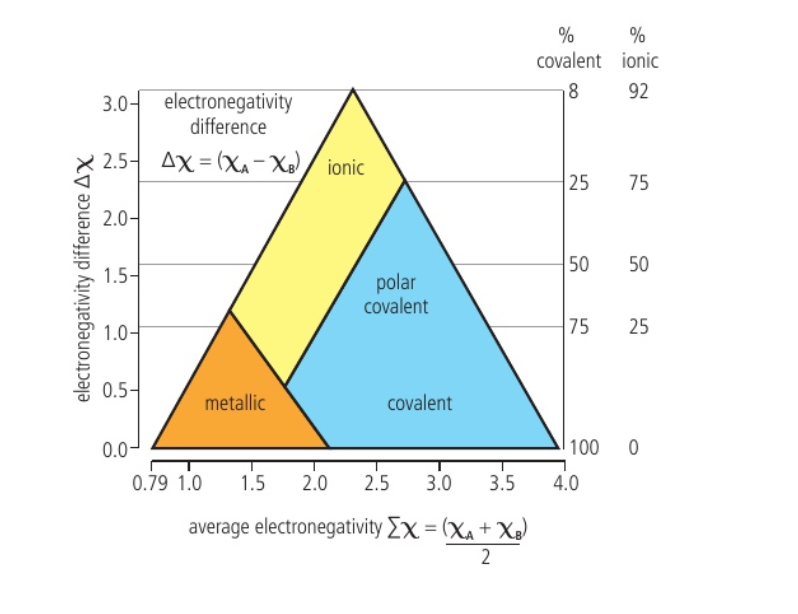
    • Bonding within a substance is best described as a continuum between ionic, covalent, and metallic bondinG
    • This can be visualized through a bonding triangle

    🔍TOK Connect : To what extent do the classification systems we use in the pursuit of knowledge affect the conclusions that we reach?

    • The position of an element or compound in the bonding triangle is determined from its electronegativity values
    • On the Y axis – calculate the difference in electronegativities
    • On the X axis – calculate the average electronegativity
    • Small difference in electronegativity, low average electronegativity – metals
    • Small difference in electronegativity, high avg electronegativity – covalent
    • Large electronegativity difference and mid-average electronegativity – ionic
    • Model of a bonding continuum helps us make more accurate predictions of properties of compounds
    • Limitations
      • Bonding in Cl2 is not more metallic than in F2
      • Does not predict the properties of transition metals and their compounds well

    S2.4.3 Alloys :

    • Mixture of two or more metals/metal and non metals with no particular composition
    • Alloys have enhanced properties compared to common metals
    • Eg. Brass is an alloy of Copper and Zinc
      • Stronger and harder than pure copper or zinc
      • Naval brass has tin which enhances its resistance to corrosion
    • Alloys are produced by adding one metal element to another in its liquid state so the atoms can mix
    • The production of alloys is possible due to the non directional nature of the delocalized electrons and the fact that the lattice can accomodate ions of different sizes
    • Due to the presence of differently sized ions – sliding of layers is prevented, making alloys stronger and more chemically stable than the metals they’re made of

    ⭐️ Alloys have no fixed composition and hence cannot be represented by a chemical formula.

    S2.4.4 Polymers :

    ⭐️ Polymers are long chain molecules formed when monomers join together through covalent bonding.

    • Polymers are also known as macromolecules as they are composed of thousands of atoms
    • Examples of natural polymers include proteins, DNA, starch
    • Examples of synthetic polymers include polyethylene, polypropene
    • Properties of plastics
      • Strength and durability – PVC (polyvinyl chloride), nylon
      • Flexibility – LDPE (low density polyethylene)
      • Lack of reactivity – for storage containers
      • Thermal insulation – low thermal conductivity, high specific heat capacity
      • Electrical insulation
      • Non biodegradable – stay in the environment for long periods of time

    🌍 Real World Connection : Global production of plastics has risen exponentially since 1950. Much of the plastic produced ends up in the ocean where it destructively impacts marine ecosystems. It is estimated by 2030 that approximately 300 million tonnes of plastic could end up in the ocean.

    • Biodegradable plastics may be plant-based eg made of corn
    • Thermoplastics – have only IMF between two chains and hence can be repeatedly cooled and heated
    • Strength of a polymer
      • Length of chain (relative molecular mass)
      • Degree of branching
      • Arrangement of groups
      • longer chains, less branching – stronger as increases strength of LDF
    • Tensile strength – ability to resist a stretching force without breaking
    • Hydrogen bonding increases strength – seen in Kevlar/Nylon
    • Plasticisers increase flexibility

    S4.4.5 Addition Polymers

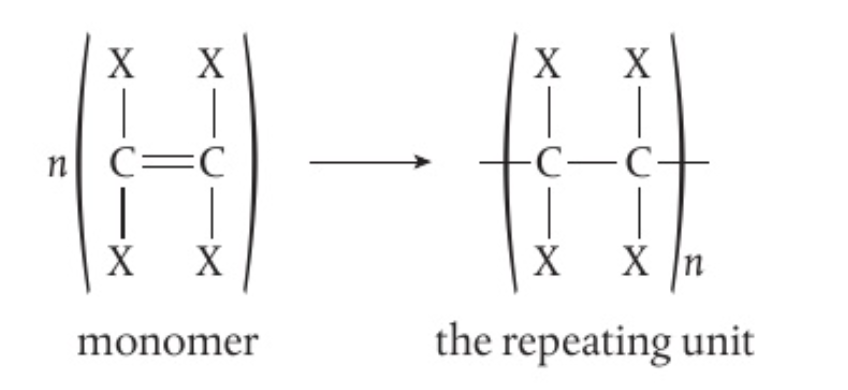
    • Addition polymers form by breaking a double bond in each monomer
    • Alkenes join together to form polymers
      • eg ethene as a monomer forms polyethene
    • Only C=C bond is affected

    🔍 Exam Tip : Remember the polymer is named according to its monomer. Hence the polymer made from ethene monomers is called polyethene, even though the actual components are ethane (since the double bond is broken).

    • Addition polymers do not generate a byproduct so convert 100% of reactants into product

    S4.4.6 Condensation Polymers [HL]

    • Condensation polymers form with a reaction between function groups of different monomers and the release of a small molecule like water
    • In order to form condensation polymers, monomers must have two different functional groups (think of them as ends to react)
    • Polyester
      • Carboxylic acid and alcohol react to form polyester
      • dicarboxylic acid + diol forms polyester (two functional groups)
      • Number of water molecules in one less than the number of monomers produced
      • Ethane-1,2-diol and Benzene-1,4-dicarboxylic acid = PET (Polyethylene terephtalate)

    🔍 Paper 2 Tip : When you draw polymers, make sure to show open bonds on both sides of the bracket surrounding a monomer, so that you can show its ability to extend in both directions. See the image below :

    • Polyamide
      • Carboxylic acid and amide react to form polyamide
      • Polyamides also form when one monomer has an acid group and one has an amino group – amino acids
      • Dicarboxylic acid + diamine = polyamide
      • Used in textile industry – Kevlar, nylon
        • Nylone 6,6 = 1,6-diaminohexane + hexandioic acid
      • Hydrolysis breaks down polymers into monomers
        • Uses water
        • Occurs in presence of acids/alkalis/enzymes

  • 3.9 – Budgets

    💼 UNIT 3.9: BUDGETS

    Understand how businesses plan financially for the future using budgets. Learn to distinguish between cost centres and profit centres, prepare budgets, calculate variances, and use budgetary control as a management tool for decision-making and accountability. Budgets are the financial blueprint for organisational performance.

    📌 Definition Table

    Term Definition
    Budget A detailed plan of estimated revenues and expenditures for a future time period; the financial blueprint the organisation will follow to guide operational and strategic decisions.
    Cost Centre A unit of a business to which costs can be allocated for accounting purposes; evaluated based on how well it minimises costs and stays within budget rather than generating revenue.
    Profit Centre A unit of a business to which both costs and profits can be allocated for accounting purposes; evaluated based on the profit it generates—how much revenue exceeds costs.
    Budget Holder A person or group responsible for formulating budgets and in charge of their achievement; accountable for ensuring actual performance aligns with budgeted targets.
    Variance The difference between budgeted amounts and actual figures; calculated as Actual Figure – Budgeted Figure; used to identify performance deviations and investigate causes.
    Budgetary Control Using budgets as a management tool to control operations, coordinate departments, motivate staff, and ensure the organisation stays on track toward financial goals through active variance management.

    📌 Cost Centres and Profit Centres

    Businesses are divided into different operational units, each responsible for different functions. Understanding the distinction between cost centres and profit centres is essential for budgeting and performance management.

    Cost Centre

    Cost Centre: A unit of a business to which costs can be allocated for accounting purposes. Cost centres are evaluated based on how well they minimise costs and stay within budget—not on generating revenue. Examples of Cost Centres include: HR department (human resources), Finance department (accounting, billing), IT department (technology support), Legal department, Admin/office support. Evaluation Metric: Cost centres are judged by whether they stay within budget and provide value. For example, if the HR department has a budget of £500,000 and spends £480,000, it’s considered efficient. The focus is on cost control, not revenue generation.

    Profit Centre

    Profit Centre: A unit of a business to which both costs and profits can be allocated for accounting purposes. Profit centres are evaluated based on profit they generate—how much revenue exceeds costs. Examples of Profit Centres include: Sales department, Marketing department, Regional offices (if each generates its own revenue), Product divisions, Retail stores. Evaluation Metric: Profit centres are judged by profitability. A regional office with £2 million in sales revenue and £1 million in costs has generated £1 million profit. The focus is on revenue generation relative to costs.

    Purpose of Distinguishing Between Them

    Understanding this distinction helps management see how efficient different business parts are at minimising costs and/or generating profits. Different budgeting and evaluation approaches apply: Cost centre budgets focus on cost control (“Stay within your £500,000 budget”). Profit centre budgets focus on profit targets (“Generate at least £1 million in profit”). This distinction prevents internal conflict. For instance, the sales department (profit centre) shouldn’t be criticised for “high costs” if it’s generating substantial profit. Meanwhile, the IT department (cost centre) should focus on providing good service efficiently within budget.

    🌍 Real-World Connection:

    Major retailers like Tesco or Sainsbury’s organise their operations into cost and profit centres. Store locations operate as profit centres, evaluated on revenue and profit. Head office functions—HR, finance, procurement—operate as cost centres, evaluated on efficiency and cost control. This distinction directly impacts how bonuses are structured: store managers receive bonuses for profitability, whilst HR managers receive bonuses for staying within budget and maintaining low hiring costs. Understanding these distinctions helps explain why different departments have different incentives and priorities.

    💼 IA Spotlight:

    For your Internal Assessment, consider investigating: “To what extent does the current budget structure in [Organisation] appropriately reflect the distinction between cost and profit centres?” Analyse actual budget allocations, evaluate profit centre performance metrics, assess whether cost centres are receiving adequate resources despite budget constraints, and survey managers about alignment between their centre type and evaluation criteria. This demonstrates understanding of how budget structure drives organisational behaviour and decision-making.

    📌 What is a Budget?

    Budget: A detailed plan of estimated revenues and expenditures for a future time period. A budget is the financial blueprint the organisation will follow. Budget Holder: A person/group responsible for formulating budget(s) and are in charge of their achievement. Types of Budgets: Master budgets (overall company), marketing budgets (marketing department), sales budgets (sales targets), staff budgets (payroll), production budgets (manufacturing), etc.

    Purpose of Budgets

    Planning and Forward Planning: Forces management to think ahead about what resources are needed and what results are expected. Prevents reactive management. Control: Provides targets. If actual results differ from budget, management investigates why and takes corrective action. Coordination and Communication: Different departments coordinate budgets so they work together. Sales forecasts drive production budgets, which drive inventory and purchasing budgets. Motivation: Budgets motivate employees. If the sales team has a £2 million sales target, they work harder to achieve it. Rewards/bonuses often tied to budget achievement. Necessary exercise: Budgetary control requires budgets to be independent. Budget holders should forecast ahead, not just accept someone else’s numbers.

    🔍 TOK Perspective:

    Budgets rely on forecasting future events based on historical data and assumptions. But how certain can we be that past trends will continue? What counts as reliable knowledge for forecasting? A company budgeting for next year’s sales assumes similar market conditions, customer behaviour, and competitive dynamics. Yet unexpected events—economic recession, new competitor entry, technological disruption—can make budgets obsolete. How do we distinguish between reasonable forecasts and overconfident predictions? This raises questions about the nature of certainty in social sciences and the limitations of quantitative methods in capturing qualitative, unpredictable human and market behaviour.

    📌 Preparing a Budget

    Budget preparation is straightforward: estimate future revenue and expenditures for the period.

    Simple Budget Structure

    Income/Revenue: Estimate expected revenues. Sales revenue (based on sales forecasts), Interest earned, Rental income, Total Income.

    Expenditures/Costs: Estimate expected costs. Salaries and wages, Materials/inventory, Rent, Advertising, Other operational costs, Total Expenditures.

    Net Income: Total Income – Total Expenditures.

    Example: A retail shop forecasts: Sales Revenue: £500,000; Interest earned: £10,000; Total Income: £510,000. Salaries & wages: £150,000; Cost of goods: £200,000; Rent: £40,000; Advertising: £15,000; Other expenses: £20,000; Total Expenditures: £425,000. Net Income (Profit): £510,000 – £425,000 = £85,000

    Process for Creating Budgets

    1. Start with sales forecasts: Estimate expected sales revenue based on market research, past trends, and plans. Everything else flows from this. 2. Estimate costs for each department: Each cost centre/profit centre estimates costs needed to achieve its goals. HR forecasts recruitment and payroll. Production forecasts materials and manufacturing costs. Marketing forecasts advertising spending. 3. Consolidate into master budget: Combine all departmental budgets into a company-wide budget. 4. Review and adjust: Senior management reviews the consolidated budget. If total costs exceed revenue projections, departments may need to trim budgets. Budgets are adjusted until they make financial sense. 5. Communicate and implement: Final budgets are communicated to departments. Budget holders are responsible for achieving their targets.

    ❤️ CAS Link:

    Apply budgeting skills to a real-world project. If your school or community organisation is planning an event, fundraiser, or initiative, volunteer to develop its budget. Work through the five-step budget process: forecast revenues (ticket sales, sponsorships), estimate costs (venue, materials, staffing), consolidate into a master budget, adjust based on constraints, and communicate the budget to the team. Track actual spending against your budget, calculate variances, and document lessons learned. This CAS activity demonstrates practical application of budgeting concepts and develops financial planning skills valuable beyond the classroom.

    📌 Budget Variance Analysis

    Once the period ends, actual results are compared to budgeted amounts. The difference between budget and actual is called a variance.

    Formula

    Variance = Actual Figure – Budgeted Figure

    Or as a percentage: Variance (%) = (Actual – Budget) ÷ Budget × 100

    Example: A company budgeted £500,000 in sales but actually achieved £520,000. Variance = £520,000 – £500,000 = £20,000 (positive/favourable). Variance (%) = (£20,000 ÷ £500,000) × 100 = 4% favourable.

    Another example: Budgeted costs of £100,000 but actually spent £105,000. Variance = £105,000 – £100,000 = £5,000 (negative/unfavourable). Variance (%) = (£5,000 ÷ £100,000) × 100 = 5% unfavourable

    Interpreting Variances

    For Revenue: Favourable variance (Actual > Budget): Actual revenue exceeded budget. Sales performed better than expected. Good news. Unfavourable variance (Actual < Budget): Actual revenue fell short of budget. Sales underperformed. Requires investigation.

    For Costs: Favourable variance (Actual Budget): Actual costs exceeded budget. Spent more than forecast. Requires investigation.

    Discrepancy between actual and budgeted outcome: Expressed as % or £. Example: “Sales were 4% favourable” or “Costs were 5% unfavourable.”

    🧠 Examiner Tip:

    In exam questions, don’t just calculate variance—interpret it meaningfully. A 5% unfavourable variance in labour costs might indicate understaffing, overtime, wage increases, or recruitment problems. A 10% favourable revenue variance might reflect market opportunity, good marketing, or competitor weakness. Strong answers investigate causes, not just report numbers. Also, remember that variances should be acted upon—static budgets that are never adjusted when conditions change are useless.

    Example Budget with Variance Analysis

    Using the retail shop example: BUDGET vs ACTUAL for the period: Sales Revenue: Budget £500,000, Actual £520,000, Variance £20,000 [4% F]; Interest Earned: Budget £10,000, Actual £5,000, Variance -£5,000 [5% U]; Total Income: Budget £510,000, Actual £525,000, Variance £15,000 [3% F].

    Salaries & Wages: Budget £150,000, Actual £180,000, Variance -£30,000 [20% U]; Cost of Goods: Budget £200,000, Actual £190,000, Variance £10,000 [5% F]; Rent: Budget £40,000, Actual £40,000, Variance £0 [0%]; Advertising: Budget £15,000, Actual £20,000, Variance -£5,000 [33% U]; Other Expenses: Budget £20,000, Actual £24,000, Variance -£4,000 [20% U]; Total Expenditures: Budget £425,000, Actual £454,000, Variance -£29,000 [7% U].

    Net Income: Budget £85,000, Actual £71,000, Variance -£14,000 [16% U].

    Analysis: Sales exceeded budget (good), but costs were significantly higher (problematic). Salaries were 20% over budget, suggesting either overtime, hire of temporary staff, or recruitment shortfalls. Advertising was also 33% over. The 16% unfavourable variance in net income suggests cost control problems despite revenue success.

    💼 IA Spotlight:

    For your IA, investigate: “To what extent can variance analysis explain [Organisation]’s financial performance relative to budget?” Collect actual budget vs. actual data for several months, calculate variances, identify significant deviations (typically > 5%), and investigate causes. Interview managers about why variances occurred, what corrective actions were taken, and whether the budget was revised. Analyse whether significant variances were acted upon or ignored. This demonstrates critical thinking about the limitations and applications of budgetary control in real organisations.

    📌 Budgetary Control and Decision-Making

    Budgetary Control: Using budgets as a management tool to control operations, coordinate different departments, motivate staff, and ensure the organisation stays on track toward financial goals. It’s about actively managing variance and taking corrective action.

    Advantages of Budgets and Budgetary Control

    • Control: Budgets set targets. Variances reveal whether operations are on track or need correction.
    • Coordination: Different departments coordinate budgets. Sales, production, and HR budgets work together seamlessly.
    • Motivation: Budget targets motivate staff. Achievements (beating sales targets) may result in bonuses.
    • Necessary exercise: Requires all departments to plan. Budget holders think critically about needs and goals.
    • Decision-making and planning: Budgets guide resource allocation and long-term planning.

    Disadvantages and Limitations

    • Stress: Budgets can stress employees. Missing budget targets may result in criticism or lost bonuses. Staff may feel pressured.
    • Qualitative factors ignored: Budgets focus on financial numbers; qualitative benefits (customer satisfaction, employee morale, brand development) are overlooked.
    • Interdependence and coordination at risk: If departments compete to meet own budgets, they may not cooperate with each other. “Sales will sell at any price to hit targets” conflicts with “Production wants high volumes for efficiency.”
    • Not always flexible (internal conflict): When unexpected events occur (recession, supply disruption), budgets become unrealistic. Staff may feel forced to follow unrealistic budgets, creating conflicts.
    • Not always flexible (problems excluded): Some problems can’t be foreseen and therefore aren’t in the budget. Unexpected equipment failure, new regulations, sudden competition.

    Budgetary Control Process

    Step 1: Set Budget – Departments forecast costs and revenue, budgets are approved. Step 2: Implement – Operations proceed according to budget. Step 3: Monitor – Track actual results against budget regularly (monthly, quarterly). Step 4: Analyse Variance – Calculate variance and investigate significant differences. Step 5: Corrective Action – If variance is unfavourable: Reduce costs in over-budget areas, Increase sales in under-revenue areas, Revise budget if situation has fundamentally changed, Investigate root causes and prevent recurrence. Step 6: Review and Learn – Use variance data to improve next period’s budget

    🧠 Examiner Tip:

    In exam questions, distinguish between cost centres and profit centres when discussing budget purposes. When asked to comment on variance, don’t just calculate it—interpret it. A 5% unfavourable variance in labour costs might indicate understaffing, overtime, wage increases, or recruitment problems. A 10% favourable revenue variance might reflect market opportunity, good marketing, or competitor weakness. Strong answers investigate causes, not just report numbers. Also, remember that budgetary control requires continuous monitoring and action—static budgets are useless.

    🌍 Real-World Connection:

    During the COVID-19 pandemic, budgetary control proved both essential and challenging. Organisations that had rigid, non-flexible budgets faced serious problems—budgets based on pre-pandemic revenue projections became worthless as lockdowns disrupted sales. However, organisations with sophisticated budgetary control systems could quickly revise forecasts, reallocate resources, and adjust targets. This real-world crisis demonstrated that budgetary control’s greatest strength—providing financial discipline—can become a weakness if budgets aren’t adapted to changed circumstances. The most successful organisations maintained budgetary frameworks whilst showing flexibility in specific targets, demonstrating that budgetary control isn’t about blindly following numbers but using them to guide adaptive decision-making.

    📌 Key Takeaways and Application to Exam Questions

    Unit 3.9 on Budgets provides essential tools for financial management and control. The key concepts you must master are:

    Cost vs Profit Centres: Be able to identify which organisational units are cost centres versus profit centres, and explain why this distinction matters for evaluation and motivation. Recognise that the same efficiency metric (cost reduction) might be praised in cost centres but insufficient in profit centres if it harms revenue generation.

    Budget Preparation Process: Understand the five-step process from sales forecasting through implementation. Recognise that budget holders must forecast independently rather than just accepting imposed budgets. Weak budgets that don’t reflect realistic operational needs become demotivating rather than motivating.

    Variance Analysis and Interpretation: Practice calculating variances and—more importantly—interpreting them meaningfully. What does a 5% unfavourable variance actually tell us? What investigations should follow? Distinguish between variances that indicate problems requiring corrective action and those reflecting changed circumstances requiring budget revision.

    Budgetary Control as Management Tool: Recognise that effective budgetary control requires balancing discipline with flexibility. Budgets that are never adjusted become obstacles; budgets that change constantly provide no control. The skill lies in knowing when to enforce budget discipline and when to adapt budgets to new realities.

    Advantages and Limitations: When analysing budgeting scenarios, consider both benefits and drawbacks. Budgets motivate but can stress; they provide control but risk causing interdepartmental conflict; they guide planning but may create inflexibility. Sophisticated analysis acknowledges these tensions rather than presenting budgets as uniformly positive or negative.

    📝 Paper 2:

    Paper 2 questions on Unit 3.9 typically test understanding of budgeting. Data-response questions often present case studies involving specific organisations evaluating capital projects. You may be asked to calculate and interpret variances, compare different budgeting approaches, evaluate strategies for improving budgetary control, or analyse budget scenarios. Command words like “analyse,” “evaluate,” and “recommend” require connecting theory to real business scenarios with specific calculations and evidence. Always show your workings and explain what figures reveal about organisational financial management.

  • 3.8 – Investment Appraisal

    💼 UNIT 3.8: INVESTMENT APPRAISAL

    Understand how businesses evaluate whether capital investments are worthwhile. Learn three quantitative techniques—Payback Period, Average Rate of Return, and Net Present Value—that help decision-makers compare investment opportunities and determine which projects to fund.

    📌 Definition Table

    Term Definition
    Investment (in IB) Purchase of an asset that (potentially) will generate future earnings; a capital expenditure (non-current asset) intended to produce future returns.
    Investment Appraisal A quantitative technique used to evaluate the pros and cons of investment opportunities; helps businesses decide whether to commit capital to a project.
    Payback Period (PBP) Time required for an investment to recover its initial cost in terms of profit; measured in years and months.
    Average Rate of Return (ARR) Average profit on investment expressed as a percentage of the initial investment capital costs; shows annual average return.
    Net Present Value (NPV) Difference between present values of future cash flows and original cost of investment; accounts for the time value of money.
    Time Value of Money The principle that money received today is worth more than money received in the future because it can be invested to earn returns.

    📌 Investment Appraisal: Evaluating Capital Projects

    Investment in IB: Purchase of an asset that (potentially) will generate future earnings. Investments are capital expenditures (non-current assets) intended to produce future returns.

    Investment Appraisal: A quantitative technique used to evaluate the pros and cons of investment opportunities. Before committing large amounts of capital to a project (factory expansion, new product launch, technology upgrade), businesses must evaluate whether the investment is worthwhile.

    Unit 3.8 covers three appraisal techniques, each with different strengths and weaknesses. The key principle: Use ALL THREE TOOLS. No single tool tells the complete story.

    🌍 Real-World Connection:

    When companies like Apple decide to invest £1 billion in a new manufacturing facility or research and development centre, they use investment appraisal techniques to justify the expenditure to shareholders. The techniques help answer critical questions: How quickly will we recover this investment? What’s the average annual return? What’s the net value created after accounting for the time value of money? These aren’t abstract calculations—they directly influence real capital allocation decisions affecting thousands of jobs and shareholder returns.

    📌 Payback Period (PBP)

    Payback Period = Time required for an investment to recover its initial cost principal in terms of profit. It measures how long it takes for cash inflows from the investment to pay back the original investment amount.

    📌 Formula and Calculation

    For Simple Payback (annual cash flows in equal amounts): PBP = Initial Investment Cost ÷ Annual Cash Flow

    For Complex Payback (cash flows vary by year): PBP = Years + (Additional CF Needed ÷ Annual CF in Next Year) × 12 months

    Example: Pizza oven costs £5,000. Expected cash inflows: Year 1: £3,000; Year 2: £1,500; Year 3: £1,500; Year 4: £1,000.
    Cumulative cash flow: Year 1: £3,000; Year 2: £4,500; Year 3: £6,000. The investment is recovered in Year 3. After Year 2, £500 more is needed. Year 3 cash flow is £1,500. PBP = 2 years + (£500 ÷ £1,500) × 12 months = 2 years + 4 months

    📌 Interpretation

    Shorter payback period = Better. The investment recovers its cost quickly, reducing risk. A 2-year payback is preferable to a 5-year payback.

    If an asset becomes obsolete before PBP is reached, it’s not worth pursuing. For example, if the pizza oven becomes technologically outdated in 2 years but payback period is 3 years, the investment will never break even.

    📌 Evaluation: Advantages and Disadvantages

    • Simple, easy, quick: Straightforward to calculate and understand. No complex formulas.
    • Helpful for industries where assets quickly become outdated: For tech, fashion, rapidly changing industries, payback period is relevant.
    • Quick way to check viability: Can quickly rule out obviously bad investments.
    • Doesn’t measure overall profitability: An investment with PBP of 2 years might generate losses after payback.
    • Ignores cash flow timing: Doesn’t distinguish between cash received in year 1 vs. year 5 (money received earlier is more valuable).

    💼 IA Spotlight:

    For your Internal Assessment, consider researching: “To what extent do investment appraisal techniques support effective capital allocation decisions in [Organisation]?” Analyse actual investment projects, calculate their PBP, ARR, and NPV using financial data from company reports, and investigate whether management actually used these techniques in their decision-making. Interview managers about which technique they prioritise and why.

    📌 Average Rate of Return (ARR)

    Average Rate of Return = Average profit on investment expressed as a % of the initial investment capital costs. It measures the annual average profit percentage the investment generates.

    📌 Formula and Calculation

    ARR = (Total Returns – Capital Costs) ÷ Years of Use ÷ Capital Costs × 100

    Or simplified: ARR = Average Annual Profit ÷ Capital Costs × 100

    Example: Pizza oven costs £5,000. Expected cash flows over 5 years: £3,000, £2,500, £2,000, £1,500, £1,000. Total Returns = £10,000. Average Annual Profit = (£10,000 – £5,000) ÷ 5 = £1,000. ARR = £1,000 ÷ £5,000 × 100 = 20%

    📌 Interpretation and Decision Rule

    Compare ARR to Criterion Rate: The criterion rate is the interest rate available (benchmark for investment). If bank offers 6% return on deposits, criterion rate = 6%.

    Decision Rule: If ARR > Criterion Rate, the investment is worthwhile. If ARR < Criterion Rate, don't invest (use the money elsewhere at higher return).

    Using the example: ARR = 20%. If criterion rate = 6%, the investment is worthwhile (20% > 6%). If criterion rate = 25%, the investment is not worthwhile (20% < 25%).

    📌 Evaluation: Advantages and Disadvantages

    • Simple, easy, quick: Straightforward calculation and interpretation.
    • Goes further in time than PBP: Accounts for profitability over the entire lifespan, not just recovery time.
    • Useful for comparing opportunities: Can rank multiple projects by ARR.
    • Ignores timing of returns: Doesn’t distinguish between profits in year 1 vs. year 5. Money received earlier is worth more (time value of money).
    • Too simplistic to be only tool: Should be combined with other methods.

    🔍 TOK Perspective:

    Investment appraisal techniques rest on significant assumptions. How do we know future cash flows will match predictions? We rely on market research, historical trends, and forecasting models—all subject to uncertainty and bias. ARR assumes profitability will be consistent across years. NPV assumes a constant discount rate, yet interest rates fluctuate. What counts as reliable knowledge for predicting the future? These techniques treat business as predictable and quantifiable, yet real markets are influenced by unpredictable events (pandemics, geopolitical disruptions, technological breakthroughs).

    📌 Net Present Value (NPV)

    Net Present Value = Difference between present values of future cash flows and original cost of investment principal. It’s the most sophisticated appraisal method, accounting for the time value of money—the principle that money received today is worth more than money received in the future.

    📌 Time Value of Money Concept

    Cash is losing value over time. Why? Because money can be invested. If you receive £100 today, you can invest it at (say) 5% interest, having £105 in one year. So £100 today = £105 in one year (at 5% discount rate).

    Conversely, £100 in one year = £95.24 today (at 5% discount rate). Future cash must be “discounted” to present value.

    Formula: Present Value = Future Cash Flow ÷ (1 + Discount Rate)^Years. Or: PV = Future Cash × Discount Factor (found in discount tables)

    📌 NPV Calculation Steps

    Step 1: Find the discount factor for each year using discount tables (provided in exam).

    Step 2: Multiply each year’s cash flow by its discount factor to get present value.

    Step 3: Sum all present values to get total PV.

    Step 4: Subtract the initial investment from total PV.

    Formula: NPV = Sum of Present Values – Original Cost

    Example: Pizza oven costs £5,000. Expected returns at 6% discount rate: Year 1: £3,000 × 0.9434 = £2,830.20; Year 2: £2,500 × 0.8900 = £2,225.00; Year 3: £2,000 × 0.8396 = £1,679.20; Year 4: £1,500 × 0.7921 = £1,188.15; Year 5: £1,000 × 0.7473 = £747.30
    Total PV = £8,669.85. NPV = £8,669.85 – £5,000 = £3,669.85

    📌 Interpretation and Decision Rule

    If NPV > 0 (positive): The investment is worthwhile. The present value of future returns exceeds the initial investment. The business should proceed.

    If NPV < 0 (negative): The investment is not worthwhile. The present value of future returns is less than the initial investment. Don’t invest.

    If NPV = 0: The investment breaks even. Indifferent; could go either way.

    If comparing multiple projects: Choose the project with the highest (most positive) NPV.

    Using the example: NPV = £3,669.85 (positive), so the investment is worthwhile. The oven generates £3,669.85 in net value (in today’s money) above its cost.

    📌 Evaluation: Advantages and Disadvantages

    • Includes both time and cash value: Accounts for when cash is received (money today is worth more than money tomorrow).
    • Flexible: Discount factor can be adjusted based on economic conditions.
    • Widely used technique: Considered the most sophisticated, takes account of multiple factors.
    • Gives absolute value: Shows in pounds how much value the investment creates, not just a percentage.
    • Relatively difficult to calculate: More complex than PBP or ARR. Requires discount tables.
    • The discount rate is highly unlikely to remain unchanged: Assumes it’s constant over the project lifespan.

    ❤️ CAS Link:

    Create a financial literacy workshop for your school community on investment appraisal concepts. Develop simplified explanations and practical examples showing how individuals might use PBP, ARR, and NPV when making personal investment decisions (university education ROI, home renovations, starting a business). Create interactive tools or calculators that help non-financial audiences understand why investment timing and present value matter. This service activity builds your expertise whilst addressing financial education gaps in your community.

    📌 Comparing the Three Appraisal Methods

    Aspect Payback Period Average Rate of Return Net Present Value
    Unit of Measurement Time (years, months) Percentage (%) Pounds (£)
    Complexity Simple Simple Complex
    What It Shows Risk (speed to recover investment) Average profitability over time Absolute value created (accounting for time)
    Accounts for Time Value of Money? No No Yes
    Best For Industries with rapid obsolescence Comparing overall profitability Rigorous financial analysis

    🧠 Examiner Tip:

    The critical instruction: USE ALL THREE TOOLS! Each tool reveals different aspects. PBP shows risk (how quickly you recover initial investment). ARR shows average profitability over time. NPV shows absolute value created accounting for time value of money. A project might have quick PBP (low risk) but low ARR (not very profitable). Another might have low PBP (risky) but high NPV (valuable). Strong exam answers use all three to evaluate investments comprehensively.

    📌 Scenario Example: Comparing Two Investment Options

    Imagine you’re deciding between two restaurant projects (criterion rate = 8%):

    Project A (Quick Service): Payback = 1.5 years, ARR = 15%, NPV = £8,000. Analysis: Fast recovery (low risk), solid profitability, good value creation. Excellent choice.

    Project B (Fine Dining): Payback = 4 years, ARR = 9%, NPV = £25,000. Analysis: Slower recovery (higher risk), barely exceeds criterion rate, but creates substantial long-term value. Worth considering if you can afford the 4-year wait.

    A one-dimensional analysis fails both projects. PBP alone would favour Project A. ARR alone slightly favours Project A (15% > 9%). NPV alone strongly favours Project B (£25,000 > £8,000). The integrated analysis reveals: Project A is lower-risk but lower-reward; Project B requires patience but delivers superior value. The choice depends on organisational risk tolerance and time horizon.

    📌 Key Takeaways and Application to Exam Questions

    Unit 3.8 on Investment Appraisal provides tools for making capital allocation decisions. Key concepts to master:

    Understanding the Three Methods: Know how to calculate PBP, ARR, and NPV, and more importantly, understand what each reveals. PBP is about risk and speed. ARR is about average returns. NPV is about total value creation adjusted for time.

    Strengths and Weaknesses: Each method has limitations. No single technique is perfect. PBP ignores profitability after payback. ARR ignores the timing of cash flows. NPV is complex and assumes stable discount rates. Sophisticated analysis acknowledges these trade-offs.

    Time Value of Money: Grasp the concept that money today is worth more than money tomorrow. This is why NPV discounts future cash flows. Understanding this principle distinguishes basic from advanced economic thinking.

    Decision-Making Integration: In real exam questions, don’t just calculate metrics—use them to make decisions. Compare projects using all three methods. Identify conflicts (what if different methods suggest different decisions?) and explain how you’d resolve them considering organisational context.

    Beyond the Numbers: Remember that investment appraisal techniques are quantitative tools in a broader decision context. Qualitative factors matter too: strategic fit, market positioning, employee retention, environmental impact, and risk tolerance. Strong analysis mentions this explicitly rather than implying that numbers alone determine decisions.

    📝 Paper 2:

    Paper 2 questions on Unit 3.8 typically test understanding of investment appraisal. Data-response questions often present case studies involving specific organisations evaluating capital projects. You may be asked to calculate PBP, ARR, and NPV, interpret results, compare different investment proposals, or evaluate strategies for improving capital efficiency. Command words like “analyse,” “evaluate,” and “recommend” require connecting theory to real business scenarios with specific calculations and evidence. Always show your workings and explain what figures reveal about investment quality.

  • 3.7 – Cash Flow

    💼 UNIT 3.7: CASH FLOW

    Understand the critical difference between profit and cash flow, and why a profitable business can still fail due to cash shortages. Learn to prepare and interpret cash flow forecasts to predict liquidity problems and plan accordingly. Cash flow management is essential for business survival.

    📌 Definition Table

    Term Definition
    Cash The most liquid asset (a current asset); physical money in bank accounts and cash registers available immediately for business use.
    Cash Flow Movement of money in and out of the business during a period; the difference between cash inflows (money coming in) and cash outflows (money going out).
    Profit Positive difference between revenue and costs; shown in the Profit & Loss account; does not equal cash movement.
    Liquidity Ability of a business to pay short-term obligations; measured using ratios like Current Ratio and Acid Test Ratio.
    Working Capital Current assets minus current liabilities; the capital available for day-to-day operations; directly affected by cash flow.
    Cash Flow Forecast Forward-looking document predicting movement of cash in and out over future periods; essential planning tool for avoiding cash crises.

    📌 Understanding the Difference: Profit vs. Cash Flow

    One of the most critical concepts in business finance: Profit and Cash Flow are NOT the same. A business can be very profitable but have negative cash flow, or unprofitable but have positive cash flow. Understanding this distinction is crucial to understanding why businesses fail.

    📌 Why Profit ≠ Cash Flow

    1. Credit Sales (Trade Credit): Revenue is recognised when a sale is made, but cash is received later. If a business makes £100,000 in sales in January but customers don’t pay until March, profit is £100,000 in January (P&L), but cash isn’t received until March (cash flow). Meanwhile, the business must pay wages and suppliers in January—creating a cash problem despite profitability.

    2. Capital Expenditure (Depreciation vs. Payment): Buying equipment costs cash upfront, but the cost is spread over years as depreciation. A £100,000 equipment purchase reduces cash by £100,000 immediately, but only reduces profit by perhaps £20,000 (depreciation) in year one. The business might be profitable but have negative cash flow due to the capital investment.

    3. Stock/Inventory Buildup: If a business buys inventory to prepare for future sales, it pays cash immediately, but revenue isn’t recognised until goods are sold. Inventory buildup reduces cash flow without affecting profit yet.

    4. Loan Repayments: Loan repayments are cash outflows but don’t reduce profit (only interest reduces profit, not the principal). A business can have positive profit but negative cash flow if loan repayments are large.

    📌 Why Cash Flow Matters More Than Profit Short-Term

    “Cash is King.” A business might be profitable on paper but fail if it runs out of cash. Why? Because cash pays bills. A profitable business with no cash in the bank can’t pay employee wages (cash), can’t pay suppliers (cash), can’t pay interest on loans (cash). Insolvency occurs when cash runs out, regardless of profitability.

    Example: A growing retail business is very profitable (15% profit margin). It’s expanding rapidly, buying inventory and opening new stores. It buys £2 million in equipment and inventory but only has £500,000 in cash. Suppliers are paid in 30 days. Customers pay in 60 days. The business runs out of cash in month two despite being profitable. Without a cash injection or credit facility, it fails. This is why businesses need both profitability AND positive cash flow.

    🌍 Real-World Connection:

    A software startup makes £500,000 in annual profit (very profitable). But the founder paid £1 million in capital expenditure (office, equipment, software development). The business has £500,000 profit but -£500,000 cash flow. Meanwhile, staff salaries are £2,000/month (cash outflow). Within months, the business runs out of cash and collapses despite profitability. This scenario repeats across fast-growing startups: growth requires working capital management. Fast-growing businesses often fail due to insufficient cash reserves, despite being profitable on paper. This is why investors scrutinise both profit margins AND cash flow when evaluating businesses.

    💼 IA Spotlight:

    For your Internal Assessment, investigate: “To what extent does profit accurately predict the cash position of [Organisation]?” Analyse financial statements to extract profit data and cash flow data across several years. Compare trends: Are they moving together or diverging? Calculate the correlation. Identify specific factors causing differences (inventory levels, capital expenditures, changes in receivables/payables). Interview finance managers about how they manage the profit-cash flow disconnect.

    📌 The Relationship Between Investment, Profit, and Cash Flow

    Understanding how investment, profit, and cash flow interconnect helps explain why these three can move in different directions. A simplified relationship:

    Cash Flow = Profit + Depreciation (non-cash expense) – Investment (capital expenditure) – Changes in Working Capital

    In other words:
    Profit is the starting point (revenue minus operating costs)
    Add back Depreciation (it’s a profit cost but not a cash cost)
    Subtract Investment (capital purchases are cash costs but not profit costs)
    Account for Working Capital (changes in debtors, creditors, inventory)

    This explains why:
    High profit + High investment = Negative cash flow (growing businesses)
    Low profit + Low investment = Positive cash flow (mature businesses)

    🔍 TOK Perspective:

    Profit and cash flow both claim to measure business performance, yet they reveal different truths. Which is more “true”? Profit shows economic value creation—the ultimate objective of business. Cash flow shows liquidity—the immediate capacity to survive. A profitable company with negative cash flow is creating value but facing existential risk. What counts as reliable knowledge about business health? Is profitability the “real” measure or is cash flow more honest? Different stakeholders prioritise differently: shareholders care about profit; creditors care about cash flow. Whose perspective represents business “truth”? Different measurement systems lead to different conclusions about the same business.

    📌 Cash Flow Forecast

    A Cash Flow Forecast is a document that shows predicted movement of cash in and out of the business per time period. It’s forward-looking, predicting future cash, unlike a Cash Flow Statement which is backward-looking, showing past cash movement.

    📌 Purpose and Structure

    Planning and Anticipation: Forecast predicts future cash position, allowing the business to plan. If the forecast shows cash running out in month three, management can arrange overdraft, delay investments, or increase sales.

    Reflection and Comparison: Compare forecast to actual results. If actual cash flow is better than forecast, great. If worse, investigate why and adjust future forecasts and decisions.

    📌 Components of a Cash Flow Forecast

    Opening Balance: Amount of cash at start of period.

    Cash Inflows: Sales revenue, debtors payments, loans received, interest received, sale of assets, rental income.

    Cash Outflows: Rent and premises costs, wages and salaries, purchase of stock, tax payments, creditors payments, advertising, dividends, loan repayments, capital expenditure.

    Net Cash Flow: Difference between inflows and outflows. Should be positive (more cash in than out).

    Closing Balance: Opening Balance + Net Cash Flow. Cash position at end of period.

    📌 Advantages and Disadvantages

    • Easy to prepare and calculate: Uses straightforward addition and subtraction. Much simpler than complex accounting.
    • Identifies problems early: Reveals months with negative cash flow, giving time to arrange financing or adjust plans.
    • Planning tool: Essential for startups and growing businesses managing working capital.
    • Based on predictions: Forecasts are estimates, not certainties. If predictions are wrong, the forecast is useless.
    • Timing assumptions critical: When exactly does cash come in/go out? A day’s difference can matter in tight situations.

    ❤️ CAS Link:

    Create a practical cash management workshop for entrepreneurs or small business owners in your community. Teach how to prepare cash flow forecasts using realistic business examples. Provide templates and tools for calculating cash inflows/outflows. Explain how to interpret forecasts and identify potential cash crises. Invite local business owners to share their cash flow challenges. This service activity develops your expertise whilst providing practical financial literacy.

    📌 Liquidity vs. Cash Flow: Important Distinctions

    Liquidity and Cash Flow are related but different concepts.

    Liquidity (Current Ratio, Acid Test): Measured using ratios. Examines the entity’s ability to pay for its current liabilities. Measured at a point in time (the balance sheet date). Shows the position at year-end.

    Cash Flow: NOT a ratio. Shows the movement of cash in and out during a period (monthly, quarterly, annual). Forward-looking (forecast) or backward-looking (statement).

    Liquidity is backward-looking: Shows the entity’s financial position at a point in time. Tells you whether the entity has sufficient current assets to cover current liabilities.

    Cash Flow is dynamic: Shows monthly movement of cash. Cash flow forecast the future, while liquidity ratio is for the past. Cash flow shows specifically cash movement; liquidity shows ability to pay using any current assets (cash, debtors, stock).

    Relationship: Cash flow is related to working capital. Positive cash flow improves liquidity. Negative cash flow worsens it.

    📌 Strategies for Dealing with Cash Flow Problems

    When a cash flow forecast shows negative cash (cash running out), the business must act. There are two basic strategies: increase cash inflows or decrease cash outflows. Or both.

    📌 Strategy 1: Increase Cash Inflow

    • Shorten Credit Period: Ask customers to pay faster. Instead of 60-day terms, require 30-day payment. Accelerates cash collection. BUT might lose some customers who prefer longer terms.
    • Debt Factoring: A factoring company purchases outstanding invoices at a discount and pays you immediately. You improve cash flow immediately. Note: This costs money.
    • Overdraft: Borrow from the bank to cover cash shortfall. Provides liquidity when cash is tight. BUT overdraft interest is expensive. Only suitable for temporary cash gaps.
    • Sale-and-Leaseback: Sell equipment or property and immediately lease it back. Converts a non-current asset to cash. Improves cash position immediately but creates long-term lease obligations.

    📌 Strategy 2: Decrease Cash Outflow

    • Prolong Credit Period: Ask suppliers for longer payment terms. Instead of 30 days, negotiate 60 days. Keeps cash in the business longer. BUT damages supplier relationships if done excessively.
    • Find Cheaper Suppliers: Reduce inventory costs by finding cheaper suppliers. Lower purchase prices = lower cash outflow. BUT might get lower quality, damaging product quality and customer satisfaction.
    • Reduce Expenses: Cut advertising, reduce perks, reduce overheads (rent, utilities). Lowers cash outflow immediately. BUT might reduce sales and employee morale.
    • Postpone Purchase of Non-Current Assets: Delay equipment, property, or vehicle purchases. Saves large cash outflows. BUT might harm long-term productivity if essential equipment isn’t replaced.
    • Hire Purchase: Instead of buying equipment outright, use hire purchase. Spreads the cost over many months. Improves monthly cash flow. BUT total cost is higher due to interest.
    • Improve Stock Control: Reduce inventory holdings. Lower inventory = less cash tied up in stock. BUT if inventory runs too low, can’t fulfil customer orders.

    🧠 Examiner Tip:

    In exam questions about cash flow problems, remember that solutions have trade-offs. Shortening credit periods improves cash flow but risks losing customers. Factoring improves cash immediately but costs fees. Reducing expenses saves cash but might hurt competitiveness. Strong answers balance short-term cash improvement with long-term consequences.

    📌 Key Takeaways and Application to Exam Questions

    Unit 3.7 on Cash Flow provides essential understanding for business survival and financial planning. Key concepts to master:

    Profit ≠ Cash Flow: This is the fundamental principle. A profitable business can fail; an unprofitable business can survive if it has cash. Understand the mechanisms causing divergence: credit sales timing, capital expenditure patterns, inventory changes, loan repayments. When analysing a business, never assume profitability guarantees survival.

    Cash Flow Forecasting: Know how to prepare a forecast showing opening balance, cash inflows, cash outflows, net cash flow, and closing balance. Understand that forecasts are predictions based on assumptions. The usefulness of a forecast depends on forecast accuracy. Unrealistic assumptions = useless forecast.

    Problem-Solving Mindset: When a forecast shows negative cash flow, think systematically. Increase inflows (shorter credit terms, factoring, borrowing, asset sales) or decrease outflows (longer supplier terms, cheaper suppliers, reduced expenses, delayed investments, hire purchase, inventory reduction). Each solution has benefits and drawbacks—evaluate them in context.

    Liquidity vs Cash Flow Distinction: Liquidity ratios measure ability to pay at a point in time. Cash flow measures movement during a period. They’re related but different. A business can have good liquidity (high current ratio) but poor cash flow (negative each month).

    Strategic Context: Cash flow management is particularly critical for growing businesses (which invest heavily), seasonal businesses (which face cyclical cash patterns), and startups (which often lack cash reserves). Mature, stable businesses with predictable cash flow face fewer challenges. When analysing cash flow problems, consider whether they’re temporary (seasonal) or structural (business model issue).

    📝 Paper 2:

    Paper 2 questions on Unit 3.7 typically test understanding of cash flow concepts. Data-response questions often present case studies involving specific organisations and their cash positions. You may be asked to prepare a cash flow forecast, interpret actual cash flow statements, identify causes of cash flow problems, or evaluate strategies to improve cash flow. Command words like “analyse,” “evaluate,” and “recommend” require connecting theory to real business scenarios with specific calculations and evidence. Always show your workings and explain what figures reveal about business health.

  • 3.6 – Debt/Equity Ratio Analysis

    💼 UNIT 3.6: EFFICIENCY RATIOS & GEARING (FINANCIAL LEVERAGE)

    Understand how businesses use their resources efficiently. Learn efficiency ratios that measure how quickly inventory turns over, how long it takes to collect payments from customers, how long it takes to pay suppliers, and how dependent the business is on borrowed capital. These ratios reveal operational efficiency and financial leverage.

    📌 Definition Table

    Term Definition
    Stock Turnover Ratio Shows how quickly the entity sells and replenishes its stock; measures how many times per year the business sells through its entire inventory.
    Debtor Days Measures the average number of days between when a sale is made on credit and when the customer pays; shows how long cash is tied up in debtors.
    Creditor Days Measures the average number of days between when goods are purchased on credit and when payment is made to the supplier.
    Gearing Ratio Shows the proportion of the business financed by borrowed money (debt) versus owner investment (equity); measures financial leverage.
    Insolvency A business cannot pay its short-term obligations; current liabilities exceed current assets; a liquidity crisis that may be temporary.
    Bankruptcy A business cannot pay any of its obligations; total liabilities exceed total assets; a legal state where operations typically cease.

    📌 Efficiency Ratios: How Well Does the Business Use Its Resources?

    Efficiency Ratios examine an entity’s performance in terms of HOW it uses its resources (assets and liabilities). They measure how effectively the business manages inventory, collects from customers, pays suppliers, and uses borrowed capital. Unit 3.6 covers four efficiency ratios.

    Data Source: Efficiency ratios come from the Balance Sheet and Profit & Loss Account. They measure the speed of resource turnover and capital efficiency.

    🌍 Real-World Connection:

    Toyota revolutionised manufacturing with Just-In-Time (JIT) inventory—ordering stock only as needed rather than holding large inventories. This dramatically improves stock turnover ratios. Traditional manufacturers might hold 60 days of inventory; Toyota holds perhaps 3 days. The difference: Toyota ties up significantly less capital in inventory. Similarly, companies like Amazon have engineered highly efficient debtor/creditor relationships: they collect from customers immediately but pay suppliers in 60+ days. This positive working capital management is a competitive advantage.

    📌 Stock Turnover Ratio

    Stock Turnover Ratio shows how quickly the entity sells and replenishes its stock. It measures how many times per year the business sells through its entire inventory. The lower the ST ratio, the more efficient the entity is in generating profit from inventory.

    📌 Formulas

    Stock Turnover (times) = Cost of Sales ÷ Average Stock

    Stock Turnover (days) = Average Stock ÷ Cost of Sales × 365

    Where Average Stock = (Opening Stock + Closing Stock) ÷ 2

    Example: Business has Cost of Sales £120,000, Opening Stock £10,000, Closing Stock £14,000. Average Stock = (£10,000 + £14,000) ÷ 2 = £12,000. ST (times) = £120,000 ÷ £12,000 = 10 times per year. ST (days) = £12,000 ÷ £120,000 × 365 = 36.5 days

    📌 Interpretation and Strategies

    Low ST ratio = More efficient. The business sells through stock quickly, tying up less capital in inventory. High ST ratio = Less efficient. Stock sits on shelves for a long time, tying up capital unproductively. Using the example: 10 times per year means the business sells and replenishes inventory 10 times annually, or every 36.5 days on average. A grocery store might have ST = 20 (sells through stock every 18 days). A luxury car dealer might have ST = 2 (sells through stock every 183 days).

    What It Shows: Operational efficiency and inventory management. A high ST ratio (fast turnover) is good—capital isn’t trapped in inventory. A low ST ratio (slow turnover) can indicate problems: slow sales, overstocking, or obsolete inventory. However, context matters: luxury goods naturally have lower ST than groceries.

    • Hold lower stock levels: Reduce average stock; stock still sells but is lower. Improves ratio.
    • Sell goods with a discount: Lower prices increase sales volume and clear stock. BUT revenues/profits down.
    • Introduce Just In Time (JIT): Hold 0 stock, order only as needed. Improves ratio dramatically. BUT hard to satisfy customers if demand spikes.

    💼 IA Spotlight:

    For your Internal Assessment, investigate: “To what extent are changes in stock turnover ratio in [Organisation] reflective of improved operational efficiency?” Calculate ST ratios for multiple years, identify trends, and investigate causes. Did the business implement JIT? Did sales patterns change? Did supply chain efficiency improve? Compare ST ratios to competitors. This demonstrates understanding that operational metrics reveal management decisions and trade-offs.

    📌 Debtor Days (Receivables Ratio)

    Debtor Days shows how long it takes to collect debt from customers. It measures the average number of days between when a sale is made (on credit) and when the customer pays the invoice.

    📌 Formula

    Debtor Days = (Debtors ÷ Sales Revenue) × 365

    Example: Business has Debtors £25,000 and Sales Revenue £365,000. Debtor Days = (£25,000 ÷ £365,000) × 365 = 25 days

    📌 Interpretation

    The lower, the more efficient. Customers pay quickly; cash comes in fast. Business doesn’t need to borrow to finance working capital. The higher, the less efficient. Customers pay slowly; cash is tied up in unpaid invoices. Business must finance this gap with overdrafts or other short-term borrowing.

    Benchmark: 30-60 days (depends on industry). If debtor days exceed this, it suggests customers are paying late or the business is offering overly generous credit terms. Using the example: 25 days is good—customers pay within about 25 days of purchase.

    What It Shows: Cash collection efficiency and credit management. Low debtor days = good cash management, customers pay on time, no need for expensive short-term borrowing. High debtor days = either generous credit terms (to win sales) or collection problems. Either way, cash is tied up.

    • Offer discounts for early payments: “Pay in 10 days, get 2% discount.” Encourages faster payment.
    • Threaten late debtors with legal action: Aggressive debt collection improves debtor days BUT damages customer relationships.

    🔍 TOK Perspective:

    Debtor days reveals a tension between financial efficiency and business relationships. High debtor days reflect trust and relationship-building (generous credit terms attract customers). But they harm cash flow and efficiency. How do we measure what’s “true” about business success: numerical efficiency or qualitative relationship strength? Different stakeholders have different answers. Whose knowledge about business success is more valid? This raises questions about whether business can be reduced to quantifiable metrics.

    📌 Creditor Days

    Creditor Days shows how long it takes to pay creditors (suppliers). It measures the average number of days between when goods are purchased (on credit) and when payment is made to the supplier.

    📌 Formula

    Creditor Days = (Creditors ÷ Cost of Sales) × 365

    Example: Business has Creditors £20,000 and Cost of Sales £120,000. Creditor Days = (£20,000 ÷ £120,000) × 365 = 61 days

    📌 Interpretation

    The higher, the better (within reason). The business takes longer to pay suppliers, improving cash flow. Money stays in the business longer before being paid out. BUT: Too high = bad relationships. If creditor days are extremely high, it suggests the business is delaying payments, damaging supplier relationships. Suppliers might refuse credit, demand cash on delivery, or switch to competitors.

    Using the example: 61 days means the business takes about 2 months to pay suppliers. This is common (30-60 day payment terms are standard).

    What It Shows: Working capital management and supplier relationships. Higher creditor days = better working capital (using supplier credit as free financing). BUT too high damages relationships. The ideal is to balance: take credit (improve cash flow) but pay on time (maintain good relationships).

    • Develop trustworthy relationships with suppliers: Suppliers who trust the business are more willing to offer longer payment terms. Improves creditor days without damaging relationships.
    • Look for other suppliers with favourable terms: Switch to suppliers offering longer payment periods. BUT might get lower quality or less reliable supply.

    ❤️ CAS Link:

    Create a practical working capital management workshop for small business owners in your community. Teach how to optimise the “cash conversion cycle” by managing stock turnover, debtor days, and creditor days. Show how working capital efficiency can mean the difference between thriving and failing for small businesses. Provide templates for calculating these ratios. Invite local entrepreneurs to share their working capital challenges and successes. This service activity demonstrates that business concepts directly impact real-world business survival.

    📌 Gearing Ratio (Financial Leverage)

    Gearing Ratio shows the reliance on loan capital. It measures the proportion of the business financed by borrowed money (debt) versus owner investment (equity). It shows the financial leverage—how much the business borrows relative to what owners have invested.

    📌 Formula

    Gearing Ratio = (Loan Capital ÷ Capital Employed) × 100

    Where:
    Loan Capital = Non-Current Liabilities (long-term debt)
    Capital Employed = Non-Current Liabilities + Equity

    Example: Business has Long-term Loans £150,000, Share Capital £100,000, Retained Earnings £250,000. Capital Employed = £150,000 + £100,000 + £250,000 = £500,000. Gearing Ratio = (£150,000 ÷ £500,000) × 100 = 30%

    📌 Interpretation

    High Gearing (> 50%): The business is highly dependent on borrowed capital. Loans exceed equity. This means: High interest payments reduce profits. High financial risk—if business struggles, fixed loan repayments can cause failure. Banks are reluctant to lend more. Vulnerable to interest rate rises.

    Low Gearing (< 50%): The business relies more on equity than debt. This means: Lower financial risk—fewer fixed obligations. Banks willing to lend more. Less vulnerable to interest rate rises. BUT: May be underutilising cheap borrowing.

    Using the example: 30% gearing is low—the business is financed mostly by equity and relatively little debt. Low financial risk but could potentially borrow more cheaply.

    What It Shows: Capital structure and financial risk. High gearing = more leverage but more risk. Low gearing = less risk but potentially missing opportunities to borrow cheaply and invest. The ideal gearing depends on the business and economy.

    • Raise equity capital (sell more shares): Raise capital by selling shares rather than borrowing. Reduces gearing without reducing capital employed. Spreads ownership but reduces financial risk.
    • Retain profits (don’t pay dividends): Retain all profits instead of distributing to shareholders. Increases retained earnings (equity), reducing gearing. BUT disappoints shareholders expecting dividends.

    📌 Insolvency vs. Bankruptcy: Two Different Problems

    Insolvency and bankruptcy are related but different. Both indicate financial distress, but they describe different situations with different implications.

    📌 Insolvency

    Insolvency: Current Liabilities > Current Assets

    Situation: The business can’t pay on time. Short-term debts exceed short-term assets. It can’t meet immediate obligations (paying wages, paying suppliers, paying interest).

    Process: Flexible. The business can try to improve (increase sales, reduce expenses, borrow more). It’s a liquidity crisis—the business may recover.

    Example: A business has Current Liabilities of £50,000 but Current Assets of only £30,000. It’s insolvent. It can’t pay bills as they come due. It needs cash injection, short-term borrowing, or asset sales to become solvent again.

    📌 Bankruptcy

    Bankruptcy: The business can’t pay at all (in a legal sense).

    Situation: The business is unable to meet any of its financial obligations. It’s declared bankrupt by a court. All assets are seized and sold to pay creditors (to the extent possible).

    Process: Inflexible. Bankruptcy is a legal process. The business typically ceases operations. Assets are liquidated. Creditors recover what they can (often only a fraction of what they’re owed).

    Example: A business has total debts of £100,000 but total assets worth only £30,000. Even if all assets are sold, creditors only recover £0.30 per £1 owed. The business is bankrupt and ceases operations.

    Aspect Insolvency Bankruptcy
    Definition Can’t pay on time (short-term crisis) Can’t pay at all (total failure)
    Test Current Liabilities > Current Assets Total Assets < Total Liabilities
    Process Flexible—business can recover Inflexible—legal proceedings, assets sold
    Outcome May continue if liquidity improves Business typically ceases operations

    🧠 Examiner Tip:

    In exam questions, remember insolvency is temporary (can be fixed), while bankruptcy is final (the game is over). A business can be insolvent (can’t pay bills right now) but still have positive equity (if you liquidated, shareholders would get something). A bankrupt business has negative equity (total assets < total liabilities). The key distinction: insolvency is about timing (can't pay NOW), bankruptcy is about totals (can't pay AT ALL).

    📌 Key Takeaways and Application to Exam Questions

    Unit 3.6 on Efficiency Ratios and Gearing provides tools for assessing operational efficiency and financial structure. Key concepts to master:

    Efficiency = Speed of Resource Use: All three working capital ratios (stock, debtor, creditor days) measure how quickly resources flow through the business. High stock turnover, low debtor days, and appropriately balanced creditor days together indicate efficient working capital management.

    Context Matters: A grocery store’s stock turnover cannot be compared to a luxury car dealer’s; different industries have different norms. When evaluating ratios, compare to industry benchmarks and competitors, not to absolute standards.

    Gearing as Strategic Choice: High gearing isn’t always bad—during economic growth, leverage can amplify returns. Low gearing isn’t always good—it might indicate underutilised borrowing capacity. The right gearing depends on business risk tolerance and economic conditions.

    Insolvency vs Bankruptcy Clarity: These are different problems requiring different solutions. Insolvency is a liquidity issue (fixable through working capital management, short-term borrowing, asset sales). Bankruptcy is a structural issue (often unfixable; business typically ceases).

    Integrated Analysis: Use all efficiency ratios together. A business might improve stock turnover but damage debtor collection. Another might stretch creditor days to dangerous levels. Sophisticated analysis examines these interconnections and evaluates trade-offs between short-term efficiency and long-term business viability.

    📝 Paper 2:

    Paper 2 questions on Unit 3.6 typically test understanding of efficiency ratios and gearing. Data-response questions often present case studies involving specific organisations and their operational/financial performance. You may be asked to calculate ratios, interpret them, compare businesses, or evaluate strategies to improve efficiency and gearing. Command words like “analyse,” “evaluate,” and “recommend” require connecting theory to real business scenarios with specific calculations and evidence. Always show your workings for calculations and explain what figures reveal about business health.

  • 3.5 – Profitability & Liquidity Ratio Analysis

    💼 UNIT 3.5: PROFITABILITY AND LIQUIDITY RATIO ANALYSIS

    Understand how to analyse business financial performance using ratios. Learn to assess a business’s ability to make profits and pay its short-term debts. Ratio analysis is a quantitative tool that turns financial statement numbers into meaningful indicators of performance.

    📌 Definition Table

    Term Definition
    Ratio Analysis Quantitative financial analysis tool that converts raw numbers from Balance Sheet and P&L Account into meaningful percentages and ratios for comparing performance across time and between businesses.
    Gross Profit Margin Percentage of gross profit in relation to revenue; shows profit from core buying/selling operations before accounting for operating expenses.
    Profit Margin (Net) Percentage of profit before interest & tax in relation to revenue; shows overall operational efficiency after all operating costs.
    Return on Capital Employed Percentage of profit before interest & tax in relation to total capital invested; measures how efficiently capital generates profit.
    Liquidity Ability of a business to pay its short-term obligations; measured by comparing liquid assets to current liabilities.
    Current Ratio & Acid Test Liquidity ratios measuring whether business has sufficient current assets (or quick assets) to cover current liabilities.

    📌 Ratio Analysis: Understanding Financial Performance

    Ratio Analysis is a quantitative financial analysis tool for judging the financial performance of a business based on financial statements. It takes raw numbers from the Balance Sheet and Profit & Loss Account and converts them into meaningful ratios (percentages) that allow comparison across time, between businesses, and against industry benchmarks. A ratio shows the relationship between two financial figures.

    Data Source: Ratios are calculated from Balance Sheet and Profit & Loss Account. All data comes from these financial statements.

    Purpose: Ratios transform raw numbers into percentage or standardised figures that reveal business performance, efficiency, and financial health. A business with £10 million profit looks impressive; but if it spent £200 million to generate that profit, it’s inefficient. Ratios reveal this relationship.

    📌 Two Main Types of Ratios Covered in Unit 3.5

    Unit 3.5 focuses on two critical types of ratios:

    1. Profitability Ratios: Examine an entity’s profit-making ability. How much profit does the business generate from its revenue and capital invested?

    2. Liquidity Ratios: Examine an entity’s ability to pay for its current liabilities. Can the business pay its short-term debts when due?

    🌍 Real-World Connection:

    When investors evaluate a company for investment, banks evaluate for lending, or suppliers evaluate for credit terms, they use ratio analysis. A company might report £50 million profit, but different stakeholders interpret this differently. Investors want high profitability ratios (ROCE > cost of capital). Banks want high liquidity ratios (Current Ratio > 1.5) to ensure the company can repay loans. Suppliers want evidence of both profitability and liquidity. Ratio analysis provides standardised language for financial stakeholders to communicate across companies and industries.

    📌 Profitability Ratios: How Well Does the Business Make Profit?

    Profitability ratios examine an entity’s profit-making ability from different perspectives. They show how much profit the business generates from sales and how efficiently it uses invested capital. There are three main profitability ratios in Unit 3.5.

    📌 1. Gross Profit Margin (GPM)

    Gross Profit Margin shows the % of gross profit in relation to revenue. It measures how much profit the business makes from buying and selling goods, before accounting for operating expenses.

    Formula: GPM = (Gross Profit ÷ Revenue) × 100

    Interpretation: If GPM = 40%, it means for every £100 of sales, the business makes £40 in gross profit (before operating expenses). Higher GPM = better; the business buys goods cheaply and sells them at good markups.

    Example: Bookstore has Revenue £100,000, Cost of Sales £62,000, Gross Profit £38,000. GPM = (£38,000 ÷ £100,000) × 100 = 38%

    What It Shows: The efficiency of the core buying/selling operation. A low GPM suggests the business pays high costs for goods or can’t command good selling prices. A high GPM suggests good cost control or premium pricing power.

    📌 2. Profit Margin (PM) – Also Called Net Profit Margin

    Profit Margin shows the % of net profit before interest & tax in relation to revenue. It measures overall profitability after all operating expenses are accounted for.

    Formula: PM = (Profit Before Interest & Tax ÷ Revenue) × 100

    Interpretation: If PM = 12%, it means for every £100 of sales, the business makes £12 in operating profit (before interest and tax). Higher PM = better.

    Example (continuing): Bookstore has Gross Profit £38,000, Expenses £26,000, Profit Before I&T £12,000, Revenue £100,000. PM = (£12,000 ÷ £100,000) × 100 = 12%

    What It Shows: Overall operational efficiency. How much of every sales pound becomes profit after paying all operating costs. A low PM suggests high operating expenses. A high PM suggests good cost control and efficiency.

    Comparing GPM and PM: Comparing GPM and PM reveals where the business is losing profit. If GPM is high but PM is low: the business buys and sells goods efficiently, but operating expenses are too high. If both GPM and PM are low: the business has problems in both areas. If both are high: the business is well-managed.

    📌 3. Return on Capital Employed (ROCE)

    ROCE shows how well capital employed performs in making profit. It measures the return (profit) generated from the total capital invested in the business (both debt and equity).

    Formula: ROCE = (Profit Before Interest & Tax ÷ Capital Employed) × 100

    Where Capital Employed = Non-Current Liabilities + Equity

    Interpretation: If ROCE = 15%, it means for every £100 of capital invested in the business, the business generates £15 in annual profit. Higher ROCE = better. Compare ROCE to alternative investments (bank interest rates, government bonds).

    What It Shows: How efficiently the business uses invested capital. A business with high ROCE is better at turning capital into profits than a business with low ROCE. Investors compare ROCE across businesses to decide where to invest.

    📌 Strategies to Improve Profitability Ratios

    • Improve Gross Profit Margin: Increase revenue by raising prices or boosting sales volume. Reduce cost of sales by using cheaper suppliers or cutting labour costs.
    • Improve Profit Margin: Reduce expenses by delayering the organisation or cutting overheads (rent, utilities, advertising).
    • Improve Return on Capital Employed: Keep profits high and reduce capital employed by minimising non-current liabilities or reducing retained profits.

    💼 IA Spotlight:

    For your Internal Assessment, investigate: “To what extent has [Organisation]’s profitability performance changed over the past three years?” Calculate GPM, PM, and ROCE for multiple years. Identify trends: Are they improving, declining, or stable? Compare to competitor ratios. Investigate causes: Did management strategies change? Did market conditions change? This demonstrates understanding that ratio trends tell stories about organisational performance and strategic choices.

    🧠 Examiner Tip:

    When evaluating strategies to improve profitability ratios, use SLAP (Stakeholders, Long-term/Short-term, Advantages/Disadvantages, Priorities). Example: “Raising prices improves GPM but may reduce volume and damage brand image. Short-term: higher margin per unit. Long-term: risk of losing market share. Stakeholders: shareholders benefit from higher profit, but customers pay more.” Strong answers balance trade-offs.

    📌 Liquidity Ratios: Can the Business Pay Its Short-Term Debts?

    Liquidity Ratios examine an entity’s ability to pay for its current liabilities. They measure whether a business has sufficient liquid assets (cash and things easily convertible to cash) to pay debts due within 12 months. A business might be profitable but unable to pay bills—liquidity measures this risk.

    📌 Understanding Liquidity

    Liquidity: The ability of an entity to pay for its current liabilities. Liquid assets are assets that can easily be turned into cash (most liquid: Cash, Debtors, Stock).

    Why Liquidity Matters: A business must pay wages, pay suppliers, pay interest on loans—all on schedule. If it doesn’t have liquid assets, it can’t meet these obligations and becomes insolvent. Even a profitable business can fail if it runs out of liquid assets.

    📌 1. Current Ratio (CR)

    Current Ratio compares entity’s current assets to current liabilities. It measures whether the business has enough current assets to cover current liabilities.

    Formula: CR = Current Assets ÷ Current Liabilities

    Interpretation:
    Less than 1:1 (CR < 1) = Liquidity problems. Current assets don’t cover current liabilities.
    1.5:1 to 2:1 (1.5-2.0) = Desirable range. Generally shows healthy liquidity.
    Over 2:1 (CR > 2) = Too much cash, debtors, or unsold stock. Money is tied up unproductively.

    Example: Business has Current Assets £50,000 (cash £20k, debtors £15k, stock £15k) and Current Liabilities £25,000. CR = £50,000 ÷ £25,000 = 2:1 (healthy)

    📌 2. Acid Test (Quick Ratio)

    Acid Test compares entity’s current assets MINUS stock to current liabilities. It’s stricter than the current ratio because it excludes stock (which may not be easily convertible to cash).

    Formula: Acid Test Ratio = (Current Assets – Stock) ÷ Current Liabilities

    Or: (Cash + Debtors) ÷ Current Liabilities

    Interpretation:
    Less than 1:1 = Liquidity problems. Without relying on inventory sales, business can’t pay current liabilities immediately.
    Over 2:1 = Too much cash or debtors; money is tied up unproductively.

    Example (continuing): Acid Test Ratio = (£50,000 – £15,000) ÷ £25,000 = £35,000 ÷ £25,000 = 1.4:1 (healthy)

    Why Two Ratios? Current Ratio includes stock (which may take weeks to sell). Acid Test excludes stock (only counts cash and debtors). In a recession when stock stops selling, Current Ratio looks good but Acid Test reveals the problem.

    📌 Strategies to Improve Liquidity Ratios

    • Improve Current Ratio: Increase current assets by selling non-current assets for cash. Decrease current liabilities by using long-term sources of finance instead of short-term.
    • Improve Acid Test Ratio: Same as Current Ratio PLUS sell stock with a discount (converts inventory to cash quickly).

    ❤️ CAS Link:

    Many nonprofits struggle with liquidity despite doing valuable work. Create a financial literacy workshop specifically for nonprofit leaders and board members on understanding liquidity ratios. Teach why nonprofits need healthy Current Ratios, how to manage seasonal cash flow, and strategies for maintaining working capital reserves. Provide case study analyses of real nonprofits. This service activity demonstrates that business financial concepts apply broadly, helping organisations focused on social good sustain their missions.

    🌍 Real-World Example:

    A growing retail business sells products on credit to large retailers (payment 60 days later). It’s profitable (PM = 15%), but it must pay suppliers in 30 days and staff weekly. Meanwhile, customers haven’t paid yet. Current Ratio might be 0.8:1 (liquidity problem) despite profitability. The business needs working capital financing (e.g., overdraft or invoice factoring) to survive until customer payments arrive. This illustrates that profitability and liquidity are separate concerns.

    📌 Profitability vs. Liquidity: Two Different Concerns

    A critical principle: Profitability and liquidity are not the same. A business can be profitable but unable to pay bills (liquidity problem). A business can be unprofitable but have plenty of cash (liquidity OK, profitability problem). Both matter—a business needs both.

    Profitability (measured by PM, GPM, ROCE): Asks “Is the business making profit?” Shows whether revenue exceeds costs over a period. Matters for long-term survival and shareholder returns.

    Liquidity (measured by Current Ratio, Acid Test): Asks “Can the business pay its bills right now?” Shows whether cash and near-cash assets cover immediate obligations. Matters for short-term survival—the business could literally run out of cash and fail.

    Both are essential. A business must be profitable to stay viable long-term, and must be liquid to survive the short term.

    📌 Profitability and Liquidity Scenarios

    Scenario Profitability Liquidity Outcome
    High profit, High liquidity ✓ Excellent ✓ Excellent Business is healthy. Can grow, pay dividends, invest.
    High profit, Low liquidity ✓ Excellent ✗ Problem Profitable but may run out of cash. Needs short-term financing.
    Low profit, High liquidity ✗ Problem ✓ Excellent Has cash but isn’t profitable. Can survive short-term but must improve profitability.
    Low profit, Low liquidity ✗ Problem ✗ Problem Business is failing. Not profitable AND can’t pay bills. Immediate intervention needed.

    🔍 TOK Perspective:

    Profitability and liquidity offer competing perspectives on business reality. Profitability asks “Is the business creating value?” Liquidity asks “Can the business survive?” Accountants favour profitability (accrual basis); cash flow analysts favour liquidity. Which reveals the “truth” about business health? A business might have strong accrual-based profits but weak cash flow. Different measurement frameworks lead to different conclusions about the same business. This raises epistemological questions: What counts as reliable knowledge about business health?

    📌 Key Takeaways and Application to Exam Questions

    Unit 3.5 on Profitability and Liquidity Ratios provides essential tools for financial analysis. Key concepts to master:

    Ratio Analysis as Translation Tool: Ratios convert raw financial statement numbers into meaningful percentages and comparisons. A £10 million profit means nothing without context; PM = 12% tells you how efficiently the business converts sales to profit. This standardisation allows comparison across time periods and between businesses.

    Three Profitability Dimensions: GPM shows core buying/selling efficiency. PM shows overall operational efficiency. ROCE shows capital efficiency. Together, they provide comprehensive profitability analysis. A business could have high GPM but low PM (operational expenses too high) or high PM but low ROCE (too much capital employed).

    Liquidity as Survival Metric: Profitability ensures long-term viability; liquidity ensures short-term survival. A business must be liquid enough to meet immediate obligations while building profitability for long-term success. These are related but distinct challenges.

    Strategy Trade-offs: Improving any ratio often requires trade-offs. Raising prices improves profit margins but risks sales volume. Holding high stock improves flexibility but worsens liquidity. Building cash reserves improves liquidity but reduces ROCE. Strong analysis recognises these tensions rather than offering simplistic solutions.

    Integrated Analysis Framework: In exam questions, calculate multiple ratios and examine them together. A business with high profitability but low liquidity faces different challenges than one with low profitability but high liquidity. The combination tells the real story about business health and management priorities. Always emphasise that no single ratio tells the complete picture.

    📝 Paper 2:

    Paper 2 questions on Unit 3.5 typically test understanding of profitability and liquidity ratios. Data-response questions often present case studies involving specific organisations and their financial performance. You may be asked to calculate ratios, interpret them, compare businesses, or evaluate strategies to improve ratios. Command words like “analyse,” “evaluate,” and “recommend” require connecting theory to real business scenarios with specific calculations and evidence. Always show your workings for calculations and explain what figures reveal about business health.

  • 3.4 – Final Accounts

    💼 UNIT 3.4: FINAL ACCOUNTS

    Understand how businesses prepare and present financial information: the Profit & Loss Account (P&L) showing trading activities and profitability, the Balance Sheet showing financial position, and Depreciation methods for accounting for asset value changes over time. These are the core financial statements used by all stakeholders.

    📌 Definition Table

    Term Definition
    Profit & Loss Account Financial statement showing trading activities over one year; breaks down revenue into gross profit, net profit, and profit after tax; shows how profit is distributed as dividends or retained earnings.
    Balance Sheet Financial statement showing financial position at a particular point in time; lists all assets, liabilities, and equity; demonstrates that Assets = Liabilities + Equity.
    Depreciation Accounting process of recording the decrease in an asset’s value over time due to wear, tear, obsolescence, or age; recorded as expense in P&L and reduces asset value on Balance Sheet.
    Gross Profit Sales Revenue minus Cost of Sales; represents profit from core buying/selling operations before operating expenses.
    Net Profit Gross Profit minus operating expenses; shows overall profitability after accounting for all operating costs.
    Cost of Sales Opening Stock + Purchases – Closing Stock; represents direct cost of inventory purchased for resale.
    Current & Non-Current Assets/Liabilities Current: convertible to cash or due within 12 months. Non-Current: long-term assets (>1 year) or debts payable after 12 months.
    Equity Owner’s/shareholders’ stake in the business; equals Net Assets (Total Assets – Total Liabilities); comprises Share Capital and Retained Earnings.

    📌 Purpose of Final Accounts and Their Users

    Final accounts are financial statements that summarise an organisation’s financial activities and position. They serve a critical purpose: to communicate financial information to different stakeholders who have different interests in the business. Understanding who uses final accounts and why is essential to understanding their importance.

    📌 Stakeholders and Their Information Needs

    Shareholders: Owners of the business. Question they ask: “How much profit did the business make? Will I receive dividends? Is my investment secure and growing?” Shareholders use final accounts to assess whether management is performing well.

    Managers: Run the business day-to-day. Question they ask: “Do we have control over expenses? Are we meeting profit targets? What is our performance?” Managers use final accounts for control and decision-making.

    Employees: Work for the business. Question they ask: “Are our jobs secure? Is the business profitable enough to give us wage increases? Is the company stable?” Employees want to know the business is healthy and can sustain employment.

    Government/Tax Authorities: Regulate and tax businesses. Question they ask: “Did they pay correct taxes? Any illegal practices? Are they complying with regulations?” Governments require final accounts to ensure tax compliance.

    Suppliers: Sell goods/services to the business. Question they ask: “Can we trust them to pay invoices? Should we offer trade credit? Are they financially healthy?” Suppliers use final accounts to assess credit risk before extending payment terms.

    Customers: Buy from the business. Question they ask: “Is this company stable enough to supply us long-term? How do they distribute profits? Do they have CSR practices?” Customers care about business stability and ethical practices.

    🌍 Real-World Connection

    When Starbucks publishes annual accounts, different stakeholders use the same numbers differently. Shareholders focus on profit and whether dividends will increase. Employees look for revenue growth suggesting job security. Suppliers check profitability to assess payment reliability. Competitors benchmark their margins against Starbucks’. Environmental groups check spending on sustainable practices. The same final accounts serve all these different purposes simultaneously.

    🌍 Real-World Connection

    In shareholder-focused economies (US, UK), public companies emphasise profit maximisation and shareholder returns. Final accounts prioritise profitability ratios and dividend information. In stakeholder-focused economies (Germany, Japan, Scandinavia), companies often balance shareholder returns with employee interests, community responsibility, and environmental impact. Final accounts increasingly include non-financial information about sustainability, employee welfare, and corporate governance. This reflects different assumptions about whose interests matter most.

    📌 Profit & Loss Account (Income Statement)

    The Profit & Loss Account (P&L) is a financial statement showing an organisation’s trading activities over one year. Its purpose is to show the profit (for-profit organisations), surplus (non-profits), or loss for that year. The P&L breaks down trading activity into the most important elements and shows how revenue becomes profit (or loss).

    📌 Structure of the Profit & Loss Account: Three Parts

    Part 1: Trading Account (Shows Gross Profit)

    The trading account shows how much gross profit the business made from its core trading activity.

    Gross Profit = Sales Revenue – Cost of Sales

    Where Cost of Sales includes:
    – Opening Stock (inventory at start of period)
    – Plus: Purchases (inventory bought during period)
    – Minus: Closing Stock (inventory at end of period)

    Formula: Cost of Sales = Opening Stock + Purchases – Closing Stock

    Example: A bookstore has Sales Revenue £100,000. Opening Stock £10,000, Purchases £60,000, Closing Stock £8,000. Cost of Sales = £10,000 + £60,000 – £8,000 = £62,000. Gross Profit = £100,000 – £62,000 = £38,000.

    Part 2: Profit Statement (Shows Net Profit)

    The profit statement shows net profit—the actual profitability after accounting for all operating expenses.

    Net Profit = Gross Profit – Expenses

    Where Expenses are indirect and/or fixed costs of production (not direct product costs): Rent on facilities, Salaries and wages (administrative, management), Depreciation, Utilities, Advertising and marketing, Insurance, Office supplies.

    Example (continuing): Bookstore has Gross Profit £38,000. Expenses: Rent £8,000, Salaries £12,000, Utilities £2,000, Advertising £3,000, Depreciation £1,000. Total Expenses = £26,000. Net Profit = £38,000 – £26,000 = £12,000.

    Part 3: Appropriation Account (Shows Dividend & Retained Profits)

    The appropriation account shows how net profit is divided between shareholders and the business.

    Profit After Interest & Tax = Net Profit – Interest – Tax

    Then this profit is split between:
    Dividends: Portion of net profits AFTER interest & tax distributed to shareholders
    Retained Profits: The remainder of profit kept in the business

    Formula: Retained Profits = Profit After Interest & Tax – Dividends

    Example (continuing): Net Profit £12,000. Interest £1,000, Tax £2,000. Profit After I&T = £12,000 – £1,000 – £2,000 = £9,000. Directors decide to pay dividends of £3,000. Retained Profits = £9,000 – £3,000 = £6,000 (stays in the business for reinvestment).

    📌 Advantages and Limitations of the Profit & Loss Account

    • Advantage – Breaks down trading: Shows the most important elements—revenue, cost of goods, gross profit, expenses, net profit.
    • Advantage – Comparison possible: Can compare Gross Profit Margin (GP/Sales) and Net Profit Margin (NP/Sales) over time or with competitors.
    • Limitation – Backwards-looking: Shows past data (the previous year). It doesn’t predict future performance.
    • Limitation – Window dressing: The account can be manipulated through timing of expenses, inventory valuation, and depreciation methods.

    🧠 Examiner Tip

    In exam questions about the P&L account, understand that profit flows through in stages: Sales Revenue → minus Cost of Sales → equals Gross Profit → minus Expenses → equals Net Profit → minus Interest & Tax → equals Profit After Tax → split into Dividends and Retained Profits. Each stage removes different types of costs. Be able to calculate each figure and explain what it represents.

    ❤️ CAS Link

    Create a workshop introducing young adults to reading and interpreting P&L accounts and balance sheets. Use real companies’ accounts (published online) to make this tangible. Show how to trace where money flows in a business, how profits are calculated, and what the accounts reveal about business health. Many young people enter the workforce or become entrepreneurs without understanding financial statements. This service activity improves financial literacy.

    📌 Balance Sheet

    The Balance Sheet is a financial statement showing an organisation’s assets, liabilities, and capital at a particular point in time. It’s like a “snapshot” of the business’s financial position on a specific date (usually the last day of the financial year). The purpose is to provide a “snapshot” and show the balance between NET ASSETS and EQUITY. It’s a legal requirement for all companies.

    📌 The Fundamental Balance Sheet Equation

    Assets = Liabilities + Equity

    Or rearranged:
    Net Assets = Equity (where Net Assets = Total Assets – Total Liabilities)

    This equation always balances—it’s the foundation of double-entry bookkeeping. Everything the business owns (assets) is financed by either debt (liabilities) or owner investment (equity).

    📌 Structure of the Balance Sheet: Three Parts

    Part 1: Assets (What the Business Owns)

    Assets are items of property owned by the entity. They’re divided into two types:

    Current Assets (Short-term liquid assets, lasting up to 1 year): Cash, Debtors (accounts receivable), Stock (Inventory), Short-term investments. Current assets are “liquid”—they can be quickly converted to cash.

    Non-Current Assets (Long-term assets, lasting more than 1 year): Property, Plant & Equipment, Vehicles, Long-term investments, Patents and intangible assets. Non-current assets are not easily converted to cash.

    Formula: Total Assets = Current Assets + Non-Current Assets

    Part 2: Liabilities (What the Business Owes)

    Liabilities are money owed by the entity to suppliers and lenders. They’re divided into two types:

    Current Liabilities (Short-term debts, paid within 1 year): Overdrafts, Creditors (Accounts Payable), Short-term loans, Wages payable. Current liabilities must be paid within 12 months.

    Non-Current (Long-term) Liabilities (Long-term debts, payable after 1 year): Mortgages, Long-term loans, Bonds. Non-current liabilities are repaid over many years.

    Formula: Total Liabilities = Current Liabilities + Non-Current Liabilities

    Part 3: Equity (Owner’s Value in the Business)

    Equity is the value of all assets if liquidated (converted to cash and liabilities paid off). It represents the owner’s/shareholders’ stake in the business. For profit-making entities: Share Capital and Retained Earnings. For non-profit entities: Retained Earnings only.

    Formula: Equity = Share Capital + Retained Earnings

    📌 Key Formulas for the Balance Sheet

    Net Assets = Total Assets – Total Liabilities

    Net Assets = Equity (Always—the two must equal)

    This is the fundamental balance: what you own (assets) minus what you owe (liabilities) equals what you’re worth (equity).

    📌 Advantages and Limitations of the Balance Sheet

    • Advantage – Quick assessment: Quick way to assess financial standing at any given time.
    • Advantage – Accountability check: Helps ensure all assets and liabilities are accounted for.
    • Limitation – Static snapshot: Shows one moment in time (year-end), not representative of entire year.
    • Limitation – Room for manipulation: Depreciation methods, asset valuations, treatment of intangibles affect reported equity.

    🧠 Examiner Tip

    In exam questions about the Balance Sheet, understand what each section represents and how they interrelate. If a business increases borrowing (liabilities up), where did that money go—into assets (machinery, property) or replaced other liabilities? If equity increases, is it from new share capital (external funding) or retained profits (internal growth)? Strong answers interpret the balance sheet as a story of the business’s financing and capital structure.

    🔍 TOK Perspective

    Balance sheets list assets at “historical cost” (what was paid for them). But if a building was purchased for £500,000 ten years ago and could now sell for £1 million, the balance sheet shows £500,000 (minus depreciation). This raises epistemological questions: Is the historical cost figure “true” or is the current market value “true”? Which represents reality better? Different accounting frameworks make different choices. This reveals that financial “facts” aren’t objective—they depend on measurement choices and conventions.

    📌 Depreciation: Accounting for Asset Value Changes

    Over time, non-current assets can increase in value (appreciate) or decrease in value (depreciate). Depreciation is the accounting process of recording the decrease in an asset’s value over time due to wear, tear, obsolescence, or age. Depreciation is recorded as an EXPENSE in the Profit & Loss account (reducing profit) and reduces the asset’s value on the Balance Sheet.

    📌 Key Depreciation Terms

    Purchase Cost: The amount spent on buying the asset initially.

    Lifespan: How long the asset is thought to last (estimated useful life).

    Residual (Scrap) Value: The estimated value of the asset at the end of its lifespan (what it can be sold for when no longer useful).

    Book Value: The value shown in the balance sheet (purchase cost minus depreciation accumulated so far).

    Market Value: The estimated value of the asset if it was to be sold at a given time (often different from book value).

    📌 Depreciation Method 1: Straight Line Method (SLM)

    The Straight Line Method assumes an asset loses value equally each year in a straight line.

    If Residual Value = 0: Annual Depreciation = Purchase Cost ÷ Lifespan

    If Residual Value ≠ 0: Annual Depreciation = (Purchase Cost – Residual Value) ÷ Lifespan

    Example: Machine costs £5,000, has 5-year lifespan, £500 residual value. Annual Depreciation = (£5,000 – £500) ÷ 5 = £900 per year

    Year 1: Book Value = £5,000 – £900 = £4,100
    Year 2: Book Value = £4,100 – £900 = £3,200
    Year 3: Book Value = £3,200 – £900 = £2,300
    Year 4: Book Value = £2,300 – £900 = £1,400
    Year 5: Book Value = £1,400 – £900 = £500

    • Advantage: Simple and easy to calculate. Suitable for cheaper assets that deteriorate evenly over time.
    • Disadvantage: Doesn’t account for usage. Inapplicable to expensive complex assets where usage matters more than time.

    📌 Depreciation Method 2: Unit of Production Method (UoPM)

    Where SLM accounts for time, the Unit of Production Method accounts for usage. Assets depreciate based on how much they’re used, not merely how much time passes.

    Annual Depreciation = Units of Production Rate (UPR) × Actual Quantity Produced

    UPR = (Purchase Cost – Residual Value) ÷ Total Units Expected Over Lifespan

    Example: Machine costs £5,000, expected to produce 50,000 units, £500 residual value. UPR = (£5,000 – £500) ÷ 50,000 = £0.09 per unit. If machine produces 10,000 units in Year 1: Depreciation = £0.09 × 10,000 = £900. If machine produces 5,000 units in Year 2: Depreciation = £0.09 × 5,000 = £450.

    • Advantage: More reflective of reality. Assets heavily used depreciate faster. Ideal for production assets.
    • Disadvantage: Quite complicated. Requires detailed record-keeping. Requires accurate estimation of total units produced.

    📌 Impact of Depreciation on Financial Statements

    On the Profit & Loss Account: Depreciation is recorded as an expense, reducing net profit. Higher depreciation = lower reported profit.

    On the Balance Sheet: Assets are reduced by accumulated depreciation. An asset purchased for £5,000 and depreciated by £900 shows as £4,100 on the balance sheet.

    Manipulation Risk: Because choice of depreciation method affects both profit and asset values, management can influence financial statements through depreciation choices. Conservative management might use accelerated methods. Aggressive management might use SLM or estimate long lifespans.

    🧠 Examiner Tip

    In exam questions, be able to evaluate which depreciation method is appropriate for different assets. For office buildings (rarely used, just decline with age), SLM is appropriate. For delivery trucks or manufacturing equipment (value depends on usage), UoPM is appropriate. Strong answers explain why one method is more suitable than another, considering the nature of the asset and how it loses value.

    ❤️ CAS Link

    Many NGOs struggle with asset management and understanding depreciation. Create a workshop for nonprofit managers on accounting for assets, understanding depreciation, and making informed decisions about asset purchases (buy vs. lease). Help organisations establish systems for tracking assets, understanding their value over time, and budgeting for asset replacement. This is particularly valuable in developing countries where NGOs often have limited finance expertise.

    📌 Key Takeaways: Final Accounts as Communication Tools

    Unit 3.4 on Final Accounts emphasises that P&L, Balance Sheet, and depreciation choices are not just accounting technicalities—they’re communication tools that inform different stakeholders and influence business decisions. Key concepts to master:

    P&L as Story of Revenue Conversion: The P&L traces how sales revenue becomes profit through successive stages of cost deduction. Each stakeholder reads this story differently: shareholders focus on final profit and retained earnings; management focuses on gross margin and expense control.

    Balance Sheet as Financial Position: The balance sheet is a snapshot showing what the business owns, owes, and what’s left for owners. It reveals capital structure (how the business is financed) and financial health (whether the business has sufficient assets).

    Depreciation as Choice, Not Fact: Depreciation methods involve management judgment. Different methods produce different profits and asset values. This illustrates that financial statements contain both facts (cash spent) and judgments (useful lifespan estimates).

    Manipulation Potential: Final accounts provide opportunities for manipulation through timing, valuation choices, and accounting method selection. Understanding these choices makes you a critical reader of financial statements rather than accepting them uncritically.

    Stakeholder Diversity: Final accounts serve many different users with different concerns. Effective business communicates clearly to all stakeholders, which requires transparency about assumptions and judgments underlying the numbers.

    📝 Paper 2

    Paper 2 questions on Unit 3.4 typically test understanding of P&L accounts, balance sheets, and depreciation methods. Data-response questions often present case studies involving specific organisations and their financial statements. You may be asked to interpret P&L accounts, construct balance sheets, calculate depreciation, or evaluate financial position. Command words like “analyse,” “evaluate,” and “recommend” require connecting theory to real business scenarios with specific calculations and evidence. Always show your workings for calculations and explain what figures reveal about business health.

  • AHL 4.13 — Non-Linear Regression & Model Evaluation

    Key Concept Meaning / Formula
    Non-linear Regression Regression where the model is not a straight line: may be quadratic, cubic, exponential, power or sinusoidal.
    Least Squares Method Chooses model parameters to minimise the sum of squared residuals SSres.
    Residual Difference between the observed value and the model’s predicted value.
    Coefficient of Determination (R2) R2 = 1 − SSres/SStot. Measures how much of the variation is explained by the model.

    📌 Understanding Non-Linear Regression

    • Non-linear regression is used when data clearly does not follow a straight line — e.g., growth curves, oscillations, or power laws.
    • Your GDC will automatically fit regression curves (quadratic, cubic, exponential, power, logistic, sine). Choose the one that visually matches the scatter plot.
    • The “best-fit” model is the one with the smallest SSres, meaning predicted values closely match actual data.
    • Different models may give similar R2 values; students must justify their chosen model by context (growth? periodic motion? decay?).

    How to Choose Between Linear and Nonlinear Regression - Statistics By Jim

    📌 Sum of Squared Residuals (SSres)

    • Residual = observed − predicted. Positive residual → model underestimates; negative residual → model overestimates.
    • SSres = Σ(residual)2. Squaring removes sign and penalises large errors more heavily.
    • A small SSres means the model fits the data tightly; a large SSres means poor fit.
    • SSres alone cannot compare drastically different model types unless the same dataset is used.

    🌍 Real-World Connection

    • Economists model cost curves using power and exponential regressions.
    • Scientists use R2 to measure goodness of fit in physics labs and biological experiments.

    📌 Understanding R2 — Coefficient of Determination

    • R2 = 1 − SSres/SStot. Measures the proportion of total variation explained by the model.
    • If SSres = 0, then R2 = 1 → perfect fit (rare and usually unrealistic for real data).
    • R2 does NOT confirm that the chosen model is appropriate — a misleading model may still have high R2.
    • Compare models using: (1) context, (2) realism, (3) residual plot shape, not only R2.

    📌 Example Questions

    Example 1 — Choosing the Best Non-Linear Model

    A dataset shows rapid initial growth, then slows down. Evaluate whether an exponential or power regression is more suitable using:

    • Scatter plot shape (concave down suggests power model).
    • Comparison of R2 values.
    • Interpretation in context — many biological systems follow power laws.
    Example 2 — Computing SSres

    Given data points and predicted values from a cubic model, compute each residual, square them, and sum to find SSres. Compare with a quadratic model to determine which fits better.

    🧠 Examiner Tip

    • Always justify your chosen regression model using both numerical (R2) and contextual reasoning.
    • Residual plots should look random — patterns mean the model is inappropriate.
    • Do NOT rewrite calculator output; include model coefficients exactly as shown on the GDC.
  • AHL 5.18 — Numerical solutions (Euler) for second-order ODEs

    📌 Core idea & why it works

    • Conversion: Second-order differential equations are rewritten as coupled first-order systems so numerical methods can be applied systematically.
    • Local linearisation: Euler’s method assumes the solution behaves linearly over very small intervals, following tangent lines step-by-step.
    • Accuracy: Euler is a first-order method, meaning total numerical error grows proportionally with the chosen step size.
    • Stability: Large step sizes may cause oscillations or divergence, revealing limitations of simple numerical schemes.

    📱 GDC Tips

    • TI-Nspire CX II: Use Lists & Spreadsheet → define columns for t, x, y → enter recursive formulas referencing previous rows.
    • TI-Nspire CX II: Use Data & Statistics to plot x against t and visually assess numerical stability and convergence.
    • Casio fx-CG50 / CG100: Use TABLE mode → manually define recursion using step size h and verify using graph mode.
    • Casio fx-CG50 / CG100: Reduce step size gradually and compare tables to ensure numerical results stabilise.

    🧠 Examiner Tip

    • Always state the step size h and show at least two explicit Euler updates.
    • Clear tables earn method marks even if the final value is inaccurate.
    • Comment briefly on expected error behaviour when justifying results.

    📌 Euler’s method for d²x/dt² = f(x, dx/dt, t)

    1. Introduce velocity variable: Let y = dx/dt to transform the equation into dx/dt = y and dy/dt = f(x,y,t).
    2. Choose step size: Select a constant step length h based on desired accuracy and computational practicality.
    3. Apply update rules: Advance both position and velocity using current values at each discrete time step.
    4. Iterate forward: Repeat updates until the final time is reached, recording all intermediate values.

    📐 IA Spotlight

    • Model damped oscillations, cooling curves, or population recovery using Euler’s method.
    • Compare Euler with RK4 to evaluate numerical accuracy and computational efficiency.
    • Include convergence tests and error graphs to strengthen mathematical justification.

    📌 Practice Questions

    MCQ 1
    Euler’s method approximates solutions by:

    • A. solving differential equations exactly
    • B. following tangent lines step-by-step
    • C. averaging slopes over intervals
    • D. fitting polynomials to data
    Answer

    B — Euler’s method uses local tangent slopes for approximation.

    MCQ 2
    Reducing step size h primarily:

    • A. increases instability
    • B. decreases computational cost
    • C. improves accuracy
    • D. removes all numerical error
    Answer

    C — Smaller h reduces truncation error.

    MCQ 3
    Euler’s method is classified as:

    • A. second-order accurate
    • B. implicit method
    • C. first-order numerical method
    • D. exact solver
    Answer

    C — Euler is first-order accurate.

    Short Question 1
    Explain why Euler’s method may fail for oscillatory systems.

    Answer

    Large step sizes may overshoot turning points, causing artificial energy growth or decay and numerical instability.

    Short Question 2
    State one advantage and one limitation of Euler’s method.

    Answer

    Advantage: simple and intuitive. Limitation: low accuracy for rapidly changing systems.

    Long Question 1
    A particle satisfies d²x/dt² = −x with x(0)=1, dx/dt(0)=0.
    (a) Rewrite as a first-order system.
    (b) Apply one Euler step with h=0.1.
    (c) Comment on long-term reliability.

    Answer

    (a) Let y=dx/dt → dx/dt=y, dy/dt=−x.
    (b) x₁=1, y₁=−0.1.
    (c) Errors accumulate, causing drift from true oscillatory motion.

    Long Question 2
    Explain why Euler’s method is unsuitable for stiff equations and suggest an improvement.

    Answer

    Stiff systems require extremely small step sizes for stability. Implicit or higher-order methods such as RK4 are more suitable.