Author: Admin

  • Reactivity 1.2 – Energy cycles in reactions

    R1.2.5 – Born-Haber cycles

    📌 What is a Born-Haber cycle?

    • The Born-Haber model is a thermodynamic cycle used to find the lattic enthalpy of an ionic compound by applying Hess’s Law to various stages in the formation of an ionic compound
    • There are 3 important parts of the cycle :

    📌 Atomisation energy

    • The atomisation energy is the enthalpy change when a substance is converted into one mole of the substance in gaseous state
    • The symbol for atomisation energy is ΔHatom°
    • The symbol for atomisation energy in the case of elements already in gaseous state is E of the bond enthalpy (for example, if Cl2(g) became Cl(g), the energy change would be the bond enthalpy of Cl-Cl divided by 2)

    📌 First ionisation energy

    • The first ionisation energy is the energy required to create the positive ion from one mole of a gaseous atom
    • This is an endothermic process as it produces one electron and a positively charged gaseous ion
    • The symbol for first ionisation energy is ΔHi°

    📌 First electron affinity

    • The first electron affinity is the energy required to create the negative ion from one mole of a gaseous atom
    • This is an exothermic process as it produces a negatively charged gaseous ion
    • The symbol for first electron affinity is ΔHe°

    📌 Calculating the lattice enthalpy

    • The concepts given above can be used to create a coherent cycle to calcualte the lattice enthalpy of an ionic compound
    • The following formula is used for this calculation :

    ΔHf° = ΔHatom° (X) + ΔHi°( X) + E(Y) + ΔHe°(Y) – ΔHlat°(XY)
    for the formation of the ionic compound XY where X forms a positive ion and Y forms a negative ion

  • Reactivity 1.2 – Energy cycles in reactions

    R1.2.4 – Calculating enthalpy changes

    📌 Using enthalpies of combustion

    ΔH°= ∑(ΔHc° reactants) − ∑(ΔHc°products)

    • This equation is easy to use when given the enthalpies of combustion to find the enthalpy change of combustion
    • When given the enthalpies of combustion and asked to find the enthalpy change of formation the following steps are used
    1. Write down the equation corresponding to the enthalpy of formation of the compound
    2. Use the formula booklet to determine the enthalpies of combustion for each compound
    3. Multiply the enthalpy by the number of moles in a balanced reaction
    4. Use the formula given above

    EXAMPLE :

    Calculate the enthalpy of formation of glucose using the enthalpies given in section 14 of the data booklet

    1. 6C + 6H2 + 3O2 (1)C6H12O2
    2. [6(-394) + 6(-286) + 3(0)] – [1(-2803)] = -1277 kJ mol-1

    Therefore, the enthalpy of formation of one mole of glucose is -1277 kJ mol-1 (using the enthalpy of combustion)

    📌 Using enthalpies of formation

    ΔH°= ∑(ΔHf° products) − ∑(ΔHf°reactants)

    • Similarly to the example given above, the enthalpy of formation can also be used to determine the enthalpy of combustion of a
    • When given the enthalpies of combustion and asked to find the enthalpy change of formation the following steps are used
    1. Write down the equation corresponding to the combustion of the compound
    2. Use the formula booklet to determine the enthalpies of formation for each compound
    3. Multiply the enthalpy by the number of moles in a balanced reaction
    4. Use the formula given above

    EXAMPLE :

    Calculate the enthalpy of combustion of butane using the enthalpies given in section 13 of the data booklet

    1. 2C4H10 + 13O2→ 8CO2 + 10H2O
    2. [8(-394) + 10(-286)] – [2(−126) + 12(0)] = -5760 kJ mol-1

    Therefore, the enthalpy of combustion of butane is -5760 kJ mol-1(using the enthalpy of formation)

  • Reactivity 1.2 – Energy cycles in reactions

    R1.2.3 – Standard enthalpy changes of combustion and formation (HL only)

    📌 Combustion

    • The standard enthalpy of combustion is defined as the enthalpy change occurring when one mole of a substance burns completely
    • The symbol for standard enthalpy of combustion is  ΔHc° 
    • The thermochemical equation of complete combustion will always involve oxygen as a reactant and carbon dioxide and water as the only products
    • The equation used for these calculations is given below

    ΔH°= ∑(ΔHc° reactants) − ∑(ΔHc°products)

    🧠 formulas and values for calcualtions are given in sections 1 and 14 of the data booklet

    📌 Formation

    • The standard enthalpy of formation is defined as the enthalpy change occurring when one mole of a substance forms from it’s constituent elements in standard states
    • The symbol for standard enthalpy of formation is ΔHf°
    • Enthalpy of formation is used to determine the enthalpy change in both hypothetical and real reactions
    • The equation used for these calculations is given below

    ΔH°= ∑(ΔHf° products) − ∑(ΔHf°reactants)

    ⭐️ remember that the products of an equation involving the enthalpy of formations MUST form only one mole of the product. This can cause fractional coefficients in the reactants.

  • Reactivity 1.2 – Energy cycles in reactions

    R1.2.2 – Hess’s Law

    📌 What is Hess’s law?

    • Hess’s Law refers to the law of conservation of energy within a chemical reaction
    • The law suggests that regardless of the pathway of a chemical reaction, the same amount of energy is used and produced during the course of the reaction
    • This can be summarised as : the enthalpy change for any reaction is independent of the route provided the same starting conditions
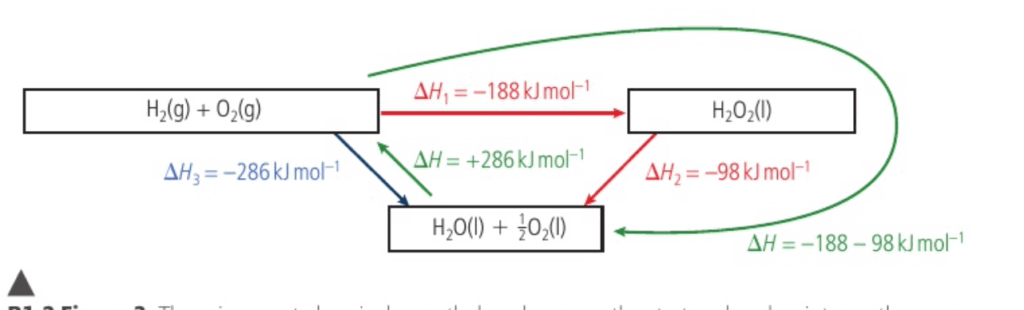
    • The following diagram depicts how a ‘cycle’ can be created from this law
    • We can see that H1 (-188) is equivilaent to H3 (-286) + H2(+98)

    ⭐️ it is important to keep in mind that the sign for the enthalpy change will switch depending on the direction of the reaction

    📌 Using Hess’s Law

    • Hess’s Law allows us to calculate the enthalpy change for reactions where it cannot be directly measured in the laboratory
    • If two elements or compounds do not directly combine to form a product, the enthalpy change of this reaction can be measured by using Hess’s law on the intermediary products formed during the reaction
    • Hess’s Law can be summarised as the following equation :

    ΔH = ΔH1 + ΔH2 + ΔH3 … where ΔH1, ΔH2 and so on refer to the enthalpy changes for the reactions producing intermediate products

  • Reactivity 1.2 – Energy cycles in reactions

    R1.2.1 – Bond enthalpy

    📌 Breaking bonds

    • Breaking bonds in an endothermic process
    • When bonds are broken, energy is absorbed from the surroundings into the system in order to provide sufficient energy for bond breaking, thus making it endothermic
    • Bond en thalpy is defined as the amount of energy required to break one mole of bonds in a gaseous substance under STP
    • To calculate the bond enthalpy in molecules containing more than 2 atoms (eg H2O), the average bond enthalpy of the breaking of the two bonds is taken (see example below)

    Example :

    H2O (g) → OH(g) + H(g) requires +502kJ mol-1

    OH (g) → O(g) +H(g) requires +427 kJ mol-1

    Therefore, the average bond enthalpy for the O-H bond is (502+427)/2 = 464.5 kJ mol-1

    • Bond enthalpies do not involve the energy used to break intermolecular forces

    ⭐️ values for average bond enthalpies can be found in sections 13&14 of the data booklet

    📌 Polarity

    • Polar bonds between two atoms of two different elements are generally stronger than non-polar bonds between atoms of the same element
    • Bond enthalpies can be used to calculate the electronegativity of an element
    • Average bond enthalpy decreases as electronegativity between 2 atoms decreases

    📌 Making bonds

    • Bond making is an exothermic process
    • When new bonds are formed in a compound, they process releases energy into the surroundings
    • The same amount of energy needed to break a bond is given out when making the bond. However since it is an exothermic reaction, the enthalpy change will be negative.

    Example :

    If :

    H2(g)→H2(g) H(g) +H(g) ΔH = +436kJ mol-1

    then :

    H(g) +H(g) →H2(g) ΔH = -436kJ mol-1

    📌 Calculating enthalpy

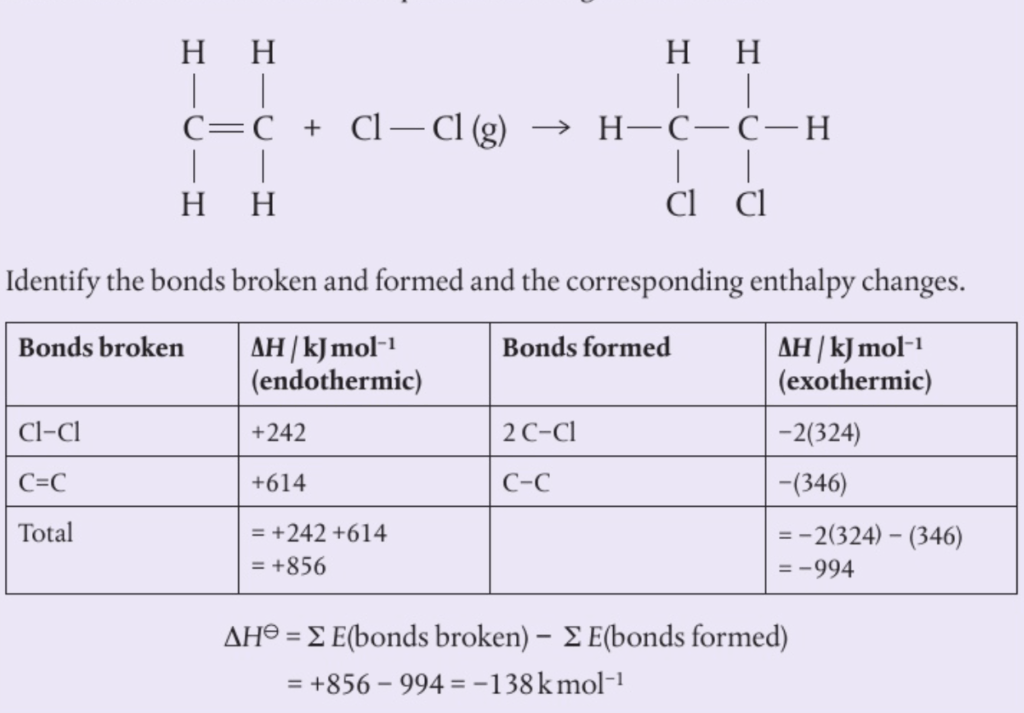
    • When calculating bond enthalpy, you must first use known (standardised) values to calculate the energy absorbed (breaking) and the energy produced (breaking)
    • This calculation can be done by subtracting the enthalpy of the bonds formed in the products from the enthalpy of bonds broken in the reactants
    • This can be summarised in the following equation :

    ΔHreaction =  ∑ E(broken) –  ∑ E(formed)

    • The following example shows this can be calculated

    🧠 you are not required to know the values for any enthalpies, they are available in the data booklet

  • S2.1 The Ionic Model

    S2.1 The Ionic Model

    S2.1.1 and S2.1.2 – The Ionic Bond

    • Metals are electropositive in nature, as they tend to lose electrons
    • Metals have low effective nuclear charges and low ionization energies, making it easy for them to lose electrons
    • When a metal atom loses electrons, it forms a positive ion called a cation
    • Non metals are electronegative in nature, as they tend to gain electrons
    • Non metals have high effective nuclear charges and can attract the transferred electrons strongly
    • When a non metal atom gains electrons, it forms a negative ion called an anion
    • The number of electrons lost/gained depend on the electronic configuration of the element
    • Transition metals can form more than 1 ion and show a range of oxidation states because they do not usually have fully filled outer shells
    • The most rigorous reactions occur between elements that are farthest apart on the periodic table

    ⭐️ Caesium Fluoride (CsF) is considered the most ionic compound.

    • The attraction between ions increases with ionic charge but removing multiple electrons has an energy cost
    • High ionization energies of metals prohibit electron loss from inner shells, preventing them from attaining higher ionic charges
    • Addition of multiple ions makes negative ions more attractive, but addition becomes increasingly difficult due to electron-electron repulsions

    ⭐️ The formation of Si4- is not feasible for this reason.

    • When an ionic compound is formed, electrons are transferred from the electropositive atom to the electronegative atom to form cations and anions

    Eg. Lewis Dot and Cross Structure of NaCl

    ⭐️ Ionic bonding is the electrostatic attraction between oppositely charged ions

    • Systematic names of compounds use oxidation numbers – only necessary when element shows more than one common oxidation state
    Formula of compoundOxidation StateSystematic Name
    FeO+2iron (II) oxide
    Fe2O3+3iron (III) oxide
    • Named with cation followed by anion
    • No net loss/gain of electrons : deducing formula involves balancing the total number of positive and negative charges
    • Polyatomic ions are made up of more than one atom which together have lost or gained an electron
    Polyatomic ion nameFormula
    nitrateNO3
    sulfateSO4 2-
    phosphatePO43-
    hydroxideOH
    hydrogencarbonateHCO3
    carbonateCO32-
    ammoniumNH4+

    🧠 While bonding between the polyatomic ion and the other ion is ionic, bonding within the polyatomic ion remains covalent.

    S2.1.3 Ionic Structure and Properties :

    • Many cations and anions arrange themselves in a characteristic lattice structure
      • no individual molecules
      • all positive ions attract negative ions
      • bonding is uniform
    • Fixed arrangement of repeating units called a formula unit (ratios of ions present)

    🧠 Make sure you avoid the term ‘molecule’ while describing an ionic compound and instead use the term ‘formula unit’

    ⭐️ Coordination number represents the number of ions that surround a given ion in a lattice

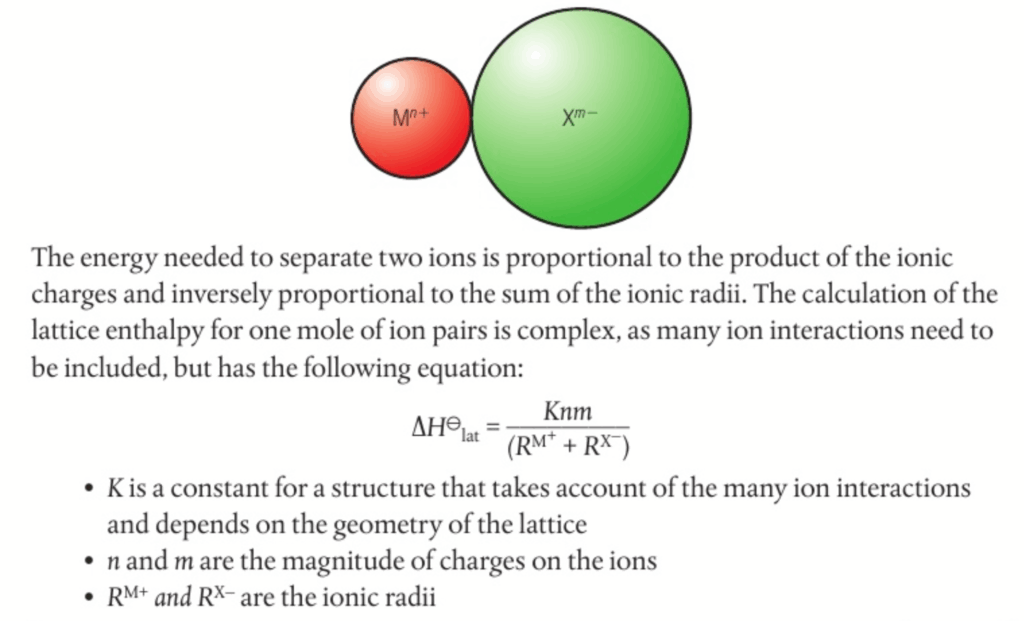
    ⭐️ Lattice enthalpy is the energy required to break 1 mol of ionic solid into its constituent gaseous ions

    • Lattice enthalpy as a measure of the strength of ionic bonding
    • Increase in ionic charge increases ionic attraction and lattice enthalpy
    • Increase in radius of one of the ions decreases ionic attraction and lattice enthalpy
    • Lattice enthalpy is greater for smaller ions with a larger charge density
    • Melting and Boiling points
      • High melting and boiling points
      • Crystalline solids at room temperature
      • Large amount of energy required to overcome the strong electrostatic forces
    • Volatility
      • ⭐️ How readily a substance vaporizes
      • Ionic compounds have low volatility
    • Solubility in water
      • Soluble in water as it is a polar solvent
      • Energy released when ions are surrounded by water (ion-dipole) pays back energy required to overcome lattice
    • Solubility in non polar solvents
      • Not soluble in non polar solvents
      • Weak interactions (LDF) would not pay back lattice enthalpy
    • Electrical conductivity
      • ⭐️ Conductivity is the flow of charged particles
      • Ionic compounds do not conduct when solid as the ions are not free to move
      • Conduct electricity when molten
      • Conduct electricity when dissolved in water
    • Ionic compounds are generally brittle – crystals tend to shatter when shear force is applied
    • Ionic character can be calculated using difference in electronegativities

    ⭐️ CsF is considered 100% ionic with a difference of 3.2.

    ⭐️ Ionic compounds >1.8 on the Pauling scale

  • ASL-3.1, 3-DIMENSIONAL GEOMETRY

    Term Definition / Formula
    Distance (3-D) Between P(x1, y1, z1) and Q(x2, y2, z2):
    d = √[(x2 − x1)2 + (y2 − y1)2 + (z2 − z1)2]
    Midpoint (3-D) Midpoint M = ((x1+x2)/2, (y1+y2)/2, (z1+z2)/2)
    Sphere Volume: V = (4/3)πr3. Surface area: A = 4πr2.
    Hemisphere Volume: V = (1/2)(4/3)πr3 = (2/3)πr3. Curved surface area = 2πr2; total surface area (including base) = 3πr2.
    Cone (right) Volume: V = (1/3)πr2h. Surface area: A = πr2 + πr s, where s = slant height = √(r2 + h2).
    Pyramid (right) Volume: V = (1/3)·(base area)·h. Lateral area depends on base perimeter and slant height: Alat = (1/2)·(perimeter of base)·s.
    Angle between two lines (vectors) If direction vectors u and v, cos θ = (u · v) / (|u||v|).
    Angle between line and plane If line direction u and plane normal n: angle φ between line and plane satisfies sin φ = |u · n| / (|u||n|). Equivalently, angle between line and normal is θ where cos θ = |u·n|/(|u||n|), and φ = 90° − θ.

    📌 Distance and Midpoint in 3-D

    Distance generalises Pythagoras to three orthogonal directions. Use differences in x, y and z coordinates and take the square root of sum of squares.
    Midpoint is the average of coordinates — useful for bisectors, centres of mass (uniform) and constructing midplanes.

    Worked example — distance & midpoint

    Find the distance and midpoint between P(−1, 2, 3) and Q(4, −2, 7).

    Distance:

    1. Δx = 4 − (−1) = 5; Δy = −2 − 2 = −4; Δz = 7 − 3 = 4.
    2. d = √(52 + (−4)2 + 42) = √(25 + 16 + 16) = √57 ≈ 7.55.

    Midpoint:

    M = ((−1 + 4)/2, (2 + (−2))/2, (3 + 7)/2) = (3/2, 0, 5).

    📌 Volumes & Surface Areas — Key Solids

    • Learn formulae and geometric meaning (why the 1/3 appears for pyramids/cones). • For combined solids, break into parts, compute each volume/area, and add/subtract as required.
    • Important note!: Refer to your formula booklet, find out the formulas that are not included in the formula booklet, memorise them. The IB will ask questions that require you to use formulas they haven’t included!

    Worked example — sphere & hemisphere

    A sphere of radius 3 cm. Find its volume and surface area. Then find the total surface area of a hemisphere made from the same sphere (including base).

    1. Volume sphere: V = (4/3)πr3 = (4/3)π(3)3 = (4/3)π·27 = 36π cm3 ≈ 113.10 cm3.
    2. Surface area sphere: A = 4πr2 = 4π(9) = 36π cm2 ≈ 113.10 cm2 (interesting: same numeric here because r=3 makes them equal numerically).
    3. Hemisphere curved area = 2πr2 = 18π. Base area = πr2 = 9π. Total hemisphere surface area = 2πr2 + πr2 = 3πr2 = 27π ≈ 84.82 cm2.

    Worked example — cone & right pyramid

    (a) Right circular cone with base radius r = 4 cm and vertical height h = 3 cm. Find volume and surface area. (b) Regular square pyramid with base side 6 cm and height 4 cm: find volume.

    1. Cone: slant height s = √(r2 + h2) = √(16 + 9) = √25 = 5 cm.
      Volume V = (1/3)πr2h = (1/3)π·16·3 = 16π cm3 ≈ 50.27 cm3.
      Surface area A = πr2 + πr s = π·16 + π·4·5 = 16π + 20π = 36π cm2 ≈ 113.10 cm2.
    2. Pyramid (square base): base area = 6×6 = 36 cm2. Volume V = (1/3)·(base area)·h = (1/3)·36·4 = 48 cm3.

    🧮 GDC Tips

    • Use the calculator/matrix solver to compute distances from coordinate differences quickly.
    • For volumes and areas, compute numeric values on the GDC and show algebraic steps in your working.
    • Use vector dot product functions (or compute manually) for angles between vectors; ensure calculator is in degree mode if required.
    • When sketching, use the graphing tool to visualise cross-sections; always include a labelled hand sketch in exam answers.

    📐 IA Spotlight

    • Model volumes of composite containers (e.g., water tank made of a cylinder + cone) and compare theoretical capacity with physical measurements.
    • Collect data on irregularly shaped objects and approximate volume via decomposition into known solids; discuss errors.

    📌 Combining Solids & Practical Strategy

    • Break complex solids into simpler parts (e.g., cylinder + cone, hemisphere + cylinder).
    • Compute volumes/areas for each part then add or subtract as required.
    • Be careful with units and ensure heights/radii refer to the same axes.
    Quick strategy: draw a labelled diagram, mark knowns, identify simple shapes, compute each volume, state final units, and include a short interpretation sentence (e.g., “the container holds X cm3“).

    🌐 EE Focus

    • Investigate the derivation of the volume formulas (e.g., why cone/pyramid have 1/3 factor) using calculus methods (integration).
    • Explore geometric optimisation problems: e.g., given surface area, maximise volume (and vice versa).

    🔍 TOK Perspective

    How do idealised mathematical objects (perfect cones, spheres) relate to messy real objects? Discuss validity of modelling and approximation, the role of measurement error, and the limits of mathematical idealisation.

    📌 Angles between Lines and Angle between a Line & a Plane

    Use vector methods: represent a line by its direction vector. For two lines with direction vectors u and v, use the dot product to find the angle. For a line and a plane, use the plane’s normal vector n.

    Worked example — angle between two lines

    Line L1 has direction vector u = <2, 1, −2> and line L2 has v = <1, 2, 1>. Find the acute angle between the lines.

    1. Compute dot product: u·v = 2·1 + 1·2 + (−2)·1 = 2 + 2 − 2 = 2.
    2. Compute magnitudes: |u| = √(4 + 1 + 4) = √9 = 3. |v| = √(1 + 4 + 1) = √6 ≈ 2.449.
    3. cos θ = (u·v)/(|u||v|) = 2 / (3·√6) = 2 / (3√6) ≈ 2 / 7.348 = 0.2722 → θ ≈ cos−1(0.2722) ≈ 74.2°.

    Worked example — angle between a line and a plane

    Line has direction vector u = <3, 0, 4>. Plane has equation 2x − y + 2z = 5, so normal n = <2, −1, 2>. Find angle φ between the line and the plane.

    1. Compute dot product: u·n = 3·2 + 0·(−1) + 4·2 = 6 + 0 + 8 = 14.
    2. Magnitudes: |u| = √(9 + 0 + 16) = √25 = 5. |n| = √(4 + 1 + 4) = √9 = 3.
    3. Angle θ between u and n: cos θ = |u·n| / (|u||n|) = 14 / (5·3) = 14/15 ≈ 0.9333 → θ ≈ cos−1(0.9333) ≈ 21.0°.
    4. Angle between line and plane φ = 90° − θ ≈ 90° − 21.0° = 69.0° (or use sin φ = |u·n|/(|u||n|) directly because sin φ = cos θ).

    ❤️ CAS Ideas

    • Organise a community challenge to design and build small scale shelters; compute required material volume/area using decomposition into solids.
    • Lead a workshop teaching 3-D geometry through hands-on models (paper models of cones, pyramids, hemispheres).

    📝 Paper Tips

    • Always include a clear labelled diagram with units.
    • State the formula you are using before substituting numbers.
    • Show intermediate arithmetic (e.g., computing slant height) — method marks are awarded for structure.
    • When combining solids, explicitly list parts and state whether you add or subtract volumes/areas.
  • AHL 2.10 Scaling and Linearising Data Using Logarithms

    📘 1. Scaling Very Large or Small Numbers Using Logarithms

    • Purpose : To compress large numerical ranges into manageable scales so data can be represented and compared easily.
    • Example : Earthquake magnitude (M) = log 10(I / I0)
      — Each increase of 1 in M represents 10× increase in intensity.
    • Advantages :
      • Highlights rate of change rather than absolute values.
      • Useful for data ranging over many orders of magnitude (e.g., 10−6 to 109).

    Worked Example :

    Suppose a quantity increases from 5 to 5 000 000.

    On a log10 scale this becomes log(5 000 000) − log(5) = 6 − 0.7 ≈ 5.3 orders of magnitude.

    This shows the growth rate clearly without the numbers becoming unmanageable.


    🌍 Real-World Connections

    • Biology : Bacterial growth and enzyme kinetics use semi-log plots to analyze rates and half-lives.
    • Chemistry : Activation energy from Arrhenius equation (ln k vs 1 / T).
    • Economics : Log-log graphs used to compare income vs consumption (power law).
    • Social Media : Follower growth modeled using logarithmic scaling to interpret relative growth rates.

    📐 IA Spotlight

    • Use real datasets (e.g., GDP growth, radioactive decay, population growth) and apply logarithmic scaling to linearize relationships.
    • Compare log-log and semi-log fits to decide whether data follows a power law or exponential trend.
    • Interpret slope and intercept in context and verify model validity using correlation coefficients.

    📗 2. Linearizing Data Using Logarithms

    Logarithms can convert non-linear data to a linear form so that parameters can be determined using a best-fit straight line.

    • Exponential Relationship : y = A ek x
      Taking natural logs: ln y = ln A + k x → straight line of form y = m x + c.
      Slope = k, Intercept = ln A.
    • Power Relationship : y = A xn
      Taking logs of both sides: log y = n log x + log A.
      Slope = n, Intercept = log A.

    Determining Linear and Logarithmic Relationships in Data: A Comprehensive  Guide - GeeksforGeeks

    download—2024-06-26T153736258.png

    Worked Example :

    Suppose the data (x, y): (1, 2), (2, 4), (3, 9), (4, 16).
    Take log10 of both x and y:

    x y log x log y
    1 2 0 0.30
    2 4 0.30 0.60
    3 9 0.48 0.95
    4 16 0.60 1.20

    Plot log y against log x → straight line with gradient ≈ 2 ⇒ y = A x2.

    Interpretation : A straight line in log-log space indicates a power relationship; a straight line in semi-log space indicates an exponential relationship.

    🔍 TOK Perspective

    When we apply logarithms to data, we change how we perceive relationships — a straight line appears only after a non-linear transformation.
    Does this make mathematics a tool of discovery or a lens of interpretation?
    Are we revealing truths about the world or constructing them through mathematical frameworks?

    ❤️ CAS Ideas

    • Conduct an experiment tracking plant growth or decay and analyze data using logarithmic plots.
    • Develop an educational infographic explaining logarithmic scales for younger students (e.g., pH scale, decibels).

    📙 3. Interpreting Log-Log and Semi-Log Graphs

    • Semi-log graph : One axis (logarithmic), the other linear → used for exponential data.
    • Log-log graph : Both axes (logarithmic) → used for power law data.
    • Slope of log-log graph : Represents exponent n in y = A xn.
    • Slope of semi-log graph : Represents rate constant k in y = A ek x.

    Example : If log y vs x is a straight line with slope −0.3, then k = −0.3 and y = A e−0.3 x.

    🌐 EE Focus

    • Investigate applications of logarithmic linearization in scientific data analysis (e.g., Arrhenius plots, spectroscopy).
    • Explore the validity of power laws in economics (Pareto distribution, wealth inequality).
    • Compare natural and base-10 log scales and their historical evolution in mathematical modeling.

    📝 Paper 1 & 2 Exam Tips

    • Recognize when to use logarithmic transformation to linearize data.
    • Interpret gradients and intercepts clearly in context of the model.
    • Remember the difference between log-log and semi-log plots in determining relationships.
    • Use GDC to find logarithmic regression fits and display best-fit lines efficiently.

    🧠 Examiner Tip

    Students often forget to state the base of the logarithm used. Always indicate whether it is log10 or ln.
    On logarithmic graphs, label axes clearly and state the relationship deduced from the linear form.
    Full marks require interpretation of the slope and constant in context.

  • AHL 2.9 — Modelling with Advanced Functions

    📘 1. Exponential Models and Half-Life

    • General form: f(x) = a·bx where a is the initial value and b > 0 is the base (growth if b > 1, decay if 0 < b < 1).
    • Half-life concept: The time it takes for a quantity to reduce to half its original amount.
    • Formula: N(t) = N0·(½)t / h where h is half-life.

    Example: A 100 g radioactive sample decays with a half-life of 5 hours.

    After 15 hours: N = 100(½)15 / 5 = 100(½)3 = 12.5 g

    The exponential model accurately describes exponential decay in physics, chemistry, and finance (e.g., depreciation).

    Applications: Radioactive decay, bacterial growth, inflation, cooling of objects, and charging/discharging of capacitors.

    📗 2. Natural Logarithmic Models

    • General form: f(x) = a + b·ln(x)
    • Meaning: Models processes that increase rapidly and then level off, or where growth slows as x increases.
    • Properties:
      • Domain: x > 0
      • Range: all real numbers
      • Vertical asymptote at x = 0

    Example: Sound intensity in decibels (dB) can be expressed as I = 10·log10(P / P0), which is logarithmic in nature.

    At x = 1 → f(1) = a (since ln(1) = 0).

    🌍 Real-World Connections

    • Exponential models: Half-life, depreciation, and radioactive decay.
    • Logarithmic models: Richter scale, pH, or sound intensity (decibel scale).
    • Sinusoidal models: Tides, seasonal changes, alternating current circuits.
    • Logistic models: Population growth with limited resources.
    • Piecewise models: Income tax brackets, postage rates, and cell phone billing.

    📐 IA Ideas

    • Investigate how logistic models predict disease spread or urban growth.
    • Use sinusoidal models to analyze daylight hours over a year for a city.
    • Model depreciation or population change using exponential and logarithmic functions.
    • Explore a piecewise cost model in an everyday scenario (e.g., cab fare structure)

    📙 3. Sinusoidal Models

    • General form: f(x) = a·sin[b(x − c)] + d
    • Parameters:
      • a: amplitude (vertical stretch, height of wave)
      • b: affects the period, which is 2π / b (in radians)
      • c: horizontal shift, called the phase shift
      • d: vertical shift (moves graph up/down)

    Example: f(x) = 3·sin(2x − π/2) + 1

    • Amplitude = 3
    • Period = 2π / 2 = π
    • Phase shift = π/4 to the right
    • Vertical shift = +1

    Interpretation: This could represent temperature variation with time, where amplitude is the seasonal temperature range, period is one year, and vertical shift represents the average temperature.

    📕 4. Logistic Models

    • General form: f(x) = L / (1 + Ce−kx), with L, C, k > 0
    • Meaning: Used when growth begins exponentially but slows as it nears a maximum limit (carrying capacity L).
    • Key features:
      • Horizontal asymptote: y = L (maximum population or capacity)
      • Inflection point: where growth rate is maximum

    Example: A bacterial population grows according to f(t) = 100 / (1 + 9e−0.5t).

    • At t = 0 → f(0) = 100 / (1 + 9) = 10
    • As t → ∞ → f(t) → 100 (the limiting population)

    ❤️ CAS Ideas

    • Create visual posters showing how different models (exponential, logistic, sinusoidal) describe natural or social processes.
    • Conduct an awareness project explaining exponential spread in public health (e.g., virus transmission).

    📝 Paper 1 & 2 Exam Tips

    • Always state domain and range for all models.
    • Clearly identify asymptotes and key features (period, amplitude, half-life, carrying capacity).
    • Label graphs with parameter changes (a, b, c, d, k, L, etc.).
    • Show working when fitting or verifying model equations with data.

    📒 5. Piecewise Models

    • Definition: A function defined by different expressions over separate intervals of x.
    • Purpose: Used when a situation behaves differently in different conditions.

    Example:

    f(x) = {
      1 + x ,   0 ≤ x < 2
      a·x² + x ,   x ≥ 2
    }
    

    To make f(x) continuous at x = 2:

    1 + 2 = a(2)² + 2 → 3 = 4a + 2 → a = ¼

    🌐 EE Focus

    • Study how logistic models describe population equilibrium and sustainability.
    • Examine the role of logarithmic models in measuring inequality (Gini index, Lorenz curve).
    • Explore transformations and continuity in piecewise-defined models.

    🔍 TOK Discussion

    Mathematics models reality, but no model perfectly represents it. To what extent can a mathematical function be said to “describe” a phenomenon, rather than merely approximate it? Is one type of model more useful than another depending on the area of knowledge?

    🧠 Examiner Tip

    Examiners look for reasoning, not memorization. Always interpret the context: What does amplitude, half-life, or carrying capacity represent in the problem? Models without contextual meaning score fewer marks in reasoning criteria.