Author: Admin

  • AHL 3.11 — SYMMETRY PROPERTIES OF TRIGONOMETRIC GRAPHS

    This topic explores how the trigonometric functions behave when angles are reflected or shifted on the unit circle.
    Understanding these symmetries makes it easier to predict graph shapes, simplify expressions, and solve equations across multiple rotations.

    Concept Meaning / Identity
    Reflection identity (sine) sin(π − θ) = sinθ

    This shows symmetry about the vertical line x = π ÷ 2.

    Reflection identity (cosine) cos(π − θ) = −cosθ

    This shows cosine is reflected and negated across x = π ÷ 2.

    Reflection identity (tangent) tan(π − θ) = −tanθ

    This matches tangent’s odd symmetry.

    📌 Understanding the symmetry of trig graphs

    • Sine is symmetric about the line x = π ÷ 2 because reflecting an angle across this line keeps the y-coordinate the same.
    • Cosine changes sign when reflected across x = π ÷ 2 because cosine represents the x-coordinate on the unit circle.
    • Tangent inherits the properties of sine ÷ cosine and therefore also changes sign under π − θ.
    • These identities are powerful shortcuts for evaluating trig values in different quadrants without full unit circle diagrams.

    640 × 480

    📌 Quick Example (Exam-Style)

    Example: Without using a calculator, find cos(π − π ÷ 6).

    Step 1 — Use the identity:
    cos(π − θ) = −cosθ

    Step 2 — Substitute θ = π ÷ 6:
    cos(π − π ÷ 6) = −cos(π ÷ 6)

    Step 3 — Use known value:
    cos(π ÷ 6) = √3 ÷ 2

    Final answer:
    cos(π − π ÷ 6) = −√3 ÷ 2

    🌍 Real-World Applications

    • Simple harmonic motion (springs, pendulums) uses symmetric sine and cosine graphs.
    • Electrical engineering (AC circuits) relies on cosine and sine wave symmetry to analyse voltage and current behaviour.
    • Rotational motion in physics uses trig symmetries to determine positions over time.

    📐 IA Spotlight

    • Investigation of symmetry in periodic functions and its role in modelling real oscillations.
    • Comparing sine vs cosine modelling for different physical systems (pendulum vs mass-spring).
    • Exploring how symmetry simplifies solving trig equations in applied contexts.

    🔍 TOK Perspective

    • Trig graphs repeat infinitely, yet we summarise them with a small set of identities — what does this say about patterns in mathematics?
    • How does the concept of symmetry influence the way mathematics describes natural phenomena?
    • Are mathematical symmetries discovered in nature or invented as a framework for understanding it?

    📝 Exam Tips

    • Remember quadrant rules: sine stays positive in quadrants I and II, while cosine becomes negative in II.
    • Use these symmetry identities to check answers quickly in multiple-choice questions.
    • Correctly identifying the quadrant is the key step before applying any identity.
  • AHL 3.10 COMPOUND ANGLE IDENTITIES

    Compound angle identities allow us to evaluate trigonometric expressions involving the sum or difference of angles.
    They are foundational tools for simplifying expressions, solving trigonometric equations, and proving relationships.
    This topic also includes the double-angle identity for tan, which is derived from the compound-angle formula.

    Concept Formula / Meaning
    Compound angle identity (sin) sin(A + B) = sinA × cosB + cosA × sinB
    sin(A − B) = sinA × cosB − cosA × sinB
    Compound angle identity (cos) cos(A + B) = cosA × cosB − sinA × sinB
    cos(A − B) = cosA × cosB + sinA × sinB
    Compound angle identity (tan) tan(A + B) = (tanA + tanB) ÷ (1 − tanA × tanB)
    tan(A − B) = (tanA − tanB) ÷ (1 + tanA × tanB)
    Double-angle identity for tan tan(2A) = (2 × tanA) ÷ (1 − tan2A)

    📌 Why compound angles are important

    • Allow evaluation of trigonometric values for angles that are not on the standard unit-circle table.
    • Enable simplification of expressions before differentiation or integration.
    • Essential in solving equations involving multiple angles.
    • Used extensively in physics (wave interference, AC circuits, oscillations).

    📌 Worked example (concise, exam-style)

    Example: Evaluate sin(75°) exactly.

    Step 1 — Express 75° as a sum:
    75° = 45° + 30°

    Step 2 — Use the identity:
    sin(45° + 30°) = sin45° × cos30° + cos45° × sin30°

    Step 3 — Substitute exact values:
    sin45° = √2 ÷ 2, cos45° = √2 ÷ 2
    cos30° = √3 ÷ 2, sin30° = 1 ÷ 2

    Step 4 — Compute:
    sin75° = (√2 ÷ 2)(√3 ÷ 2) + (√2 ÷ 2)(1 ÷ 2)
    sin75° = (√6 ÷ 4) + (√2 ÷ 4)
    = (√6 + √2) ÷ 4

    🌍 Real-World Applications

    • AC electrical systems use compound angle identities to analyse phase shifts between voltage and current.
    • GPS triangulation algorithms depend on compound angle relationships for accurate positioning.
    • Wave interference patterns in physics rely heavily on angle-sum trigonometry.

    📐 IA Spotlight

    • Investigating how compound-angle identities appear in oscillations or resonance.
    • Modelling two-source wave interference using sin(A ± B) expressions.
    • Exploring GPS triangulation mathematics through angle sum relationships.

    🔍 TOK Perspective

    • Compound identities originate from geometric proofs. How does mathematical proof differ from scientific evidence?
    • Why do different methods of proof (geometric, algebraic, analytic) all confirm the same identities?
    • What does this reveal about the interconnected structure of mathematical knowledge?

    📝 Exam Tips

    • Always choose the simplest angle pair for evaluating expressions (e.g., 45° + 30°, not 60° + 15°).
    • Keep exact values in radical form unless the question requests decimals.
    • For tan(2A), check that tanA is defined—avoid values where tanA is undefined.

  • AHL 3.9 RECIPROCAL TRIG RATIOS & INVERSE FUNCTIONS

    This topic extends trigonometry by introducing the reciprocal trigonometric ratios, their identities and the inverse trigonometric functions.
    Understanding these requires familiarity with the unit circle and the basic trigonometric ratios sinθ, cosθ and tanθ.

    Concept Meaning / Explanation
    secθ secθ = 1 ÷ cosθ

    Undefined when cosθ = 0.

    cosecθ cosecθ = 1 ÷ sinθ

    Undefined when sinθ = 0.

    cotθ cotθ = cosθ ÷ sinθ

    Undefined when sinθ = 0.

    Pythagorean identities (AHL) 1 + tan2θ = sec2θ

    1 + cot2θ = cosec2θ

    arcsin(x) Inverse of sinθ, giving the angle whose sine is x.

    Domain: −1 ≤ x ≤ 1

    Range: −π ÷ 2 ≤ arcsin(x) ≤ π ÷ 2

    arccos(x) Inverse of cosθ, giving the angle whose cosine is x.

    Domain: −1 ≤ x ≤ 1

    Range: 0 ≤ arccos(x) ≤ π

    arctan(x) Inverse of tanθ.

    Domain: all real x

    Range: −π ÷ 2 < arctan(x) < π ÷ 2

    📌 1. Understanding reciprocal trig ratios

    Reciprocal trig ratios arise naturally from the unit circle:

    • If cosθ is the x-coordinate on the unit circle, then secθ = 1 ÷ cosθ measures how “large” the reciprocal of that horizontal distance is.
    • If sinθ is the y-coordinate, then cosecθ = 1 ÷ sinθ measures the reciprocal vertical distance.
    • cotθ = cosθ ÷ sinθ is the reciprocal of tanθ.

    These values often appear in calculus, trigonometric simplifications and differential equations, especially in advanced mathematics.

    📌 2. Pythagorean identities (AHL extensions)

    Starting from the basic identity:

    cos2θ + sin2θ = 1

    Divide through by cos2θ:

    tan2θ + 1 = sec2θ

    Divide through by sin2θ:

    1 + cot2θ = cosec2θ

    These identities help simplify expressions and solve trigonometric equations in a wider range of contexts.

    📌 3. Inverse trigonometric functions: definitions, domains & ranges

    Each inverse trigonometric function “undoes” its original function, but because trigonometric functions are periodic, they are restricted to specific ranges to ensure they are functions.

    • arcsin(x) returns angles only from −π ÷ 2 to π ÷ 2.
    • arccos(x) returns angles only from 0 to π.
    • arctan(x) returns angles from −π ÷ 2 to π ÷ 2, not including endpoints.

    Knowing these domains and ranges is crucial when solving equations like sinθ = 0.4 or tanθ = 2.

    Example — solving using inverse functions

    Solve sinθ = 0.6 for θ in the principal range.

    θ = arcsin(0.6)

    arcsin(0.6) returns an angle between −π ÷ 2 and π ÷ 2.
    Using GDC: θ ≈ 0.6435 radians.

    🧮 GDC Use

    • Use inverse trig keys to compute arcsin, arccos and arctan values accurately.
    • Graph reciprocal functions (secx, cosecx, cotx) to identify asymptotes and discontinuities.
    • Use graph intersection methods to solve equations like secx = 2 or tanx = 3, by plotting the graph of the function and using x calc to find the answer.
    • Always ensure the calculator is in radian mode for AHL trigonometry unless stated otherwise.

    🌍 Real-World Applications

    • Inverse trig functions appear frequently in navigation, engineering angles and direction calculations.
    • secθ, cosecθ and cotθ are used in advanced mathematics and physics, including wave analysis and differentiation of trig functions.
    • Computer graphics use arctan functions to determine camera angles and object orientation.

    🔍 TOK Perspective

    • Inverse functions illustrate how we decide which parts of a periodic function to treat as “principal” — is this a discovery or a convention?
    • Reciprocal trig ratios highlight how mathematical structures extend logically — does mathematics grow from internal necessity or external usefulness?
    • Different cultures contributed to trigonometric ideas; does this influence how we perceive the “facts” of mathematics?

    📝 Paper Tips

    • Always check whether the inverse trig answer must be in radians or degrees.
    • Know the domain and range of arcsin, arccos and arctan — many mistakes come from giving the wrong branch.
    • When simplifying trig expressions, use reciprocal identities to reduce complexity.
    • Sketch a unit circle to understand signs (positive/negative) in different quadrants.
  • AHL 3.8 UNIT CIRCLE AND TRIGONOMETRIC FUNCTIONS

    This topic focuses on defining the trigonometric functions cosθ, sinθ, and tanθ using the unit circle.
    Understanding trigonometric graphs, identities, and the ambiguous case of the sine rule is clearer through geometric interpretation on the unit circle.

    Concept Meaning / Explanation
    Unit circle A circle centred at the origin with radius 1.
    Any point on the unit circle has coordinates (cosθ, sinθ), where θ is the angle from the positive x-axis.
    sinθ and cosθ For a point P on the unit circle:

    x-coordinate = cosθ

    y-coordinate = sinθ
    This definition works for all angles, including negatives and angles greater than 360°.

    Pythagorean identity On the unit circle: cos2θ + sin2θ = 1
    Derived from the equation of the unit circle: x2 + y2 = 1.
    tanθ tanθ = sinθ ÷ cosθ
    Represented on the unit circle as the slope of the terminal ray.
    Ambiguous case (sine rule) Occurs in non-right triangles when two sides and a non-included angle (SSA) are given.
    Sometimes two possible triangles exist, one, or none.
    Understanding the unit circle helps interpret why sinθ repeats values.
    Graphical solutions Trigonometric equations can be solved by graphing y = f(x) on a finite interval and identifying intersection points.

    📌 1. Understanding trigonometric functions from the unit circle

    The unit circle provides a unified, geometric definition for sinθ, cosθ, and tanθ:

    • Each angle θ corresponds to a point P(cosθ, sinθ).
    • This point moves smoothly as θ increases, which naturally produces the wave-like graphs of sine and cosine.
    • sinθ corresponds to vertical projection; cosθ corresponds to horizontal projection.
    • tanθ is the gradient (rise ÷ run) of the radius line.

    Because the unit circle wraps around itself, values of sinθ and cosθ repeat every 2π, explaining periodicity.

    📌 2. Worked example — interpreting the unit circle

    Example

    For θ = 150°, find cosθ, sinθ and tanθ using the unit circle interpretation.

    Step 1 — Convert to radians

    150° = 150 × (π ÷ 180) = 5π ÷ 6

    Step 2 — Determine coordinates

    Angle 150° lies in quadrant II, where cosine is negative and sine is positive.
    Coordinates on the unit circle: (−√3 ÷ 2, 1 ÷ 2)

    Step 3 — Calculate tanθ

    tanθ = sinθ ÷ cosθ = (1 ÷ 2) ÷ (−√3 ÷ 2) = −1 ÷ √3

    Thus:
    cosθ = −√3 ÷ 2
    sinθ = 1 ÷ 2
    tanθ = −1 ÷ √3

    🧮 GDC Use

    • Graph sinx, cosx and tanx to visualise intersections when solving equations.
    • Use trace mode to identify exact or approximate values of θ where the graph equals a given number.
    • Check ambiguous case solutions by graphing sinθ to see why two possible values of θ yield the same sine.
    • Ensure the GDC is in radian mode for AHL topics unless specifically using degrees.

    🌍 Real-World Applications

    • Electrical engineering uses sinusoidal voltage and current, which follow the sine function exactly.
    • Mechanical systems (rotors, gears, oscillators) use unit-circle-based rotational models.
    • Computer graphics, wave simulation and signal processing use cosine-sine decomposition.

    📐 IA Spotlight

    • Investigate how the unit circle leads to periodic motion in mechanics or electricity.
    • Model a real-life oscillation (pendulum, spring, alternating current) using sine or cosine functions.
    • Explore the ambiguous case through geometric construction and compare exact vs approximate methods.

    🔍 TOK Perspective

    • The word “sine” has cultural roots in Indian and Arabic mathematics—does this show that mathematics is not culturally neutral?
    • Unit-circle trigonometry evolved across multiple civilizations; how does mathematical knowledge develop through intercultural exchange?
    • Many identities (e.g., cos2θ + sin2θ = 1) arise from geometry. Does this suggest mathematics is discovered rather than invented?

    📝 Paper Tips

    • Sketch the unit circle whenever possible—visualising quadrants helps avoid sign errors.
    • Use radians unless the question specifically mentions degrees.
    • For solving equations like sinx = a, always consider solutions in the full interval (e.g. 0 ≤ x ≤ 2π).
    • For ambiguous case questions, consider the geometry—not just the algebraic sine rule.
  • AHL 3.7 RADIANS AND ARC LENGTH

    Radians provide a natural mathematical way to measure angles based on the geometry of a circle itself.
    This topic extends SL knowledge of circles and connects directly to trigonometric functions, calculus, and periodic modelling.

    Concept Meaning / Formula
    Radian One radian is the angle formed when the arc length equals the radius.

    In symbols: arc length s = r gives angle = 1 radian.

    Conversion 180° = π radians

    1 radian = 180° ÷ π

    Degrees to radians: θ (radians) = θ° × (π ÷ 180)

    Radians to degrees: θ° = θ × (180 ÷ π)

    Arc length s = rθ   (θ in radians only)
    Area of a sector A = (1 ÷ 2) × r2 × θ   (θ in radians only)

    📌 1. Why radians are the natural unit for angles

    • Radians relate angle size directly to the arc length on a circle.
    • Many formulas in trigonometry and calculus only work cleanly in radians.
    • The radian measure removes arbitrary choices: degrees are human-made, but radians arise naturally from geometry.
    • When modelling real-life periodic behaviour (waves, oscillations), radians simplify derivatives and equations.

    📌 2. Worked example — converting and applying radian measure

    Example

    A circle has radius 7 cm. Find:

    1. The arc length for an angle of 60°

    2. The area of the corresponding sector.

    Step 1 — Convert angle to radians

    θ = 60° × (π ÷ 180) = π ÷ 3 radians

    Step 2 — Arc length

    s = rθ = 7 × (π ÷ 3)

    s = 7π ÷ 3 cm

    Step 3 — Area of sector

    A = (1 ÷ 2) × r2 × θ

    A = (1 ÷ 2) × 49 × (π ÷ 3)

    A = 49π ÷ 6 cm²

    🧮 GDC Use

    • Use “angle conversion” functions to switch between radians and degrees quickly.
    • Graphing radian-based trigonometric functions is more accurate; ensure the calculator mode is set to radians when needed.
    • For arc length and sector area, enter formulas directly to check working and avoid arithmetic errors.

    🌍 Real-World Applications

    • Circular motion in physics uses radians to measure angular displacement, velocity and acceleration.
    • Wave motion and diffraction patterns rely on radian measure due to their trigonometric foundations.
    • Engineering fields such as robotics and mechanical systems measure rotation using radians for precision.

    📐 IA Spotlight

    • Explore arc lengths or sector areas in real objects (gears, wheels, tracks) and analyse how angle measurement affects calculations.
    • Investigate circular motion and model angular velocity or acceleration using radian-based trigonometric functions.
    • Analyse why radians simplify calculus and compare results obtained using degrees vs radians.

    🔍 TOK Perspective

    • Radians arise from geometry, while degrees are human conventions. Which system provides more “mathematical truth”?
    • Is a natural measure (rad) “better” than a human-made one (deg)? By what criteria do mathematicians decide?
    • Different cultures used different angle systems—Babylonians used 360 degrees. Does the choice of unit affect how mathematics is understood?

    📝 Paper Tips

    • Check calculator mode — most mistakes occur from using degree mode in radian questions.
    • Sector formulas only work when θ is in radians.
    • Leave answers as exact multiples of π unless the question asks for decimals.
    • Show conversion steps clearly to earn method marks.
  • ASL 3.6 VORONOI DIAGRAMS

    Voronoi diagrams are a way of dividing the plane into regions according to closeness to given points called sites.
    Each region contains all points that are closer to one particular site than to any other.
    This topic connects coordinate geometry, perpendicular bisectors and a wide range of applications in geography, biology, economics and computer science.

    Term Meaning in a Voronoi diagram
    Site A fixed point in the plane, often representing a real object such as a town, weather station or cell tower.
    Cell (region) The set of all points that are closer to a particular site than to any other site. Each site has its own cell.
    Edge A boundary line segment between two cells, consisting of points that are equidistant from two sites.
    Algebraically, an edge is part of a perpendicular bisector between two sites.
    Vertex A point where three (or more) edges meet. It is equidistant from three (or more) sites.

    📌 1. Building Voronoi boundaries using perpendicular bisectors

    The key geometric idea is that points on the boundary between two sites are equidistant from both.
    In coordinate terms, the set of points equidistant from two points A and B lies on the perpendicular bisector of segment A B.

    For two sites A(x1, y1) and B(x2, y2):

    • The midpoint between A and B gives one point on the boundary.
    • The gradient of A B is (y2 − y1) ÷ (x2 − x1).
    • The gradient of the perpendicular bisector is the negative reciprocal, −1 ÷ m.
    • The equation of the boundary line is then found using the midpoint and this perpendicular gradient.
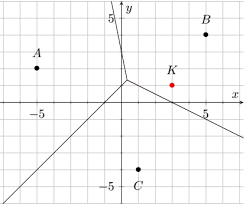
    Voronoi Diagrams: How to Create Stunning Voronoi Diagrams

    Example — equation of a Voronoi edge

    Two sites are P(2, 1) and Q(8, 5). Find the equation of the boundary between their Voronoi cells.

    Midpoint:

    M = ((2 + 8) ÷ 2, (1 + 5) ÷ 2) = (10 ÷ 2, 6 ÷ 2) = (5, 3)

    Gradient of P Q:

    m = (5 − 1) ÷ (8 − 2) = 4 ÷ 6 = 2 ÷ 3

    Gradient of perpendicular bisector:

    m = −1 ÷ (2 ÷ 3) = −3 ÷ 2

    Equation through M(5, 3):

    y − 3 = (−3 ÷ 2) × (x − 5)
    This line forms the Voronoi edge between P and Q.

    📌 2. Adding a new site to an existing Voronoi diagram

    When a new site is added (for example, a new hospital, store or weather station), its cell is formed by drawing boundaries between it and existing sites:

    • Take the new site S and each neighbouring site in turn.
    • Construct the perpendicular bisector between S and that neighbour; this line is a candidate boundary.
    • Only the part of each bisector that is closer to S than to other sites becomes an edge of the new region.
    • The final cell may be bounded by several such edges, forming a polygon around S.

    Conceptually, you are “carving out” space where S is the nearest site. This models how adding a new facility changes which households are closest to which centre.

    📌 3. Nearest neighbour interpolation

    Often each site carries a numerical value, for example rainfall at a weather station, pollution level at a sensor or population at a city.
    Nearest neighbour interpolation assumes that:

    • Every point inside a Voronoi cell takes the same value as that cell’s site.
    • There are sudden jumps in value at the boundaries (edges) where the nearest site changes.

    This is a simple but powerful way to estimate values across a region using data from a limited number of measurement points.
    In practice, it is used in ecology, meteorology and resource management as a first approximation, sometimes improved later by smoother methods.

    📌 4. The “toxic waste dump” problem

    The “toxic waste dump” problem is a classic application of Voronoi diagrams to optimisation and fairness:

    • Several towns (sites) are located on a map.
    • A waste disposal site must be placed in a position that is as far as possible from all towns, to minimise risk and political opposition.
    • The best location is at a point that maximises the minimum distance to any town.

    In a Voronoi diagram, this optimal point lies at a vertex where three edges meet.
    At such a point, three towns are equally far away, and all other towns are at least that far or further.
    In exam questions you may be given coordinates of vertices and asked to choose the one that provides the greatest minimum distance.

    🧮 GDC Use

    • Plot the sites as points to visualise the Voronoi cells. Some GDCs or graphing apps support drawing perpendicular bisectors directly.
    • Use distance functions to check which site is closest to a given point by computing several distances and comparing them.
    • For the “toxic waste dump” problem, store candidate vertex coordinates and evaluate distances to each town using the distance formula on the GDC.

    🌍 Real-World Connections

    • Urban planning: Assigning each house to its nearest school, hospital or fire station.
    • Spread of diseases: Modelling which health centre is likely to serve each area, or which outbreak source is nearest.
    • Ecology and meteorology: Dividing a region according to the nearest weather station or sampling site to estimate rainfall, temperature or species density.
    • Telecommunications and computing: Cell tower coverage areas, clustering in data science and nearest neighbour search algorithms.

    📐 IA Spotlight

    • Use real locations from your city (schools, clinics, bus stops) and create a Voronoi diagram on graph paper or using technology. Analyse which households are closest to which facility.
    • Investigate how adding a new site (for example, a new clinic) changes the sizes of Voronoi cells and shifts boundaries of service areas.
    • Explore relationships between cell area and underlying data like population or rainfall, discussing limitations of nearest neighbour interpolation.

    🔍 TOK Perspective

    • Voronoi diagrams show how we divide continuous space into discrete regions based on a chosen rule (nearest site). To what extent is this division a natural feature of the world, and to what extent is it a human-made model?
    • Different disciplines (geography, biology, economics, computer science) use the same mathematical structure. Does this support the idea that mathematics provides a shared language across areas of knowledge?

    📝 Paper Tips

    • Label sites clearly and sketch a rough Voronoi diagram if not provided; this helps identify which region a point belongs to.
    • When asked for a boundary equation, remember it is a perpendicular bisector, so find midpoint and negative reciprocal gradient carefully.
    • For “nearest site” questions, compare squared distances when possible to avoid unnecessary square roots; the smallest squared distance gives the nearest site.
    • In “toxic waste dump” questions, focus on vertices where three regions meet and compare their distances to all sites systematically.
  • ASL 3.5 PERPENDICULAR BISECTORS

    A perpendicular bisector is a line that cuts a line segment into two equal halves and is at 90° to the original line.
    It is a foundational tool in coordinate geometry, used to find equidistant points, construct geometric loci, and solve circle-related problems.

    Concept Meaning
    Midpoint For points (x1, y1) and (x2, y2), midpoint =
    ((x1 + x2) ÷ 2, (y1 + y2) ÷ 2)
    Gradient of original line m = (y2 − y1) ÷ (x2 − x1)
    Gradient of perpendicular bisector m = −1 ÷ m (negative reciprocal)

    📌 1. What a perpendicular bisector represents

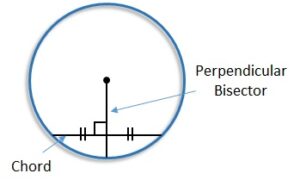
    • It contains all points equidistant from the endpoints of the segment.
    • It forms the basis for finding the centre of a circle by intersecting perpendicular bisectors of chords.
    • It is a geometric locus used in design, surveying, navigation and triangulation.
    • Many coordinate problems rely on identifying the perpendicular bisector to locate points that satisfy distance conditions.

    Circle Theorem: Perpendicular Bisector of a Chord Passes Through the Center of a Circle (Key Stage 3)


    📌 2. Worked example: perpendicular bisector from two points

    Example

    Find the perpendicular bisector of the segment joining A(2, 3) and B(8, 9).

    Step 1: Midpoint

    Midpoint = ((2 + 8) ÷ 2, (3 + 9) ÷ 2) = (10 ÷ 2, 12 ÷ 2) = (5, 6)

    Step 2: Gradient of AB

    m = (9 − 3) ÷ (8 − 2) = 6 ÷ 6 = 1

    Step 3: Gradient of perpendicular bisector

    m = −1 ÷ 1 = −1

    Step 4: Equation

    Use point-slope form with midpoint (5, 6):
    y − 6 = −1 × (x − 5)

    Expand:
    y − 6 = −x + 5
    y = −x + 11

    Perpendicular bisector: y = −x + 11

    📌 3. Worked example: given midpoint and gradient of segment

    Example

    A line segment has midpoint M(4, −2). The gradient of the segment is 2.
    Find the equation of the perpendicular bisector.

    Step 1: Perpendicular gradient

    m = −1 ÷ 2 = −0.5

    Step 2: Equation through midpoint

    y + 2 = −0.5 × (x − 4)

    y + 2 = −0.5x + 2
    y = −0.5x

    Perpendicular bisector: y = −0.5x

    🧮 GDC Use

    • You can use the GDC to check midpoints and gradients quickly by plugging values into tables or geometry tools.
    • Graph both the segment AB and your perpendicular bisector to visually confirm the line crosses the midpoint and is at 90°.
    • Useful especially in exam settings to verify your negative reciprocal gradient and avoid sign errors.

    🌍 Real-World Applications

    • Used in locating equidistant points between two transmitters, towers or landmarks.
    • Base method in triangulation and surveying for mapping and positioning.
    • Essential for finding the centre of a circle formed by three non-collinear points.
    • Appears in design and engineering when constructing perpendicular supports or symmetrical shapes.

    🔍 TOK Perspective

    • The perpendicular bisector represents a set of points defined by a logical rule: “equidistant from two points”. Is this mathematical locus an invention or a discovery?
    • Coordinate geometry allows us to express geometric ideas algebraically. Does representing a geometric idea in algebra change how we understand it?

    📝 Paper Tips

    • Write the midpoint first—it anchors the perpendicular bisector.
    • Always double-check the perpendicular gradient: it must be the negative reciprocal.
    • Simplify the equation neatly and give final answer in the form y = mx + c unless instructed otherwise.
    • A sketch (even small) helps prevent sign mistakes with gradients.
  • ASL 3.4CIRCLES: ARC LENGTH AND AREA OF A SECTOR

    This small topic focuses on two key ideas in circle geometry:
    length of an arc and area of a sector.
    At SL you will work entirely in degrees (radians are not required).

    Quantity Formula in degrees
    Arc length For a circle of radius r and central angle θ (in degrees):
    arc length = (θ ÷ 360) × 2πr.
    Area of a sector For the same circle and angle:
    sector area = (θ ÷ 360) × πr2.

    📌 1. Understanding arcs and sectors

    • Arc
      A piece of the circumference of a circle. If you think of the circle as a track, an arc is a portion of that track.
    • Sector
      The region bounded by two radii and the arc between them. It looks like a “pizza slice”.
    • The full circle has central angle 360°. If a sector has angle θ, it represents the fraction θ ÷ 360 of the whole circle.
    • Both formulas above come from this idea of a fraction:
      • Full circumference = 2πr, so arc length is that multiplied by θ ÷ 360.
      • Full area = πr2, so sector area is that multiplied by θ ÷ 360.

    📌 2. Short worked example

    Example

    A circle has radius 7 cm. A sector has central angle 60°. Find:

    1. Arc length
      Arc = (θ ÷ 360) × 2πr
      = (60 ÷ 360) × 2π × 7
      = (1 ÷ 6) × 14π
      = (14π ÷ 6) = (7π ÷ 3) cm
      ≈ 7.33 cm.
    2. Sector area
      Area = (θ ÷ 360) × πr2
      = (60 ÷ 360) × π × 72
      = (1 ÷ 6) × 49π
      = 49π ÷ 6 cm2
      ≈ 25.66 cm2.

    📌 3. Strategy and common mistakes

    • Always check the angle unit. At SL you will use degrees, so the fraction is θ ÷ 360, not θ ÷ 2π.
    • Confirm that the angle given is actually the central angle at the centre of the circle. Angles at the circumference correspond to double angles at the centre in some contexts, so the question will be clear about which angle you should use.
    • Keep π symbol until the final step if the question allows an exact answer. Approximating π too early can cause rounding differences.
    • Pay attention to units: lengths in centimetres or metres; areas in square units like cm2 or m2.

    🧮 GDC Use

    • Store r, θ and π values in your calculator memory when using them repeatedly in one question.
    • Use the π key rather than 3.14 to keep results accurate and consistent.
    • For multi-step questions (for example when the arc length is then used to work out something else), keep full precision on the GDC and round only in your final written answer.

    🌍 Real-World Connections

    • Designing curved paths or tracks, where the arc length gives the distance travelled along a bend.
    • Calculating the area of circular sectors in engineering, for example the cross-section of partially opened valves or gates.
    • Determining the size of slices in circular charts or pie charts, where the central angle represents a proportion of the whole.

    📐 IA Spotlight

    • Investigate how changing the angle of a sector affects arc length and area while keeping radius fixed, and discuss which changes are linear and which are not.
    • Model real circular objects (for example, pizzas, wheels, circular gardens) and compare theoretical sector areas with measurements or photographs.

    🔍 TOK Perspective

    • The idea that a sector with angle θ represents θ ÷ 360 of a full circle relies on the convention that a full turn is 360°. Why 360 and not another number?
    • Our experience of circular motion (wheels, rotations, cycles) influences how we define and use angles. To what extent is this mathematical or cultural?
  • ASL 3.3 APPLICATIONS OF TRIGONOMETRY

    This part of the course focuses on using trigonometry and Pythagoras’ theorem in real situations.
    You will turn written descriptions into clear labelled diagrams, identify right or non-right triangles, and then choose the correct method: Pythagoras, basic trig ratios, sine rule or cosine rule.
    Contexts include heights and distances, navigation, bearings, triangulation and map-making.

    Idea Description
    Pythagoras’ theorem In a right-angled triangle: hypotenuse2 = opposite2 + adjacent2.
    Used to link distances when one angle is 90°.
    Right-angled trig sin, cos and tan connect angles with side ratios. Used for angles of elevation and depression and many height or depth problems.
    Non-right-angled trig Sine rule and cosine rule solve triangles that are not right-angled, especially in navigation and triangulation.
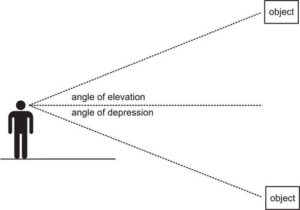
    Angles of elevation and depression Angles measured from a horizontal line of sight up or down. They always start at the eye level of the observer.
    Bearings Three-digit angles measured clockwise from North, used to describe directions in navigation and map-based questions.

    📌 1. Applications of right and non-right angled trigonometry

    Trigonometry becomes powerful when you recognise a triangle hidden inside a real situation.
    The general approach is:

    • Translate the word problem into one or more triangles.
    • Decide whether each triangle is right-angled or non-right-angled.
    • Select the appropriate method:
      • Pythagoras or basic sin, cos, tan for right-angled cases.
      • Sine rule or cosine rule for non-right-angled cases (using the patterns from SL 3.2).
    • Use the units and context (height, distance, speed) to interpret your answer.

    In map-making and triangulation, several triangles are formed by joining observation points to a target.
    Distances that are hard to measure directly (for example across a river or to a tall tower) can be found by measuring more accessible lengths and angles and then applying trigonometry.

    Illustrative scenario — combining Pythagoras and trig

    A surveyor stands 40 metres from the base of a building on flat ground.
    The angle of elevation to the top is 32°. The roof has a short vertical antenna whose top is 5 metres higher than the roof itself.

    Step one is to model the building without the antenna using a right-angled triangle: ground, building height, and line of sight.
    Using tan 32° = height ÷ 40, the height of the building alone is 40 × tan 32°.
    The total height including the antenna is then that value plus 5 metres.

    The exact calculator evaluation is less important here than the reasoning:
    the triangle lets us express an unreachable vertical distance in terms of a measurable horizontal distance and a measurable angle.

    📌 2. Angles of elevation and depression

    These angles appear in almost every “height or depth” question and are a frequent source of mistakes, so definitions must be very clear:

    • Angle of elevation
      The angle measured upwards from a horizontal line of sight to an object that is higher than the observer.
      Example: looking up at a plane or the top of a tower.
    • Angle of depression
      The angle measured downwards from a horizontal line of sight to an object that is lower than the observer.
      Example: looking down from a cliff to a boat on the sea.
    • The angle of elevation from point A to point B is equal to the angle of depression from B to A, because alternate interior angles are equal when you draw the horizontal lines.
    • The horizontal line of sight is always at eye level, not on the ground. Forgetting this shifts the triangle and often changes which side is opposite or adjacent.

    Once the triangle is drawn, usually one side is given as a horizontal distance (ground distance or distance at sea level) and the vertical side represents the height to be found.
    You choose tan, sin or cos depending on which lengths are known or required.

    https://www.ck12.org/book/cbse-maths-book-class-x/section/9.2/

    📌 3. Bearings, navigation and non-right triangles

    Many application questions combine distances, bearings and trigonometry. Bearings give direction in navigation:

    • Bearings are measured as three-digit angles from North, turning clockwise.
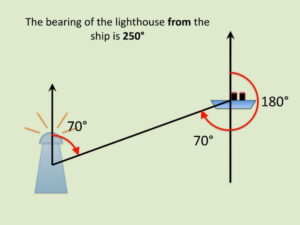
      For example, a ship travelling on a bearing of 060° is heading 60° east of North.
    • The bearing from A to B is not generally the same as the bearing from B to A. The return bearing is usually 180° different, adjusted to stay within 000° to 359°.
    • To use trig, you normally convert the bearing into an interior angle in a triangle by marking North at each point and drawing the directions as rays.
    • Often two journeys form two sides of a triangle and the angle between them is known from the difference in bearings. This can create a non-right-angled triangle where the cosine rule or sine rule is needed.

    Navigation questions sometimes ask for the displacement between start and finish or for the bearing from one point to another. In both cases you:

    • Draw a scaled diagram with North lines at main points.
    • Mark distances along the bearings.
    • Identify the triangle formed by the journeys and apply trigonometry to find the third side or missing angle.

    https://www.tes.com/teaching-resource/maths-gcse-bearings-doing-the-simple-geometry-for-foundation-11494933


    📌 4. Constructing labelled diagrams from written statements

    Drawing a correct diagram is often half the marks in an applications question. A systematic approach helps:

    • Step 1: Identify objects. Who or what is at each point? For example, observer, tower, boat, ship A, ship B, radio mast.
    • Step 2: Decide on a view. Side view (for heights and angles of elevation or depression) or plan view from above (for bearings and maps).
    • Step 3: Mark known distances and angles. Use clear labels like 40 m, 2.5 km, 60°. If using bearings, draw a North arrow at each relevant point first.
    • Step 4: Mark right angles clearly. Use a small square symbol to indicate a 90° corner at the base of a building or where horizontal meets vertical.
    • Step 5: Decide the triangle type. Right-angled or non-right-angled, then choose Pythagoras, basic trig or sine / cosine rule accordingly (with the ÷ and × notation in your algebra).
    • Step 6: Write a short sentence conclusion. For example, “The height of the building is approximately 23.4 m” or “The ship must travel 18.2 km on a bearing of 132°.”

    🧮 GDC Use

    • Use the calculator’s trig functions to evaluate expressions like 40 × tan 32° or to compute inverse trigonometric functions quickly.
    • When solving multi-step problems, store intermediate values in memory (for example, the height found from one triangle that is used in a second triangle) to avoid rounding errors.
    • Some GDCs can draw simple triangles or show values in a table, which can be used to check whether your answers for heights or distances are reasonable.
    • Always show the algebraic setup in your written work; the GDC is for numerical evaluation, not for replacing reasoning.

    🌍 Real-World Connections

    • Triangulation and surveying: Used to map coastlines, mountain ranges and city layouts by measuring angles from known baseline distances.
    • Navigation and aviation: Pilots and ship captains use bearings and angles of elevation or depression when approaching runways or navigating around hazards.
    • Radio and satellite communication: Positioning of radio towers and satellite dishes relies on angles and heights to maximise signal strength.
    • Parallax methods in astronomy: Distances to nearby stars can be estimated using tiny angles and Earth’s orbital radius as the baseline.

    📐 IA Spotlight

    • Investigate the accuracy of height measurements found using angles of elevation from different distances away from a building or tree.
    • Design a small triangulation project in your local area, using multiple observation points and bearings to estimate the position of an inaccessible point.
    • Compare measurements obtained using trigonometry with those from digital tools such as phone range-finder apps or mapping software, and analyse discrepancies.

    🌐 EE Focus

    • Explore the historical development of triangulation and its role in determining the size and curvature of the Earth, including early geodetic surveys.
    • Examine different proofs and generalisations of Pythagoras’ theorem, including those that apply in non-Euclidean geometries where the angle sum of a triangle is not 180°.
    • Investigate how modern GPS systems conceptually rely on distance and angle ideas, and compare this with classical triangulation methods.

    🔍 TOK Perspective

    • In Euclidean geometry the angles of a triangle add to 180°, but on curved surfaces this is no longer true. What does this say about the status of mathematical truths?
    • When explorers used trigonometry to estimate Earth’s size, how did they decide whether the models and measurements were “good enough” to count as knowledge?
    • Many cultures contributed to trigonometry and proofs of Pythagoras’ theorem. How does recognising this global history affect our view of ownership and authorship in mathematics?

    ❤️ CAS Ideas

    • Organise a “geometry walk” around your school, where participants estimate heights or widths of buildings and trees using simple trigonometric tools.
    • Create an interactive workshop for younger students on bearings and map-reading, using small navigation challenges in the playground or local park.
    • Collaborate with geography or physics teachers to design a field study that measures slopes, distances and directions in a nearby natural area.

    📝 Paper 1 and Paper 2 Tips

    • Start every problem with a neat, labelled diagram. Most mistakes in this topic come from missing or mis-labelled angles and distances.
    • Clearly state which method you are using: “Using Pythagoras”, “Using sin rule”, “Using cosine rule”, or “Using right-angled trig and tan”.
    • Keep angle mode in degrees unless the question explicitly uses radians, and check that answers are reasonable (for example, a height should not be less than a horizontal distance if the angle of elevation is large).
    • Round only at the end of your solution, especially if one result is reused in a later calculation.

    🧠 Examiner Tip

    Examiners report that many students try to jump straight to formulas without first understanding the situation.
    Marks are often lost because of an incorrect diagram or misidentified angle.
    If you take time to sketch, label and think about the story the question is telling, the trigonometry becomes routine and you gain both method and accuracy marks.

  • ASL 3.2 TRIGONOMETRY IN TRIANGLES

    Concept Key idea and formula (using × and /)
    Basic trig ratios In a right-angled triangle:
    sin θ = opposite / hypotenuse,
    cos θ = adjacent / hypotenuse,
    tan θ = opposite / adjacent.
    Sine rule For any triangle with sides a, b, c opposite angles A, B, C:
    a / sin A = b/sin B = c/sin C.
    Cosine rule (sides) c2 = a2 + b2 − 2 × a × b × cos C.
    Cosine rule (angles) cos C = (a2 + b2 − c2) / (2 × a × b).
    Area of a triangle Area = (1/2) × a × b × sin C, where C is included angle between sides a and b.

    📌 Using sine, cosine and tangent in right-angled triangles

    In a right-angled triangle, trigonometric ratios relate the lengths of the sides to the angles.
    Always start by:

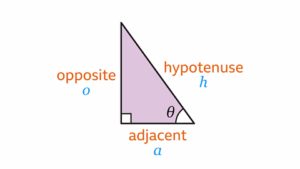
    • Identifying the right angle.
    • Marking the side opposite the angle θ as opposite, the side touching θ (but not the hypotenuse) as adjacent, and the longest side as hypotenuse.
    • Choosing sin, cos or tan depending on which sides are involved

    https://www.bbc.co.uk/bitesize/articles/zyjtfdm

    📐 IA Spotlight

    • Investigate triangulation methods to estimate heights or distances you cannot measure directly (for example, height of a building, width of a river) using sine and cosine rules.
    • Collect real data using a clinometer or phone sensor and compare theoretical distances against measured ones, discussing sources of error.

    🌐 EE Focus

    • Explore the history and development of trigonometry in ancient cultures (Indian, Chinese, Greek, Islamic) and how triangle methods evolved.
    • Study error propagation when using trig rules to approximate long distances or heights in navigation and surveying.

    Worked example 1 — finding a side

    A ladder leans against a wall, making an angle of 70° with the horizontal.
    The ladder is 5 metres long. Find the height the ladder reaches on the wall.

    1. The ladder is the hypotenuse. The height on the wall is opposite the 70° angle.
    2. Use sin: sin 70° = opposite/hypotenuse.
    3. Let h be the height. Then sin 70° = h/5.
    4. So h = 5 × sin 70°.
    5. Using calculator: sin 70° ≈ 0.9397.
      h ≈ 5 × 0.9397 ≈ 4.70 m.

    Worked example 2 — finding an angle

    In a right-angled triangle, the side opposite θ is 7 cm and the adjacent side is 10 cm. Find θ to the nearest degree.

    1. Known: opposite and adjacent → use tan.
    2. tan θ = opposite / adjacent = 7/10 = 0.7.
    3. θ = tan−1(0.7) ≈ 34.99°.
    4. To nearest degree, θ ≈ 35°.

    🧮 GDC Tips

    • Check your calculator angle mode (degrees for IB SL questions unless stated otherwise).
    • Use the built-in sin−1, cos−1, tan−1 functions to find angles from ratios.
    • Store intermediate results to avoid rounding too early when using values again (for example, use the answer memory).

    📌 The sine rule — non-right-angled triangles

    The sine rule applies to any triangle where you know:

    • Two angles and one opposite side (A A S or A S A situations), or
    • Two sides and a non-included angle, when side is opposite that angle (S S A).
      In this SL topic the ambiguous case is not examined.

    Relationship: a / sin A = b / sin B = c / sin C.
    You usually pick two of these fractions and form an equation.

    Worked example 3 — sine rule to find a side

    In triangle ABC, A = 40°, B = 75°, and side a (opposite A) is 8 cm. Find side b.

    1. Use a / sin A = b/sin B.
    2. 8/sin 40° = b/sin 75°.
    3. Rearrange: b = sin 75° × (8/sin 40°).
    4. Compute: sin 75° ≈ 0.9659; sin 40° ≈ 0.6428.
    5. b ≈ 0.9659 × (8/0.6428) ≈ 0.9659 × 12.44 ≈ 12.02 cm.

    📌 The cosine rule — non-right-angled triangles

    The cosine rule is used when you have:

    • Two sides and the included angle (S A S) → find the third side.
    • All three sides (S S S) → find an angle.

    Side form: c2 = a2 + b2 − 2 × a × b × cos C.
    Angle form: cos C = (a2 + b2 − c2)/(2 × a × b).

    📝 Paper 1 & Paper 2 Tips

    • Always draw a clear, labelled diagram with angles and sides marked before choosing a rule.
    • Write down the formula first, then substitute values — this gains method marks even if arithmetic slips occur.
    • Round angles at the very end; use unrounded values in later calculations.
    • Check whether your answer is reasonable: angles should add to about 180°; side opposite larger angle should be longest.

    Worked example 5 — using cosine rule to find a side

    In triangle X Y Z, sides adjacent to angle Z are 7 cm and 10 cm, and angle Z is 50°. Find side z opposite angle Z.

    1. Let a = 7, b = 10, C = 50°, c = z.
    2. c2 = a2 + b2 − 2 × a × b × cos C.
    3. c2 = 72 + 102 − 2 × 7 × 10 × cos 50°.
    4. c2 = 49 + 100 − 140 × cos 50°.
    5. cos 50° ≈ 0.6428 → 140 × 0.6428 ≈ 89.99.
    6. c2 ≈ 149 − 89.99 ≈ 59.01.
    7. c ≈ √59.01 ≈ 7.68 cm.

    Worked example 6 — using cosine rule to find an angle

    Triangle A B C has sides a = 6 cm, b = 8 cm, c = 9 cm. Find angle C to the nearest degree.

    1. Use cos C = (a2 + b2 − c2) / (2 × a × b).
    2. cos C = (62 + 82 − 92) / (2 × 6 × 8).
    3. cos C = (36 + 64 − 81) / 96 = 19 / 96 ≈ 0.1979.
    4. C = cos−1(0.1979) ≈ 78.6° → C ≈ 79°.

    📌 Area of a triangle using ½ a b sin C

    For any triangle, if you know two sides and the included angle between them, the area can be found without dropping a perpendicular.

    Area = (1/2) × a × b × sin C, where C is the angle between sides a and b.

    Worked example 7 — area from two sides and an included angle

    A triangle has sides 9 cm and 12 cm with an included angle of 40°. Find its area.

    1. Area = (1/2) × 9 × 12 × sin 40°.
    2. (1/2) × 9 × 12 = 54.
    3. sin 40° ≈ 0.6428.
    4. Area ≈ 54 × 0.6428 ≈ 34.71 cm2.

    📌 Choosing the correct rule — quick strategy

    • Right angle present → use basic sin, cos, tan.
    • Triangle is non-right-angled and you know A A S or A S A or S S A (with side opposite known angle) → sine rule.
    • Triangle is non-right-angled and you know S A S or S S S → cosine rule.
    • Need area with two sides and included angle → use (1/2) × a × b × sin C.

    🔍 TOK Perspective

    Trigonometry is based on axioms and definitions about triangles and angles. How universal are these ideas?
    When explorers used trigonometry to estimate the size and shape of Earth, how did assumptions and measurement tools influence what was accepted as knowledge?

    ❤️ CAS Ideas

    • Run a “map-making” or orienteering activity for younger students where they locate points by measuring angles and distances.
    • Create a mural or digital artwork based on triangular patterns, labelling the trig relationships used.

    🧠 Examiner Tip

    Examiners frequently see answers where students select the wrong rule or forget to indicate which side corresponds to which angle.
    Always state clearly: “using the sine rule” or “using the cosine rule” and match labels (a opposite A, b opposite B, c opposite C). Clear diagrams and formula statements are an easy way to secure method marks.