Author: Admin

  • Reactivity 1.3 – Energy from fuels

    1.3.3 – Fossil fuels

    📌 Fuels

    • Ideal fuels are ones that produce a great amount of energy and minimal pollution
    • Fossil fuels are non-renewable energy sources
    • Wood is a renewable energy source
    • Fossil fuels have become a very widely used source of energy because of their high energy density (energy produced per unit volume) and their cheap cost and wide accessibility
    • Fossil fuels are the result of decomposition of organic compounds

    📌 Common fossil fuels

    1. Coal : The most abundantly used fossil fuel
    • Coal is the most widely used fossil fuel as it is 80-90% carbon by mass and has a high energy density
    • It is a combustible sedimentary rock that is widely available

    2. Crude oil : a composite mixture of several organic compounds

    • Formed from the remains marine animals from millions of years ago
    • Organic matter decayed due to bacteria and a lack of oxygen
    • Crude oil is a limited resource

    3. Natural gas : a mix of several gases – mainly methane

    • Contains nitrogen and sulfur compounds in addition to methane
    • Gas is trapped in geological formations
    • It is highly explosive when in contact with air
    • Low carbon content, therefore it is the ‘cleanest’ fossil fuel

    📌 Combustion of alkanes

    • Hydrocarbons with higher carbon content are mosre likely to undergo incomplete combustion
    • Higher alkanes have a lower energy released per unit mass
    • Thus we can also infer that coal (greatest carbon content) is the most polluting and ‘dirtiest’ fuel to burn
    • Higher percentage of carbon content also means that the specific energy (energy produced per unit mass) is lower

    📌 Greenhouse effect

    • The greenhouse effect is the process by which gases in the atmosphere trap heat on Earth
    • Increased carbon dioxide levels due to increase burning of fossil fuels has contributed significantly to the greenhouse effect
    • Greenhouse gases absorb long-wave radiation and allow short-wave radiation to pass through the atmosphere
    • Vibrations in CO2 molecules during infrared radiation absorption allow the radiation to be ‘re-radiated’ back to the Earth’s surface, thus increasing global temperature
    • Therefore, the increase in CO2 has contributed significantly to global warming

  • Reactivity 1.3 – Energy from fuels

    1.3.2 – Incomplete combustion of organic compounds

    📌 Incomplete combustion

    • The products of incomplete combustion (CO and C) are harmful
    • Incomplete combustion occurs when the oxygen supply is limited or insufficient
    • Incomplete combustion releases less heat than complete combustion and is therefore less efficient

  • Reactivity 1.3 – Energy from fuels

    1.3.1 – Combustion reactions

    📌 When does combustion occur?

    • Combustion is the result of substances being burnt in the presence of oxygen
    • Metals form basic (covalent) oxides while non-metals form acidic (ionic) oxides

    📌 Combustion of organic compounds

    • Combustion reactions where energy is released usefully (such as hydrocarbons and alcohols) are used as fuels
    • Substances with high activation energy are used so combustion does not occur spontaneously
    • When substances produce ONLY water and carbon dioxide (for compounds containing only hydrogen and carbon) as a result of combustion, this is known as ‘complete’ combustion
    • Incomplete combustion occurs when carbon monoxide gas or solid carbon (soot) is produced

  • SL 4.10 — Regression Line of x on y & Prediction

    Content Guidance, Clarification & Syllabus Links
    Equation of the regression line of x on y. Students should know the form of the regression line and understand what it represents.
    Use of the equation for prediction purposes. Students should be aware they cannot reliably predict y from x using the x-on-y equation.

    1. Understanding the Regression Line of x on y

    The regression line of x on y is a mathematical model used when our goal is to estimate or predict values of x given values of y.
    It takes the form:

    x = a + by

    This line is derived using the least squares principle — the method that minimises the vertical distances between the observed x-values and the predicted ones generated by the model.
    It is essential to understand that:

    • this line minimizes errors in predicting x, not y;
    • the slope depends on the correlation between x and y;
    • the regression line is not symmetric — the regression of x on y ≠ regression of y on x.

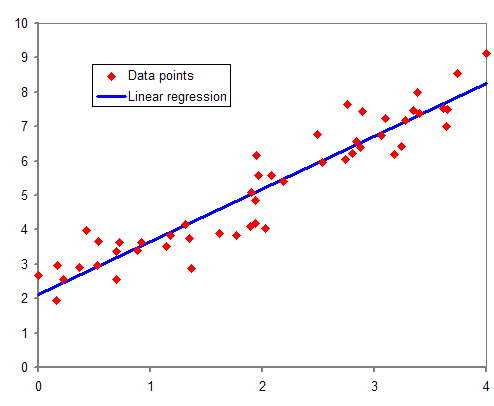
    Regression analysis - Wikipedia

    https://upload.wikimedia.org/wikipedia/commons/b/be/Normdist_regression.png

    Example:
    Suppose we have paired data values (x, y).
    If the regression line of x on y is found to be:x = 3.2 + 1.5y

    Then for y = 4 we estimate:
    x = 3.2 + 1.5(4) = 9.2

    2. Using the Regression Line for Predictions

    The purpose of a regression line is to predict the most likely value of x for a given value of y.
    However, predictions are only meaningful under certain conditions:

    • The relationship between x and y must be approximately linear.
    • The value of y used for prediction lies realistically within the data range (to avoid extrapolation).
    • The regression line of x on y must only be used to predict x, not y.

    🧠 Examiner Tip:
    The most common mistake in exams is using the x on y regression line to estimate y.
    If the question asks for a predicted y-value, the regression line of y on x must be used instead.

    3. The Danger of Extrapolation

    Extrapolation occurs when we use values of y that are outside the observed data range.
    The regression model is only valid within the limits of the data we have collected.
    Beyond that range, predictions become unreliable because:

    • the relationship may not remain linear;
    • future trends may change;
    • the model cannot account for new behaviour outside the dataset.

    🌍 Real-World Connection:
    Regression lines are commonly used in economics for forecasting growth or inflation.
    Misusing regression lines beyond data bounds can lead to poor financial predictions and failed policy decisions.

    📊 IA Spotlight:
    Regression analysis is excellent for an IA if you investigate a real dataset.
    Make sure to justify:

    • why a linear model is suitable,
    • whether correlation is strong enough,
    • and discuss limitations such as extrapolation.

    🔍 TOK Perspective:
    To what extent can prediction models provide knowledge about the future?
    Are mathematical predictions inherently reliable, or do they depend on assumptions that may not hold?
  • SL 4.9 — The Normal Distribution

    Content Guidance, clarification & links
    • Normal distribution and bell-shaped curve
    • Properties of the normal distribution
    • Diagrammatic representation & 68–95–99.7 rule
    • Normal probability calculations (technology)
    • Inverse normal calculations
    • Recognise natural occurrence of normal data
    • Understand symmetry about mean μ and spread via σ
    • Approximately 68% within μ ± σ, 95% within μ ± 2σ, 99.7% within μ ± 3σ
    • Use GDC for probabilities and inverse normal
    • No need to transform to standardised variable z for exams

    1. The Normal Distribution and Curve

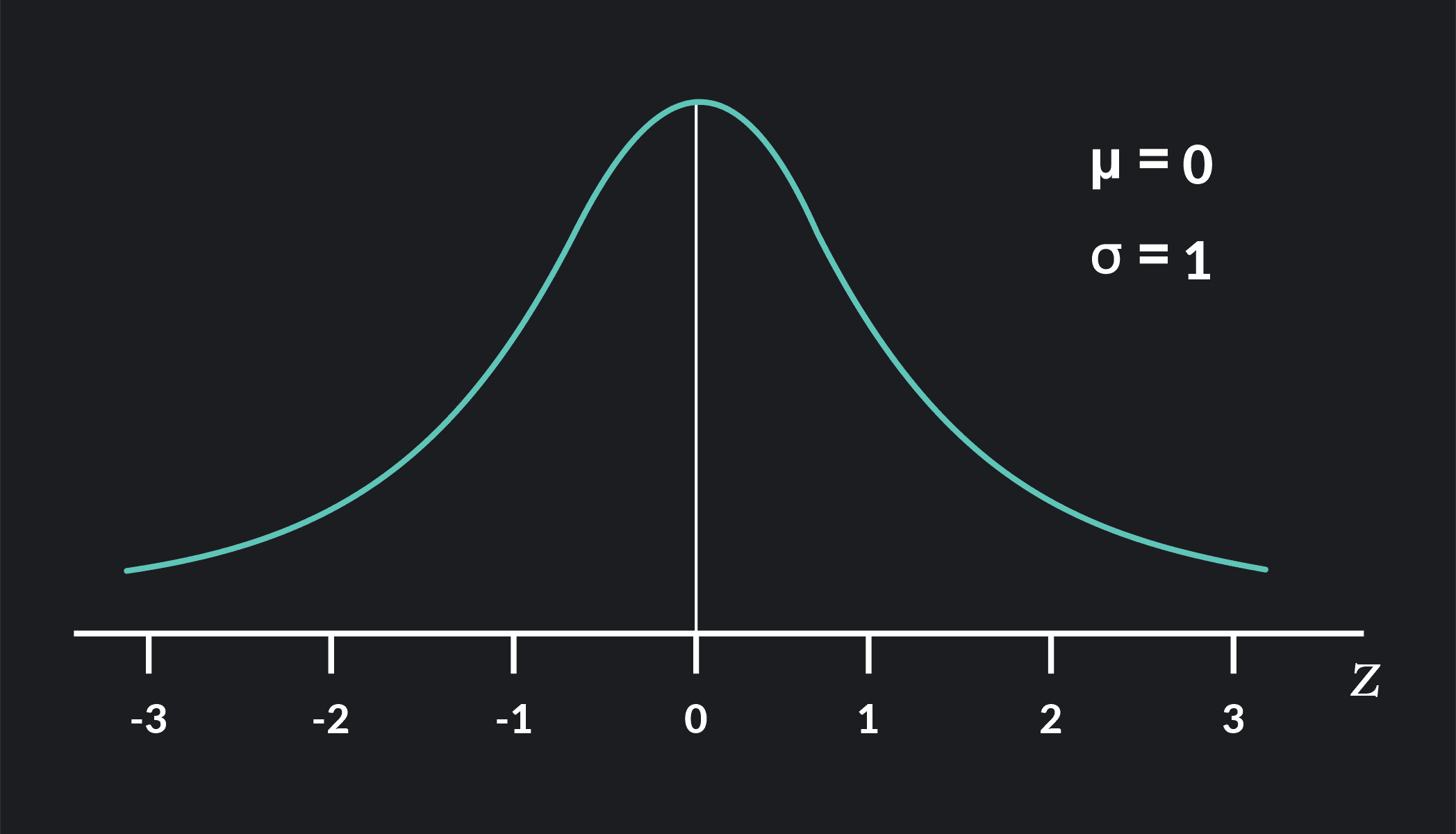
    The normal distribution is a continuous probability distribution with a characteristic
    bell-shaped curve. A normal random variable X is written as X ~ N(μ, σ), where:

    • μ = mean (centre of the distribution)
    • σ = standard deviation (measure of spread)
    • The curve is perfectly symmetric about x = μ.
    • The highest point (peak) of the curve occurs at x = μ.
    • Total area under the curve = 1 (represents probability 1).

    Unlike discrete distributions (such as binomial), the normal distribution is
    continuous. Probability is represented by area under the curve, not by bars.
    For a single exact value P(X = a) = 0; we always consider intervals such as P(a < X < b).

    🌍 Real-World Connection:
    Many real-life measurements are approximately normal:

    • Human heights and masses within a population
    • IQ scores and some psychological test scores
    • Measurement errors in experiments
    • Natural variation in manufacturing processes

    Recognising when the normal model is reasonable allows us to make powerful probability-based predictions.

    2. Key Properties & the 68–95–99.7 Rule

    Important qualitative properties:

    • Shape is bell-shaped and symmetric about μ.
    • As x moves far from μ, the curve approaches (but never touches) the x-axis.
    • Mean, median and mode are all equal to μ.

    For many normal distributions, the following empirical rule holds:

    • Approximately 68% of data lies between μ ± σ.
    • Approximately 95% lies between μ ± 2σ.
    • Approximately 99.7% lies between μ ± 3σ.

    These percentages provide a quick way to judge whether a value is “typical” or “unusual”.
    Values beyond μ ± 2σ are uncommon; beyond μ ± 3σ are very rare in a normal distribution.

    🧠 Examiner Tip:
    When a question asks whether a data value is “unusual” or “consistent with the model”,
    compare it to μ ± 2σ or μ ± 3σ and comment using the 68–95–99.7 rule.
    A brief sentence such as “this lies more than 2σ from the mean, so it is unlikely” often earns reasoning marks.

    3. Diagrammatic Representation

    In exam diagrams:

    • Draw a smooth bell-shaped curve over the x-axis.
    • Mark the mean μ on the horizontal axis at the centre.
    • Optionally mark μ − σ, μ + σ, μ − 2σ, μ + 2σ to show the spread.
    • Shade the region corresponding to the probability being asked, e.g. x > a or a < x < b.

    Even when the question uses technology, a quick sketch with a shaded region helps you
    understand what the GDC output represents and can reveal obvious mistakes (like probabilities > 1 or negative).

    Understanding the Normal Distribution Curve | Outlier

    https://articles.outlier.org/_next/image?url=https%3A%2F%2Fimages.ctfassets.net%2Fkj4bmrik9d6o%2FUuFO0KrA3JNEZfBsG8bSc%2F9fd6ec46281d7e907820cdd1cb75bff9%2FNormal_Distribution_07.png&w=3840&q=75

    4. Normal Probability Calculations (Using Technology)

    To work with a normal variable X:

    1. Define the variable clearly:
      “Let X be the height (in cm) of students in a school, X ~ N(170, 8).”
    2. Sketch a quick normal curve marking μ and shading the relevant region.
    3. Use GDC normal distribution functions to find the area (probability).

    Common probability types:

    • P(X < a) → lower tail
    • P(X > a) = 1 − P(X < a) → upper tail
    • P(a < X < b) = P(X < b) − P(X < a)

    Example 1 – Tail probability

    Suppose X ~ N(100, 15). Find P(X > 130).

    • Sketch: mean at 100, shade the right tail beyond 130.
    • Use your calculator’s normal CDF function with mean = 100, sd = 15, lower = 130, upper = a large number (e.g. 109).
    • Result is a small probability showing such a high value is rare.
    🟢 GDC Tip (Normal CDF):

    • For P(X < a), use lower = −109, upper = a.
    • For P(X > a), use lower = a, upper = 109.
    • For P(a < X < b), use lower = a, upper = b.
    • Always double-check that your shaded sketch matches the bounds you entered.

    5. Inverse Normal Calculations

    Inverse normal problems ask for a value of X corresponding to a given area (probability).
    The mean μ and standard deviation σ are given, and we find x such that:

    P(X < x) = p   or   P(X > x) = p   or   P(a < X < b) = p.

    You do not need to transform to the standardised variable z in IB exams;
    use the inverse normal function on your GDC directly with μ and σ.

    Example 2 – Percentile

    Test scores are normally distributed with mean 60 and standard deviation 8.
    Find the score that marks the top 10% of students.

    • We want the 90th percentile, since 10% are above and 90% are below.
    • So find x such that P(X < x) = 0.90.
    • Use inverse normal with area = 0.90, mean = 60, sd = 8 → x ≈ 70.2
    • Interpretation: students scoring about 70 or above are in the top 10%.
    📝 Paper Strategy:
    Clearly state whether the area you enter is left tail or right tail.
    If the question gives a right-tail probability (P(X > x) = p), convert to a left-tail area first: P(X < x) = 1 − p.

    Links to Other Subjects:

    • Sciences: measurement errors, biological variation, experimental data
    • Psychology: distribution of test scores and traits
    • Environmental systems: variation in environmental indicators
    🔍 TOK Perspective:
    The normal distribution is a model, not reality. Important questions:

    • When is it reasonable to assume data are normal, and who decides?
    • What happens if we apply the normal model where it does not hold (e.g. income distributions)?
    • How do choices about which data to include or exclude influence the “fit” to a normal curve?

    Misuse of the normal model can lead to misleading or dangerous conclusions, especially in medicine and social policy.

    Historical / International-mindedness:
    The normal distribution was developed through work by De Moivre, Gauss and others, and later used by Quetelet to model
    “l’homme moyen” (the average man). This illustrates how mathematical ideas can both describe natural patterns and shape
    the way societies think about “normality”.

    To succeed in SL 4.9, you should be confident drawing and interpreting normal curves, using technology for normal and inverse normal calculations, and critically evaluating when the normal model is appropriate in context.

  • SL 4.8 — Binomial Distribution

    Content Guidance, clarification & links
    • Definition of the binomial distribution
    • Probability formula P(X = k)
    • Mean and variance of X ~ Bin(n, p)
    • Real-life modelling situations
    • Appropriate conditions for binomial model
    • Use of technology to find binomial probabilities
    • Mean = n p and Variance = n p (1 − p) (no formal proof needed)
    • Linked to expected number of occurrences from SL 4.5

    1. What is a Binomial Distribution?

    A random variable X follows a binomial distribution when we count the number of “successes” in a fixed number of
    repeated trials, each trial having only two possible outcomes (success / failure).
    We write this as X ~ Bin(n, p), where:

    • n = number of trials (fixed in advance)
    • p = probability of success on each trial (constant)
    • Each trial is independent of the others
    • Each trial has only two outcomes: success (with probability p) or failure (with probability 1 − p)
    • X counts how many successes occur in n trials → X takes values 0, 1, 2, …, n

    If any of these conditions is clearly broken (e.g. probability changes, trials not independent), the binomial model may not
    be appropriate and another distribution should be considered.

    🌍 Real-World Connection:
    Binomial models appear in:

    • Quality control: number of defective items in a batch
    • Medicine: number of patients responding positively to a treatment
    • Marketing: number of customers who buy after receiving an advert
    • Sports: number of successful penalty kicks out of n attempts

    2. Binomial Probability Formula

    For X ~ Bin(n, p), the probability that X takes the value k (i.e. exactly k successes) is

    P(X = k) = C(n, k) pk (1 − p)n − k    for k = 0, 1, 2, …, n

    • C(n, k) (also written nCk) is the number of different ways to choose which k trials are successes.
    • pk gives the probability of those k successes.
    • (1 − p)n − k gives the probability of the remaining n − k failures.

    In IB exams you do not need to derive this formula, but you must know how to:

    • Write down the correct expression for P(X = k)
    • Interpret “at least”, “at most”, “no more than”, “no fewer than” using sums of binomial terms or GDC

    Example 1 – Exact probability

    The probability that a machine produces a defective item is 0.1. In a batch of n = 8 items, let X be the number of defectives.
    Find P(X = 2).

    P(X = 2) = C(8, 2) (0.1)2 (0.9)6 = 28 × 0.01 × 0.531441 ≈ 0.148.

    🟢 GDC Tip (Binomial):
    Most calculators have functions like binompdf(n, p, k) and binomcdf(n, p, k).

    • Use binompdf for P(X = k).
    • Use binomcdf for P(X ≤ k); for P(X ≥ k), use 1 − P(X ≤ k − 1).
    • Always define X (e.g. “Let X be the number of successes …”) before using these commands.
    🧠 Examiner Tip:
    Marks are often lost by:

    • Not stating X ~ Bin(n, p) before calculating probabilities
    • Using the wrong n or p (e.g. confusing success with failure)
    • Mistreating “at least / at most” — write the probability sum explicitly or show the GDC command clearly

    3. Mean and Variance of X ~ Bin(n, p)

    For a binomial random variable X ~ Bin(n, p):

    • Mean (expected value): E(X) = n p
    • Variance: Var(X) = n p (1 − p)
    • Standard deviation: σ = √[n p (1 − p)]

    These results link directly to SL 4.5: if the probability of success is p and there are n trials, the expected number of successes is n p.

    Example 2 – Mean and variance

    A basketball player scores a free throw with probability 0.75.
    She takes 20 shots in a practice session. Let X be the number of successful shots (assume independence).

    • Model: X ~ Bin(20, 0.75)
    • E(X) = n p = 20 × 0.75 = 15 → on average she scores 15 shots.
    • Var(X) = n p (1 − p) = 20 × 0.75 × 0.25 = 3.75
    • σ ≈ √3.75 ≈ 1.94 → typical deviation from the mean is about 2 shots.

    4. When is a Binomial Model Appropriate?

    When reading a word problem, check:

    • Is there a fixed number of trials n?
    • Does each trial have only two outcomes (success / failure)?
    • Is the probability of success constant between trials?
    • Are outcomes of trials independent of each other?

    If all answers are “yes”, then a binomial model is usually reasonable.

    📝 Paper Strategy:
    In explanation questions (“justify the use of a binomial model”), list the four key conditions
    in short sentences. Examiners look for explicit reference to fixed n, independence, constant p, and two outcomes.

    📐 Mathematical Connections (Pascal / Yang Hui):
    Binomial coefficients C(n, k) appear in Pascal’s triangle, which is closely related to the binomial distribution.
    Historically, similar triangular arrays were studied by the Chinese mathematician Yang Hui long before Pascal.
    This highlights how mathematical ideas develop in parallel across different cultures.
    🔍 TOK Perspective:

    • How do we choose between different probability models (binomial vs. normal vs. Poisson)?
    • To what extent is a model “true”, and to what extent is it only a convenient approximation?
    • Does assigning a probability to rare events (e.g. system failures) change how society responds to risk?
    🌐 Enrichment / EE Ideas:

    • Hypothesis testing using binomial models (e.g. testing if a coin or die is biased)
    • Comparing theoretical binomial predictions with experimental data
    • Investigating real-world data sets where binomial or related models appear

    Mastering SL 4.8 means you can recognise when a situation is binomial, write X ~ Bin(n, p), use technology or formulae
    to calculate probabilities, and interpret the mean and variance in context.

  • SL 4.7 — Discrete Random Variables

    Content Guidance, Clarification & Links
    • Concept of discrete random variables
    • Probability distributions
    • Expected value (mean)
    • Applications (fairness, games, decisions)
    • Tables and formulas may be used for probability distributions
    • Expected value used to evaluate fairness
    • Probabilities must sum to 1
    • Applications include gambling, business risk & modelling

    Understanding Discrete Random Variables

    A discrete random variable (DRV) is a variable that takes a list of countable outcomes.
    Examples include:

    • Dice results {1,2,3,4,5,6}
    • Number of goals scored
    • Number of defective items

    A DRV is paired with a probability distribution describing how likely each value is.

    Probability Distributions (Table Form)

    X 1 2 3 4 5
    P(X=x) 0.1 0.2 0.15 0.05 0.5

    This is a valid probability distribution because:

    • All probabilities are ≥ 0
    • The total = 1

    Probability Distributions (Function Form)

    Sometimes probabilities are expressed as a rule:

    P(X = x) = (1/18)(4 + x) for x ∈ {1,2,3}

    You must verify:

    • Probabilities are positive
    • The sum equals 1

    Expected Value (Mean)

    The expected value is the long-run average:

    E(X) = Σ[x × P(X = x)]

    Example

    Using the table above:

    E(X) = 1(0.1) + 2(0.2) + 3(0.15) + 4(0.05) + 5(0.5)
    = 3.65

    Applications (Fair Games, Risk Analysis)

    Expected value helps evaluate:

    • Fairness of games (E(X) = 0 → fair game)
    • Casino profitability (house edge)
    • Insurance calculations
    • Decision-making under uncertainty

    🌍 Real-World Connection:
    Expected value is used in:

    • Insurance (predicting average payouts)
    • Casino game design
    • Business risk modelling
    • Medical testing reliability
    • Engineering safety calculations

    🧠 Examiner Tip:

    • Always confirm that total probability = 1
    • Label probability tables carefully
    • Write E(X) clearly with Σ notation for full method marks

    📝 Paper 1 & Paper 2 Tips:

    • Paper 1: Expect manual calculations.
    • Paper 2: Use 1-Var Stats with probabilities stored in L2.
    • Interpret expected value contextually (profit/loss).

    🔍 TOK Perspective:

    • Is a “fair” game a mathematical or ethical idea?
    • Does expected value reflect real experiences of chance?
    • Can randomness ever be truly understood?

    🌐 EE Focus:

    • Investigating casino strategy mathematically
    • Risk analysis models in finance
    • Modelling insurance payouts

    ❤️ CAS Ideas:

    • Create & test a fair game at a school event
    • Run probability simulations using dice/cards
  • SL 4.6 – Combined & Conditional Probability, Independent Events

    Concept Short description
    Combined events Use P(A ∪ B) = P(A) + P(B) − P(A ∩ B) to handle “A or B” when events may overlap.
    Mutually exclusive events Events that cannot occur together: P(A ∩ B) = 0, so P(A ∪ B) = P(A) + P(B).
    Conditional probability Probability of A given that B has occurred: P(A|B) = P(A ∩ B) / P(B).
    Independent events Events where knowing B does not affect A: P(A ∩ B) = P(A)P(B).
    Diagrams Venn diagrams, tree diagrams and tables of outcomes help visualise and calculate probabilities.

    This topic extends basic probability into situations where events overlap, depend on each other, or are independent.
    The key tools are Venn diagrams, tree diagrams, and sample space tables, together with the
    formulae for combined, conditional and independent events.


    1. Visual Tools for Probability – Venn & Tree Diagrams

    Venn diagrams

    Venn diagrams use overlapping circles inside a rectangle (the sample space) to represent events.

    • The rectangle represents the whole sample space U.
    • Each circle represents an event (e.g. A, B, C).
    • The overlap A ∩ B shows outcomes where both events occur.
    • The outer parts of each circle show outcomes where only that event occurs.
    • The area outside all circles represents outcomes where none of the events occur

    Tree diagrams

    Tree diagrams display multi-stage experiments step by step.

    • Each branch is labelled with the probability of that outcome at that stage.
    • Probabilities along a path are multiplied to find the probability of that combined outcome.
    • Probabilities of different paths are added when representing “or” situations.
    • Tree diagrams are very helpful for problems with or without replacement.

    🧠 Examiner Tip:
    For multi-step questions, you will often earn method marks simply for drawing a correct tree diagram
    with probabilities on the branches. Even if an arithmetic mistake occurs later, the diagram can protect marks.

    🌍 Real-World Connection:
    Tree-like models are used in decision analysis, where each branch represents a decision or chance outcome
    (for example, market up/down, drug effective/ineffective). Probabilities along branches help estimate expected profits or risks.


    2. Combined Events – “A or B”

    General addition rule

    For any two events A and B:

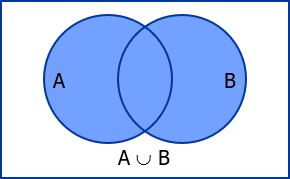
    P(A ∪ B) = P(A) + P(B) − P(A ∩ B)

    • A ∪ B means “A or B or both”.
    • The term P(A ∩ B) is subtracted because the overlap has been counted twice: once in P(A) and once in P(B).
    • This rule expresses the non-exclusivity of “or” in probability.
    290 × 179

    Intersection of Events (A ∩ B)

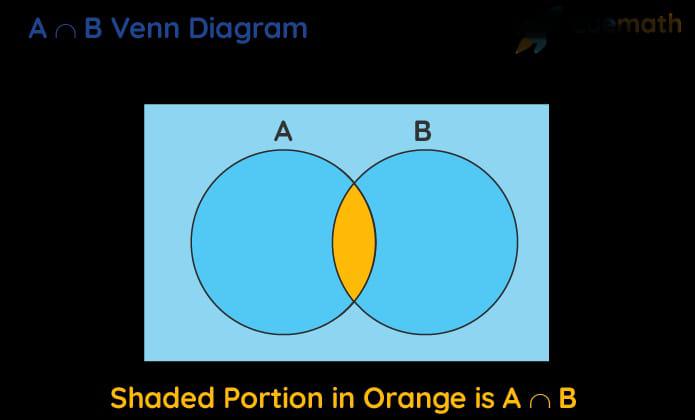
    The intersection of two events A and B, written as A ∩ B, represents all outcomes that belong to both A and B at the same time.

    Graphically, it is shown as the overlapping region in a Venn diagram.
    Probabilistically, P(A ∩ B) measures the chance of A and B occurring together.

    When A and B have no overlap, their intersection is empty and P(A ∩ B) = 0, meaning they are mutually exclusive.
    A∩B Formula - GeeksforGeeks

    https://media.geeksforgeeks.org/wp-content/uploads/20240803015120/A-intersection-B.jpg

    Mutually exclusive events

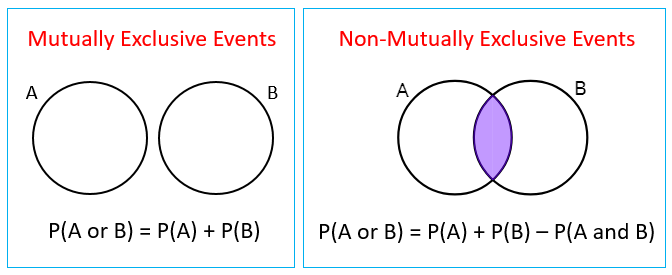
    • Events A and B are mutually exclusive if they cannot happen at the same time: P(A ∩ B) = 0.
    • For mutually exclusive events, the rule simplifies to: P(A ∪ B) = P(A) + P(B).
    • On a Venn diagram, mutually exclusive events have no overlap.
    Mutually Exclusive Events (video lessons, examples and solutions)

    https://www.onlinemathlearning.com/image-files/probability-mutually-exclusive.png

    Example (combined events):
    In a survey, 60% of students like coffee (A) and 40% like tea (B). If 25% like both coffee and tea,
    P(A ∪ B) = 0.60 + 0.40 − 0.25 = 0.75 → 75% like at least one of the two.

    📝 Paper 1 Strategy:
    When you see the word “or” in a probability question, pause and check:
    Can both events happen together?
    If yes, use the full formula with −P(A ∩ B); if no, simply add P(A) and P(B).


    3. Conditional Probability – P(A|B)

    Definition and meaning

    • Conditional probability describes the chance of event A occurring given that event B has already happened.
    • It “shrinks” the sample space to only those outcomes where B is true.
    • Formula: P(A|B) = P(A ∩ B) / P(B), provided P(B) ≠ 0.

    Rearranging gives another useful form:

    P(A ∩ B) = P(B) P(A|B)

    This version often appears in tree diagrams: the joint probability of A and B is the probability of reaching B,
    multiplied by the conditional probability of A at that stage.

    Example – card drawing (without replacement)

    Two cards are drawn in order from a standard 52-card deck, without replacement.
    Let A = “second card is a heart”, B = “first card is a heart”.

    • P(B) = 13/52 = 1/4.
    • If B has happened, there are now 12 hearts left out of 51 cards → P(A|B) = 12/51.
    • P(A ∩ B) = P(B)P(A|B) = (1/4) × (12/51) = 12/204 = 1/17.

    💻 GDC Use:
    For complex conditional probability questions, especially with many branches, you can verify results
    using a GDC’s table or simulation functions. However, in Paper 1 you must still show
    the algebra or tree diagram to earn full method marks.

    🧠 Examiner Tip:
    Many students confuse P(A|B) with P(B|A). In the exam, write a short sentence such as
    “P(A|B) = probability that A happens given B has occurred” before using the formula.
    This helps you choose the correct conditional direction.


    4. Independent Events – No Influence

    Definition

    • Events A and B are independent if the occurrence of one does not affect the probability of the other.
    • Formally, A and B are independent if P(A|B) = P(A) (and equivalently P(B|A) = P(B)).
    • This leads to: P(A ∩ B) = P(A)P(B).

    Example: Tossing a fair coin and rolling a fair die.
    A = “coin shows heads”, B = “die shows 6”.
    P(A) = 1/2, P(B) = 1/6, and P(A ∩ B) = 1/12 = (1/2) × (1/6), so A and B are independent.

    📝 Paper 2 Tip:
    When a question gives you P(A), P(B) and P(A ∩ B), quickly test whether
    P(A ∩ B) equals P(A)P(B). If yes, state clearly that A and B are independent and use this result
    to simplify later calculations.


    5. With and Without Replacement

    Many conditional probability problems involve whether items are replaced after each draw.

    • With replacement: after each selection, the object is returned.
      Probabilities stay the same for each draw → often leads to independent events.
    • Without replacement: objects are not returned.
      Probabilities change after each draw → events are usually dependent.
    • Tree diagrams clearly show how branch probabilities alter when there is no replacement.

    🔍 TOK / Ethics Connection:
    Probability models are used in gambling, lotteries and online gaming.
    How should mathematicians and game designers consider the ethics of using sophisticated probability
    calculations to design games where the house has a long-term advantage?
    Should mathematics be used to maximise profit from players who may not understand these models?

    Mastering SL 4.6 means being comfortable switching between diagrams, formulas and contextual reasoning.
    Always check whether events overlap, are conditional on each other, or are independent, and then choose the
    appropriate probability rule.
  • SL 4.5 – Probability

    Probability provides a structured way to quantify uncertainty. In IB Mathematics, probability concepts help students
    reason about chance events, evaluate risks, and analyse patterns in real-world scenarios such as genetics, finance,
    gambling, and scientific experiments. This topic covers foundational ideas of trials, outcomes, equally likely events,
    relative frequency, sample spaces, complementary events, and the expected number of occurrences.

    1. Trials, Outcomes & Sample Spaces

    Concepts of trial and outcome

    • Trial: A single performance of an experiment (e.g., rolling a die once).
    • Outcome: The result obtained from a trial (e.g., rolling a 4).
    • Outcome set: All individual possible results the experiment can generate.
    • Outcomes are typically considered atomic — meaning they cannot be broken down further.

    Equally likely outcomes

    • Outcomes are equally likely when each outcome has the same probability of occurring.
    • This assumption is vital for theoretical probability, e.g., a fair die where each face has probability 1/6.
    • In real life, “equally likely” rarely holds perfectly—this is why experimentation and simulation are used.

    Sample space U

    • The sample space (U) is the complete set of all possible outcomes of an experiment.
    • It can be represented as a list, table, tree diagram, or even a grid for two-variable situations.
    • Choosing a clear representation reduces errors in probability calculations.

    🌍 Real-World Connection: Actuarial science constructs sample spaces for life expectancy predictions
    and uses probability to set insurance premiums. This involves extremely large and structured sample spaces
    based on population data, age brackets, lifestyle categories, and health factors.


    2. Events, Relative Frequency & Theoretical Probability

    Event and its probability

    • An event is a collection of outcomes (e.g., rolling an even number = {2,4,6}).
    • The probability of event A is given by:
      P(A) = n(A) / n(U)
      where n(A) = number of favorable outcomes, and n(U) = total number of outcomes.
    • This applies only when outcomes are equally likely.

    Relative frequency

    • Relative frequency approximates probability using repeated experimentation.
    • Formula: relative frequency = (number of successful trials) / (total trials).
    • The more trials performed, the closer the relative frequency tends to the true probability.
    • This aligns with the Law of Large Numbers.

    🔍 TOK Perspective: How do repeated experiments influence our confidence in probability?
    Does probability measure truth, or simply our uncertainty?
    In medicine and economics, “probability” often represents beliefs, not physical frequencies.

    3. Complementary Events

    Understanding A and A’

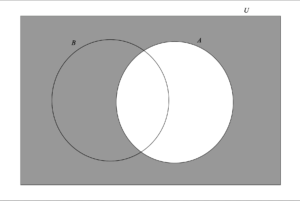
    • The complement A’ contains all outcomes in the sample space that are not in A.
    • The probabilities satisfy: P(A) + P(A’) = 1.
    • Complementary reasoning is one of the fastest methods for calculating probabilities.
    • Often used when finding “at least one success” in repeated trials.
    • In the below image, the area shaded in grey is the A’ or A complement

    Example: If the probability of rain today is 0.3, then the probability it does not rain is 1 – 0.3 = 0.7.

    4. Expected Number of Occurrences

    Meaning of expectation

    • The expected number is the long-run average count of occurrences of an event.
    • Formula: Expected value = n × P(A), where n = number of trials.
    • Expectation does not mean the event will occur that exact number of times.
    • It is a theoretical average over very large numbers of repetitions.

    Example: If a class has 128 students and the probability a student is absent is 0.1,
    Expected absentees = 128 × 0.1 = 12.8 students.

    🟢 GDC Tip: Use probability simulation functions on your calculator to approximate long-run expected values.
    With enough trials, the simulated average stabilises close to the expected value.

    🌍 Real-World Connection: Expected value is the foundation of insurance risk modeling,
    gambling strategy analysis, actuarial forecasting, and Monte Carlo simulations used in
    engineering and finance. It is directly tied to how risks are priced and how companies predict losses.

    🔍 TOK Perspective: The St. Petersburg paradox shows how expected value can fail to match human intuition.
    Why does a game with infinite expected value appear “not worth much”?
    This raises philosophical questions about value, risk, and rationality.

  • SL 4.4 – Correlation and Linear Regression

    This topic studies how two numerical variables may be related. We look at correlation to measure the
    strength and direction of a linear relationship and use a regression line to make predictions.
    A key idea is that correlation does not imply causation: even a strong correlation does not automatically
    mean that one variable causes the other.

    1. Linear correlation and Pearson’s product–moment coefficient

    Linear correlation of bivariate data

    When each individual in a data set provides a pair of values (x, y), we call the data bivariate.
    We are interested in whether increases in x tend to be associated with increases or decreases in y.

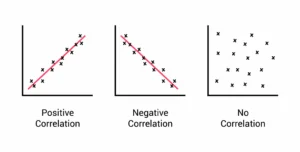
    • Positive correlation: as x increases, y tends to increase.
    • Negative correlation: as x increases, y tends to decrease.
    • No (or very weak) correlation: there is no clear linear pattern.

    1,920 × 972

    Pearson’s product–moment correlation coefficient, r

    Pearson’s coefficient r is a number between −1 and 1 that measures the strength and
    direction of the linear relationship between x and y.

    • r ≈ 1 → strong positive linear correlation.
    • r ≈ −1 → strong negative linear correlation.
    • r ≈ 0 → little or no linear correlation.

    Technology (GDC) is normally used to calculate r in IB exams. Hand calculations are not required but can help
    you understand that r combines information from means, standard deviations and the “matching” of x and y values.

    🌍 Real-World Connection:
    Correlation is widely used in economics (e.g. income vs. spending), health science
    (exercise vs. blood pressure), and environmental studies (CO₂ levels vs. temperature).
    Analysts often start by computing r to see whether a straight-line model might be reasonable.

    2. Scatter diagrams and lines of best fit

    Scatter diagrams

    A scatter diagram is a plot of the paired data (x, y) on a coordinate grid. By eye, we look for:

    • Overall direction (positive, negative or none).
    • Approximate linearity (do the points lie roughly along a straight line?).
    • Presence of outliers that do not follow the main pattern.

    Line of best fit (by eye)

    A straight line can be sketched to represent the overall trend. When doing this by eye:

    • The line should pass roughly through the mean point (average x, average y).
    • The points should be scattered fairly evenly above and below the line.

    🧠 Examiner Tip:
    When asked to comment on a scatter diagram, use clear language such as
    strong positive linear correlation
    or “weak negative correlation”.
    Avoid vague phrases like “they are sort of related”.

    3. Regression line of y on x

    Equation of the regression line

    When the relationship between x and y is roughly linear, we model it with an equation of the form
    y = a x + b.
    This is called the regression line of y on x. Technology is used to find the values of a (slope) and b (intercept) by
    minimising the total squared vertical distances between the observed points and the line.

    Meaning of the parameters a and b

    a (slope): the predicted change in y when x increases by 1 unit.
    For example, if a = 0.5, then increasing x by 1 increases the predicted y by 0.5 on average.

    b (y-intercept): the predicted value of y when x = 0. This may or may not be meaningful, depending on the context.

    🟢 GDC Tip:
    Enter x-values into one list and y-values into another (for example L1 and L2).
    Use your calculator’s LinReg or regression function to obtain a, b and r.
    Many GDCs also allow you to draw the regression line on the scatter plot to visually check the fit.

    4. Using the regression line for prediction

    Once we have a regression equation, we can use it to predict y from x.
    This is useful when we know x-values that were not directly measured.

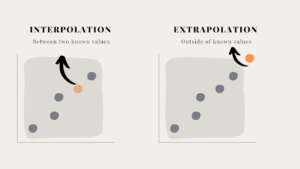
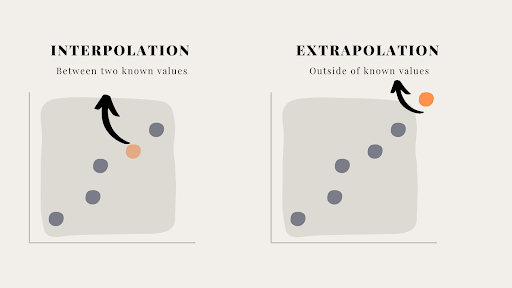
    • Interpolation: predicting for x-values within the observed data range.
      Usually reliable if the relationship is clearly linear.
    • Extrapolation: predicting for x-values outside the observed range.
      This is dangerous because the true relationship may change beyond the data.

    https://builtin.com/sites/www.builtin.com/files/styles/ckeditor_optimize/public/inline-images/

    🌍 Real-World Connection:
    Regression is used to forecast sales from advertising spend,
    exam scores from study hours, or house prices from size.
    In each case, predictions far outside the original data range can be very misleading because conditions may no longer be similar.

    🧠 Examiner Tip:
    If a question explicitly mentions values outside the data range,
    you should comment on the danger of extrapolation.
    Full marks often require a short sentence explaining that the model may no longer hold.