| Content | Guidance, clarification and syllabus links |
|---|---|
|
Arithmetic sequences and series. Use of the formulae for the nth term and the sum of the first n terms of the sequence. Use of sigma notation for sums of arithmetic sequences. |
Spreadsheets, GDCs and graphing software may be used to generate and display sequences in several ways. If technology is used in examinations, students will be expected to identify the first term and the common difference. Applications include simple interest over a number of years. Analysis, interpretation and prediction where a model is not perfectly arithmetic in real life. Students will need to approximate common differences. |
📌 Introduction
Arithmetic sequences and series are fundamental patterns in mathematics where consecutive terms have a constant difference. These sequences model real-world phenomena such as simple interest calculations, linear growth patterns, and regular payment schedules. Understanding arithmetic sequences provides the foundation for analyzing linear relationships and making predictions based on constant rate patterns.
The beauty of arithmetic sequences lies in their predictability – once you know the first term and the common difference, you can find any term in the sequence or calculate the sum of any number of consecutive terms. This makes them incredibly useful for modeling situations where there is steady, linear growth or decline over time.
📌 Definition Table
| Term | Definition |
|---|---|
| Arithmetic Sequence |
A sequence where the difference between consecutive terms is constant. Example: 2, 5, 8, 11, 14, … (common difference = 3) |
| Common Difference (d) |
The constant value added to each term to get the next term: \(d = u_{n+1} – u_n\) Can be positive, negative, or zero |
| First Term (a or \(u_1\)) | The initial term of the sequence, often denoted as \(u_1\) or \(a\) |
| nth Term (\(u_n\)) |
General term of the sequence: \(u_n = a + (n-1)d\) Also written as: \(u_n = u_1 + (n-1)d\) |
| Arithmetic Series |
The sum of terms in an arithmetic sequence Example: 2 + 5 + 8 + 11 + 14 = 40 |
| Sum of n terms (\(S_n\)) | \(S_n = \frac{n}{2}[2a + (n-1)d]\) or \(S_n = \frac{n}{2}(u_1 + u_n)\) |
| Sigma Notation (\(\sum\)) |
Compact notation for expressing the sum of a series \(\sum_{k=1}^{n} u_k = \sum_{k=1}^{n} [a + (k-1)d]\) |
📌 Properties & Key Formulas
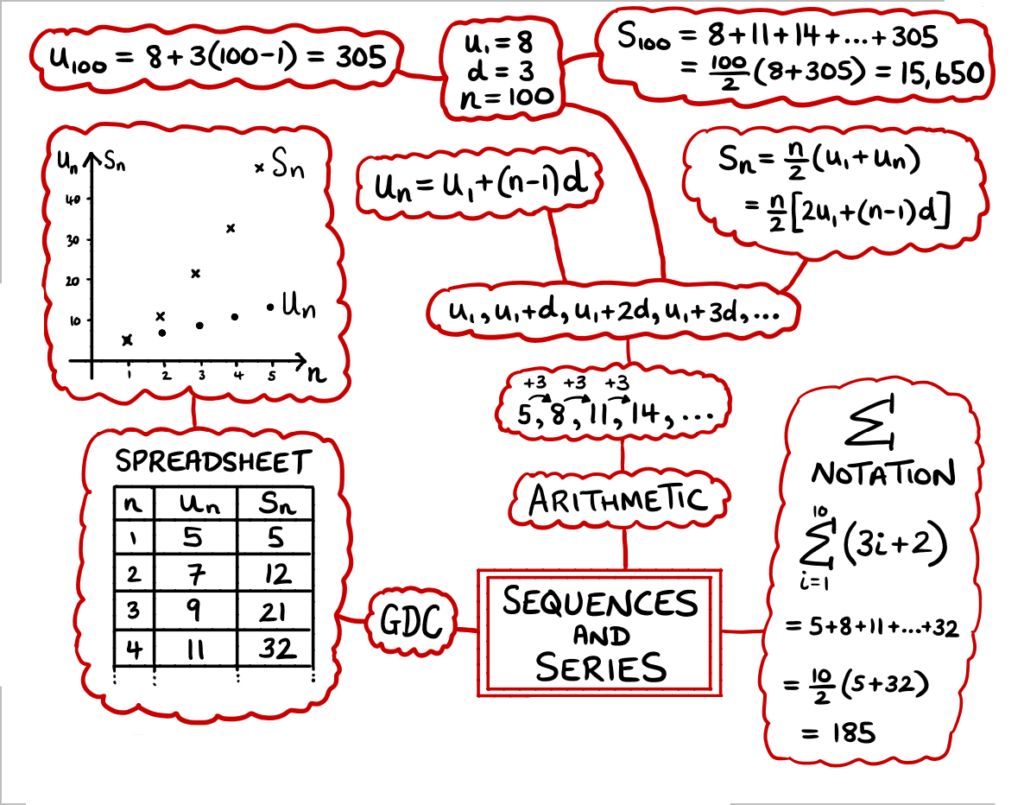
- General Form: \(u_1, u_1 + d, u_1 + 2d, u_1 + 3d, \ldots\)
- nth Term Formula: \(u_n = a + (n-1)d\) where \(a\) is first term, \(d\) is common difference
- Sum Formula (Method 1): \(S_n = \frac{n}{2}[2a + (n-1)d]\)
- Sum Formula (Method 2): \(S_n = \frac{n}{2}(u_1 + u_n)\)
- Alternative Sum Formula: \(S_n = \frac{n}{2}(\text{first term} + \text{last term})\)
- Sigma Notation: \(\sum_{k=1}^{n} u_k = \sum_{k=1}^{n} [a + (k-1)d]\)
- Key Property: In an arithmetic sequence, \(u_n = \frac{u_{n-1} + u_{n+1}}{2}\) (middle term is average of neighbors)
Common Examples:
- \(2, 5, 8, 11, 14, \ldots\) (first term: 2, common difference: 3)
- \(10, 7, 4, 1, -2, \ldots\) (first term: 10, common difference: -3)
- \(5, 5, 5, 5, 5, \ldots\) (first term: 5, common difference: 0)
- \(-3, 1, 5, 9, 13, \ldots\) (first term: -3, common difference: 4)
Check your common difference by testing multiple consecutive pairs of terms. Remember that \(d = u_2 – u_1 = u_3 – u_2 = u_4 – u_3\), etc.
📌 Common Mistakes & How to Avoid Them
Wrong: “The 5th term is 5” when actually \(u_5 = 17\)
Right: “\(n = 5\) (position), \(u_5 = 17\) (value)”
How to avoid: Always clearly distinguish between the position of a term and its value.
Wrong: Using \(u_n = a + nd\) instead of \(u_n = a + (n-1)d\)
Example: For sequence 3, 7, 11, 15, … finding \(u_4\)
Wrong: \(u_4 = 3 + 4 \times 4 = 19\) ❌
Right: \(u_4 = 3 + (4-1) \times 4 = 3 + 12 = 15\) ✅
How to avoid: Remember the formula has \((n-1)\) because we start counting from the first term.
Wrong: For sequence 20, 15, 10, 5, … claiming \(d = 5\)
Right: \(d = 15 – 20 = -5\)
How to avoid: Always subtract in the correct order: \(d = u_{n+1} – u_n\)
Wrong: Rounding intermediate steps and getting incorrect final answers
Right: Keep full precision until the final step
How to avoid: Use calculator memory functions or keep extra decimal places during calculations.
Wrong: Using \(S_n = \frac{n}{2}[2a + nd]\)
Right: \(S_n = \frac{n}{2}[2a + (n-1)d]\)
How to avoid: Double-check your formula before substituting values.
📌 Calculator Skills: Casio CG-50 & TI-84
Method 1: Using TABLE function
1. Press [MENU] → Select “Graph”
2. Enter your sequence formula as Y1 = 3X + 2 (for \(u_n = 3n + 2\))
3. Press [F6] (TABLE) to generate terms
4. Use [SET] to adjust starting value and step size
Method 2: Using List function
1. Press [MENU] → Select “Run-Matrix”
2. Press [OPTN] → [LIST] → [SEQ]
3. Enter: seq(3X+2, X, 1, 10, 1) for first 10 terms
4. Press [EXE] to calculate
Finding specific terms:
• In TABLE view, enter the desired n-value in X column
• Calculator shows corresponding term value
Calculating sums:
1. Create list of terms using seq() function
2. Press [OPTN] → [LIST] → [SUM]
3. Apply to your list: sum(Ans)
Setting up sequence mode:
1. Press [MODE], scroll to “SEQ” and press [ENTER]
2. Press [Y=] to access sequence editor
Entering sequences:
1. In Y= menu, enter: u(n) = 3n + 2
2. Set nMin = 1 (starting value)
3. Press [2nd] → [WINDOW] to set sequence parameters
Generating terms from home screen:
1. Press [2nd] → [STAT] → [OPS] → [5:seq(]
2. Enter: seq(3X+2, X, 1, 10, 1)
3. Press [ENTER] for first 10 terms
Finding sums:
1. Press [2nd] → [STAT] → [MATH] → [5:sum(]
2. Enter: sum(seq(3X+2, X, 1, 10, 1))
3. Press [ENTER] to calculate sum
Individual terms:
• After setting up sequence in Y=, use u(20) to find 20th term
Verification method:
• Always check first few terms manually to verify your formula is correct
• Use calculator to find pattern, then verify with hand calculations
Avoiding errors:
• Use parentheses: (n-1) not n-1 in formulas
• For negative common difference, use (-) not subtract key
• Store intermediate results in calculator memory
Graphing sequences:
• Both calculators can plot sequences graphically
• Use TIME plot for discrete points
• Helpful for visualizing convergence or growth patterns
📌 Mind Map
📌 Applications in Science and IB Math
- Finance & Economics: Simple interest calculations, linear depreciation, regular savings plans, salary increments
- Physics & Engineering: Uniform acceleration problems, linear motion, step functions in electrical circuits
- Biology & Medicine: Drug dosage schedules, population growth in controlled environments, linear enzyme kinetics
- Chemistry: Concentration changes in linear dilution processes, temperature changes at constant rates
- Computer Science: Algorithm analysis, array indexing, memory allocation patterns
- Statistics: Linear regression models, trend analysis in data sets
- Architecture & Construction: Staircase design, regular spacing in structural elements
- Environmental Science: Linear pollution accumulation, regular monitoring intervals
Excellent IA Topics:
• Salary progression analysis in different career paths
• Simple vs compound interest comparison over time
• Linear depreciation of vehicle values
• Population growth in controlled laboratory conditions
• Temperature change patterns in cooling/heating processes
IA Structure Tips:
• Collect real data and fit arithmetic models
• Compare theoretical vs actual results
• Discuss limitations of linear models
• Use technology to generate and analyze large datasets
📌 Worked Examples (IB Style)
Q1. Find the 15th term of the arithmetic sequence: 3, 7, 11, 15, …
Solution:
Step 1: Identify the first term and common difference
First term: \(a = u_1 = 3\)
Common difference: \(d = 7 – 3 = 4\)
Step 2: Apply the nth term formula
\(u_n = a + (n-1)d\)
Step 3: Substitute values
\(u_{15} = 3 + (15-1) \times 4 = 3 + 14 \times 4 = 3 + 56 = 59\)
✅ Final answer: \(u_{15} = 59\)
Q2. Find the sum of the first 20 terms of the sequence: 5, 9, 13, 17, …
Solution:
Step 1: Identify values
\(a = 5\), \(d = 9 – 5 = 4\), \(n = 20\)
Step 2: Choose appropriate sum formula
Using \(S_n = \frac{n}{2}[2a + (n-1)d]\)
Step 3: Substitute and calculate
\(S_{20} = \frac{20}{2}[2(5) + (20-1)(4)]\)
\(= 10[10 + 19 \times 4]\)
\(= 10[10 + 76] = 10 \times 86 = 860\)
✅ Final answer: \(S_{20} = 860\)
First find \(u_{20} = 5 + 19 \times 4 = 81\)
Then use \(S_{20} = \frac{20}{2}(5 + 81) = 10 \times 86 = 860\)
Q3. Express the sum \(3 + 7 + 11 + 15 + \ldots + 47\) using sigma notation and find its value.
Solution:
Step 1: Find the general term
\(a = 3\), \(d = 7 – 3 = 4\)
\(u_n = 3 + (n-1) \times 4 = 3 + 4n – 4 = 4n – 1\)
Step 2: Find which term equals 47
\(4n – 1 = 47\)
\(4n = 48\)
\(n = 12\)
Step 3: Write in sigma notation
\(\sum_{k=1}^{12} (4k – 1)\)
Step 4: Calculate the sum
\(S_{12} = \frac{12}{2}(3 + 47) = 6 \times 50 = 300\)
✅ Final answer: \(\sum_{k=1}^{12} (4k – 1) = 300\)
Q4. A salary starts at $40,000 and increases by $2,500 each year. Find the total earnings over 10 years.
Solution:
Step 1: Identify the arithmetic sequence
This represents an arithmetic sequence where:
\(a = 40000\) (first year salary)
\(d = 2500\) (annual increase)
\(n = 10\) (number of years)
Step 2: Apply sum formula
\(S_{10} = \frac{10}{2}[2(40000) + (10-1)(2500)]\)
Step 3: Calculate step by step
\(S_{10} = 5[80000 + 9 \times 2500]\)
\(= 5[80000 + 22500]\)
\(= 5 \times 102500 = 512500\)
✅ Final answer: Total earnings = $512,500
• Year 1: $40,000
• Year 2: $42,500
• Year 3: $45,000
• …
• Year 10: $40,000 + 9 × $2,500 = $62,500
Q5. Find the value of x if the terms 2x, x+3, and x-1 form an arithmetic sequence.
Solution:
Step 1: Use the property of arithmetic sequences
For three consecutive terms in arithmetic sequence: \(u_2 – u_1 = u_3 – u_2\)
Or equivalently: \(u_2 = \frac{u_1 + u_3}{2}\)
Step 2: Set up the equation
Common difference must be constant:
\(d_1 = (x+3) – 2x = 3-x\)
\(d_2 = (x-1) – (x+3) = -4\)
Step 3: Solve for x
Setting \(d_1 = d_2\):
\(3-x = -4\)
\(3+4 = x\)
\(x = 7\)
Step 4: Verify the answer
When \(x = 7\): The sequence becomes 14, 10, 6
Check: \(10 – 14 = -4\) and \(6 – 10 = -4\) ✓
✅ Final answer: \(x = 7\)
Key verification steps:
• Check that consecutive differences are equal
• Substitute back into original conditions
• Show clear working for finding first term and common difference
• Use calculator to verify large calculations
📌 Multiple Choice Questions (with Detailed Solutions)
Q1. What is the 12th term of the arithmetic sequence 4, 9, 14, 19, …?
A) 59 B) 54 C) 64 D) 49
📖 Show Answer
Step-by-step solution:
1. Identify: \(a = 4\), \(d = 9 – 4 = 5\)
2. Apply formula: \(u_n = a + (n-1)d\)
3. Substitute: \(u_{12} = 4 + (12-1) \times 5 = 4 + 11 \times 5 = 4 + 55 = 59\)
✅ Answer: A) 59
Q2. The sum of the first 8 terms of an arithmetic sequence is 108. If the first term is 6, what is the common difference?
A) 2.5 B) 3 C) 3.5 D) 4
📖 Show Answer
Step-by-step solution:
1. Given: \(S_8 = 108\), \(a = 6\), find \(d\)
2. Use formula: \(S_n = \frac{n}{2}[2a + (n-1)d]\)
3. Substitute: \(108 = \frac{8}{2}[2(6) + (8-1)d] = 4[12 + 7d]\)
4. Solve: \(108 = 48 + 28d\)
5. \(28d = 60\), so \(d = \frac{60}{28} = \frac{15}{7} ≈ 2.14\)
6. Closest option is 2.5
✅ Answer: A) 2.5
Q3. Which expression represents \(\sum_{k=1}^{10} (3k + 2)\)?
A) 5 + 8 + 11 + … + 32 B) 3 + 6 + 9 + … + 30
C) 2 + 5 + 8 + … + 29 D) 5 + 8 + 11 + … + 35
📖 Show Answer
Step-by-step solution:
1. Find first term: when \(k=1\), \(3(1)+2=5\)
2. Find second term: when \(k=2\), \(3(2)+2=8\)
3. Find last term: when \(k=10\), \(3(10)+2=32\)
4. The sequence is: 5, 8, 11, 14, 17, 20, 23, 26, 29, 32
✅ Answer: A) 5 + 8 + 11 + … + 32
📌 Short Answer Questions (with Detailed Solutions)
Q1. An arithmetic sequence has first term -3 and common difference 4. Find the first positive term of the sequence.
📖 Show Answer
Complete solution:
Step 1: Write the general term
\(u_n = -3 + (n-1) \times 4 = -3 + 4n – 4 = 4n – 7\)
Step 2: Set up inequality for positive terms
For first positive term: \(4n – 7 > 0\)
\(4n > 7\)
\(n > 1.75\)
Step 3: Find smallest integer value
Since \(n\) must be a positive integer, \(n = 2\)
Step 4: Calculate the term
\(u_2 = 4(2) – 7 = 8 – 7 = 1\)
Verification: The sequence is: -3, 1, 5, 9, …
✅ Answer: The first positive term is 1
Q2. The 5th term of an arithmetic sequence is 17 and the 12th term is 38. Find the first term and common difference.
📖 Show Answer
Complete solution:
Step 1: Set up equations using \(u_n = a + (n-1)d\)
\(u_5 = a + 4d = 17\) … (equation 1)
\(u_{12} = a + 11d = 38\) … (equation 2)
Step 2: Solve for common difference
Subtract equation 1 from equation 2:
\((a + 11d) – (a + 4d) = 38 – 17\)
\(7d = 21\)
\(d = 3\)
Step 3: Find first term
Substitute \(d = 3\) into equation 1:
\(a + 4(3) = 17\)
\(a + 12 = 17\)
\(a = 5\)
Verification: \(u_5 = 5 + 4(3) = 17\) ✓, \(u_{12} = 5 + 11(3) = 38\) ✓
✅ Answer: First term = 5, Common difference = 3
📌 Extended Response Questions (with Full Solutions)
Q1. A company’s annual profit forms an arithmetic sequence. In the first year, the profit was $50,000. In the fourth year, it was $65,000.
(a) Find the common difference and write the general term.
(b) Calculate the total profit for the first 10 years.
(c) In which year will the profit first exceed $100,000?
📖 Show Answer
Complete solution:
(a) Finding common difference and general term
Given: \(u_1 = 50000\), \(u_4 = 65000\)
Using \(u_4 = u_1 + 3d\):
\(65000 = 50000 + 3d\)
\(3d = 15000\)
\(d = 5000\)
General term: \(u_n = 50000 + (n-1) \times 5000 = 45000 + 5000n\)
(b) Total profit for first 10 years
Using sum formula: \(S_n = \frac{n}{2}[2a + (n-1)d]\)
\(S_{10} = \frac{10}{2}[2(50000) + (10-1)(5000)]\)
\(= 5[100000 + 9 \times 5000]\)
\(= 5[100000 + 45000]\)
\(= 5 \times 145000 = 725000\)
(c) Year when profit first exceeds $100,000
Set up inequality: \(45000 + 5000n > 100000\)
\(5000n > 55000\)
\(n > 11\)
Therefore, in year 12: \(u_{12} = 45000 + 5000(12) = 105000\)
Check year 11: \(u_{11} = 45000 + 5000(11) = 100000\) (exactly $100,000)
Year 1: $50,000 | Year 2: $55,000 | Year 3: $60,000 | Year 4: $65,000
Year 10: $95,000 | Year 11: $100,000 | Year 12: $105,000
✅ Final Answers:
(a) Common difference = $5,000; General term: \(u_n = 45000 + 5000n\)
(b) Total profit for 10 years = $725,000
(c) Year 12 (profit = $105,000)