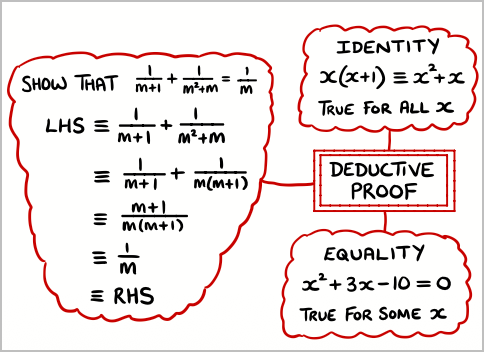
This question bank contains 11 questions covering simple deductive proof techniques, distributed across different paper types according to IB AAHL curriculum standards.
📌 Multiple Choice Questions (2 Questions)
MCQ 1. Which of the following is a counterexample to the statement “All prime numbers are odd”?
A) 3 B) 5 C) 2 D) 7
📖 Show Answer
Solution:
To find a counterexample, we need a prime number that is NOT odd (i.e., is even).
Check each option:
A) 3 is prime and odd ✗
B) 5 is prime and odd ✗
C) 2 is prime and even ✓
D) 7 is prime and odd ✗
✅ Answer: C) 2 (2 is prime but even, disproving the statement)
MCQ 2. In a proof by contradiction, what do we assume at the beginning?
A) The statement we want to prove
B) The opposite of what we want to prove
C) A related statement
D) Nothing specific
📖 Show Answer
Solution:
Proof by contradiction follows this structure:
1. Assume the negation (opposite) of what we want to prove
2. Show this assumption leads to a logical contradiction
3. Conclude the original statement must be true
✅ Answer: B) The opposite of what we want to prove
📌 Paper 1 Questions (No Calculator) – 4 Questions
Paper 1 – Q1. Prove that the sum of two odd integers is always even.
[4 marks]
📖 Show Answer
Solution:
Proof: Let the two odd integers be represented as general forms.
Since the first integer is odd, we can write it as 2a + 1 for some integer a.
Since the second integer is odd, we can write it as 2b + 1 for some integer b.
❌ No counterexample exists – the statement is actually TRUE!
Paper 1 – Q4. Prove that if n² is odd, then n is odd.
[4 marks]
📖 Show Answer
Solution (Proof by Contradiction):
Step 1: Assume the opposite.
Assume n² is odd but n is even.
Step 2: Since n is even, we can write n = 2k for some integer k.
Step 3: Calculate n².
n² = (2k)² = 4k² = 2(2k²)
Step 4: Identify the contradiction.
Since 2k² is an integer, n² = 2(2k²) is even.
But we assumed n² is odd. This is a contradiction.
Step 5: Conclude.
Our assumption must be false. Therefore, if n² is odd, then n is odd. ∎
✅ Proof by contradiction complete
📌 Paper 2 Questions (Calculator Allowed) – 6 Questions
Paper 2 – Q1. Prove that √3 is irrational using proof by contradiction.
[6 marks]
📖 Show Answer
Solution:
Proof by contradiction:
Step 1: Assume √3 is rational.
Then √3 = p/q where p, q are integers with no common factors and q ≠ 0.
Step 2: Square both sides.
3 = p²/q², so 3q² = p²
Step 3: Analyze divisibility.
Since 3q² = p², we know 3 divides p². This means 3 divides p.
So p = 3r for some integer r.
Step 4: Substitute back.
3q² = (3r)² = 9r², so q² = 3r²
Step 5: Find contradiction.
Since q² = 3r², we know 3 divides q² and hence 3 divides q.
Both p and q are divisible by 3, contradicting our assumption that they have no common factors.
Therefore, √3 is irrational. ∎
✅ √3 is irrational
Paper 2 – Q2. Consider the statement: “If x > 0 and y > 0, then xy > 0.”
(a) Prove this statement using direct proof. [3 marks]
(b) State the contrapositive of this statement. [2 marks]
📖 Show Answer
Solution:
(a) Direct Proof:
Given: x > 0 and y > 0
To prove: xy > 0
Proof: Since x > 0, we know x is positive.
Since y > 0, we know y is positive.
By the properties of real numbers, the product of two positive numbers is positive.
Therefore, xy > 0. ∎
(b) Contrapositive:
Original: “If (x > 0 and y > 0), then xy > 0”
Contrapositive: “If xy ≤ 0, then (x ≤ 0 or y ≤ 0)”
✅ Direct proof and contrapositive complete
Paper 2 – Q3. In a right triangle with legs of length a and b and hypotenuse of length c, prove that a² + b² = c² (Pythagorean theorem).
[7 marks]
📖 Show Answer
Geometric Proof:
Construction: Draw a square with side length (a + b).
Inside this square, place four identical right triangles with legs a and b.
Step 1: Calculate the area of the large square.
Area = (a + b)² = a² + 2ab + b²
Step 2: Calculate the areas of the components.
Four triangles: 4 × (½ab) = 2ab
Inner square (formed by hypotenuses): c²
Step 3: Set up the equation.
Total area = Area of triangles + Area of inner square
a² + 2ab + b² = 2ab + c²
Step 4: Solve for c².
a² + 2ab + b² – 2ab = c²
a² + b² = c² ∎
✅ Pythagorean theorem proven
Paper 2 – Q4. Prove that between any two distinct rational numbers, there exists another rational number.
[5 marks]
📖 Show Answer
Solution:
Given: Two distinct rational numbers r₁ and r₂ where r₁ < r₂
To prove: There exists a rational number r such that r₁ < r < r₂
Proof: Consider the average of r₁ and r₂:
r = (r₁ + r₂)/2
Step 1: Show r is rational.
Since r₁ and r₂ are rational, r₁ = p₁/q₁ and r₂ = p₂/q₂ for integers p₁, p₂, q₁, q₂
r = (p₁/q₁ + p₂/q₂)/2 = (p₁q₂ + p₂q₁)/(2q₁q₂)
Since the numerator and denominator are integers, r is rational.
• proof of the irrationality of numbers such as \(\sqrt{2}\)
• geometric proof
Students should understand the nature of proof and be able to construct simple proofs.
The difference between a proof and verification by examples should be understood.
Use of technology to verify results is encouraged, but this does not constitute proof.
Simple counterexamples to show that a statement is false.
Link to proof by induction in AHL topic 1.
📌 Introduction
Mathematical proof is the cornerstone of mathematical reasoning, providing absolute certainty that mathematical statements are true. Unlike verification through examples or calculator computations, proof establishes truth through logical reasoning that covers all possible cases. Simple deductive proof forms the foundation of mathematical thinking and provides students with essential skills for rigorous mathematical argument.
The ability to construct and understand mathematical proofs develops critical thinking skills that extend beyond mathematics. Students learn to distinguish between evidence (which suggests truth) and proof (which establishes truth), understand the logical structure of arguments, and appreciate the beauty and certainty that mathematical proof provides. This topic introduces fundamental proof techniques that students will encounter throughout their mathematical studies.
📌 Definition Table
Term
Definition
Proof
A logical argument that establishes the truth of a mathematical statement with complete certainty
Must cover all possible cases, not just specific examples
Deductive Proof
A proof that proceeds from general principles (axioms, definitions, previously proven theorems) to specific conclusions
Uses logical reasoning to establish truth
Proof by Contradiction
Assume the opposite of what you want to prove, then show this leads to a logical contradiction
Also called reductio ad absurdum (“reduction to absurdity”)
Direct Proof
A straightforward logical argument that proceeds directly from assumptions to conclusion
Often uses algebraic manipulation or logical steps
Counterexample
A single example that shows a statement is false
One counterexample is sufficient to disprove a universal statement
Rational Number
A number that can be expressed as \(\frac{p}{q}\) where p and q are integers and \(q \neq 0\)
Examples: \(\frac{1}{2}\), \(-3\), \(0.25\)
Irrational Number
A real number that cannot be expressed as \(\frac{p}{q}\) where p and q are integers
Examples: \(\sqrt{2}\), \(\pi\), \(e\)
Theorem
A mathematical statement that has been proven to be true
Can be used as a foundation for proving other statements
Assumption/Hypothesis
A statement that is taken to be true for the purpose of the proof
Starting point from which conclusions are drawn
📌 Properties & Key Concepts
Structure of Proof: Assumptions → Logical Steps → Conclusion
Proof vs Verification: Proof covers all cases; examples only verify specific instances
Contradiction Method: Assume negation → Derive contradiction → Original statement is true
Algebraic Proof: Use algebraic manipulation and known properties to establish relationships
Geometric Proof: Use geometric properties, theorems, and logical reasoning
Universal vs Existential: “All” statements need general proof; “Some” statements need one example
Disproof by Counterexample: One example that violates the statement disproves it
Common Proof Structures:
Common Proof Structures:
Direct Proof: To prove P implies Q, assume P and show Q follows
Proof by Contradiction: To prove P, assume not P and derive a contradiction
Proof by Cases: Consider all possible cases and prove the statement in each case
Existence Proof: To prove something exists, construct an example
Uniqueness Proof: Show existence, then show any two solutions must be equal
🧠 Examiner Tip:Always state your assumptions clearly and justify each logical step in your proof.
Remember: A proof must be convincing to someone who is skeptical. Every step must be logically justified, and all cases must be covered.
📌 Common Mistakes & How to Avoid Them
⚠️ Common Mistake #1: Confusing proof with verification by examples
Wrong: “Since 2² + 3² = 13 is odd, the sum of squares of consecutive integers is always odd” Right: Use algebraic proof: If n and n+1 are consecutive integers, then n² + (n+1)² = 2n² + 2n + 1, which is always odd
How to avoid: Examples suggest patterns but don’t prove them. Use general algebraic expressions.
⚠️ Common Mistake #2: Assuming what you want to prove
Wrong: “To prove √2 is irrational, assume √2 is irrational…” Right: “To prove √2 is irrational, assume √2 is rational and derive a contradiction”
How to avoid: In proof by contradiction, assume the negation of what you want to prove.
⚠️ Common Mistake #3: Incomplete case analysis
Wrong: Proving a statement only for positive integers when it should hold for all integers Right: Consider all relevant cases: positive, negative, and zero
How to avoid: Identify all possible cases before beginning the proof.
⚠️ Common Mistake #4: Unclear logical structure
Wrong: Jumping between unrelated statements without clear connections Right: Each statement should follow logically from previous statements
How to avoid: Use connecting words: “therefore,” “since,” “because,” “it follows that.”
⚠️ Common Mistake #5: Misunderstanding proof by contradiction
Wrong: Deriving the original statement as the “contradiction” Right: Derive a logical impossibility (like 0 = 1 or p is both odd and even)
How to avoid: The contradiction should be a statement that is obviously false or violates basic logic.
📌 Calculator Skills: Verification vs Proof
📱 Using Technology for Verification (Not Proof)
Calculator can help verify results:
1. Test conjectures with multiple examples
2. Check arithmetic in your proofs
3. Explore patterns that might suggest proof strategies
4. Verify final answers
What calculators CANNOT do:
• Prove general statements
• Cover infinite cases
• Provide logical justification
• Replace mathematical reasoning
Using Casio CG-50 for exploration:
1. Use TABLE function to test patterns
2. Graph functions to visualize relationships
3. Use STAT functions to analyze data patterns
4. Verify specific calculations within your proof
📱 TI-84 for Pattern Recognition
Useful functions for proof preparation:
1. Use [2nd] [TABLE] to generate sequences
2. Graph functions to see behavior
3. Use [MATH] menu for number theory functions
4. Store formulas and test multiple values
Example: Testing irrationality of √2
1. Calculate √2 to many decimal places
2. Try to find rational approximations
3. Observe that no simple fraction equals √2 exactly
4. This suggests √2 might be irrational (but doesn’t prove it!)
Engineering: Proving safety and reliability of systems, mathematical modeling validation
Cryptography: Proving security of encryption methods, mathematical foundations of cybersecurity
Economics: Proving optimality of economic models, game theory proofs
Statistics: Proving properties of statistical tests, establishing confidence intervals
➗ IA Tips & Guidance:Mathematical proof can provide excellent IA opportunities for exploring fundamental mathematical concepts.
Suitable IA Topics:
• Explore different proofs of the irrationality of √2, √3, etc.
• Investigate the proof of the infinitude of prime numbers
• Examine geometric proofs vs algebraic proofs of the same result
• Study proof by contradiction vs direct proof methods
• Explore historical development of proof techniques
• Investigate counterintuitive mathematical results and their proofs
• Compare proof methods across different areas of mathematics
IA Structure Tips:
• Present multiple proof methods for the same result
• Discuss the historical context and development of proof techniques
• Analyze the logical structure of different types of proofs
• Include your own attempts at constructing proofs
• Reflect on the role of proof in mathematical certainty
• Connect proof methods to broader mathematical thinking
📌 Worked Examples (IB Style)
Q1. Prove that the sum of two even integers is always even.
Solution (Direct Proof):
Step 1: State what we want to prove
We want to prove: If a and b are even integers, then a + b is even.
Step 2: Use the definition of even numbers
Since a is even, we can write a = 2k for some integer k
Since b is even, we can write b = 2m for some integer m
Step 3: Add the two even numbers
a + b = 2k + 2m = 2(k + m)
Step 4: Conclude
Since k + m is an integer, 2(k + m) is even by definition.
Therefore, a + b is even.
✅ The sum of two even integers is always even. ∎
Q2. Prove that √2 is irrational.
Solution (Proof by Contradiction):
Step 1: Assume the opposite
Assume √2 is rational. Then √2 = p/q where p, q are integers with no common factors and q ≠ 0.
Step 2: Square both sides
2 = p²/q², so 2q² = p²
Step 3: Analyze what this means
Since 2q² = p², we know p² is even, which means p is even.
So p = 2r for some integer r.
Step 4: Substitute back
2q² = (2r)² = 4r², so q² = 2r²
This means q² is even, so q is even.
Step 5: Find the contradiction
Both p and q are even, so they have a common factor of 2.
This contradicts our assumption that p and q have no common factors.
Step 6: Conclude
Our assumption must be false. Therefore, √2 is irrational.
✅ √2 is irrational. ∎
Q3. Prove that in any triangle, the sum of any two sides is greater than the third side.
Solution (Geometric Proof):
Step 1: Set up the triangle
Let triangle ABC have sides of length a, b, and c opposite to vertices A, B, and C respectively.
Step 2: Consider the path from A to C
The direct path from A to C has length b.
The indirect path from A to B to C has length a + c.
Step 3: Apply the geometric principle
The shortest distance between two points is a straight line.
Therefore, the direct path is shorter than any indirect path: b < a + c
Step 4: Apply to all combinations
Similarly: a < b + c and c < a + b
Step 5: Conclude
In any triangle, the sum of any two sides is greater than the third side.
This is known as the Triangle Inequality.
✅ Triangle Inequality proven. ∎
Q4. Disprove: “All prime numbers are odd.”
Solution (Counterexample):
Step 1: Understand what we need to disprove
The statement claims that every prime number is odd.
To disprove this, we need just one even prime number.
Step 2: Find a counterexample
Consider the number 2.
Step 3: Verify it’s prime
2 has exactly two positive divisors: 1 and 2.
Therefore, 2 is prime by definition.
Step 4: Verify it’s even
2 = 2 × 1, so 2 is divisible by 2.
Therefore, 2 is even by definition.
Step 5: Conclude
Since 2 is both prime and even, the statement “All prime numbers are odd” is false.
❌ Statement disproven by counterexample: 2 is prime and even. ∎
Q5. Prove that the square of an odd integer is odd.
Solution (Algebraic Proof):
Step 1: Express an odd integer generally
Let n be an odd integer. Then n = 2k + 1 for some integer k.
Step 5: Conclude
Since 2k(k + 1) is an integer, n² has the form 2m + 1 where m = 2k(k + 1).
Therefore, n² is odd by definition.
✅ The square of an odd integer is always odd. ∎
📝 Paper Tip:Always end your proofs with a clear conclusion and use the ∎ symbol or “QED” to indicate completion.
Key proof-writing tips:
• State assumptions clearly at the beginning
• Use precise mathematical language
• Justify each logical step
• Consider all necessary cases
• Write for a skeptical audience
• End with a definitive conclusion
Q1. Which of the following is a counterexample to the statement “All even numbers greater than 2 are composite”?
A) 4 B) 6 C) 8 D) None of these
📖 Show Answer
Step-by-step solution:
Check each option:
A) 4 = 2 × 2, so 4 is composite (has factors other than 1 and itself)
B) 6 = 2 × 3, so 6 is composite
C) 8 = 2 × 4, so 8 is composite
All even numbers greater than 2 are indeed composite (they’re all divisible by 2).
✅ Answer: D) None of these (the statement is actually true)
Q2. In a proof by contradiction, what do we assume at the beginning?
A) The statement we want to prove
B) The negation of what we want to prove
C) A related but different statement
D) Nothing; we start from first principles
📖 Show Answer
Solution:
In proof by contradiction, we assume the opposite (negation) of what we want to prove.
Then we show this assumption leads to a logical contradiction.
Since the assumption leads to impossibility, the original statement must be true.
✅ Answer: B) The negation of what we want to prove
Q3. What is the difference between a mathematical proof and verification by examples?
A) There is no difference
B) Proof covers all cases; examples only show specific instances
C) Examples are more reliable than proofs
D) Proofs are just many examples put together
📖 Show Answer
Solution:
A proof establishes truth for ALL possible cases using logical reasoning.
Examples only verify the statement for specific instances.
No matter how many examples you test, you cannot prove a general statement without covering all cases.
✅ Answer: B) Proof covers all cases; examples only show specific instances
📌 Short Answer Questions (with Detailed Solutions)
Q1. Prove that the product of two consecutive integers is always even.
📖 Show Answer
Complete solution:
Proof: Let n be any integer. Then n and n+1 are consecutive integers.
Case 1: If n is even, then n = 2k for some integer k.
Product = n(n+1) = 2k(n+1) = 2[k(n+1)], which is even.
Case 2: If n is odd, then n+1 is even, so n+1 = 2m for some integer m.
Product = n(n+1) = n(2m) = 2[nm], which is even.
In both cases, the product is even. ∎
✅ The product of consecutive integers is always even.
Q2. Find a counterexample to disprove: “If n² is even, then n is even.”
📖 Show Answer
Complete solution:
Wait – let me reconsider this statement. Let’s test some values:
If n = 1 (odd): n² = 1 (odd)
If n = 2 (even): n² = 4 (even)
If n = 3 (odd): n² = 9 (odd)
If n = 4 (even): n² = 16 (even)
Actually, this statement appears to be TRUE! We cannot find a counterexample because:
If n is odd, then n² is odd (never even).
So whenever n² is even, n must indeed be even.
❌ No counterexample exists – the statement is actually true!
This question bank contains 11 questions covering laws of exponents and introduction to logarithms, distributed across different paper types according to IB AAHL curriculum standards.
📌 Multiple Choice Questions (2 Questions)
MCQ 1. Simplify: \(\frac{3^7 \times 3^2}{3^5}\)
A) \(3^2\) B) \(3^4\) C) \(3^9\) D) \(3^{14}\)
📖 Show Answer
Solution:
Step 1: Apply product law in numerator: \(3^7 \times 3^2 = 3^{7+2} = 3^9\)
Paper 3 – Q2. The magnitude of an earthquake is given by the Richter scale formula: \(M = \log\left(\frac{A}{A_0}\right)\), where A is the amplitude of seismic waves and \(A_0\) is a reference amplitude.
(a) An earthquake has amplitude 50,000 times the reference amplitude. Find its magnitude. [2 marks]
(b) How many times greater is the amplitude of a magnitude 7 earthquake compared to a magnitude 4 earthquake? [3 marks]
(c) Two earthquakes occur with magnitudes 6.2 and 8.1 respectively. Express the ratio of their amplitudes in the form \(10^k\) where k is exact. [4 marks]
✅ Final Answers:
(a) Magnitude = 4.7
(b) 1000 times greater
(c) \(10^{1.9}\)
Paper 3 – Q3. A radioactive substance decays according to the formula \(N(t) = N_0 e^{-\lambda t}\), where \(N(t)\) is the amount remaining after time t, \(N_0\) is the initial amount, and \(\lambda\) is the decay constant.
(a) A sample has a half-life of 20 years. Find the decay constant \(\lambda\). [3 marks]
(b) Starting with 100g, how much remains after 50 years? [2 marks]
(c) After how many years will only 10g remain? [4 marks]
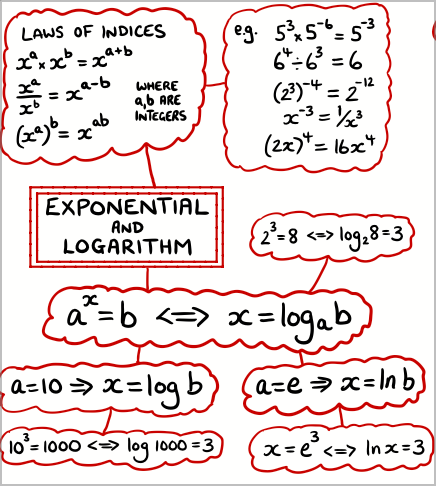
Introduction to logarithms with base 10 and base e.
Numerical evaluation of logarithms using technology.
Relationship between logarithms and exponents.
Laws of logarithms.
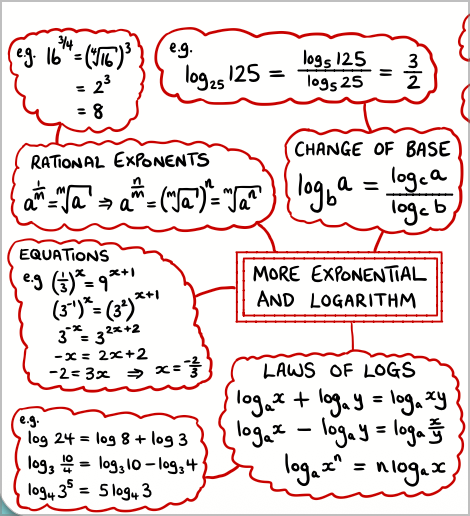
Change of base.
The definition of a logarithm is not expected to be proved or derived by students.
Students are expected to be able to determine exact values of logarithms such as \(\log_2 8\) and \(\log_{10} 0.001\).
Use of technology to evaluate logarithms.
Solving exponential equations using logarithms.
Solving logarithmic equations.
Link to exponential and logarithmic functions in topic 2.
📌 Introduction
The laws of exponents provide the foundation for working with powers and form the basis for understanding exponential functions. These rules allow us to simplify complex expressions involving powers and solve equations where variables appear as exponents. The concept of logarithms emerges as the inverse operation of exponentiation, enabling us to “undo” exponential operations.
Understanding exponents and logarithms is crucial for modeling real-world phenomena such as population growth, radioactive decay, sound intensity (decibels), earthquake magnitude (Richter scale), and pH in chemistry. These mathematical tools bridge algebra and advanced topics like calculus, providing essential techniques for solving exponential and logarithmic equations that appear throughout mathematics and science.
📌 Definition Table
Term
Definition
Exponent (Power)
In \(a^n\), the exponent \(n\) indicates how many times the base \(a\) is multiplied by itself
Example: \(2^5 = 2 \times 2 \times 2 \times 2 \times 2 = 32\)
Base
In \(a^n\), the base \(a\) is the number being raised to the power
Must be positive for real-valued logarithms
Logarithm
\(\log_a x = y\) means \(a^y = x\)
The logarithm is the exponent to which the base must be raised to get the argument
Common Logarithm
\(\log x\) means \(\log_{10} x\) (base 10)
Used in scientific applications like pH and Richter scale
Natural Logarithm
\(\ln x\) means \(\log_e x\) where \(e ≈ 2.718\)
Used in calculus and natural growth/decay models
Argument
In \(\log_a x\), the argument is \(x\)
Must be positive for real-valued logarithms
Zero Exponent
\(a^0 = 1\) for any \(a ≠ 0\)
Example: \(5^0 = 1\), \((-3)^0 = 1\)
How to avoid: Remember that exponent laws apply to multiplication and division, not addition and subtraction.
⚠️ Common Mistake #2: Confusing the order in logarithm definition
Wrong: If \(\log_a x = y\), then \(x^y = a\) Right: If \(\log_a x = y\), then \(a^y = x\)
How to avoid: Remember: “base to the power equals argument” – the base gets raised to the power.
⚠️ Common Mistake #3: Applying log laws to expressions that aren’t products/quotients
Wrong: \(\log(x + y) = \log x + \log y\) Right: \(\log(xy) = \log x + \log y\) (product, not sum)
How to avoid: Log laws only work for multiplication, division, and powers – not addition or subtraction.
⚠️ Common Mistake #4: Forgetting domain restrictions
Wrong: Solving \(\log(x – 2) = 1\) and getting \(x = 12\) without checking Right: Check that \(x – 2 > 0\), so \(x > 2\). Since 12 > 2, the solution is valid
How to avoid: Always verify that arguments of logarithms are positive.
⚠️ Common Mistake #5: Confusing common and natural logarithms
Wrong: Using \(\log\) and \(\ln\) interchangeably Right: \(\log x = \log_{10} x\) and \(\ln x = \log_e x\) are different functions
How to avoid: Always specify the base or use the correct notation. When in doubt, write the base explicitly.
📌 Calculator Skills: Casio CG-50 & TI-84
📱 Using Casio CG-50 for Exponents and Logarithms
Exponents:
1. Use [^] key for exponents: 2^5 gives 32
2. For negative exponents: 2^(-3) using parentheses
3. Scientific notation: 1.5 × 10^6 enter as 1.5E6
Logarithms:
1. [LOG] key for base-10 logarithms: log(100) = 2
2. [LN] key for natural logarithms: ln(e) = 1
3. For other bases, use change of base: log₂(8) = ln(8)/ln(2)
Solving equations:
1. Press [MENU] → “Equation/Func” → “Solve”
2. Enter equation like: 2^X=32
3. Press [SOLVE] and specify range for X
Verification:
• Use [ANS] key to check solutions
• Store values in variables: 5→A, then use A in calculations
📱 Using TI-84 for Exponents and Logarithms
Exponents:
1. Use [^] or [**] for exponents
2. [2nd] [^] for square root, or use fractional exponents
3. Store large numbers: 2.5E8 for 2.5 × 10⁸
Logarithms:
1. [LOG] for base-10: LOG(1000) = 3
2. [LN] for natural log: LN(e²) = 2
3. Change of base: LOG(8)/LOG(2) for log₂(8)
Equation solver:
1. Press [MATH] → [0:Solver]
2. Enter 0 = 2^X – 32
3. Press [ENTER], then [ALPHA] [SOLVE]
Graphing method:
1. Graph Y₁ = 2^X and Y₂ = 32
2. Use [2nd] [CALC] → [5:intersect] to find solution
3. This visual method helps verify algebraic solutions
📱 Calculator Tips & Tricks
Checking your work:
• Substitute solutions back into original equations
• Use different approaches (algebraic vs graphical) for verification
• Round appropriately for context (exact vs decimal)
Common calculator errors:
• Forgetting parentheses in complex expressions
• Using LOG when you mean LN (or vice versa)
• Not clearing previous calculations
Efficiency tips:
• Learn to use memory functions (STO→ and RCL)
• Use parentheses liberally to avoid order of operations errors
• Check your calculator is in the correct angle mode if using trig
Computer Science: Algorithm complexity (\(O(\log n)\)), information theory, data compression
Engineering: Signal processing, control systems, electrical circuits with capacitors
Psychology: Weber-Fechner law (perception intensity), learning curves, memory decay
➗ IA Tips & Guidance:Exponents and logarithms provide excellent IA opportunities for modeling real-world phenomena.
Excellent IA Topics:
• pH analysis of household substances using logarithmic scale
• Earthquake magnitude comparison using Richter scale mathematics
• Population growth modeling with exponential and logistic functions
• Sound intensity and decibel scale investigation
• Radioactive decay simulation and half-life calculations
• Bacterial growth experiments with exponential modeling
• Investment growth: comparing exponential models
IA Structure Tips:
• Collect real data and fit exponential/logarithmic models
• Use technology for regression analysis and curve fitting
• Compare theoretical predictions with experimental results
• Discuss limitations and assumptions of exponential models
• Include error analysis and goodness of fit measures
• Connect mathematical concepts to real-world implications
📌 Worked Examples (IB Style)
Q1. Simplify: \(\frac{2^5 \times 2^3}{2^4}\)
Solution:
Step 1: Apply the product law in the numerator
\(2^5 \times 2^3 = 2^{5+3} = 2^8\)
Step 2: Apply the quotient law
\(\frac{2^8}{2^4} = 2^{8-4} = 2^4\)
Step 3: Evaluate
\(2^4 = 16\)
✅ Final answer: 16
Q2. Solve for x: \(3^{x+1} = 27\)
Solution:
Step 1: Express 27 as a power of 3
\(27 = 3^3\)
Step 2: Rewrite the equation
\(3^{x+1} = 3^3\)
Step 3: Since the bases are equal, the exponents are equal
\(x + 1 = 3\)
Step 4: Solve for x
\(x = 3 – 1 = 2\)
✅ Final answer: x = 2
Q3. Find the exact value of \(\log_4 64\)
Solution:
Step 1: Use the definition of logarithm
\(\log_4 64 = y\) means \(4^y = 64\)
Step 2: Express both numbers as powers of 2
\(4 = 2^2\) and \(64 = 2^6\)
Step 3: Substitute into the equation
\((2^2)^y = 2^6\)
\(2^{2y} = 2^6\)
Step 4: Equate exponents
\(2y = 6\)
\(y = 3\)
✅ Final answer: \(\log_4 64 = 3\)
Q4. Solve for x: \(\log_2(x + 3) = 4\)
Solution:
Step 1: Convert to exponential form
\(\log_2(x + 3) = 4\) means \(2^4 = x + 3\)
Step 2: Evaluate \(2^4\)
\(2^4 = 16\)
Step 3: Solve for x
\(16 = x + 3\)
\(x = 16 – 3 = 13\)
Step 4: Check domain restriction
For \(\log_2(x + 3)\) to be defined, we need \(x + 3 > 0\)
Since \(13 + 3 = 16 > 0\), our solution is valid
✅ Final answer: x = 13
Q5. Express \(\log_3 20\) in terms of common logarithms
Solution:
Step 1: Apply the change of base formula
\(\log_a x = \frac{\log x}{\log a}\) where \(\log\) means \(\log_{10}\)
Step 3: This can be evaluated using a calculator
\(\log_3 20 = \frac{\log 20}{\log 3} ≈ \frac{1.301}{0.477} ≈ 2.727\)
✅ Final answer: \(\log_3 20 = \frac{\log 20}{\log 3}\)
Alternative using natural logs:
\(\log_3 20 = \frac{\ln 20}{\ln 3}\) (same result, different base)
📝 Paper Tip:Always check domain restrictions when solving logarithmic equations, and verify your answers by substitution.
Key verification steps:
• Check that all arguments of logarithms are positive
• Substitute solutions back into the original equation
• Use exact values when possible, approximations when required
• Show clear steps when converting between exponential and logarithmic forms
• State any restrictions on variables clearly
📌 Extended Response Questions (with Full Solutions)
Q1. The Richter scale measures earthquake magnitude using the formula \(M = \log\left(\frac{I}{I_0}\right)\), where I is the intensity of the earthquake and \(I_0\) is the intensity of a reference earthquake.
(a) An earthquake has magnitude 6.2. Express its intensity in terms of \(I_0\). [3 marks]
(b) How many times more intense is an earthquake of magnitude 8 compared to one of magnitude 5? [4 marks]
(c) Two earthquakes have intensities \(I_1\) and \(I_2\). If \(I_2 = 50 I_1\), find the difference in their magnitudes. [4 marks]
📖 Show Answer
Complete solution:
(a) Earthquake with magnitude 6.2:
Given: \(M = 6.2\)
Using \(M = \log\left(\frac{I}{I_0}\right)\):
\(6.2 = \log\left(\frac{I}{I_0}\right)\)
Converting to exponential form:
\(\frac{I}{I_0} = 10^{6.2}\)
Therefore: \(I = 10^{6.2} I_0\)
(b) Comparing magnitude 8 and magnitude 5:
For magnitude 8: \(8 = \log\left(\frac{I_8}{I_0}\right)\), so \(I_8 = 10^8 I_0\)
For magnitude 5: \(5 = \log\left(\frac{I_5}{I_0}\right)\), so \(I_5 = 10^5 I_0\)
FINANCIAL APPLICATIONS OF GEOMETRIC SEQUENCES AND SERIES
This question bank contains 12 questions covering financial applications of geometric sequences and series, distributed across different paper types according to IB AAHL curriculum standards.
📌 Multiple Choice Questions (5 Questions)
MCQ 1. $3000 is invested at 4% per annum, compounded annually, for 5 years. What is the final amount?
A) $3649.96 B) $3600.00 C) $3750.00 D) $3500.00
📖 Show Answer
Solution:
Using compound interest formula: \(FV = PV(1 + \frac{r}{100})^n\)
\(FV = 3000(1 + \frac{4}{100})^5 = 3000(1.04)^5\)
\(FV = 3000 \times 1.2167 = \$3649.96\)
✅ Answer: A) $3649.96
MCQ 2. A car worth $18,000 depreciates at 10% per annum. What is its value after 3 years?
A) $13,122 B) $14,400 C) $12,600 D) $15,120
📖 Show Answer
Solution:
Using depreciation formula: \(FV = PV(1 – \frac{d}{100})^n\)
Paper 2 – Q6. Marcus invests $8000 at an unknown interest rate, compounded quarterly. After 4 years, his investment is worth $9856.
(a) Find the annual interest rate. [4 marks]
(b) What would be the effective annual rate? [2 marks]
📖 Show Answer
Solution:
(a) Finding interest rate:
Given: PV = $8000, FV = $9856, n = 4 years, k = 4
\(9856 = 8000(1 + \frac{r}{400})^{16}\)
\((1 + \frac{r}{400})^{16} = 1.232\)
\(1 + \frac{r}{400} = (1.232)^{1/16} = 1.0133\)
\(\frac{r}{400} = 0.0133\), so \(r = 5.32\%\)
(b) Effective annual rate:
\(EAR = (1 + \frac{5.32}{400})^4 – 1\)
\(EAR = (1.0133)^4 – 1 = 1.0544 – 1 = 5.44\%\)
✅ Answer: (a) 5.32%; (b) 5.44%
📌 Paper 3 Question (Extended Response) – 1 Question
Paper 3 – Extended Question. Lisa is planning for retirement and considering two financial strategies over 30 years:
Strategy A: Invest $500 monthly in an account paying 6% per annum, compounded monthly. Strategy B: Invest $1500 quarterly in an account paying 6.2% per annum, compounded quarterly.
(a) Calculate the future value of Strategy A after 30 years. [4 marks]
(b) Calculate the future value of Strategy B after 30 years. [4 marks]
(c) Which strategy gives better returns and by how much? [2 marks]
(d) Calculate the total amount invested in each strategy. [2 marks]
(e) If inflation averages 2.5% per year, what is the real value of the better strategy in today’s purchasing power? [3 marks]
(f) Recommend which strategy Lisa should choose, justifying your answer with at least three financial considerations. [5 marks]
📖 Show Answer
Complete Solution:
(a) Strategy A Future Value:
This is a monthly annuity: PMT = $500, r = 6% p.a., n = 360 months
Monthly rate = 6/1200 = 0.005
Using annuity formula: \(FV = PMT \times \frac{(1+i)^n – 1}{i}\)
Strategy B is better by $514,500 – $502,300 = $12,200
(d) Total invested:
Strategy A: $500 × 360 = $180,000
Strategy B: $1500 × 120 = $180,000
(e) Real value with inflation:
Better strategy (B) real value = \(\frac{514,500}{(1.025)^{30}}\)
Real value = \(\frac{514,500}{2.098} = \$245,354\)
(f) Recommendation:
Recommendation: Strategy B
Financial Considerations:
1. Higher Returns: Strategy B provides $12,200 more despite equal total investment
2. Higher Interest Rate: 6.2% vs 6% compounds significantly over 30 years
3. Quarterly Discipline: Larger quarterly payments may be easier to manage than monthly commitments
4. Flexibility: Quarterly payments allow for better cash flow management
5. Compounding Benefit: Higher rate overcomes the less frequent compounding
Caution: Strategy B requires disciplined saving of larger amounts quarterly, which may be challenging if income is irregular.
✅ Final Answers:
(a) Strategy A: $502,300
(b) Strategy B: $514,500
(c) Strategy B better by $12,200
(d) Both invest $180,000 total
(e) Real value: $245,354
(f) Recommend Strategy B for higher returns
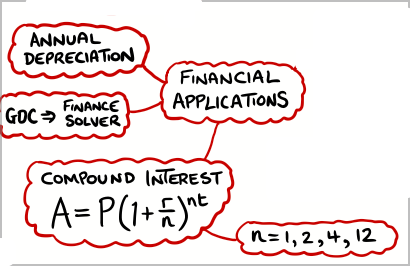
Financial applications of geometric sequences and series: compound interest, annual depreciation.
Use of technology, including built-in financial packages.
Calculate the real value of an investment with an interest rate and an inflation rate.
Examination questions may require the use of technology, including built-in financial packages.
The concept of simple interest may be used as an introduction to compound interest.
Compound interest can be calculated yearly, half-yearly, quarterly or monthly.
In examinations, questions that ask students to derive the formula will not be set.
Link to exponential models/functions in topic 2.
📌 Introduction
Financial applications of geometric sequences bridge the gap between mathematical theory and real-world economics. When money grows through compound interest or assets lose value through depreciation, these processes follow geometric patterns where each term relates to the previous by a constant multiplicative factor.
Understanding compound interest is fundamental to personal finance, investment decisions, and economic modeling. Unlike simple interest, where growth is linear, compound interest creates exponential growth as interest earns interest. Similarly, depreciation models help businesses and individuals understand how assets lose value over time, following geometric decay patterns essential for accounting, taxation, and investment planning.
📌 Definition Table
Term
Definition
Simple Interest
Interest calculated only on the principal amount. Formula: \(A = P(1 + rt)\)
Growth is linear – same amount added each period
Compound Interest
Interest calculated on principal plus accumulated interest. Formula: \(FV = PV(1 + \frac{r}{100k})^{kn}\)
Growth is exponential – interest earns interest
Present Value (PV)
The initial amount of money invested or borrowed
Also called principal amount
Future Value (FV)
The value of an investment after compound interest is applied
Total amount = Principal + Interest
Interest Rate (r)
Annual percentage rate at which money grows or is charged
Usually given as percentage per annum (p.a.)
Compounding Period (k)
How often interest is calculated and added:
Annual (k=1), Semi-annual (k=2), Quarterly (k=4), Monthly (k=12)
Depreciation
The decrease in value of an asset over time
Formula: \(FV = PV(1 – \frac{d}{100})^n\) where d is depreciation rate
Real Value
The purchasing power of money accounting for inflation
Adjusts nominal values for the effect of inflation
📌 Properties & Key Formulas
Compound Interest Formula: \(FV = PV(1 + \frac{r}{100k})^{kn}\) where k = compounding frequency
Quarterly compounding: k = 4 (four times per year)
Monthly compounding: k = 12 (twelve times per year)
Daily compounding: k = 365 (every day)
🧠 Examiner Tip:Always identify the compounding frequency first – this determines your k value and affects both the interest rate division and the exponent.
Remember: More frequent compounding leads to higher effective returns due to the “compounding effect” – interest earning interest more often throughout the year.
📌 Common Mistakes & How to Avoid Them
⚠️ Common Mistake #1: Confusing simple and compound interest formulas
Wrong: Using \(A = P(1 + rt)\) for compound interest Right: Use \(FV = PV(1 + \frac{r}{100})^n\) for annual compounding
How to avoid: Simple interest is linear (same amount added each period), compound interest is exponential (percentage of growing amount).
⚠️ Common Mistake #2: Incorrect handling of compounding frequency
Wrong: Using annual rate directly for monthly compounding Right: Divide rate by 12 and multiply time by 12 for monthly compounding Example: 6% annually, monthly compounding = \(\frac{6}{12} = 0.5\%\) per month
How to avoid: Always adjust both rate and time for the compounding frequency.
⚠️ Common Mistake #3: Sign errors in depreciation calculations
Wrong: Using addition instead of subtraction for depreciation Right: \(FV = PV(1 – \frac{d}{100})^n\) with minus sign
How to avoid: Depreciation decreases value, so use (1 – rate), not (1 + rate).
⚠️ Common Mistake #4: Mixing up PV and FV in loan calculations
Wrong: Using loan amount as FV instead of PV Right: Loan amount borrowed is PV; total amount paid back is FV
How to avoid: PV = Present (now), FV = Future (later). Money borrowed now grows to amount owed later.
⚠️ Common Mistake #5: Ignoring inflation in real value calculations
Wrong: Comparing nominal values across different time periods Right: Adjust for inflation: \(Real = \frac{Nominal}{(1 + \frac{inflation}{100})^n}\)
How to avoid: When comparing values across time, always consider purchasing power changes due to inflation.
📌 Calculator Skills: Casio CG-50 & TI-84
📱 Using Casio CG-50 for Financial Calculations
TVM Solver (Time Value of Money):
1. Press [MENU] → Select “Financial”
2. Choose “TVM Solver”
3. Enter known values:
• N = number of periods
• I% = annual interest rate
• PV = present value (negative for money paid)
• PMT = payment per period
• FV = future value
4. Position cursor on unknown value, press [SOLVE]
Compound Interest Example:
$5000 invested at 4% annually for 8 years
• N = 8
• I% = 4
• PV = -5000 (money invested)
• PMT = 0
• FV = ? (solve for this)
For monthly compounding:
• N = 8 × 12 = 96 months
• I% = 4 (annual rate)
• P/Y = 12 (payments per year)
• C/Y = 12 (compounding per year)
📱 Using TI-84 for Financial Calculations
Apps → Finance → TVM Solver:
1. Press [APPS] → “Finance” → “TVM Solver”
2. Enter values:
• N = total number of payments
• I% = annual interest rate
• PV = present value
• PMT = payment amount
• FV = future value
• P/Y = payments per year
• C/Y = compounding periods per year
3. Move cursor to unknown variable
4. Press [ALPHA] [SOLVE]
Manual calculation using formula:
1. Press [2nd] [QUIT] to exit to home screen
2. Enter formula: 5000*(1+.04)^8
3. Press [ENTER] for result
For different compounding periods:
• Quarterly: 5000*(1+.04/4)^(4*8)
• Monthly: 5000*(1+.04/12)^(12*8)
📱 Financial Calculator Tips & Tricks
Sign conventions:
• Money flowing out (invested/paid) = negative
• Money flowing in (received/earned) = positive
• This helps distinguish between loans and investments
Solving for different variables:
• Interest rate: Enter N, PV, FV; solve for I%
• Time: Enter I%, PV, FV; solve for N
• Payment: Enter N, I%, PV, FV; solve for PMT
Verification methods:
• Always check if your answer makes sense
• Compound interest should give higher returns than simple interest
• Depreciation should decrease value over time
• More frequent compounding should give slightly higher returns
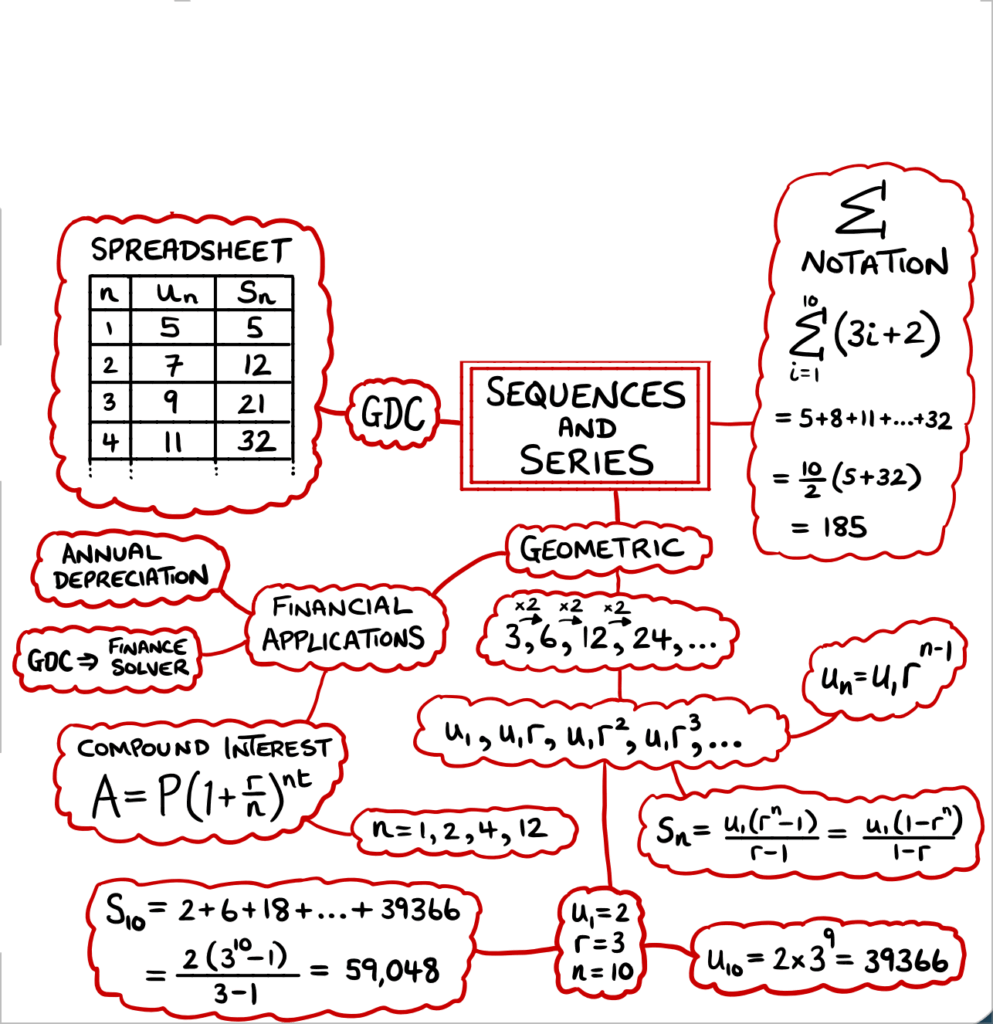
📌 Mind Map
📌 Applications in Science and IB Math
Personal Finance: Savings accounts, retirement planning, mortgage calculations, loan repayments
Business & Economics: Investment valuation, asset depreciation, present value analysis, inflation modeling
➗ IA Tips & Guidance:Financial applications provide excellent IA topics with real-world relevance and mathematical depth.
Excellent IA Topics:
• Comparing investment strategies: compound vs simple interest over different periods
• Mortgage vs renting analysis with inflation considerations
• Student loan repayment optimization strategies
• Cryptocurrency investment analysis using geometric growth models
• Car depreciation models and optimal selling times
• Retirement savings planning with compound interest
• Credit card debt analysis and payoff strategies
IA Structure Tips:
• Use real financial data from banks, government sources, or personal examples
• Compare different scenarios (frequencies, rates, time periods)
• Include graphical representations of growth/decay curves
• Consider external factors like inflation, taxes, fees
• Use technology extensively for calculations and modeling
• Draw practical conclusions and recommendations
📌 Worked Examples (IB Style)
Q1. Sarah invests $8000 in an account that pays 3.5% per annum, compounded quarterly. Find the value of her investment after 6 years.
Solution:
Step 1: Identify the values
PV = $8000, r = 3.5% per annum, k = 4 (quarterly), n = 6 years
Step 2: Apply the compound interest formula
\(FV = PV(1 + \frac{r}{100k})^{kn}\)
Q4. James takes a loan of $20,000 at 6% per annum, compounded monthly. If he repays it in 3 years with equal monthly payments, find his monthly payment (EMI).
Solution:
Step 1: Identify values
P = $20,000, r = 6% per annum, n = 3 years = 36 months
Step 2: Use EMI formula
\(EMI = \frac{P \times \frac{r}{1200} \times (1+\frac{r}{1200})^n}{(1+\frac{r}{1200})^n-1}\)
📝 Paper Tip:Always state your formula first, then substitute values clearly. Check if your answer makes financial sense.
Key verification points:
• Compound interest should give higher returns than simple interest
• More frequent compounding should yield slightly higher returns
• Depreciation should decrease value over time
• Interest rates should be positive for investments
• EMI payments should be reasonable relative to loan amount
• Use technology to verify complex calculations
📌 Extended Response Questions (with Full Solutions)
Q1. David wants to buy a house and is comparing two loan options:
Option A: $300,000 at 4.5% per annum, compounded monthly, for 25 years
Option B: $300,000 at 4.8% per annum, compounded quarterly, for 20 years
(a) Calculate the monthly payment for Option A. [4 marks]
(b) Calculate the quarterly payment for Option B. [4 marks]
(c) Calculate the total amount paid over the life of each loan. [3 marks]
(d) Which option would you recommend and why? Consider both monthly burden and total cost. [4 marks]
📖 Show Answer
Complete solution:
(a) Monthly payment for Option A:
Given: P = $300,000, r = 4.5% p.a., n = 25 × 12 = 300 months
Analysis:
• Option A: Lower monthly payment ($1669.39) but higher total cost ($500,817)
• Option B: Higher quarterly burden ($5896.93 ≈ $1965.64/month) but lower total cost ($471,754)
• Savings with Option B: $29,063
Recommendation: Choose Option B if monthly cash flow allows, as it saves $29,063 over the loan life despite higher monthly payments.
✅ Final Answers:
(a) Monthly payment A: $1669.39
(b) Quarterly payment B: $5896.93
(c) Total A: $500,817, Total B: $471,754
(d) Recommend Option B for lower total cost
This question bank contains 11 questions covering geometric sequences and series, distributed across different paper types according to IB AAHL curriculum standards.
📌 Multiple Choice Questions (4 Questions)
MCQ 1. The 4th term of a geometric sequence is 24 and the 7th term is 192. What is the first term?
A) 3 B) 6 C) 8 D) 12
📖 Show Answer
Solution:
Let first term = \(a\), common ratio = \(r\)
\(u_4 = ar^3 = 24\) … (1)
\(u_7 = ar^6 = 192\) … (2)
Divide (2) by (1): \(r^3 = 8\) so \(r = 2\)
Substitute into (1): \(a \times 2^3 = 24\), so \(a = 3\)
✅ Answer: A) 3
MCQ 2. A geometric sequence has first term 8 and common ratio 0.5. Which term is the first to be less than 0.1?
A) 6th B) 7th C) 8th D) 9th
📖 Show Answer
Solution:
General term: \(u_n = 8 \times (0.5)^{n-1}\)
For term less than 0.1: \(8 \times (0.5)^{n-1} < 0.1\)
Use ratios to get \(r=2\), \(a=4.5\) \(S_{10}=4.5 \times (2^{10}-1)=4603.5\)
✅ Answers: (a) \(a=4.5\), \(r=2\); (b) 4603.5
Paper 2 – Q4. The terms \(2y\), \(y+12\), and \(\frac{y+30}{2}\) are consecutive terms of a geometric sequence.
(a) Find the value of \(y\). [4 marks]
(b) Write down the first three terms. [2 marks]
(c) Find the sum of first 8 terms. [3 marks]
📖 Show Answer
Solution:
(a) Solve equation yields \(y=24\)
(b) Sequence is 48, 36, 27 with ratio 0.75
(c) \(S_8=172.78\)
✅ Answers: (a) \(y=24\); (b) 48,36,27; (c) 172.78
📌 Paper 3 Question (Extended Response) – 1 Question
Paper 3 – Extended Question. A viral video is shared according to a geometric pattern. On day 1, the video has 100 views. Each day, the number of new views is 2.5 times the previous day.
(a) Show the new views on day \(n\) are \(u_n=100 \cdot (2.5)^{n-1}\). [2 marks]
(b) Find the total views after 7 days. [4 marks]
(c) Platform pays $0.001 per view: (i) Earnings on day 10; (ii) Total earnings first 10 days. [4 marks]
(d) Competing platform offers lump sum for first 20 days if single-day views exceed 1M in first 15 days. Should the creator accept? [5 marks]
📖 Show Answer
Complete Solution:
(a) Each term forms a geometric sequence: \(u_n=100 \cdot (2.5)^{n-1}\)
(b) \(S_7=\frac{100((2.5)^7-1)}{1.5}=40623\)
(c)(i) Earnings on day 10: \(u_{10}=381470\) views, $381.47 (ii) Total 10 days: $636.25
(d) Day 12 passes 1M views; total in 20 days: $6,357,829. Original platform is better due to exponential growth.
✅ Answers:
(a) Formula shown
(b) 40,623
(c) (i) $381.47, (ii) $636.25
(d) Do not accept lump sum if thinking long-term!
Use of the formulae for the nth term and the sum of the first n terms of the sequence.
Use of sigma notation for sums of geometric sequences.
Spreadsheets, GDCs and graphing software may be used to generate and display sequences in several ways.
If technology is used in examinations, students will be expected to identify the first term and the common ratio.
Link to models/functions in topic 2 and regression in topic 4.
Applications. Examples include the spread of disease, salary increase and decrease, and population growth.
📌 Introduction
Geometric sequences and series represent patterns where consecutive terms are related by multiplication by a constant factor called the common ratio. Unlike arithmetic sequences that grow by constant addition, geometric sequences exhibit exponential growth or decay patterns that model many real-world phenomena including population dynamics, radioactive decay, compound interest, and viral spread.
The power of geometric sequences lies in their multiplicative nature – once you know the first term and common ratio, you can determine any term in the sequence or calculate the sum of any number of terms. This exponential behavior makes geometric sequences essential for modeling situations with constant percentage growth or decay over equal time intervals.
📌 Definition Table
Term
Definition
Geometric Sequence
A sequence where the ratio between consecutive terms is constant.
Example: 2, 6, 18, 54, 162, … (common ratio = 3)
Common Ratio (r)
The constant value by which each term is multiplied to get the next term: \(r = \frac{u_{n+1}}{u_n}\)
Can be positive, negative, fractional, or greater than 1
First Term (a or \(u_1\))
The initial term of the sequence, often denoted as \(u_1\) or \(a\)
nth Term (\(u_n\))
General term of the sequence: \(u_n = ar^{n-1}\)
Also written as: \(u_n = u_1 \times r^{n-1}\)
Geometric Series
The sum of terms in a geometric sequence
Example: 2 + 6 + 18 + 54 + 162 = 242
Sum of n terms (\(S_n\))
\(S_n = \frac{a(r^n – 1)}{r – 1}\) when \(r \neq 1\)
\(S_n = na\) when \(r = 1\)
Sigma Notation (\(\sum\))
Compact notation for expressing the sum of a series
\(\sum_{k=1}^{n} ar^{k-1} = a + ar + ar^2 + … + ar^{n-1}\)
📌 Properties & Key Formulas
General Form: \(u_1, u_1r, u_1r^2, u_1r^3, u_1r^4, \ldots\)
nth Term Formula: \(u_n = ar^{n-1}\) where \(a\) is first term, \(r\) is common ratio
Sum Formula (r ≠ 1): \(S_n = \frac{a(r^n – 1)}{r – 1}\) or \(S_n = \frac{a(1 – r^n)}{1 – r}\)
Sum Formula (r = 1): \(S_n = na\) (constant sequence)
How to avoid: Carefully calculate \(r = \frac{u_{n+1}}{u_n}\) including signs.
⚠️ Common Mistake #5: Mixing up sum formula versions
Wrong: Randomly choosing between \(\frac{a(r^n – 1)}{r – 1}\) and \(\frac{a(1 – r^n)}{1 – r}\) Right: Both are equivalent! Choose the one that’s easier for your calculation
How to avoid: Note that \(\frac{a(r^n – 1)}{r – 1} = \frac{a(1 – r^n)}{1 – r}\) (multiply top and bottom by -1).
📌 Calculator Skills: Casio CG-50 & TI-84
📱 Using Casio CG-50 for Geometric Sequences
Method 1: Using TABLE function
1. Press [MENU] → Select “Graph”
2. Enter your sequence formula as Y1 = 3*(2^(X-1)) (for \(u_n = 3 \times 2^{n-1}\))
3. Press [F6] (TABLE) to generate terms
4. Use [SET] to adjust starting value and step size
Method 2: Using List function
1. Press [MENU] → Select “Run-Matrix”
2. Press [OPTN] → [LIST] → [SEQ]
3. Enter: seq(3*(2^(X-1)), X, 1, 8, 1) for first 8 terms
4. Press [EXE] to calculate
Calculating sums:
1. Create list of terms using seq() function
2. Press [OPTN] → [LIST] → [SUM]
3. Apply to your list: sum(Ans)
Finding ratios:
• Create two lists: terms and their consecutive terms
• Use division to verify constant ratio
📱 Using TI-84 for Geometric Sequences
Setting up sequence mode:
1. Press [MODE], scroll to “SEQ” and press [ENTER]
2. Press [Y=] to access sequence editor
Entering sequences:
1. In Y= menu, enter: u(n) = 3*(2^(n-1))
2. Set nMin = 1 (starting value)
3. Press [2nd] → [WINDOW] to set sequence parameters
Generating terms from home screen:
1. Press [2nd] → [STAT] → [OPS] → [5:seq(]
2. Enter: seq(3*(2^(X-1)), X, 1, 8, 1)
3. Press [ENTER] for first 8 terms
Verification method:
• Always check first few terms manually to verify your formula is correct
• Use calculator to find pattern, then verify with hand calculations
Working with fractional ratios:
• Use parentheses: (1/2)^(n-1) not 1/2^n-1
• Store fractions as decimals when necessary: 0.5^(n-1)
Large terms:
• For exponential growth, terms can become very large quickly
• Use scientific notation when appropriate
• Be aware of calculator limitations for very large numbers
Social Sciences: Social media spread, rumor propagation, market penetration models
Mathematics: Fractal geometry, infinite series, probability distributions, chaos theory
➗ IA Tips & Guidance:Use geometric sequences to model exponential growth and decay phenomena in your IA.
Excellent IA Topics:
• Compound interest vs simple interest analysis over long periods
• Population growth models using geometric sequences
• Radioactive decay and half-life calculations
• Viral spread modeling (especially relevant post-pandemic)
• Depreciation of assets using geometric decay
• Bacterial growth in laboratory conditions
IA Structure Tips:
• Collect real data and fit geometric models
• Compare theoretical predictions with actual data
• Discuss limitations of exponential models
• Use technology to generate and analyze large datasets
• Consider factors that might cause deviations from pure geometric growth
📌 Worked Examples (IB Style)
Q1. Find the 8th term of the geometric sequence: 5, 15, 45, 135, …
Solution:
Step 1: Identify the first term and common ratio
First term: \(a = u_1 = 5\)
Common ratio: \(r = \frac{15}{5} = 3\)
Step 2: Apply the nth term formula
\(u_n = ar^{n-1}\)
Step 2: Find value after 10 years
\(u_{11} = 1000 \times (1.05)^{10} = 1000 \times 1.629 = $1629\) (approximately)
Step 3: Find total growth
Total growth = Final value – Initial value
Total growth = $1629 – $1000 = $629
✅ Final answer: Value after 10 years = $1629, Total growth = $629
Real-world interpretation:
The investment grows exponentially, not linearly. Each year’s growth is 5% of the previous year’s total, creating compound growth.
Q5. Find the value of x if the terms 2x, 6x, and 18x form a geometric sequence.
Solution:
Step 1: Use the property of geometric sequences
For three consecutive terms in geometric sequence: \(\frac{u_2}{u_1} = \frac{u_3}{u_2}\)
Or equivalently: \(u_2^2 = u_1 \times u_3\)
Step 2: Set up the equation
Using the ratio property:
\(\frac{6x}{2x} = \frac{18x}{6x}\)
Step 3: Solve for x
\(\frac{6x}{2x} = 3\) and \(\frac{18x}{6x} = 3\)
Both ratios equal 3, confirming this is geometric for any \(x \neq 0\)
Step 4: Verify the answer
The sequence 2x, 6x, 18x has common ratio 3 for any non-zero value of x
For example, when x = 1: sequence is 2, 6, 18 with ratio 3 ✓
✅ Final answer: Any value of x where \(x \neq 0\)
📝 Paper Tip:Always verify your answers by checking if the calculated terms actually form a geometric sequence with constant ratio.
Key verification steps:
• Check that consecutive ratios are equal
• Substitute back into original conditions
• Show clear working for finding first term and common ratio
• Use calculator to verify large calculations
• Consider special cases like r = 1 or negative ratios
Q2. A geometric sequence has \(u_2 = 12\) and \(u_5 = 96\). Find the first term and common ratio.
📖 Show Answer
Complete solution:
Step 1: Set up equations
\(u_2 = ar = 12\) … (1)
\(u_5 = ar^4 = 96\) … (2)
Step 2: Find common ratio
Divide (2) by (1): \(\frac{ar^4}{ar} = \frac{96}{12}\)
\(r^3 = 8\), so \(r = 2\)
Step 3: Find first term
Substitute into (1): \(a \times 2 = 12\), so \(a = 6\)
✅ Answer: \(a = 6\), \(r = 2\)
📌 Extended Response Questions (with Full Solutions)
Q1. A viral video is shared according to a geometric pattern. On day 1, the video has 100 views. Each day, the number of new views is 2.5 times the number of new views from the previous day.
(a) Show that the number of new views on day \(n\) is given by \(u_n = 100 \times (2.5)^{n-1}\). [2 marks]
(b) Find the total number of views after 7 days. [4 marks]
(c) After how many complete days will the video first exceed 50,000 views in a single day? [3 marks]
📖 Show Answer
Complete solution:
(a) Showing the formula
Day 1: 100 new views
Day 2: \(100 \times 2.5 = 250\) new views
Day 3: \(250 \times 2.5 = 100 \times (2.5)^2 = 625\) new views
This forms a geometric sequence with \(a = 100\), \(r = 2.5\)
General term: \(u_n = ar^{n-1} = 100 \times (2.5)^{n-1}\) ✓
(b) Total views after 7 days
Using sum formula: \(S_n = \frac{a(r^n – 1)}{r – 1}\)
This question bank contains 5 questions covering Scientific Notation, distributed across different paper types according to IB AAHL curriculum standards.
📌 Multiple Choice Questions (3 Questions)
MCQ 1. Write \(340{,}000\) in standard form.
A) \(3.4 \times 10^2\) B) \(3.4 \times 10^3\) C) \(3.4 \times 10^4\) D) \(3.4 \times 10^5\)
📖 Show Answer
Standard form: move decimal to make a number between 1 and 10, count places.
\(340{,}000 = 3.4 \times 10^5\)
✅ Answer: D) \(3.4 \times 10^5\)
MCQ 2. Which number is correctly written in standard form?
A) \(0.62 \times 10^5\) B) \(6.2 \times 10^5\) C) \(62 \times 10^5\) D) \(620 \times 10^3\)
📖 Show Answer
Standard form must be a number between 1 and 10 multiplied by a power of 10.
Only \(6.2 \times 10^5\) is valid.
✅ Answer: B) \(6.2 \times 10^5\)
MCQ 3. Express \(0.0078\) in the form \(a \times 10^k\) where \(1 \leq a < 10\).
A) \(7.8 \times 10^2\) B) \(7.8 \times 10^{-2}\) C) \(7.8 \times 10^{-3}\) D) \(7.8 \times 10^{-4}\)
This question bank contains 11 questions covering arithmetic sequences and series, distributed across different paper types according to IB AAHL curriculum standards.
📌 Multiple Choice Questions (4 Questions)
MCQ 1. The 7th term of an arithmetic sequence is 23 and the 15th term is 47. What is the first term?
A) 2 B) 5 C) 8 D) 11
📖 Show Answer
Solution:
Let first term = \(a\), common difference = \(d\)
\(u_7 = a + 6d = 23\) … (1)
\(u_{15} = a + 14d = 47\) … (2)
Subtract (1) from (2): \(8d = 24\), so \(d = 3\)
Substitute into (1): \(a + 6(3) = 23\), so \(a = 5\)
✅ Answer: B) 5
MCQ 2. An arithmetic sequence has first term 12 and common difference -3. Which term is the first negative term?
MCQ 3. The sum of the first 10 terms of an arithmetic sequence is 185. If the first term is 4, what is the 10th term?
A) 31 B) 33 C) 35 D) 37
📖 Show Answer
Solution:
Using \(S_n = \frac{n}{2}(u_1 + u_n)\)
\(185 = \frac{10}{2}(4 + u_{10})\)
\(185 = 5(4 + u_{10})\)
\(37 = 4 + u_{10}\)
\(u_{10} = 33\)
✅ Answer: B) 33
MCQ 4. How many terms of the arithmetic sequence 8, 11, 14, 17, … are needed for the sum to equal 275?
A) 8 B) 9 C) 10 D) 11
📖 Show Answer
Solution:
First term \(a = 8\), common difference \(d = 3\)
Using \(S_n = \frac{n}{2}[2a + (n-1)d]\)
\(275 = \frac{n}{2}[2(8) + (n-1)(3)]\)
\(550 = n[16 + 3n – 3]\)
\(550 = n[13 + 3n]\)
\(550 = 13n + 3n^2\)
\(3n^2 + 13n – 550 = 0\)
Using quadratic formula or factoring: \(n = 10\) or \(n = -18.33\)
Since \(n\) must be positive: \(n = 10\)
✅ Answer: C) 10
📌 Paper 1 Questions (No Calculator) – 2 Questions
Paper 1 – Q1. The first three terms of an arithmetic sequence are \(2k + 3\), \(5k – 2\), and \(8k – 7\).
(a) Find the value of \(k\). [4 marks]
(b) Hence find the 20th term of the sequence. [3 marks]
📖 Show Answer
Solution:
(a) Finding k:
For arithmetic sequence, common difference must be constant:
\(d_1 = (5k – 2) – (2k + 3) = 3k – 5\)
\(d_2 = (8k – 7) – (5k – 2) = 3k – 5\)
Since \(d_1 = d_2\):
\(3k – 5 = 3k – 5\) ✓ (This is always true)
Alternative approach using middle term property:
\(2(5k – 2) = (2k + 3) + (8k – 7)\)
\(10k – 4 = 10k – 4\) ✓
This means any value of k works. However, let’s verify the common difference exists:
Common difference: \(d = 3k – 5\)
(b) Finding 20th term:
First term: \(u_1 = 2k + 3\)
Common difference: \(d = 3k – 5\)
\(u_{20} = u_1 + 19d\)
\(u_{20} = (2k + 3) + 19(3k – 5)\)
\(= 2k + 3 + 57k – 95\)
\(= 59k – 92\)
✅ Answer: (a) Any value of k (sequence is arithmetic for all k); (b) \(u_{20} = 59k – 92\)
Paper 1 – Q2. The sum of the first \(n\) terms of an arithmetic sequence is given by \(S_n = 2n^2 + 5n\).
(a) Find the first term. [2 marks]
(b) Find the common difference. [3 marks]
(c) Find the 15th term. [2 marks]
📖 Show Answer
Solution:
(a) Finding first term:
\(u_1 = S_1 = 2(1)^2 + 5(1) = 2 + 5 = 7\)
(b) Finding common difference:
Method 1: Find \(u_2\)
\(S_2 = 2(2)^2 + 5(2) = 8 + 10 = 18\)
\(u_2 = S_2 – S_1 = 18 – 7 = 11\)
\(d = u_2 – u_1 = 11 – 7 = 4\)
Method 2: Use general formula
For \(n \geq 2\): \(u_n = S_n – S_{n-1}\)
\(u_n = [2n^2 + 5n] – [2(n-1)^2 + 5(n-1)]\)
\(= 2n^2 + 5n – 2(n^2 – 2n + 1) – 5n + 5\)
\(= 2n^2 + 5n – 2n^2 + 4n – 2 – 5n + 5\)
\(= 4n + 3\)
Common difference = coefficient of n = 4
(c) Finding 15th term:
Using \(u_n = 4n + 3\):
\(u_{15} = 4(15) + 3 = 60 + 3 = 63\)
Or using \(u_n = u_1 + (n-1)d\):
\(u_{15} = 7 + (15-1)(4) = 7 + 56 = 63\)
✅ Answer: (a) 7; (b) 4; (c) 63
📌 Paper 2 Questions (Calculator Allowed) – 4 Questions
Paper 2 – Q1. A theatre has 20 rows of seats. The first row has 15 seats, the second row has 18 seats, the third row has 21 seats, and so on in an arithmetic sequence.
(a) Find the number of seats in the 20th row. [3 marks]
(b) Find the total number of seats in the theatre. [3 marks]
(c) In which row are there first more than 50 seats? [3 marks]
📖 Show Answer
Solution:
First term \(a = 15\), common difference \(d = 18 – 15 = 3\)
(a) Seats in 20th row:
\(u_{20} = 15 + (20-1)(3) = 15 + 57 = 72\)
(b) Total seats:
\(S_{20} = \frac{20}{2}[2(15) + (20-1)(3)]\)
\(= 10[30 + 57] = 10 \times 87 = 870\)
(c) First row with more than 50 seats:
\(u_n > 50\)
\(15 + (n-1)(3) > 50\)
\(15 + 3n – 3 > 50\)
\(3n + 12 > 50\)
\(3n > 38\)
\(n > 12.67\)
Therefore, the 13th row is the first with more than 50 seats
Paper 2 – Q3. An arithmetic sequence has \(u_3 = 22\) and \(u_7 = 42\).
(a) Find the first term and common difference. [4 marks]
(b) Express \(\sum_{k=1}^{20} u_k\) as a single numerical value. [3 marks]
📖 Show Answer
Solution:
(a) Finding first term and common difference:
\(u_3 = a + 2d = 22\) … (1)
\(u_7 = a + 6d = 42\) … (2)
Subtract (1) from (2):
\(4d = 20\), so \(d = 5\)
Substitute into (1):
\(a + 2(5) = 22\), so \(a = 12\)
(b) Finding sum:
\(\sum_{k=1}^{20} u_k = S_{20}\)
\(S_{20} = \frac{20}{2}[2(12) + (20-1)(5)]\)
\(= 10[24 + 95]\)
\(= 10 \times 119 = 1190\)
✅ Answer: (a) \(a = 12\), \(d = 5\); (b) 1190
Paper 2 – Q4. The terms \(x\), \(2x + 5\), and \(4x + 3\) are consecutive terms of an arithmetic sequence.
(a) Find the value of \(x\). [3 marks]
(b) Write down the first three terms of the sequence. [1 mark]
(c) Find the sum of the first 25 terms of the sequence. [3 marks]
📖 Show Answer
Solution:
(a) Finding x:
For arithmetic sequence: \(d_1 = d_2\)
\((2x + 5) – x = (4x + 3) – (2x + 5)\)
\(x + 5 = 2x – 2\)
\(5 + 2 = 2x – x\)
\(x = 7\)
(b) First three terms:
When \(x = 7\):
First term: \(x = 7\)
Second term: \(2(7) + 5 = 19\)
Third term: \(4(7) + 3 = 31\)
Sequence: 7, 19, 31 (common difference = 12)
(c) Sum of first 25 terms:
\(a = 7\), \(d = 12\), \(n = 25\)
\(S_{25} = \frac{25}{2}[2(7) + (25-1)(12)]\)
\(= 12.5[14 + 288]\)
\(= 12.5 \times 302 = 3775\)
✅ Answer: (a) \(x = 7\); (b) 7, 19, 31; (c) 3775
📌 Paper 3 Question (Extended Response) – 1 Question
Paper 3 – Extended Question. A construction company is building a pyramid structure using concrete blocks. The top layer has 1 block, the second layer has 4 blocks, the third layer has 7 blocks, and so on, forming an arithmetic sequence.
(a) Show that the number of blocks in the \(n\)th layer is given by \(u_n = 3n – 2\). [2 marks]
(b) The pyramid has 20 layers. Find the total number of blocks needed to build the pyramid. [4 marks]
(c) Each block weighs 25 kg and costs $15. Calculate:
(i) The total weight of the pyramid in tonnes. [2 marks]
(ii) The total cost of all blocks. [2 marks]
(d) The company wants to build a larger pyramid where the total number of blocks is at least 2000. Find the minimum number of layers needed. [5 marks]
📖 Show Answer
Complete Solution:
(a) Showing the formula:
Layer 1: 1 block
Layer 2: 4 blocks
Layer 3: 7 blocks
First term: \(a = 1\)
Common difference: \(d = 4 – 1 = 3\)
General term: \(u_n = a + (n-1)d\)
\(u_n = 1 + (n-1)(3)\)
\(u_n = 1 + 3n – 3\)
\(u_n = 3n – 2\) ✓
(b) Total blocks for 20 layers:
Using sum formula: \(S_n = \frac{n}{2}[2a + (n-1)d]\)
\(S_{20} = \frac{20}{2}[2(1) + (20-1)(3)]\)
\(= 10[2 + 57]\)
\(= 10 \times 59 = 590 \text{ blocks}\)
Alternative: Using \(S_n = \frac{n}{2}(u_1 + u_n)\)