Author: Admin

  • 7.3 SOLID WASTE

    TermDefinition
    Crop ResiduesThe remains of harvested crops, such as stalks or leaves, left in the field to decompose or be used as soil cover.
    Culture of ConvenienceA societal tendency to prioritize ease and speed over environmental responsibility, often leading to waste and overconsumption.
    Fast FashionA model of mass-producing cheap, trendy clothing that leads to high waste, resource use, and environmental degradation.
    Environmental InjusticeThe unequal distribution of environmental harms or access to resources across different social, economic, or ethnic groups.
    Agricultural RunoffWater from farmland that carries soil, nutrients, pesticides, or fertilizers into nearby water bodies.
    EutrophicationThe nutrient enrichment of water bodies leading to excessive algal growth, oxygen depletion, and aquatic ecosystem damage.
    LeachateContaminated liquid that drains from landfills or waste sites, potentially polluting soil and groundwater.
    Deposit-Return SchemesPrograms where consumers pay a deposit on recyclable containers and receive a refund upon returning them, promoting recycling.
    • 🧠 Exam Tips:

      For pollution terms (e.g., runoffleachateeutrophication), link to water quality and ecosystem impact in explanations.

      Use examples like fast fashion brands or recycling laws when asked for applications or case studies.
    • The use of natural resources generates waste
      • This waste can be classified by source or type

    Sources of waste

    • Domestic waste:
      • Waste generated from households, including food scraps, packaging and broken items
    • Industrial waste:
      • Produced by factories and industries, such as chemicals, metals and manufacturing by-products
    • Agricultural waste:
      • Created by farming activities, including animal manure, crop residues and empty containers from chemicals like pesticides and herbicides

    Types of waste

    • E-waste:
      • Electronic waste, such as old computers, mobile phones and televisions
      • E-waste contains toxic materials like lead and mercury
    • Food waste:
      • Edible food that is discarded, often due to over-purchasing or spoilage
    • Biohazardous waste:
      • Dangerous waste from hospitals or laboratories, such as medical equipment, needles and blood products (e.g. blood or plasma samples)

    Solid domestic waste

    • Solid domestic waste (SDW) refers to the non-liquid waste produced in homes
      • SDW typically includes a wide variety of materials, making it a challenge to manage and recycle

    Common components of solid domestic waste

    • Paper: newspapers, magazines and packaging materials
    • Cardboard: packaging boxes and containers
    • Glass: bottles and jars
    • Metal: aluminium cans and tin containers
    • Plastics: bottles, food containers and plastic bags
    • Organic waste: food scraps, garden clippings and other biodegradable materials
    • Packaging: items such as plastic wrap, Styrofoam and boxes
    • Construction debris: waste from home repairs or renovations, such as bricks and wood
    • Clothing: old or unwanted clothes and textiles

    Volume & composition of waste

    • The volume and composition of waste vary across time and between societies
      • Numerous factors play a role in this

    Factors influencing waste volume and composition

    Socio-economic factors

    • Wealthier societies often generate more waste
      • This is due to:
        • Higher consumption levels
        • Single-use products
        • Excessive packaging
        • Culture of convenience
        • Fast fashion
      • For example, high-income countries like the United States generate more waste per person compared to lower-income countries like India
    • Lower-income countries may produce less waste
      • However, they often have less capacity to manage it properly

    Political factors

    • Government policies can impact waste production, such as:
      • Recycling laws
      • Waste taxes
      • Bans on certain materials
      • Landfill regulations
    • Countries with strong waste management policies tend to have lower levels of unmanaged waste
      • For example, the European Union’s ban on single-use plastics has reduced plastic waste in member countries

    Environmental factors

    • Environmental awareness can lead to reduced waste, such as more recycling or composting programmes
    • Geographical location:
      • Popular tourist destinations experience high amounts of waste production during peak seasons
    • Large amounts of crop waste follow harvest seasons in the agricultural sector
    • Natural disasters can also increase the amount of waste generated
      • For example, after powerful hurricanes, large volumes of construction and debris waste can be generated during rebuilding efforts

    Technological factors

    • Advancements in technology can reduce waste, such as:
      • Creating biodegradable plastics
      • More efficient recycling methods
    • However, the rapid pace of technological advancements causes large amounts of electronic waste
      • This is because consumers want to regularly update their devices to newer versions with better features
      • Renewable energy sources can also produce large amounts of electronic waste, e.g. old or damaged solar panels and wind turbine blades
    • New products can also increase waste if they are designed for short-term use (e.g. disposable electronics such as e-cigarettes or vapes)
    • The productiontreatment and disposal of waste can have severe environmental consequences, both locally and globally

    Pollution

    • Air pollution: burning waste, especially in open landfills, can release harmful gases like methane and carbon dioxide
      • These gases contribute to climate change
      • Decomposing organic waste in landfills also produces methane (a potent greenhouse gas)
    • Water pollution: improper waste disposal can lead to chemicals and hazardous materials leaching into rivers, lakes and oceans
      • This harms aquatic life and contaminates drinking water sources
    • Soil pollution: hazardous waste, chemicals and heavy metals from landfills or improper waste disposal can seep into the soil
      • These pollutants contaminate soils and harm plant growth, as well as enter food chains through plants and crops

    Habitat destruction

    • Landfills and waste dumps take up large areas of land
      • This often leads to the destruction of natural habitats and loss of biodiversity
      • For example, in Ghana, the Agbogbloshie e-waste dump has not only polluted local water sources but also destroyed large areas of natural land

    Social impacts of waste

    • Waste management also has important social consequences
      • These particularly affect low-income communities and countries

    Health risks

    • Exposure to waste, especially e-waste and biohazardous materials, can lead to serious health issues
      • This can include respiratory diseases, skin infections and cancers
    • Low-income countries that receive waste from high-income nations often lack proper facilities to safely handle and treat waste
      • This can result in dangerous living and working conditions for local people

    Environmental injustice

    • Waste exports: high-income countries often export their waste to low-income countries, which struggle to manage it safely
      • This leads to environmental injustice
      • This occurs when the negative impacts of waste are disproportionately experienced by poorer countries
    • The Basel Convention was introduced by the United Nations Environment Programme (UNEP) in 1992
      • It is an international treaty designed to:
        • Regulate the movement of hazardous waste between countries
        • Prevent the export of such waste from high-income to low-income nations
        • Protect human health and the environment from the dangers of improper waste disposal
      • However, illegal waste exporting and dumping still occurs

    Impact on local communities

    • The presence of landfills or waste processing plants near communities can decrease the quality of life for local people due to:
      • Bad smells
      • Noise
      • Potential contamination of local water and soil
    • Communities near waste sites often suffer from:
      • Lower property values
      • Reduced economic opportunities
      • Poor health outcomes

    Ecosystems & pollution

    • Pollution occurs when harmful substances are added to the environment at a rate faster than ecosystems can process or transform them into harmless substances
      • Ecosystems naturally have the ability to absorb and manage a certain amount of waste and pollution
      • They achieve this through processes like photosynthesis and nutrient cycling
      • However, when the amount of waste exceeds their capacity, pollution builds up
      • At this point, it causes harm to the environment

    Ability of ecosystems to absorb waste

    • Ecosystems as natural filters: many ecosystems can absorb and transform pollutants into less harmful substances
    • Some examples include:
      • Forests: trees absorb carbon dioxide during photosynthesis
        • They convert it into oxygen, reducing the amount of CO2 in the atmosphere
      • Wetlands: ecosystems like salt marshes and mangroves can absorb nitrogenphosphorus and other pollutants from water
        • They act as natural filters, trapping these substances and using them for plant growth
      • Grasslands and farmlands: plants can take up nitrogen and phosphorus from the soil as nutrients for their growth
        • This can help reduce the impact of agricultural runoff
    • Ecosystem services: ecosystems provide services that help manage pollution, such as:
      • Carbon sequestration: plants absorb CO2 from the atmosphere and store it in their tissues, reducing greenhouse gases
      • Water filtration: wetlands and forests filter pollutants from water before they enter rivers, lakes, or oceans, improving water quality
        • For example, salt marshes along coastlines can absorb pollutants like heavy metals and excess nutrients
        • This reduces the flow of these substances into the ocean, protecting marine ecosystems

    Limits to ecosystem absorption

    • Overloading ecosystems: when pollutants are added at a faster rate than ecosystems can process them, pollution occurs
    • For example:
      • Excess CO2: while forests can absorb CO2, human activities like deforestation reduce the number of trees
        • This limits their ability to manage rising CO2 levels
      • Eutrophication: wetlands can absorb nutrients, but when agricultural runoff contains too much nitrogen and phosphorus, these ecosystems become overloaded
        • This leads to water pollution and eutrophication

    Biodegradability and half-lives

    • The term biodegradability refers to how quickly natural processes can break down a substance into harmless components
      • Biodegradable materials: substances like paper and food waste decompose quickly
        • This is because bacteria and other organisms break them down into harmless materials
      • Non-biodegradable materials: substances like plastic, glass or synthetic chemicals do not break down easily
        • They can remain in the environment for hundreds or thousands of years
    • Half-lives: this concept refers to the time it takes for half of a substance to decay or break down
    • Some pollutants, especially chemicals or radioactive materials, have long half-lives, meaning they remain dangerous in the environment for extended periods
      • Long half-lives: pollutants like pesticides (e.g. DDT) or radioactive waste have long half-lives
        • They persist in ecosystems for years or decades
        • For example, DDT has a half-life of around 15 years, meaning it can stay in the soil and water for decades, affecting wildlife, food chains and whole ecosystems
      • Short half-lives: substances like organic waste decompose quickly
        • This reduces their environmental impact
    • Waste disposal is critical in managing and minimising the environmental impact of waste
    • Various methods are available
      • Each has advantages and disadvantages that should be taken into account when considering their impact on societies and ecosystems

    ❤️ CAS Tip: Start a school-wide waste segregation or zero-waste initiative.

    1. Landfill sites

    • Landfills involve burying waste in designated areas in large holes dug into the ground

    Advantages

    • Centralised waste management: provide a single location for managing large volumes of waste
    • Flexible: handle a wide range of materials, including non-recyclable materials
    • Lower operational costs: relatively inexpensive compared to other waste disposal methods
    • Reduced environmental impact: can be engineered with liners and leachate collection systems to minimise environmental impact
    • Gas capture potential: some capture methane gas, which can be used as an energy source

    Disadvantages

    • Methane generation: produces methane, a potent greenhouse gas
    • Land requirements: needs significant land, which can be difficult to find
    • Risk of contamination: potential for groundwater and soil pollution from leachate
    • Long-term monitoring: requires management long after closure
    • Environmental injustice: often causes noise and smell pollution in less affluent urban outskirts
      • This disproportionately impacts the health and quality of life of residents in these areas

    2. Incineration

    • Incineration involves burning waste materials at high temperatures to reduce their volume

    Advantages

    • Reduces waste volume: drastically cuts down the physical size of waste
    • Less reliance on landfills: reduces amount of waste sent to landfill sites
    • Handles hazardous waste: can process hazardous materials safely

    Disadvantages

    • Air pollution: emits harmful gases and pollutants, including greenhouse gases
    • High operational costs: requires expensive technology and maintenance.
    • Ash disposal: produces toxic ash that requires careful disposal
    • Public concern: communities often oppose incinerators due to health and environmental concerns

    3. Waste-to-energy (WtE)

    • Waste-to-energy (WtE) or energy-from-waste (EfW) plants burn waste to generate electricity or heat

    Advantages

    • Energy recovery: converts waste into usable energy, reducing reliance on fossil fuels
    • Reduces landfill use: decreases the amount of waste sent to landfills
    • Waste volume reduction: significantly reduces the amount of waste

    Disadvantages

    • Pollution risks: can release harmful emissions and greenhouse gases unless controlled properly
    • High capital investment: expensive to build, operate and maintain WtE plants
    • Limited by waste composition: not all types of waste can be efficiently converted to energy
    • Not a perfect solution: still encourages waste generation instead of focusing on reduction and recycling.

    4. Exporting waste

    • Exporting waste involves sending waste materials to other countries for treatment, recycling or disposal

    Advantages

    • Offloads waste responsibility: countries with waste management challenges can send waste to others
    • Reduces domestic pressure: eases the burden on local waste management systems
    • Access to advanced facilities: may provide waste producers with access to specialised waste treatment options
    • Economic benefit: may be cheaper for some countries to export waste than to process it locally

    Disadvantages

    • Environmental injustice: exporting to low-income countries may cause environmental and social harm there, raising ethical concerns
    • Environmental impact of transport: shipping waste long distances increases carbon emissions
    • Legal risks: can lead to legal issues between exporting and importing nations
    • Long-term effects: does not help solve the root cause of excessive waste generation

    5. Recycling

    • Recycling involves converting waste materials into new, usable products

    Advantages

    • Resource conservation: saves raw materials and reduces the need for new resource extraction, which can be environmentally damaging and polluting
    • Energy savings: recycling typically uses less energy than producing new materials
    • Economic cost: may be cheaper than other waste disposal options
    • Reduces landfill and incineration: keeps recyclable materials out of waste disposal facilities

    Disadvantages

    • Energy use in processing: sorting, collecting and processing recyclables can be energy-intensive
    • Limited recycling facilities: availability and access to recycling facilities can vary between countries and regions
    • Contamination: contaminated recyclables can reduce the efficiency of the recycling process
    • Limited market: not all materials are recyclable and there can be limited demand for recycled products

    6. Composting

    • Composting is the process of breaking down organic waste into nutrient-rich soil

    Advantages

    • Environmentally friendly: composting produces natural fertilisers, reducing the need for chemical alternatives
    • Reduces landfill waste: organic matter is kept out of landfills, lowering methane emissions
    • Enriches soil: compost improves soil health and can enhance crop growth
    • Low cost: can be done on a small scale at home or in local communities

    Disadvantages

    • Limited to organic waste: can only handle biodegradable materials
    • Space and time requirements: requires space for compost piles and can take time to break down waste
    • Potential for odour: if not properly managed, composting can create unpleasant smells
    • Waste management strategies aim to minimise the impact of waste on the environment and human health
    • They can be divided into preventative and restorative strategies

    Preventative strategies

    • Preventative strategies focus on reducing waste generation and controlling pollution before it happens
      • These strategies are generally more sustainable than restorative approaches
    • Changing human behaviour: encouraging people to reduce consumption and recycle more effectively can prevent waste from accumulating.
      • E.g. reduced consumption through campaigns encouraging people to buy only what they need or use reusable products like bags and bottles
      • E.g. composting food waste at home reduces organic waste sent to landfills and returns nutrients to the soil
    • Controlling the release of pollutants: limiting the amount of pollution and waste released into the environment can help prevent damage
      • E.g. waste disposal legislation sets strict rules about how and where waste can be disposed of to minimise environmental harm
      • E.g. recycling and reuse programmes help conserve natural resources and reduce the need for landfills and incinerators
    • The most effective preventative strategy is to consume fewer products, leading to less waste

    Restorative strategies

    • Restorative strategies focus on:
      • Cleaning up waste
      • Repairing environmental damage caused by waste mismanagement
    • Oceanic garbage patch clean-up: efforts to remove plastic waste from the Great Pacific Garbage Patch are an example of a restorative strategy
      • Though challenging and expensive, it helps to reduce harm to marine life
    • Landfill reclamation: some landfills are being reclaimed by removing waste and turning the land into parks or other usable spaces
      • This process restores the land but is costly and time-consuming
    • Restoration of contaminated sites: some areas heavily polluted by industrial waste or hazardous materials undergo clean-up efforts to make the land safe again
      • This often involves removing soil or water contamination

    Sustainability of preventative vs. restorative strategies

    • Preventative strategies are more sustainable because they stop the problem before it happens
      • They require less energy and resources compared to cleaning up waste after the damage has been done
    • Restorative strategies are important but less sustainable
      • They usually require large amounts of money, time and effort
      • Often the damage cannot be fully undone

    Sustainable waste management

    • Sustainable waste management focuses on:
      • Minimising the environmental and social impacts of waste
      • Promoting more efficient use of resources
    • It encourages reducing, reusing and recycling waste rather than relying on disposal methods like landfills and incineration

    Strategies for promoting sustainable waste management

    • Societies can adopt various strategies to promote more sustainable management of solid domestic waste (SDW):
    • Taxes:
      • Governments can impose taxes on activities or products that generate excessive waste
      • E.g. plastic bag taxes in the UK have reduced single-use plastic consumption by over 90% since 2015
    • Incentives:
      • Financial rewards can encourage sustainable behaviour, such as recycling or composting
      • E.g. deposit-return schemes for bottles and cans provide consumers with a financial incentive to recycle
    • Social policies:
      • Social policies can regulate the way waste is managed at a societal level
      • E.g. pay-as-you-throw (PAYT) waste schemes: in some areas, residents are charged based on the amount of waste they produce
        • This encourages people to recycle more and generate less waste, as they can save money by reducing their waste output
    • Legislation:
      • Laws can require businesses and individuals to follow sustainable waste management practices
      • E.g. the European Union’s Waste Framework Directive sets clear guidelines for recycling and waste reduction
    • Education and campaigns:
      • Educating the public about the importance of sustainable waste management can change behaviours
      • E.g. school recycling programmes, where students are taught about waste separation, recycling and environmental conservation
    • Improved access to disposal facilities:
      • Making it easier for people to dispose of waste sustainably can encourage more responsible behaviour
      • E.g. increasing the number of recycling points in urban areas can reduce improper waste disposal

    The circular economy and sustainable waste management

    • circular economy is a sustainable approach to managing resources and waste by:
      • Keeping materials in use for as long as possible
      • Minimising waste
      • Recovering resources at the end of a product’s life
    • This system contrasts with the traditional linear economy
      • This is where products are made, used and then discarded
    • Principles of the circular economy:
      • Design for longevity: making products that last longer and can be reused or repaired
      • Resource efficiency: minimising the use of raw materials by recycling and reusing
      • Product recovery: recovering and reusing materials at the end of a product’s life
    • Example of a circular economy path (aluminium cans):
      • Manufacturing: aluminium cans are made from recycled aluminium
      • Use: consumers purchase and use the cans
      • Collection: used cans are collected through recycling bins or deposit-return schemes
      • Recycling: the cans are cleaned, melted and reformed into new cans, reducing the need for new raw materials
      • Reuse: the recycled cans are used to package new products (e.g. soft drinks) and the cycle begins again
    • This example demonstrates how the circular economy reduces waste, conserves resources and reduces the need for raw material extraction

    🌐 EE Tip: Investigate the lifecycle and waste impact of a commonly used material (e.g. plastic, aluminum) in your area.
  • 7.2 ENERGY SOURCES: USES AND MANAGEMENTS

    TermDefinition (Exam-Ready, 2 Marks)
    Energy IndependenceA state in which a country can meet its energy needs without relying on imported sources.
    Initial High Capital InvestmentThe large upfront cost required to develop or install infrastructure, such as renewable energy systems.
    Solar FarmsLarge-scale installations of solar panels designed to generate electricity from sunlight for distribution to the grid.
    Energy SecurityThe reliable and affordable access to sufficient energy supplies to meet national needs.
    Peak-ShavingThe process of reducing energy consumption during periods of highest demand to ease grid pressure and lower costs.
    • 🧠 Exam Tips:

      Use terms like “infrastructure,” “grid,” “demand,” and “supply” in energy-related definitions to demonstrate systems understanding.

      For capital investment, mention its role in long-term sustainability when elaborating in extended responses.
    • Energy sources are classified into renewable and non-renewable categories
      • This is based on their ability to regenerate within a human lifespan

    What are renewable energy sources?

    • Renewable energy comes from energy sources that will not run out and includes:
      • Wind energy
      • Solar energy
      • Tidal energy
      • Biomass (wood)
      • Geothermal energy
      • Hydropower 
    • Once in place, these renewable energy sources do not produce any greenhouse gas emissions (except for biomass)
      • It is important to note that greenhouse gases may be emitted in the production, construction and transport of the equipment required for renewable energy sources
    • Advantages of all:
      • Reduces dependence on fossil fuels and foreign energy sources
        • This promotes energy independence and security
      • The renewables industry creates jobs in manufacturing, installation, operation and maintenance of renewable infrastructure

    Wind energy

    • Wind energy harnesses the kinetic energy of moving air to generate electricity
      • It involves the use of wind turbines
      • These have large blades that spin when the wind blows
      • The rotating blades transfer kinetic energy to a generator, which converts it into electrical energy
    • Advantages:
      • Abundant energy source
      • No greenhouse gas emissions or air pollutants produced during operation
      • Land beneath turbines can often still be used for farming or other purposes
      • Can be installed offshore (in the sea) to minimise land use conflicts
      • Installation and running costs have decreased significantly, making it competitive with non-renewable energy sources
      • Can be small- or large-scale
    • Disadvantages:
      • Intermittent (non-constant) energy source dependent on wind availability
      • Visual and noise pollution can affect local communities
      • Initial high capital investment for turbines and infrastructure
      • Potential impact on wildlife, particularly birds and bats flying into the turbine blades
      • Wind farms require large areas of land, which can have an impact on agricultural or natural landscapes

    Solar energy

    • Solar energy uses photovoltaic (PV) panels that transfer energy from sunlight to produce an electrical current, generating electrical power
    • Advantages:
      • Abundant energy source
      • No greenhouse gas emissions or air pollutants produced during operation
      • Suitable for various scales of application (from house rooftops to very large solar farms)
      • Can be integrated into existing buildings and infrastructure
      • Solar is progressively becoming less expensive and more efficient
      • Solar energy can be generated in remote places where they don’t have electricity (e.g. to power solar street signs in rural areas)
    • Disadvantages:
      • Intermittent (non-constant) energy source dependent on sunlight availability
      • Initial high capital investment for solar panels and equipment
      • Requires significant land area for solar farm installations (which could otherwise be used for agriculture)
      • Energy storage solutions needed for night-time or cloudy days
      • Potential environmental impact during manufacturing and disposal of panels (electronic waste)
      • Some people dislike the appearance of large solar farms (visual pollution)

    Tidal energy

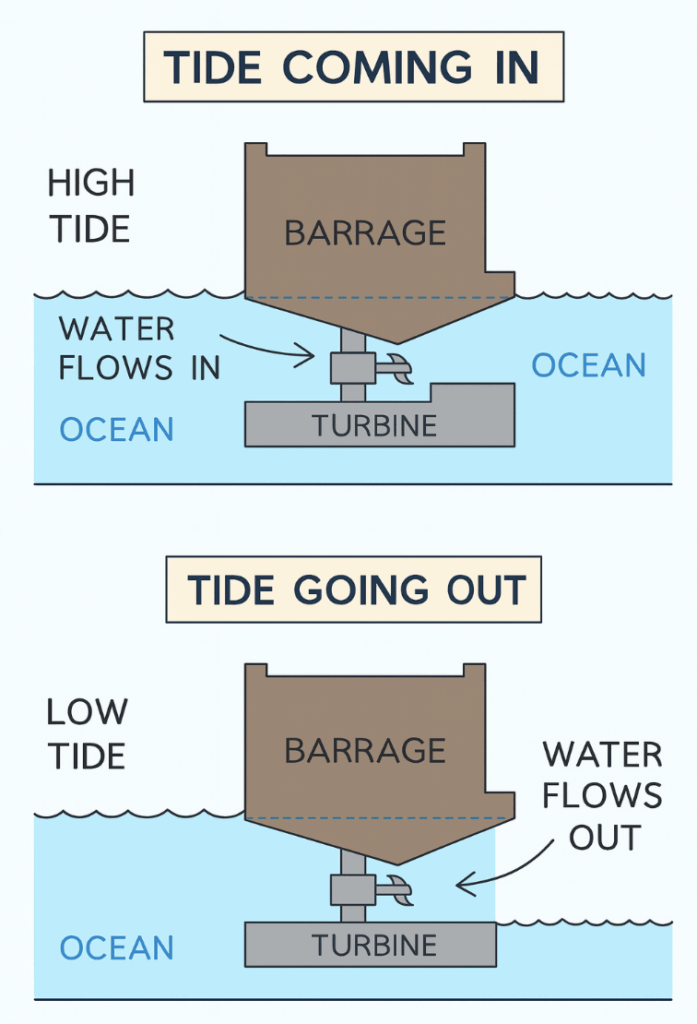
    • Tidal energy uses the energy of rising and falling tides to turn a turbine and generate electricity
    • Advantages:
      • Abundant energy source
      • No greenhouse gas emissions or air pollutants produced during operation
      • Predictable and reliable source of energy due to regular tidal patterns
      • Can produce a large amount of electricity at short notice
      • Minimal visual impact when installed underwater
      • Long lifespan of tidal turbines with minimal maintenance
    • Disadvantages:
      • High initial costs
      • Limited availability of suitable sites
      • Potential environmental impact on marine ecosystems and fish migration
      • Maintenance challenges and costs due to underwater installations
      • Possible interference with shipping lanes and navigation

    Biomass (wood)

    • Biomass energy uses organic materials such as wood to generate heat or electricity
    • Advantages:
      • Renewable resources and carbon neutral if managed sustainably
      • Readily available in many regions, especially rural areas
    • Disadvantages:
      • Carbon dioxide and air pollution from combustion emissions
      • Deforestation risk and habitat loss if not sustainably managed
      • Impact on indoor air quality if not properly ventilated

    Geothermal energy

    • Geothermal energy harnesses heat from within the Earth’s crust for electricity generation or heating purposes.
      • The Earth’s interior is extremely hot
      • Water can be poured into shafts below the Earth’s surface
      • The water is heated and returned via another shaft as steam or hot water
      • Steam can be used to turn a turbine and generate electricity
      • The hot water can also be used to heat homes
    • Advantages:
      • Sustainable energy source
      • Reliable and stable source of energy available at all times
      • Small land footprint compared to other renewable sources (e.g. wind and solar)
      • Geothermal power stations are usually small compared to nuclear or fossil fuel power stations
      • Long lifespan of geothermal plants with low operating costs
    • Disadvantages:
      • Site-specific; limited to regions with near-surface geothermal activity
      • High initial drilling and exploration costs
      • Can result in the release of greenhouse gases from underground
      • Geological risks such as earthquakes or ground subsidence

    Hydropower

    • Hydropower uses flowing water to generate electricity through turbines in dams
    • Advantages:
      • Reliable and predictable source of energy
      • Low greenhouse gas emissions during operation
      • Multi-purpose benefits, including flood control and irrigation
      • Long lifespan of hydroelectric plants with low operating costs
      • Can respond to demand quickly, generating large scale amounts of electricity in a short period of time
    • Disadvantages:
      • Disruption of river ecosystems and fish migration routes
      • High initial capital costs for dam construction and infrastructure
      • Dam construction and reservoir formation floods habitats and can require relocation of human communities
      • Climate change impacts on water availability is affecting reservoir levels, making them less reliable

    What are non-renewable energy sources?

    • Non-renewable energy comes from energy sources that will eventually run out, including:
      • Fossil fuels
      • Nuclear energy (using uranium as a fuel)

    Fossil fuels

    • Fossil fuels include:
      • Coal
      • Crude oil, which is refined into petrol, diesel and other fuels
      • Natural gas (mostly methane), which is used in domestic boilers and cookers
    • Fossil fuels are formed from the remains of plants and animals
      • Chemical energy stored in fossil fuels originally came from sunlight
      • Energy from the sun was transferred to chemical energy stores within plants through photosynthesis (plants use energy from sunlight to make food)
      • Animals ate the plants and the energy was then transferred to their chemical store
    • Advantages
      • The current systems of transport and electricity generation used by human societies rely heavily on fossil fuels
        • These fossil fuels are generally readily available on a daily basis
      • In the past, fossil fuels have been reliable for large-scale energy production (although this is changing as supplies start to become depleted and prices rise)
      • Efficient—fossil fuels typically have a high energy density (they produce a large amount of energy per kilogram)
    • Disadvantages
      • It takes millions of years for fossil fuels to form:
        • This is why they are considered a non-renewable energy resource
      • The increasing demand for decreasing supply causes prices to increase
        • Fossil fuels are predicted to completely run out within the next 200 years
      • Burning fossil fuels pollutes the atmosphere with harmful gases such as:
        • Carbon dioxide, which contributes to the greenhouse effect
        • Sulphur dioxide, which produces acid rain
        • Both carbon and sulphur can be captured upon burning, preventing them from being released into the atmosphere, but this is expensive to do
      • Oil spills can occur during transport of fossil fuels, which damage the marine environment and wildlife over very large areas
      • Prices fluctuate rapidly
      • Conflict and political disagreements (such as the war in Ukraine) can have an impact on supplies

    Nuclear energy

    • Energy stored in the nucleus of atoms can be released when the nucleus is broken in two:
      • This is known as nuclear fission
    • Nuclear power stations use fission reactions to create steam to turn turbines to generate electricity
    • Nuclear power is a low-carbon, low-emission, non-renewable resource
      • However, it is controversial due to the radioactive waste it produces and the potential scale of any accident
    • Advantages
      • No pollution released into atmosphere
      • Nuclear reactors are perfectly safe as long as they are functioning properly (rigorous safety checks must be routinely carried out and rigorous safety procedures followed)
      • Nuclear power stations can generate electricity reliably on a large scale to be available as needed
      • Small amounts of uranium are needed, and large reserves are available
      • Reduces reliance on fossil fuels
      • Increases energy security
    • Disadvantages
      • There is a finite supply of uranium ore, so nuclear power is a non-renewable resource
      • Nuclear fuels produce radioactive waste, which needs to be stored for thousands of years
      • Safe ways of storing radioactive waste are very expensive
      • If an accident occurs at a nuclear reactor, radioactive waste can leak out and spread over large areas
      • The cost of decommissioning (shutting down) nuclear power plants is very high

    Sustainability of energy sources

    • Energy sustainability refers to meeting current energy demands without compromising the ability of future generations to meet their needs
    • The sustainability of energy sources can vary greatly depending on:
      • Whether they are renewable or non-renewable
      • Their environmental impact

    Environmental cost of non-renewable energy

    Fossil fuels

    • Extraction: mining for coal and drilling for oil and gas can destroy habitats and lead to soil erosion and water contamination
    • Refining crude oil: this process releases harmful chemicals and contributes to air and water pollution
    • Liquefaction of natural gas: turning gas into liquid for easier transportation emits carbon dioxide and other greenhouse gases

    Nuclear energy

    • Mining of uranium: extracting uranium for nuclear power plants is energy-intensive and leaves behind radioactive waste
    • Nuclear waste: long-term storage of nuclear waste is difficult, as it remains hazardous for thousands of years

    Environmental cost of renewable energy sources

    • Renewable energy comes from sources that can be naturally replenished, such as the sun, wind and water
    • These sources tend to have a lower environmental impact
    • However, they can still have significant (sometimes ‘hidden‘) environmental costs, including:
      • Manufacturing: producing renewable energy devices requires energy and raw materials, leading to environmental damage
      • End-of-life management: recycling components from solar panels, wind turbines and batteries is often expensive and not always efficient, leading to waste and pollution

    Examples of renewable energy devices

    • Wind turbines
      • Challenges:
        • Wind turbines require rare earth elements for magnets and motors, such as neodymium
        • At the end of their life, turbine blades are difficult to recycle and often end up in landfills
    • Solar panels
      • Challenges:
        • The production of solar panels requires mining for materials like silicon and rare earth elements
        • Solar panels have a limited lifespan (20-30 years) and need careful disposal to avoid chemical pollution
    • Tidal barrages
      • Tidal barrages use the movement of tides to generate energy
      • Challenges:
        • Building tidal barrages can disrupt local ecosystems, affecting fish and marine life
        • Barrages are large and expensive to construct and maintain

    Rare earth elements in renewable energy

    • Renewable technologies, like electric vehicles (EVs) and wind turbines, rely on rare earth elements for efficient energy conversion
    • However, these elements are difficult to mine and refine, leading to sustainability issues, including:
      • Energy-intensive extraction:
        • Extracting rare earth elements requires significant energy (e.g. for mining machinery), contributing to greenhouse gas emissions
      • Mining impacts:
        • Mining for rare earth elements can cause severe environmental damage, including:
          • Water contamination: mining processes release toxic chemicals into nearby water sources, affecting both surface water and groundwater
          • Habitat destruction: clearing land for mining operations and access routes can destroy local ecosystems, disrupt wildlife habitats and cause deforestation
          • Dust pollution: dust from cutting, drilling and blasting rocks accumulates in surrounding areas, leading to air pollution and increasing the risk of respiratory diseases for nearby communities
    • Energy consumption refers to the total amount of energy used by individuals, industries and countries
    • As populations grow and individual demand increases, global energy consumption continues to rise
    • Meeting energy needs whilst also managing environmental and economic impacts is a significant challenge

    Rising demand

    • Population growth:
      • As the global population increases, so does energy demand
      • More people need energy for electricity, transport, heating and cooling
    • Per capita energy demand:
      • People are using more energy per person
        • Particularly in developing countries where industrialisation and living standards are improving

    Energy production and consumption changes

    • Fossil fuels like coal, oil, and natural gas continue to supply the majority of the world’s energy
    • Renewable energy (e.g. wind, solar and hydro) is growing but still provides a smaller portion of global energy
      • E.g. in 2022, 80% of the world’s energy came from fossil fuels, with renewable energy making up 12.7%

    Reasons for changes in energy use

    • Economic development:
      • As countries become wealthier, they tend to use more energy for:
        • Industrial processes
        • Transportation
        • Technology
      • For example, India’s energy consumption is rapidly increasing as it develops its manufacturing sector and infrastructure
    • Environmental concerns:
      • Global concerns about climate change are driving a shift towards cleaner energy sources like solar and wind
      • Governments are setting targets to:
        • Reduce carbon emissions
        • Invest in renewable energy
      • For example, the European Union aims to achieve carbon neutrality by 2050, which requires a massive reduction in fossil fuel use

    The role of fossil fuels

    • Despite environmental concerns, fossil fuels still play a crucial role in supporting industries that are hard to power with renewable energy:
    • Steel and concrete industries:
      • The production of steel and concrete relies heavily on coal and natural gas
      • Renewable energy is not yet suitable for these high-energy processes
        • For example, China is the world’s largest producer of steel, and its steel industry is responsible for a significant portion of global coal consumption
    • Synthetic fertilisers:
      • Natural gas is essential for producing ammonia
        • Ammonia is a key ingredient in synthetic fertilisers that support global agriculture
        • As global food demand increases, the need for synthetic fertilisers (and therefore natural gas) is likely to continue

    Meeting the growing demand for energy

    Changing energy production resources

    • Increased renewable energy:
      • Investing in renewable energy sources can help meet rising demand while reducing reliance on fossil fuels
    • Energy storage:
      • Storing energy efficiently is key to managing renewable sources that are not able to provide a constant supply, like solar and wind
        • For example, Tesla’s battery storage systems in Australia help store surplus solar energy for use at night or during low-wind periods

    Reducing energy consumption

    • Energy efficiency:
      • Improving the energy efficiency of appliances, vehicles and buildings can significantly reduce overall consumption
        • For example, the UK government has introduced stricter building regulations
        • These require homes to be more energy efficient, helping to lower overall energy demand
    • Behavioural changes:
      • Encouraging individuals and industries to use less energy can make a big difference

    Energy choices

    • Energy choices refer to the decisions a country makes about how it generates and consumes energy
    • There are many factors that affect decisions, such as:
      • Economic cost
      • Pollution
      • Energy efficiency
      • Availability
      • Energy security

    Factors influencing energy choices

    Economic cost

    • The cost of building and maintaining energy infrastructure plays a big role in energy choices
      • Fossil fuels: often cheaper to develop initially but come with high environmental and long-term costs
      • Renewables: may have higher upfront costs but offer long-term savings and environmental benefits
        • For example, solar energy is becoming more cost-competitive in many countries due to advances in technology and falling costs

    Pollution

    • Some energy sources cause more pollution than others
    • Many countries are trying to balance energy needs with environmental health
      • Fossil fuels: emit large amounts of greenhouse gases and contribute to air pollution
      • Renewables: produce little to no pollution during operation

    Energy efficiency

    • Energy efficiency refers to how well energy is used and conserved.
      • Fossil fuels: often less efficient and result in energy waste during burning
      • Renewables: can be efficient but some rely on weather conditions

    Availability

    • The natural resources available to a country influence its energy choices
      • Fossil fuels: countries with large reserves of coal, oil, or natural gas are likely to use them as major energy sources
      • Renewables: depend on geographic features like sunlight, wind, or water availability

    Energy security

    • Energy security refers to a country’s ability to meet its energy needs reliably and without being overly dependent on foreign sources
      • Fossil fuels: many countries that rely on imported oil or gas face risks from fluctuating prices or geopolitical issues
      • Renewables: provide more energy security, as they are often produced locally and are not subject to international market fluctuations
    • Energy storage is important for managing the supply of energy, especially from renewable sources
    • This is because many renewable sources do not produce a consistent flow of energy
    • By storing energy, countries can ensure a reliable supply even when renewable sources like wind or solar power are not generating electricity

    The need for energy storage:

    • Some renewable energy sources, such as wind and solar, produce energy intermittently
    • This means they only generate power when conditions are right:
      • Wind power: only produces electricity when the wind is blowing
      • Solar power: only generates electricity during the day when there is sunlight
    • Because of this, there can be times when energy supply does not meet demand
    • Energy storage systems help solve this problem by:
      • Storing excess energy when production is high
      • Releasing it when demand exceeds supply

    Energy storage solutions

    There are several ways to store energy to ensure supply can meet demand, including the following:

    • Batteries: Store electricity as chemical energy, which can be released when needed
      • Uses: common in electric vehicles and home solar systems
      • Example: Tesla Powerwall batteries store energy from solar panels and can supply power to homes during outages or high demand periods

    Pumped hydroelectricity storage (PHS)

    • PHS stores energy by pumping water to a higher reservoir when there is surplus electricity
    • When electricity demand is high, the water is released back down to a lower reservoir, turning turbines to generate electricity
      • Uses: large-scale energy storage used by national grids
      • Example: Dinorwig Power Station in Wales is one of the largest PHS systems and is used to balance electricity supply in the UK
    • Advantages of PHS:
      • Large capacity: can store huge amounts of energy from excess electricity generated during periods of high renewable energy production (e.g. when the wind is blowing strongly or during peak solar energy generation)
      • Reliable: provides quick response to sudden demand increases (known as peak-shaving)
      • Long lifespan: PHS plants can operate for decades with low maintenance, contributing to their sustainability
    • Disadvantages of PHS:
      • Geographic limitations: requires specific landforms (mountains, valleys) and large reservoirs, limiting where it can be built
      • Environmental impact: constructing dams and reservoirs can damage ecosystems and disrupt local wildlife
      • Economic costs: can have very high initial costs to build

    Fuel cells

    • Fuel cells convert stored chemical energy (often hydrogen) directly into electricity
      • Uses: used in transportation (e.g. hydrogen-powered vehicles) and backup power systems
      • Example: Japan is investing in hydrogen fuel cells for its energy transition, particularly for powering vehicles and buildings

    Thermal storage

    • Stores heat energy, which can be used to generate electricity later or provide heating
      • Uses: often used with solar power plants, where excess solar energy is stored as heat and converted to electricity during low sunlight
      • Example: the Crescent Dunes Solar Energy Project in the US uses molten salt to store solar energy as heat, which is then used to generate electricity after sunset

    Managing energy demand: peak-shaving

    • Energy storage systems can be used for peak-shaving
      • This is the process of levelling out periods of high demand to ensure supply meets demand
    • When there is a peak in electricity usage (like during cold winter evenings), stored energy can be released to meet the extra demand
      • This avoids blackouts or the need to turn on extra power plants

    Energy conservation & efficiency

    What is energy conservation?

    • Energy conservation means changing our behaviour to use less energy
    • It includes small daily actions such as:
      • Turning off lights when not in use
      • Reducing the use of heating or air conditioning by wearing appropriate clothing or using natural ventilation
      • Travelling less by fuel-driven vehicles and opting for walking, cycling or public transport instead

    What is energy efficiency?

    • Energy efficiency means using technologies and designs that require less energy to perform the same task
    • This can include:
      • Installing low-energy LED lighting in homes and buildings
      • Using energy-efficient appliances (e.g. the latest washing machines and fridges with high energy-efficiency ratings)
      • Developing fuel-efficient transportation methods, such as electric vehicles (EVs)
      • Designing buildings to conserve heat through better insulation, reducing the need for heating and cooling
        • For example, the use of double-glazed windows in homes increases energy efficiency by keeping heat inside, reducing the need for heating systems

    The importance of energy conservation and efficiency

    • Energy conservation and efficiency help reduce energy demand and waste
    • These strategies make countries less dependent on importing energy resources
      • This reduces costs and improve energy security
    • They also contribute to reducing carbon emissions
      • This helps combat climate change

    Examples of energy conservation and efficiency

    Smart lighting systems

    • Energy-efficient lighting like LED bulbs and motion sensors are designed to reduce electricity use
    • Motion sensors ensure that lights are only on when needed, reducing waste in public spaces and large buildings
    • Effectiveness:
      • LEDs use up to 80% less energy than traditional bulbs, making them a cost-effective solution for reducing electricity use

    Passive solar building design

    • Passive solar design uses natural sunlight to heat buildings, reducing the need for artificial heating
    • Buildings are designed with large windows facing the sun and materials that store and release heat efficiently
    • Effectiveness:
      • Passive solar design is effective in regions with consistent sunlight, helping reduce energy bills and making homes more energy-efficient

    Designing goods to be easily recycled

    • The circular economy aims to reduce waste by designing products that can be easily reused, repaired or recycled
    • By creating products with longer lifespans and using recyclable materials, less energy is needed for producing new items
    • Effectiveness:
      • Designing goods to be recycled reduces the energy needed for producing new materials, cutting down energy demand in industries

    Commercial shipping with sails

    • One innovative way to improve energy efficiency in the shipping industry is by designing ships with sails (wind-assisted propulsion)
    • Modern ships can use large, automated sails, known as rotor sails or kite sails, to harness wind energy and reduce fuel consumption
      • This reduces greenhouse gas emissions
    • Effectiveness:
      • Ships using wind-assisted propulsion can reduce fuel consumption by 10-30%, depending on wind conditions
  • TOPIC 7: NATURAL RESOURCES

    7.1 NATURAL RESOURCES USES AND MANAGEMENT

    TermDefinition
    Reed Bed Buffer ZonesWetland areas planted with reeds to filter runoff and reduce nutrient and pollutant flow into water bodies.
    Cultural HeritageThe legacy of physical artifacts and intangible attributes of a group or society, often tied to natural landscapes or resources.
    Saltwater IntrusionThe movement of seawater into freshwater aquifers due to groundwater depletion, contaminating freshwater supplies.
    Resource ConflictsDisputes arising from competition over access, control, or use of natural resources like water, land, or minerals.
    Sustainable DevelopmentDevelopment that meets present needs without compromising the ability of future generations to meet their own needs.
    GMOs (Genetically Modified Organisms)Organisms whose DNA has been altered using genetic engineering to enhance desired traits like yield or pest resistance.
    SubsidiesFinancial support provided by governments to reduce the cost of producing goods, often used in agriculture or resource sectors.
    • 🧠 Exam Tips:

      For sustainable development, always link to the three pillars (environmental, social, economic) when elaborating.

      Use case studies or examples when asked to apply terms like GMOssubsidies, or resource conflicts in context.
    • Natural resources are the sources of energy and raw materials that society uses and consumes
    • In other words, the term natural resources applies to anything that comes from nature that can be used to benefithumans
      • Examples include:
        • Sunlight is essential for photosynthesis, solar energy
        • Air: oxygen for breathing, wind energy
        • Water: drinking, irrigation, hydroelectric power
        • Land: soils, agriculture, construction, habitat for wildlife
        • Rocks: minerals, construction materials
        • Ecosystems: forests, wetlands and coral reefs
        • Living things: plants for food and medicine, animals for food and clothing
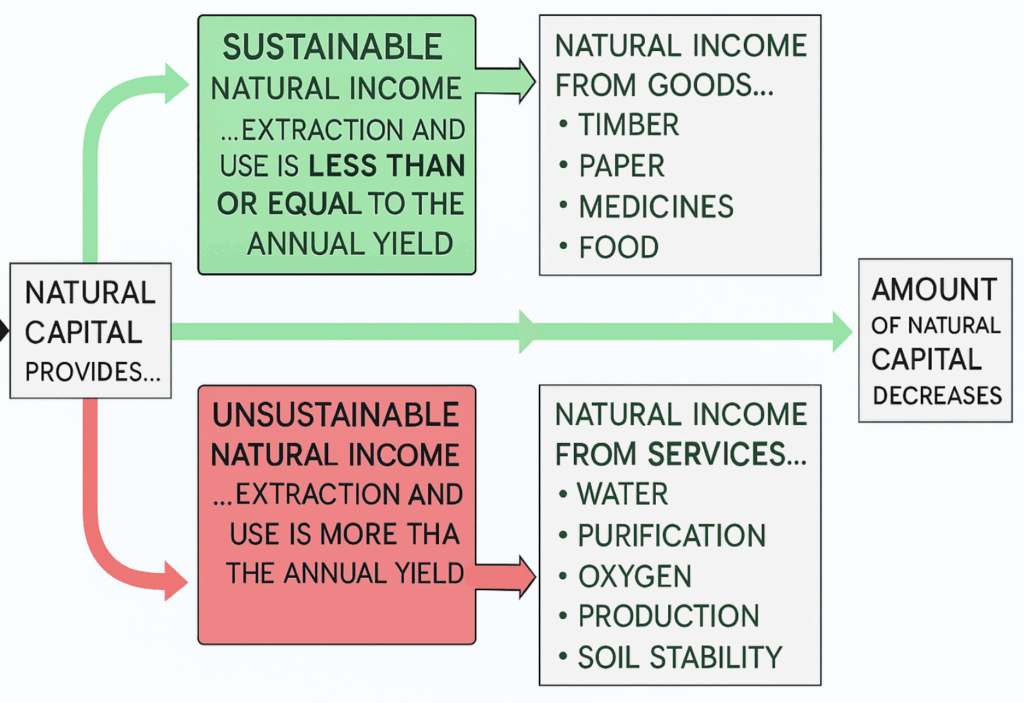
      • In the environmental sciences, these resources are sometimes referred to as natural capital
    • Definition: natural capital is the stock of natural resources available on Earth
    • Types of natural capital:
      • Renewable resources are resources that can be replenished naturally
        • Examples: forests (timber), fish populations
      • Non-renewable resources are resources that are finite and cannot be replenished
        • Examples: fossil fuels (coal, oil), minerals (gold, iron ore)
      • Ecosystem services are the benefits provided by ecosystems that support human life and economic activity
        • Examples: pollination of crops, water purification, carbon sequestration

    What is natural income?

    • Definition: natural income is the flow of goods and services produced by natural capital
      • Examples of goods:
        • Fish: harvested from oceans and rivers
        • Timber: harvested from forests for building and paper products
      • Examples of services:
        • Climate regulation: forests reduce global warming by absorbing CO2
        • Flood prevention: wetlands reducing flood risk by absorbing excess rainfall, or mangroves buffering against storm surges

    Sustainable natural income

    • If these natural goods and services are carefully and sustainably managed, they can provide even more resources over time
      • This is referred to as sustainable natural income
      • For example:
        1. Trees are cut down for timber but forests are also re-planted or left to recover
        2. The rate of new tree growth is greater than the rate of timber production
        3. Timber production is a sustainable source of income that can be marketed and used to benefit humans
    • In other words, natural income is the term used to describe the sustainable income produced by natural capital
      • Again, using the timber production example:
        • Our forests are the natural capital
        • The sustainable timber we can obtain from these forests is our natural income
    • Non-renewable resources, such as fossil fuels, can be used to generate wealth but can only be used once and cannot be sustainably managed
      • Therefore, even if they can be considered as natural capital, non-renewable resources cannot produce sustainable natural income

    Perspectives on nature

    • Economic value:
      • Viewing nature as natural capital highlights the economic value of resources
      • Encourages investment in their preservation and sustainable use
      • It helps policymakers and businesses recognise financial benefits of maintaining healthy ecosystems
    • Sustainable management:
      • Emphasising natural capital and natural income encourages sustainable management practices
      • By valuing natural resources as capital, societies are more likely to invest in conservation efforts
        • Ensures a continuous flow of natural resources, such as clean water, air and fertile soil
    • Anthropocentrism:
      • This perspective may imply that nature exists solely for human use and exploitation
        • This is an extreme anthropocentric view
      • It suggests that the environment’s primary purpose is to serve human needs and economic interests
        • Leads to over-exploitation and degradation of natural resources
    • Intrinsic value:
      • Some argue that this anthropocentric view reduces nature’s intrinsic value
        • I.e. it ignores the inherent worth of ecosystems and species beyond their use to humans

    Ecosystem services

    • Definition: benefits provided by ecosystems that support life and human well-being
    • Ecosystem services usually fall into one of four main categories:
      • Supporting services
      • Regulating services
      • Provisioning services
      • Cultural services
    Ecosystem ServiceDescriptionExamples
    SupportingEssential ecological processes for supporting lifePrimary productivity (photosynthesis)Soil formationCycling of nutrients (e.g. carbon cycle, nitrogen cycle)
    RegulatingA diverse set of services that shape and stabilise ecosystemsClimate regulationFlood regulationWater quality regulationAir quality regulationErosion controlDisease and pest control
    ProvisioningThe goods humans obtain from ecosystemsFoodFibresFuelFresh waterTimber
    CulturalThese services derive from humans interacting with nature in a culturally beneficial wayRecreation and tourismEducationHealth benefitsSense of place, national identity and cultural heritageEmployment

    Examples of Regulating Ecosystem Services

    Ecosystem serviceDescriptionFurther informationExamples
    Water replenishmentNatural process of replenishing water in aquifers, rivers and lakesProvides clean drinking waterSupports agriculture and industryMountain watersheds—snowmelt and rainfall replenish rivers and groundwater, e.g. glacial meltwater
    Flood and erosion protectionEcosystems absorb excess rainfall and prevent soil erosionWetlands and floodplains reduce flood risksCoastal mangroves and vegetation protect against storm surgesCoastal Mangroves in Southeast Asia protect shorelines and support fisheriesForest tree root networks stabilise soil and prevent erosion on hillsides
    Pollution mitigationEcosystems help remove pollutants from the environmentImproves water quality in rivers and lakesReed bed buffer zones filter water, removing inorganic nutrients and pollutantsWetlands e.g. saltmarshes, absorb pollution
    Carbon sequestrationProcess of capturing and storing atmospheric carbon dioxideForests and oceans act as carbon sinksReduces greenhouse gases, mitigating climate changeTropical rainforests, e.g. Amazon rainforest is a major carbon sink, regulating global climateSeagrass meadows
    • Natural capital provides natural income in the form of goods (tangible products such as timber and crops) and services
    • These goods and services have great value to human societies
      • This value may be aesthetic, cultural, economic, environmental, health, intrinsic, social, spiritual, or technological

    Natural Capital Value Types

    Value typeDescriptionExample
    AestheticValue from the beauty, visual appeal and enjoyment of natural landscapes and biodiversityAppreciating a stunning sunset over a pristine beachEnjoying the vibrant colours of a diverse coral reef
    CulturalValue in shaping cultural practices, traditions and identities of communitiesIndigenous communities relying on forests for their livelihoods and incorporating traditional ecological knowledge in their practices
    EconomicContribution to economic activities through provision of raw materials, fuels, food and other tangible productsLogging industry relying on forests for timber productionAgriculture relying on fertile soils for crop cultivation
    EnvironmentalProvision of essential ecosystem services that support the health and functioning of ecosystemsWetlands purifying water by filtering pollutantsForests sequestering carbon dioxide and mitigating climate change
    HealthSupporting physical and mental health through clean air, water and natural spacesAccess to clean air and water and green spaces for exercise and relaxation contributes to overall health and well-being
    IntrinsicInherent worth of natural capital, independent of its instrumental value to humansAppreciating untouched wilderness as an essential and irreplaceable part of our planet
    SocialContribution to human well-being, including recreational spaces, opportunities for maintaining physical and mental health and fostering social cohesionParks, woodlands and beaches can provide spaces for people to connect with nature and strengthen social bonds
    SpiritualSpiritual significance and connection to nature, essential to some communitiesSacred mountains revered for their spiritual significanceOther natural places where people seek solace, reflection and spiritual experiences
    TechnologicalInspiration and utilisation of natural capital in technological advancements and innovationsBiomimicry, e.g. where the design of a building is inspired by the cooling properties of termite mounds, leading to energy-efficient architecture
    • This diverse range of values associated with natural capital highlights the importance of preserving and sustainably managing these resources
      • This is for the benefit of both present and future generations

    The dynamic nature of natural capital

    • The concept of natural capital is highly dynamic
      • This is because the value of natural capital can change regionally and over time
    • Cultural factors can influence the value of certain natural resources
      • E.g. cork forests in Portugal have been recognised as valuable natural capital due to their importance in the wine industry
      • The cultural heritage associated with this is significant
    • Social factors can influence value of natural capital
      • E.g. in certain regions, uranium mining is seen as a threat to human health and the environment
      • As a result, uranium may be regarded as negative or harmful natural capital
    • Economicfactors play a significant role in determining the market value of natural capital
      • E.g. lithium, which is essential for battery production in the rapidly growing electric vehicle industry, has seen increased market value and demand
    • Environmentalfactors, such as the physical scarcity or abundance of a resource, can influence its value
      • E.g. in areas with significant lithium deposits, such as the lithium triangle in South America, lithium has become highly valuable natural capital due to its critical role in batteries
      • Initially valued for industrial use, coal is now facing scrutiny due to environmental impacts
    • Technologicalfactors, such as advancements in technology, can influence the value of natural capital
      • For example, flint was once an important resource used for hand tools
      • It is now redundant, as it was replaced by the development of metal extraction from ores
    • Politicalfactors, including regulations and policies, can change the market value of natural capital
      • Governments can impose restrictions or incentives that affect the extraction and use of certain resources, e.g. limiting uranium mining due to environmental concerns

    🔍 TOK Tip: How do ethical considerations affect the way we manage natural resources?

    Renewable natural capital

    • Renewable natural capital includes natural resources that can be replaced or regenerated at a rate equal to or faster than they are being used
    • Living species and ecosystems:
      • These include forests, wetlands, coral reefs and grasslands, which can regenerate through natural processes
      • These systems are able to do this as they harness solar energy and use photosynthesis to convert it into biomass
        • E.g. forests provide fuel wood for many communities and are harvested for timber
          • They have the capacity to regenerate through seed dispersal and natural growth
          • This allows new trees to replace the ones that have been harvested
        • Wetlands play a vital role in maintaining water quality, regulating floods and providing habitat for diverse species
          • They can self-sustain and regenerate, through natural processes like sedimentation and nutrient cycling
          • They can even regenerate after disturbances such as droughts or human activities like mining or construction
    • Non-living systems:
      • These include renewable resources such as groundwater and the ozone layer
      • These can be replenished through natural processes
        • E.g. groundwater is recharged by precipitation and infiltration
          • This ensures that it can be sustainably used as a freshwater resource
        • The ozone layer can also regenerate itself naturally
          • This can occur if the emissions of ozone-depleting substances are significantly reduced
          • This allows the stratospheric ozone concentration to recover over time

    Non-renewable natural capital

    • Non-renewable natural capital includes natural resources that cannot be replaced or regenerated at a rate equal to or faster than they are being used
      • This is because these resources are either irreplaceable or can only be replenished over geological timescales (i.e. extremely long periods of time)
    • Fossil fuels:
      • Coal, oil and natural gas are finite resources formed over millions of years from the remains of plants and animals
        • Once extracted and burned for energy production, they cannot be replaced within human timescales
      • Although not a fossil fuel, uranium, used in nuclear power plants, is also considered as non-renewable natural capital
        • Uranium reserves are also not replenishable within human timescales
    • Soil:
      • Soil is a renewable resource to some extent
      • However, it can become non-renewable when it is degraded or eroded at a faster rate than it can be naturally replenished
        • Unsustainable agricultural practices, such as excessive tilling and deforestation, can lead to soil erosion and depletion
        • Urbanisation and construction activities can result in the permanent loss of fertile soil
        • This effectively removes its ability to regenerate in these areas
    • Minerals:
      • These include various elements and metals extracted from the Earth’s crust
      • These are finite and cannot be replenished within human timescales
        • Rare-earth minerals used in electronics, e.g. lithium, have finite reserves
        • Precious metals, e.g. gold and silver, will have to be recycled or obtained from existing stockpiles once natural reserves have been completely extracted

    Sustainable and unsustainable use of natural capital

    • It is crucial to manage and use renewable natural capital sustainably to ensure its long-term availability

    Sustainable use of renewable natural capital

    • Forest management:
      • Implementing sustainable forestry practices, e.g. selective logging, reforestation and maintaining biodiversity
      • This preserves the integrity of forest ecosystems
      • This ensures continued provision of timber, non-timber forest products and ecosystem services
    • Fisheries management:
      • Strategies can help maintain fish populations at sustainable levels
      • This allows for continued fishing activities and the preservation of marine biodiversity
      • These include:
        • Setting catch limits
        • Implementing seasonal fishing restrictions
        • Establishing marine protected areas
    • Renewable energy:
      • Harnessing renewable energy sources such as solar, wind and hydroelectric power
      • This helps reduce reliance on fossil fuels and minimises environmental impacts, providing a sustainable energy alternative

    Unsustainable use of renewable natural capital

    • Deforestation:
      • Examples of unsustainable use include:
        • Unsustainable logging practices
        • Large-scale conversion of forests for agriculture or infrastructure development
      • Clearing forests at a rate faster than their regeneration can contribute to:
        • Habitat loss
        • Soil erosion and desertification
        • Climate change
    • Overfishing:
      • Excessive fishing beyond the natural reproduction rate of fish populations can:
        • Depleted fish stocks
        • Disrupt marine ecosystems
        • Impact the livelihoods of fishing communities
    • Water extraction:
      • Excessive withdrawal of groundwater from aquifers can result in:
        • Freshwater depletion
        • Saltwater intrusion
        • Long-term water scarcity
      • When water is used beyond its natural replenishment rate, it becomes unsustainable
    • Resource security is the ability of societies to ensure long-term availability of sufficient natural resources to meet demand
      • Key natural resources include water, food, energy and raw materials

    Importance of resource security

    • Ensures stable supply to meet current and future needs
    • Prevents resource conflicts
    • Supports sustainable development

    Case Study

    Resource security in contrasting societies

    Example 1: Food security in the United States

    • The US is a high-income country with advanced agricultural technology
    • Factors contributing to food security:
      • Economic: high investment in agricultural research and development
      • Technological: use of GMOs and advanced irrigation systems
      • Political: government subsidies and support for farmers
      • Environmental: diverse climate allows a variety of crops

    Example 2: Water security in Ethiopia

    • Ethiopia is a low-income country with challenges in water accessibility
    • Factors affecting water security:
      • Economic: limited funds for water infrastructure
      • Geographical: arid regions with irregular rainfall
      • Political: dependency on upstream countries for water sources
      • Technological: lack of advanced water purification and distribution systems

    Factors affecting resource choices

    • Various factors influence how societies choose to use natural resources
      • These factors include economic, sociocultural, political, environmental, geographical, technological and historical considerations
    • Economic factors:
      • Cost and availability: resources that are cheaper and readily available are preferred
      • Market demand: high demand for certain resources drives their usage
    • Sociocultural factors:
      • Cultural preferences: traditional foods and materials influence resource choices
      • Population growth: increased population raises resource demand
    • Political factors:
      • Government policies: regulations and subsidies affect resource use
      • International relations: trade agreements and conflicts influence resource access
    • Environmental factors:
      • Sustainability: focus on using resources that do not harm the environment
      • Climate change: affects the availability and viability of certain resources
    • Geographical factors:
      • Resource distribution: proximity to natural resources affects their use
      • Natural disasters: areas with more frequent disasters may have limited resource choices
    • Technological factors:
      • Innovation: advances in technology can create new resources, enable resource extraction or improve resource use efficiency
      • Infrastructure: availability of technology and infrastructure influences resource use
    • Historical factors:
      • Historical usage: long-term use of certain resources can establish dependency
      • Colonial history: past exploitation can affect current resource availability and control

    Impact of international agreements on resource choices

    • International agreements, like the Paris Agreement, aim to reduce greenhouse gas (GHG) emissions
    • Different countries have set varied dates for achieving carbon neutrality (also know as net zero)
      • These targets are crucial for meeting global climate goals
      • They influence the resource choices of countries
    • Net zero emissions goals:
      • Encourage use of renewable energy over fossil fuels
      • Promote sustainable agricultural practices to reduce carbon footprint
      • Influence local and national policies to align with global sustainability targets
  • SCHEMA THEORY

    📘 Definition Table

    TermDefinition
    SchemaA mental framework or cognitive structure that organizes knowledge, beliefs, and expectations about the world.
    Schema TheoryThe idea that all knowledge is organized into units (schemas), which influence how information is encoded, stored, and retrieved.
    EncodingThe process of transforming sensory input into a form that can be processed and remembered.
    RetrievalAccessing stored information, which can be influenced by existing schemas.
    ReconstructionThe process of piecing together memory based on schemas rather than an exact replay of events.
    Cognitive BiasA systematic error in thinking due to reliance on schemas and heuristics.
    AssimilationIntegrating new information into existing schemas.
    AccommodationModifying existing schemas to incorporate new information.

    🧠 Core Concepts

    1️⃣ Overview:

    • Schema theory explains how people use stored knowledge (schemas) to interpret new information.
    • Schemas help simplify complex information but can also distort recall.
    • They act as mental shortcuts guiding attention, encoding, and memory retrieval.

    🔬 Key Studies Supporting Schema Theory

    📄 Bartlett (1932) – “War of the Ghosts”

    Aim: Investigate how memory of a story is influenced by cultural schemas.
    Procedure: British participants read a Native American folk story (“War of the Ghosts”) and recalled it after days or weeks.
    Findings:

    • Story became shorter and more conventional.
    • Culturally unfamiliar details (canoes, ghosts) were changed to fit British expectations.
      Conclusion:
    • Memory is reconstructive.
    • Recall is influenced by pre-existing cultural schemas.
      Supports schema theory: People actively reconstruct memories using their prior knowledge.

    Evaluation:

    • ✅ Groundbreaking — introduced reconstructive memory concept.
    • ⚠️ Low ecological validity (artificial task).
    • ⚠️ Qualitative analysis open to researcher bias.
    • ✅ Replicated by modern studies (Brewer & Treyens, 1981).

    📄 Brewer & Treyens (1981) – Office Schema

    Aim: Investigate whether people’s memory for objects in a room is influenced by their schemas of what an office should contain.
    Procedure: Participants sat briefly in an office containing typical and atypical items (e.g., skull, brick). Later asked to recall or recognize objects.
    Findings:

    • Recalled schema-consistent items (desk, chair) more than inconsistent ones.
    • Often falsely remembered typical items not actually present (books).
      Conclusion:
    • Schema-driven expectations guide encoding and retrieval.
      Supports schema theory — memory is biased by schema expectations.

    Evaluation:

    • ✅ High ecological relevance (realistic setting).
    • ⚠️ Artificial recall task.
    • ⚠️ Potential demand characteristics.
    • ✅ Empirically strong — consistent with other schema research.

    📄 Anderson & Pichert (1978) – Role Perspective in Recall

    Aim: Test whether schema activation (house-buyer vs. burglar) affects recall.
    Procedure: Participants read a house description from one of two perspectives, recalled details, then switched perspectives and recalled again.
    Findings:

    • Participants recalled new information relevant to their new schema.
      Conclusion:
    • Schemas can influence retrieval, not just encoding.
      ✅ Shows schema theory explains both selective attention and memory recall.

    💬 Evaluation of Schema Theory

    StrengthsLimitations
    Supported by a wide range of empirical studies.Vague and difficult to test experimentally.
    Explains distortions in memory and perception.Oversimplifies memory — ignores emotion and biological processes.
    Useful in understanding stereotypes, eyewitness testimony, and learning.Deterministic — assumes schemas always influence recall.
    Supported by both cognitive and neuroimaging evidence (activation of schema-related brain areas).Some cultural biases in early schema research.
    💡 TOK Link
    Schema theory demonstrates that our “knowledge” is interpretive rather than objective.If memory is reconstructive, can we ever claim to know the past accurately?

    TOK Reflection: How do culture and language shape the schemas that define our understanding of reality?
    🌍 Real-World Connection
    Explains stereotype formation and confirmation bias in social perception.

    Applied in education — teaching new material is easier when linked to prior schemas.

    Important in eyewitness testimony — memory may be distorted by schema-driven reconstruction (Loftus & Palmer, 1974).
    ❤️ CAS Link
    Create awareness projects on bias and memory — e.g., how stereotypes affect perception.

    Conduct group memory tests showing schema-based distortion and reflect on ethical implications.

    Volunteer in tutoring programs to help peers use schema activation strategies for learning.
    🧪 IA Guidance
    Ideal for cognitive IA experiments: use schema recall tasks.

    Example: Office schema or “story recall” paradigm.

    Dependent variable: number of accurate vs. schema-consistent false recalls.

    Ethical, simple, and aligns with original cognitive methods.
    🧠 Examiner TipsAlways name and describe a supporting study (Bartlett, Brewer & Treyens, or Anderson & Pichert).

    Explain how findings support schema theory (link mechanism to result).

    Evaluate construct validity — schemas can’t be directly observed.

    Link to cognitive bias and memory distortion for higher-level analysis.
  • 6.4 STRATOSPHERIC OZONE

    TermDefinition (Exam-Ready, 2 Marks)
    Soil FumigationThe process of applying gaseous pesticides to soil to eliminate pests, pathogens, and weeds before planting.
    Flame RetardantsChemicals added to materials to slow the spread of fire; some types can release toxic pollutants into the atmosphere.
    CFCs (Chlorofluorocarbons)Synthetic compounds once used in refrigeration and aerosols that deplete the ozone layer and contribute to global warming.
    HCFCs (Hydrochlorofluorocarbons)Ozone-depleting substances used as transitional replacements for CFCs, with lower but still harmful ozone impact.
    • 🧠 Exam Tips:

      For CFCs and HCFCs, always mention their role in ozone depletion and connection to the Montreal Protocol if asked for policy context.

      For soil fumigation, link to agriculture and atmospheric pollution when relevant.
    • The Sun emits electromagnetic radiation in a range of wavelengths, from low-frequency radio waves to high-frequency gamma radiation
    • Shorter wavelengths of radiation have higher frequencies
      • More energy damages living organisms
      • E.g. ultraviolet (UV) radiation

    Effects on human health

    • Ultraviolet radiation from the Sun can have damaging effects on humanliving tissues
      • When excessive UV radiation reaches the surface of the Earth, it can lead to various health issues by damaging cells and tissues

    UV Radiation Effects on Humans

    Health issues caused by UV radiationExplanation
    CataractsProlonged exposure to UV radiation can contribute to the development of cataractsCataracts cause clouding of the lens in the eye, leading to blurry vision and eventual vision loss if left untreated
    UV radiation affects cellsUV radiation has the potential to induce mutations in DNA during cell divisionWhen cells are exposed to UV radiation, it can lead to genetic alterations and mutationsThis can disrupt normal cell growth and increase the risk of developing cancer
    Skin cancerUV radiation is a major risk factor for the development of skin cancerUV rays can damage the DNA in skin cells, leading to uncontrolled cell growth and the formation of cancerous tumoursProlonged or intense exposure to UV radiation, especially without proper protection, increases the risk of developing skin cancer
    SunburnWhen the skin is exposed to excessive UV rays, it triggers an inflammatory response as a defence mechanismSunburned skin becomes red, painful and may blister, indicating damage to the skin cells
    Premature skin ageingChronic exposure to UV radiation accelerates the ageing process of the skinIt can cause the breakdown of collagen and elastin fibres, leading to wrinklessagging skin and the development of age spots

    Effects on biological productivity

    • Harmful UV radiation reaching the Earth’s surface affects plant growth and productivity
    • Increased UV exposure can lead to:
      • Reduced photosynthesis rates
      • Altered plant metabolism
      • Decreased crop yields
    • Exposure to increased UV radiation can affect other photosynthetic organisms, such as phytoplankton
      • Phytoplankton play a crucial role in aquatic food webs
      • They convert sunlight, carbon dioxide and nutrients into organic matter through photosynthesis
      • UV radiation damages phytoplankton by:
        • Causing DNA damage
        • Reducing photosynthetic activity and growth
      • This leads to a decrease in primary productivity in aquatic ecosystems
    • Reduced phytoplankton productivity can have cascading effects on higher trophic levels in aquatic ecosystems
      • Zooplankton, which feed on phytoplankton, have less food available
        • This affects their growth and reproduction
      • This, in turn, can impact higher-level consumers, such as fish and marine mammals
        • Organisms in these higher trophic levels rely on phytoplankton and zooplankton as food source
        • This can significantly reduce the biodiversity of aquatic ecosystems
    • Ozone is a molecule composed of three oxygen atoms (O3)
      • It is mainly found in the Earth’s stratosphere
      • This is a layer of the atmosphere located approximately 10 to 50 kilometres above the Earth’s surface
    • Ozone plays a very important role in protecting life on Earth
      • This is because it absorbs a significant portion of the Sun’s harmful UV radiation
      • This significantly reduces the amount of UV radiation that reaches the Earth’s surface
    • Types of UV radiation:
      • UVA:
        • Longest wavelength
        • Least harmful but can cause skin aging and contribute to skin cancer
      • UVB:
        • Medium wavelength
        • Can cause skin burns and direct DNA damage
        • Mostly absorbed by stratospheric ozone, but some reaches the Earth’s surface
      • UVC:
        • Shortest wavelength
        • Most harmful
        • Completely absorbed by stratospheric ozone

    Ozone equilibrium

    • The amount of ozone in the stratosphere remains relatively constant over long periods
      • This is due to a steady state of equilibrium
    • Equilibrium is maintained between the processes of ozone formation and destruction
    • When UV radiation from the Sun interacts with ozone molecules, some of the ozone absorbs the energy and breaks apart
    • This results in the formation of an oxygen molecule (O2) and a free oxygen atom (O)
      • This process of ozone destruction occurs naturally in the stratosphere
      • Under normal conditions, the free oxygen atom (O) can combine with another oxygen molecule (O2) to form ozone (O3) again
      • This ozone destruction and reformation creates a dynamic equilibrium in the stratosphere
        • There is a continuous cycle of ozone molecules being broken apart and reformed
      • This dynamic equilibrium ensures that the concentration of ozone in the stratosphere remains relatively stable over time
        • The rate of the forward reaction equals the rate of the backward reaction in the system, so the concentrations of the reactants and products remain relatively constant

    Ozone-depleting substances

    • Ozone-depleting substances (ODSs) are chemicals that cause stratospheric ozone depletion
      • These substances cause the destruction of ozone molecules
      • In other words, they enhance the natural ozone breakdown process (beyond natural levels)
    • ODSs are commonly used in various human activities and products:

    Sources of Ozone Depleting Substances

    SourceDetails
    AerosolsChlorofluorocarbons (CFCs) were previously used as propellants in aerosol products like sprays, foams, and deodorantsWhen released into the atmosphere during spraying, these substances can eventually reach the stratosphere and contribute to ozone depletion
    Gas-blown plasticsODSs were also used as blowing agents in the production of foamed plasticsThese agents help create air pockets within the plastic material, making it lightweightDuring manufacturing or disposal of these products, ODSs can be released into the atmosphere
    PesticidesSome pesticides, e.g. those containing methyl bromide, have been used in agricultural practices for soil fumigationWhen applied, these substances can vaporise and enter the atmosphere, where they can contribute to ozone depletion
    Flame retardantsSome flame retardants contain halogen atoms and have been used in various products to reduce their flammabilityWhen these products degrade or are disposed of, the halogenated compounds can be released into the atmosphere
    RefrigerantsODSs were widely used as refrigerants in cooling systems, such as air conditioners and refrigeratorsThe most well-known examples are CFCsWhen these refrigerants leak or are improperly disposed of, they can reach the stratosphere and contribute to ozone depletion

    Imbalance in equilibrium

    • When ozone formation and destruction rates are unequal, equilibrium is disrupted
      • This leads to increased ozone depletion
      • Increased UVB radiation reaches the Earth’s surface
      • Affects ecosystems and human health
      • Causes increased rates of skin cancer and cataracts
      • Reduces terrestrial and marine productivity

    Ozone holes

    • Ozone depletion affects the entire Earth’s stratosphere
      • However, ozone holes are most prominent at the poles
      • Ozone holes are areas of low stratospheric ozone
      • These holes appear every spring due to ODSs and seasonal weather patterns

    ❤️ CAS Tip: Create an educational video or exhibition on climate change and ozone depletion for younger students.

    The role of UNEP

    • The United Nations Environment Programme (UNEP) has played a critical role in the protection of the stratospheric ozone layer
      • This have been achieved through its efforts in providing information and creating international agreements:
    • UNEP has been instrumental in raising awareness about:
      • The fact that the ozone layer was being rapidly depleted
      • The causes of this depletion
      • The associated environmental and health impacts of this depletion
        • Through research and sharing of information, UNEP has helped educate governments, industries and the public about the importance of ozone layer protection
        • UNEP has been actively involved in the creation of international agreements aimed at reducing the use of ozone-depleting substances (ODSs)
    • The Montreal Protocol on Substances that Deplete the Ozone Layer was initiated in 1987
      • It was started under the guidance of UNEP
      • It is a landmark international agreement that regulates the production, trade and use of chlorofluorocarbons (CFCs) and other ODSs.
        • 24 countries initially signed the initial protocol, and the total now stands at 197 countries
        • It has been updated and strengthened (a later amendment at a summit in Copenhagen in 1992 tightened restrictions further)
        • It has resulted in emissions of ODSs falling rapidly from around 1.5 million tonnes in 1987 to around 400 000 tonnes in 2010
        • UNEP hopes to end production of all HCFCs by 2040
    • The illegal market for ozone-depleting substances is a significant challenge to the effectiveness of ozone protection efforts:
      • UNEP recognises the need for consistent monitoring and enforcement to tackle this issue
      • By collaborating with national authorities, customs agencies and other relevant stakeholders, UNEP works towards:
        • Stopping the illegal trade of ozone-depleting substances
        • Ensuring compliance with international regulations
    • Phased reductions:
      • Gradual reduction schedules for ODSs have allowed industries to adapt
      • The Montreal Protocol provided time for the development and adoption of alternatives to ODSs
    • National governments play an important role in implementing the agreements made by the UNEP:
      • In response to the Montreal Protocol, governments have enacted national laws and regulationsto decrease the consumption and production of halogenated organic gases, such as chlorofluorocarbons (CFCs)
      • These laws help enforce the reduction targets and promote the transition to ozone-friendly alternatives
      • The collective efforts of UNEP, governments, industries and other stakeholders are vital in achieving goals, including:
        • Ozone layer protection
        • Mitigating the illegal trade of ozone-depleting substances
        • Encouraging global cooperation for a more sustainable future

    Planetary boundary for stratospheric ozone depletion

    • Stratospheric ozone depletion is one of the nine planetary boundaries outlined by the planetary boundaries model
      • Planetary boundaries are thresholds that lead to significant environmental changes if they are crossed
    • The Montreal Protocol is regarded as the most successful example yet of international cooperation in management and intervention to resolve a significant environmental issue
      • Actions taken in response to the Montreal Protocol have prevented the planetary boundary for stratospheric ozone depletion being crossed
    • Evidence from data:
      • Data shows a decrease in the size of ozone holes over time
      • Continuous monitoring indicates that ozone layer recovery is underway
  • 6.3 CLIMATE CHANGE: MITIGATION AND ADAPTATION

    TermDefinition (Exam-Ready, 2 Marks)
    Nationally Determined Contributions (NDCs)Climate action plans submitted by countries under the Paris Agreement, outlining targets to reduce greenhouse gas emissions.
    Carbon LeakageThe transfer of emissions from one country to another due to the relocation of carbon-intensive industries to areas with weaker climate policies.
    LeveesMan-made embankments built along rivers or coastlines to prevent flooding of adjacent land areas.
    Zoning RegulationsLand-use planning laws that control how land in specific areas can be developed, often used to reduce climate or disaster risks.
    Building CodesStandards that govern the design and construction of buildings to ensure safety, resilience, and energy efficiency in the face of environmental challenges.
    • 🧠 Exam Tips:

      For policy terms like NDCs or carbon leakage, always link to international climate efforts.

      For infrastructure terms, highlight risk reduction or resilience benefits.

    Importance of global action

    • Climate change affects the entire planet
      • Therefore, coordinated global action is essential
    • Actions by individual countries and states are insufficient to address the global nature of climate change
      • This means that international cooperation is necessary for effective climate action

    State sovereignty and international cooperation

    • State sovereignty: the principle that each country has the authority to govern itself without external interference
    • Climate change crosses national borders, requiring countries to work together and often requiring countries to compromise some of their sovereignty
    • International cooperation is achieved through negotiations, protocols, conventions and treaties

    Key UN treaties and protocols

    • United Nations Framework Convention on Climate Change (UNFCCC), 1992:
      • Established at the Earth Summit in Rio de Janeiro
      • Framework for international efforts to address climate change
      • Encouraged developed countries to lead in reducing emissions and supporting developing countries
    • Kyoto Protocol, 1997:
      • First major international treaty to reduce greenhouse gas emissions
      • Set legally binding targets for developed countries to reduce emissions
    • Doha Amendment to the Kyoto Protocol, 2012:
      • Extended the Kyoto Protocol beyond 2012
      • Set new emission reduction targets for developed countries for 2013-2020
      • Encourages further international cooperation and support for developing countries on how to adapt to climate change
    • Paris Agreement (2015):
      • Aim: limit global warming to well below 2°C above pre-industrial levels, with efforts to limit the increase to 1.5°C
      • Nearly all countries have committed to reducing their emissions
      • Countries submit Nationally Determined Contributions (NDCs) outlining their climate action plans
      • Set a mechanism for regular review and enhancement of NDCs every five years

    International cooperation mechanisms

    • Negotiations: countries discuss and agree on common goals, commitments and actions to tackle climate change
    • Protocols and conventions: formal agreements that outline specific commitments and actions countries must take
    • Sanctions: tools like cross-border carbon taxes can be used to encourage compliance and ensure countries adhere to climate policies
      • A cross-border carbon tax is a levy imposed on imported goods based on the carbon emissions produced during their manufacture
      • These taxes aims to equalise the cost of carbon between countries with different climate policies
      • They encourage global reduction of greenhouse gas emissions and help reduce carbon leakage

    Decarbonisation

    What is decarbonisation?

    • Reducing or ending the use of fossil fuels (coal, oil, natural gas) that emit carbon dioxide when burned
    • Transitioning to renewable energy sources such as wind, solar, hydro and geothermal energy

    Carbon neutrality

    • Achieving net-zero carbon emissions
    • This means balancing the amount of emitted CO2 with an equivalent amount of CO2 removal
      • Methods to achieve this include:
        • Reducing emissions
        • Enhancing carbon sinks (e.g. forests)
        • Using technologies like carbon capture and storage (CCS)

    Targets for carbon neutrality

    • Different countries have set varied dates for achieving carbon neutrality, for example:
      • UK: by 2050
      • China: by 2060
      • Germany: by 2045
    • These targets are crucial for meeting global climate goals and are part of each country’s NDC under the Paris Agreement

    Steps towards decarbonisation

    • Transitioning to renewable energy:
      • Solar, wind, hydro and geothermal energy
    • Energy efficiency:
      • Improving efficiency of energy and lowering energy waste in buildings, transportation and industry
    • Electrification:
      • Using electricity (preferably from renewable sources) for heating, cooking and transportation
    • Carbon Capture and Storage (CCS):
      • Capture: capturing CO2 emissions directly from sources like power plants and industrial processes
      • Transport: once captured, CO2 is compressed and transported, typically via pipelines, to a storage site
      • Storage: CO2 is injected deep underground, where it is securely stored

    🔍 TOK Tip: How can scientific uncertainty influence climate policy decisions?

    Real-world examples

    European Union (EU) Green Deal

    • Objective: aimed at making Europe the first climate-neutral continent by 2050
    • Policies:
      • Carbon border adjustment mechanism: introduces a carbon tax on imports to prevent “carbon leakage” and ensure fair competition for EU industries that have stricter climate regulations
      • Renewable energy expansion: sets targets for increasing the share of renewable energy sources in the EU’s energy mix
      • Energy efficiency: promotes energy-efficient technologies and practices across various sectors

    Norway’s renewable energy initiatives

    • Achievement: Norway generates nearly 100% of its electricity from renewable sources, primarily hydropower
    • Incentives for electric vehicles (EVs):
      • Offers incentives for purchasing electric vehicles, including tax exemptions, toll reductions and free parking
    • Climate policies:
      • Plans to phase out fossil fuel-based vehicles by 2025, contributing significantly to reducing transportation emissions
    • Climate change mitigation is now of crucial importance for human societies
    • Mitigation strategies focus on reducing and stabilising greenhouse gas (GHG) emissions
    • Climate change mitigation includes:
      • Reducing GHG emissions at their source
      • Developing techniques to remove GHGs from the atmosphere

    Mitigation Strategies to Reduce GHGs

    Mitigation StrategyHow to Implement Strategy
    Reduction of Energy ConsumptionImplement energy efficiency measures such as insulation, efficient lighting and higher efficiency appliancesPromote smart grids and energy management systemsSupport energy-efficient industrial processes
    Transport PoliciesImplement fuel efficiency standards for vehiclesImplement policies to promote electric vehicles, hybrid cars and fuel-efficient transportation systemsInvest in public transportation infrastructure to reduce reliance on individual car usageEncourage sustainable transportation options like public transit, cycling, and walking
    Reduction of Emissions from AgricultureImplement agricultural practices to minimise nitrogen oxides and methane emissionsPromote sustainable livestock management techniques such as improved feed quality, methane capture systems and rotational grazing
    Use of Alternatives to Fossil FuelsTransition to renewable energy sources such as solar, wind, hydro and geothermal energyPromote electric vehicles (EVs) and support the development of charging infrastructureInvest in research and development of biofuels, hydrogen and nuclear energy
    GeoengineeringExplore solar radiation management techniques like stratospheric aerosol injection to reflect sunlight back into space
    Carbon TaxImplement a tax on carbon emissions to incentivise reduction in GHG emissions
    Natural carbon Sinks (e.g. forestation, rewilding)Afforestation and reforestation, promote rewilding initiatives, restore degraded ecosystems, and protect existing forests to increase carbon sinks
    Carbon Capture and StorageCarbon removal techniques such as direct air capture (DAC) to remove carbon dioxide from the atmosphereDevelop and deploy technologies to capture carbon dioxide emissions from industrial and energy processesStore captured carbon dioxide underground or in other long-term repositories
    • As the impacts of climate change increase, it is essential to implement adaptation strategies to reduce adverse effects and maximise any potential positive outcomes
      • Climate change adaptation strategies focus on building resilience and adapting to changing climate conditions

    Climate Change Adaptation Strategies

    Adaptation StrategyHow to Implement Strategy
    Flood DefencesConstruct and reinforce flood protection infrastructure (levees, flood barriers, coastal defences)Implement sustainable drainage systems (SUDs) to manage and control excess water during heavy rainfall eventsRestore and preserve natural floodplains, wetlands, and mangroves as natural buffers against flooding
    Vaccination ProgrammesDevelop and implement proactive public health measures, including vaccination programsStrengthen disease surveillance systems to monitor and respond to climate-related health impacts, such as the spread of vector-borne diseases in new regions
    Desalination PlantsInvest in desalination technologies to increase freshwater availability in water-scarce regionsEnsure sustainability through energy-efficient methods, renewable energy use and responsible environmental management
    Planting of Crops in Previously Unsuitable AreasExpand cultivation into areas now suitable due to shifting climate patternsDiversify crop varieties to adapt to new environmental conditions and enhance food security
    Adapting Agricultural PracticesPromote adoption of drought-resistant crops and resilient crop varietiesImplement soil management techniques to conserve water and nutrients in changing climate conditions
    Land Zoning and Building Code ChangesUpdate zoning regulations to consider climate risks like sea-level rise and extreme weather eventsE.g. restrict development in areas prone to flooding or require elevated construction; limit development along vulnerable coastlinesStrengthen building codes to enhance resilience against hurricanes, floods, wildfires and heatwavesE.g. enforce building materials and landscaping practices that reduce fire risk; promote green spaces and reflective building materials to mitigate urban heat islands
    • Adaptation plans are strategies designed to help individuals, communities and societies cope with the impacts of climate change
    • These plans aim to:
      • Reduce vulnerability to climate-related hazards
      • Increase resilience to climate change impacts

    National Adaptation Programmes of Action (NAPAs)

    What are NAPAs?

    • NAPAs are plans developed by Least Developed Countries (LDCs) to identify and prioritise urgent adaptation needs
      • These plans are submitted to the United Nations Framework Convention on Climate Change (UNFCCC)
    • They focus on immediate actions to address climate change impacts, particularly in sectors like agriculture, water resources and health
    • For example:
      • Bangladesh: has implemented NAPA projects to improve flood forecasting and early warning systems
      • Malawi: has developed strategies to enhance food security through drought-resistant crops and sustainable land management

    Resilience and adaptation plans

    • Resilience plans aim to strengthen the ability of communities and ecosystems to recover from climate shocks
    • Adaptation plans focus on long-term strategies to adjust to changing climate conditions
    • For example:
      • New York City One NYC plan: includes measures to protect against coastal flooding and enhance green infrastructure
      • Netherlands Delta Programme: involves constructing robust flood defences and adaptive water management systems to protect against sea-level rise
      • UK Climate Change Risk Assessment (CCRA) identifies key risks and adaptation priorities, such as flood risk management and resilient infrastructure

    UN Development Programme (UNDP)

    Role of UNDP

    • The UNDP helps developing countries create and implement adaptation plans
    • Provides technical and financial support to address the most imminent impacts of climate change
    • Process:
      • Assess local vulnerabilities and climate risks
      • Develop action plans prioritising urgent needs
      • Implement projects with community involvement
    • For example:
      • Samoa, with UNDP support, has improved its coastal infrastructure to protect communities from storm surges
      • Bhutan has developed climate-resilient agricultural practices to adapt to changing weather patterns

  • 6.2 CLIMATE CHANGE: CAUSES AND IMPACTS

    TermDefinition (Exam-Ready, 2 Marks)
    Industrial RevolutionA period of rapid industrial growth beginning in the 18th century, marked by increased fossil fuel use and greenhouse gas emissions.
    Proxy DataIndirect evidence (e.g., ice cores, tree rings) used to reconstruct past climate conditions in the absence of direct measurements.
    AlbedoThe proportion of incoming solar radiation reflected by a surface; high albedo surfaces (like ice) reflect more sunlight.
    Little Ice AgeA period of cooler global temperatures from roughly the 14th to 19th centuries, with regional climate impacts.
    Planetary Boundaries ModelA framework identifying limits within which humanity can safely operate to avoid destabilizing Earth system processes.
    Vector-Borne DiseasesDiseases transmitted by vectors such as mosquitoes or ticks, often influenced by climate and environmental changes.
    • 🧠 Exam Tips:

      Use dates and impacts when defining historical periods like the Industrial Revolution or Little Ice Age.

      Connect albedo and planetary boundaries to climate regulation and system stability for stronger answers.
    • Climate describes the typical conditions resulting from various physical processes in the atmosphere

    Atmospheric Processes Affecting Climate

    ProcessExplanation
    Solar radiationEnergy from sun reaches Earth’s surface, varying in intensity due to Earth’s tilt and rotationHeats equator more intensely than poles, creating temperature gradientsInitiates atmospheric processes such as atmospheric circulation and convection currents
    Atmospheric circulationMovement of air driven by solar heating and Earth’s rotation, creating global wind patterns (Hadley, Ferrel and Polar cells), which transport heat and moisture
    Convection currentsVertical movement of air due to temperature differences, creating weather phenomena (e.g. thunderstorms and tropical cyclones)
    Condensation and cloud formationAtmospheric water vapour cools and condenses into liquid droplets or ice crystalsForms clouds that affect weather by reflecting sunlight and trapping infrared radiation
    PrecipitationWater droplets or ice crystals fall from clouds as rain, snow, sleet, or hail, depending on temperature and atmospheric conditions
    EvaporationConversion of water from liquid to vapour phase due to heat, which then rises into the atmosphere
    Greenhouse effectNatural process where atmospheric gases in trap heat from sun, making Earth’s temperature suitable for lifeAnthropogenic activities increase concentration of greenhouse gasesEnhances greenhouse effect, increases average annual temperatures and impacts many of the atmospheric processes outlined above
    • The main factors influencing climate are seasonal variations in temperature and precipitation
    • These variations shape the long-term climate patterns of a region

    🌐 EE Tip: Analyze historical climate data (e.g., temperature or CO₂ trends) and assess the local impacts or responses.

    Anthropogenic influence on climate

    • Human activities have significantly increased atmospheric concentrations of greenhouse gasessince the Industrial Revolution
      • Particularly carbon dioxide emissions from burning fossil fuels
    • This has led to:
      • Global warming: average global temperatures have risen due to enhanced greenhouse effect
      • Climate change: altered weather patterns, sea level rise and impacts on ecosystems and human societies

    Global rate of emissions

    • Since 1950, the rate of anthropogenic carbon dioxide emissions has significantly accelerated
      • This acceleration is due to several factors, including:
    • Industrial Revolution:
      • It began in the late 18th century in Europe
      • Marked a turning point with the widespread use of fossil fuels such as coal and later oil
    • Technological advancements:
      • The 20th century saw rapid industrialisation, transportation development and urbanisation
      • These all contributed to increased emissions
    • Population growth:
      • The global population has increased exponentially
      • This has increased demand for energy and resources, further accelerating emissions

    Analysis of ice cores, tree rings and sediments

    • Ice cores, tree rings and sediment deposits provide important data for understanding:
      • Historical climate patterns
      • The relationship between carbon dioxide levels and global temperatures
    • Ice cores:
      • Layers of ice in glaciers trap air bubbles containing the gases from ancient atmospheres
      • Analysis of these bubbles shows historical carbon dioxide levels
        • Ice is deposited as water freezes over time, so the deeper into the ice you go, the older it is
    • Tree rings:
      • Trees form annual rings with varying widths based on climate conditions
        • Thicker rings indicate favourable (warmer) conditions, potentially linked to higher carbon dioxide levels
      • Analysis of the width of tree rings can provide a measure of climate during each year of growth
      • Taking cores from the trunks of older trees can provide samples that go back over hundreds of years
    Diagram showing tree trunk cross-section: core sample explains tree bark, most recent growth, warm and cold yearly growth, autumn growth, spring and summer growth, and trunk center.


    Image source: savemyexams.com

    • Sediments:
      • Deposits in lakes and oceans contain remains of organisms sensitive to environmental changes
        • This provides indirect evidence of past climates

    Positive correlation between carbon dioxide and global temperatures

    • Research using data from these sources shows a clear positive correlation between atmospheric carbon dioxide concentrations and global temperatures
      • Carbon dioxide levels: as industrial activities have increased, so have atmospheric carbon dioxide levels
      • Temperature records: proxy data from ice cores, tree rings and other sources indicates that periods with higher carbon dioxide concentrations correspond to warmer global temperatures
      • Modern instrumental records: direct measurements since the mid-20th century confirm a sharp rise in temperatures, aligning with increased emissions
    • Since the Industrial Revolution, atmospheric carbon dioxide levels have risen to their highest in Earth’s history
      • Before, the highest atmospheric carbon dioxide concentration was around 300 parts per million (ppm)
      • It is currently above 400 ppm
    • Data show a correlation between changing atmospheric carbon dioxide levels and temperature over thousands of years
      • Correlation does not equal causation
      • However, this is convincing evidence supporting the hypothesis that carbon dioxide emissions from human activity are driving up global temperatures

    Average global temperatures

    • Thermometers can be used to measure air temperature
    • Records from the mid-1800s show an overall trend of increasing average global temperatures
      • There are some short time periods within this window during which temperatures have declined, but the overall trend is upward
    • The time period since the mid-1800s corresponds with the time during which humans have been burning fossil fuels
    • 90% of global carbon dioxide emissions come from industry and burning fossil fuels
      • As carbon dioxide, methane and water vapour are released, they act as greenhouse gases andtrap heat within the Earth’s atmosphere
      • Human activities are responsible for almost all of the increase in greenhouse gases in the atmosphere over the last 150 years

    The enhanced greenhouse effect

    • The enhanced greenhouse effect is different from the natural greenhouse effect
      • It is the result of human activities that release excessive greenhouse gases into the atmosphere
      • This leads to an intensified trapping of heat and results in global warming
    • The natural greenhouse effect is a necessary process
      • It helps regulate the Earth’s temperature by trapping some heat to maintain a habitable climate
    • The enhanced greenhouse effect disrupts this balance as a result of greenhouse gas concentrations being artificially increased beyond natural levels

    Modelling climate change

    Systems diagrams and models

    • Representing cause and effect:
      • Systems diagrams and models are tools that can be used to visualise how different factors interact and cause climate change
      • They help us understand cause-and-effect relationships and how changes in one part of the system affect others

    Feedback loops

    • Feedback loops are processes that can either amplify or dampen the effects of climate change
      • Positive feedback loops amplify changes
      • Negative feedback loops reduce or counteract changes
    • Global energy balance:
      • The global energy balance is the balance between the energy Earth receives from the Sun and the energy it radiates back into space
      • Changes in this balance can significantly impact the climate

    Changes in solar radiation and terrestrial albedo

    • Solar radiation is the primary source of energy for Earth’s climate system
    • Variations in solar radiation can lead to changes in climate
      • For example, the Maunder Minimum (1645–1715), a period with very few sunspots, was associated with cooler global temperatures
    • Changes in solar radiation can initiate feedback loops
      • Decrease in solar radiation: can cause cooling, leading to an increase in snow and ice cover
        • This increases the Earth’s albedo, causing further cooling (negative feedback loop)
        • For example, during the Maunder Minimum, reduced solar radiation contributed to the Little Ice Age
      • Increase in solar radiation: can cause warming, reducing snow and ice cover
        • This decreases the Earth’s albedo, causing further warming (positive feedback loop)


    Carbon dioxide and methane release

    • Carbon dioxide and methane are greenhouse gases
    • Carbon dioxide and methane get trapped in permafrost as organic matter freezes before it can fully decompose
    • Positive feedback loop:
      • When the permafrost thaws due to warming temperatures, these trapped gases are released into the atmosphere
      • These greenhouse gases then contribute to further global warming and climate change
    Diagram showing how positive feedback loops triggered by human-induced global warming are increasing the rate at which further greenhouse gases are released from permafrost


    Image source: savemyexams.com

    Crossing the planetary boundary for climate change

    • Climate change is one of the nine planetary boundaries outlined by the planetary boundaries model
      • Planetary boundaries are thresholds that lead to significant environmental changes if they are crossed
    • Evidence suggests Earth has alreadycrossed the boundary for climate change
      • The Intergovernmental Panel on Climate Change (IPCC) is a leading authority on climate science
      • IPCC reports provide comprehensive assessments of climate change, based on the latestscientific research
      • These reports show:
        • Significant increases in global temperatures:
          • Over the past century, the average global temperature has risen by approximately 1.1 °C
          • The most rapid warming has occurred in recent decades
        • Rising greenhouse gas concentrations:
          • Levels of carbon dioxide and methane in the atmosphere have increased dramatically
          • Due to human activities like burning fossil fuels, deforestation and agriculture,
        • Current impacts:
          • These changes contribute to more frequent and intense extreme weather events, such as heatwaves, storms and flooding
          • As well as long-term effects like rising sea levels and shifting ecosystems
    • Climate change:
      • Impacts ecosystems on various scales, from local to global
      • Affects the resilience of ecosystems
      • Leads to biome shifts
    Diagram showing how climate change affects the environment


    Image source: savemyexams.com

    Local impacts

    Coral bleaching

    • Cause:
      • Increased sea temperatures cause corals to expel the algae (zooxanthellae) living in their tissues
      • Without these algae, corals lose their colour (giving them a white appearance)
      • They also lose their main food source (the algae perform photosynthesis, producing organic compounds that the corals use as a primary energy source)
      • This leads to bleaching and eventually coral death
    • Effects:
      • Loss of biodiversity as fish and other marine species lose their habitat
      • Decline in fish populations in reef ecosystems
    • Example:
      • The Great Barrier Reef in Australia has experienced significant coral bleaching events

    Desertification

    • Cause:
      • Prolonged droughts and higher temperatures
      • Unsustainable land practices like deforestation and overgrazing
    • Effects:
      • Loss of arable land and vegetation, leading to soil erosion
      • Reduced agricultural productivity
      • Displacement of communities
    • Example:
      • The Sahel region in Africa is facing severe desertification, affecting local livelihoods that rely on agriculture
    Flowchart of natural desertification due to changing climate, showing the progression from drought, intense rainfall, and temperature increases leading to loss of vegetation, bare soil, and land degradation resulting in desertification.


    Image source: savemyexams.com

    Global impacts

    Changes to ocean circulation

    • Cause:
      • Melting ice caps and glaciers increase the freshwater input into oceans
      • This disrupts normal currents and circulation patterns
    • Effects:
      • Altered weather patterns
      • Changes in marine and coastal ecosystems
      • Changes in fish migration and distribution affecting fisheries
    • Example:
      • Slowing down of Atlantic Meridional Overturning Circulation (AMOC), which includes the Gulf Stream
      • This is leading to colder winters in Europe and warmer temperatures in the Arctic

    Sea-level rise

    • Cause:
      • Melting ice caps and glaciers
      • Thermal expansion of seawater due to higher temperatures
    • Effects:
      • Coastal flooding and erosion, impacting ecosystems like mangroves and salt marshes
      • Loss of habitats for species in these biodiverse ecosystems
    • Example:
      • The Maldives is at risk of becoming uninhabitable due to rising sea levels

    Regional impacts on natural productivity

    Increased productivity

    • Northern regions:
      • Warmer temperatures can extend the growing season and increase vegetation
      • Expansion of suitable areas for agriculture and forestry
      • For example, in parts of Canada and Russia, agriculture is expanding northward and growing seasons are longer due to warmer conditions

    Decreased productivity

    • Tropical regions:
      • Higher temperatures and unpredictable rainfall can harm crops
      • For instance, shifting monsoon patterns in Southeast Asia are threatening rice yields

    Factors affecting ecosystem resilience

    Biodiversity

    • Climate change can reduce resilience by decreasing biodiversity
    • High biodiversity:
      • Increases resilience by providing a variety of species that can adapt to changes
      • For example, tropical rainforests have high biodiversity, helping them recover from disturbances
    • Low biodiversity:
      • Decreases resilience, making ecosystems more vulnerable
      • For example, monoculture farms are less resilient to pests and diseases
    • Impact of climate change:
      • Climate change can lead to habitat loss, altered food webs and extreme weather events
      • All of these can reduce biodiversity
        • For example, coral bleaching due to increased sea temperatures reduces the variety of species in coral reefs
        • This can reduce the resilience of coral reefs to other stressors, like ocean acidification or increased tropical storms

    Habitat fragmentation

    • Climate change can also reduce resilience by causing habitat fragmentation
    • Connected habitats:
      • Enable species to migrate and adapt to changes
    • Fragmented habitats:
      • Isolate species and split populations, reducing their ability to adapt
    • Impact of climate change:
      • Rising temperatures and changing precipitation patterns can shift habitats, leading to fragmented landscapes
      • Climate change can fragment habitats in various ways:
        • Increased desertification: expanding deserts can divide ecosystems, making it harder for species to find resources and migrate
        • Increased rates of forest fires: more frequent and intense fires can break up forest ecosystems, isolating populations and reducing biodiversity
        • Melting polar ice caps: loss of ice habitats can fragment the habitats of polar species like polar bears and penguins, affecting their ability to hunt and reproduce
        • Species in mountainous regions might be forced to move to higher altitudes, creating isolated populations
    • These changes reduce the resilience of ecosystems by isolating species and limiting their ability to adapt to new conditions

    Biome shifts

    • Climate change:
      • Impacts ecosystems on various scales, from local to global
      • Affects the resilience of ecosystems
      • Leads to biome shifts


    • Climate change impacts human societies at various scales and socio-economic conditions
      • This means that the impacts of climate change affect societies differently based on their:
        • Economic status
        • Resources
        • Social conditions
      • Socio-economic conditions include factors like:
        • Income levels
        • Access to resources
        • Quality of infrastructure
        • Education
        • Healthcare availability
    • Impacts of climate change also affect the resilience of societies

    🔍 TOK Tip: What role does media play in shaping public knowledge of atmospheric science?

    Key impacts of climate change

    • Key areas of societies that are impacted include health, water supply, agriculture and infrastructure

    Health impacts

    • Heatwaves:
      • Increased frequency and intensity
      • These can be especially dangerous for the young and elderly
      • E.g. the North American Heatwave 2021:
        • A severe and prolonged heatwave hit the Pacific Northwest region of the United States and Western Canada in June 2021
        • The extreme heatwave led to:
          • Hundreds of deaths across the region
          • Overwhelmed hospitals with cases of heat-related illnesses
          • Caused power outages as electrical grids struggled to cope with increased demand for air conditioning
    • Diseases:
      • Warmer temperatures expand habitats for disease-carrying insects
      • Leads to spread of vector-borne diseases like malaria and dengue to new areas
    • Air quality:
      • Poor air quality due to higher temperatures and pollutants:
        • Higher temperatures can enhance the formation of ground-level ozone, a harmful air pollutant
        • More frequent and severe wildfires release large amounts of smoke and particulate matter into the air
        • Climate change can lead to more frequent stagnant air conditions, which prevent pollutants from dispersing

    Water supply impacts

    • Droughts:
      • Longer and more severe droughts reduce water availability
      • E.g. Cape Town’s Day Zero water crisis in 2018
    • Melting glaciers:
      • Reduces freshwater availability for downstream communities
      • E.g. glaciers in the Andes are melting, threatening water supplies in South America
    • Flooding:
      • More intense rainfall leads to flooding
      • Flooding can contaminate drinking water sources with pollutants, sewage and hazardous chemicals, making the water unsafe to drink
    • Water Quality:
      • Combined with nutrient pollution (e.g. from agricultural runoff), warmer water temperatures promotes the growth of harmful algal blooms
      • These blooms produce toxins that can contaminate drinking water
      • E.g. algal blooms in Lake Erie in North America have repeatedly made the water unsafe for consumption

    Agriculture impacts

    • Crop yields:
      • Changes in temperature and rainfall affect crop production
      • E.g. reduced wheat yields in Australia and India due to heat stress
    • Pest outbreaks:
      • Warmer climates increase the prevalence of agricultural pests
    • Food security:
      • Less reliable food supply and higher prices
    • Livestock:
      • Heat stress affects livestock health and productivity
      • E.g. heat stress in dairy cows decreases their milk yield

    Infrastructure impacts

    • Extreme weather:
      • More frequent hurricanes, floods and storms damage infrastructure
    • Transportation:
      • Roads and railways damaged by extreme weather
      • E.g. UK railways have been disrupted by flooding and heat in recent years
    • Buildings:
      • Increased costs for cooling
      • Increased cost of repairs from storm damage
      • Coastal erosion damages properties on seafronts
    • Energy supply:
      • Power outages from extreme weather affecting grids

    Resilience of societies

    • Resilience refers to a society’s ability to withstand, adapt to and recover from climate change impacts
      • Different factors contribute to the resilience of societies, including economic stability, social equity and adaptive capacity
    • Economic stability:
      • Economic resources are crucial for repairing and rebuilding after climate-related disasters
      • E.g. the cost of rebuilding after hurricanes can strain local economies, but wealthier regions have more resources to recover quickly
    • Social equity:
      • Vulnerable communities, such as low-income or marginalised groups, are often more severely affected by climate change
    • Adaptive capacity:
      • The ability to adapt to climate change varies significantly between regions and countries
      • E.g. the Netherlands has advanced flood defences, while Bangladesh remains highly vulnerable to flooding due to limited resources
    • Individual experiences, societal values, and policies all influence perspectives on climate change
      • These perspectives shape how people and societies respond to climate challenges

    Individual perspectives

    • People’s own experiences with climate change shape their awareness and concern
      • For example, farmers noticing changes in growing seasons may be more aware of climate impacts than urban residents
    • Individuals can take personal steps to mitigate their contributions to climate change
      • E.g. by reducing their carbon footprint, such as using public transport or reducing energy consumption
    • Personal health concerns may influence perspectives on climate action
      • E.g. parents in polluted urban areas may be concerned about children’s asthma

    Societal perspectives

    • Government policies play an important role in mitigating and adapting to climate change
      • E.g. UK’s commitment to net-zero carbon emissions by 2050
    • Local communities often take initiatives to enhance resilience and reduce climate impacts
      • E.g. urban community gardens may help to improve food security and reduce heat island effects
    • Cultural values and traditions influence how societies perceive and respond to climate change
      • For example, indigenous communities may incorporate traditional ecological knowledge into their adaptation strategies
      • This might include adjusting agricultural practices based on seasonal changes observed over many generations
  • TOPIC 6: ATMOSPHERIC SYSTEMS AND SOCIETIES

    6.1 INTRODUCTION TO THE ATMOSPHERE

    TermDefinition
    BiosphereThe global system that includes all living organisms and their interactions with the atmosphere, lithosphere, and hydrosphere.
    Greenhouse EffectThe natural process where greenhouse gases trap heat in the Earth’s atmosphere, maintaining suitable temperatures for life.
    StratificationThe layering of water in lakes or oceans due to differences in temperature, salinity, or density, which limits mixing.
    Tricellular Model of Atmospheric CirculationA model describing three large-scale circulation cells (Hadley, Ferrel, Polar) in each hemisphere that distribute heat and moisture globally.
    SublimationThe phase change of a substance directly from solid to gas without passing through the liquid state (e.g., ice to vapor).
    Rice PaddiesFlooded fields used for growing rice, often associated with methane emissions due to anaerobic decomposition.
    • 🧠 Exam Tips:

      In climate-related terms, always connect process to environmental function or impact (e.g., “traps heat,” “distributes moisture”).

      For rice paddies, mention greenhouse gas link when relevant to climate change questions.
    • The atmosphere forms the boundary between Earth and space
    • It is the outer limit of the biosphere
    • The atmosphere supports life on Earth

    Atmospheric gases and their redistribution

    • The atmosphere is mainly composed of nitrogen (about 78%) and oxygen (about 21%)
      • These two gases make up the majority of the atmosphere and play vital roles in supporting life on Earth
    • The atmosphere contains smaller amounts of other gases, including:
      • Carbon dioxide
      • Argon
      • Water vapour
      • Various trace gases
    • Carbon dioxide, although present in relatively low concentrations (around 0.04%), is essential for:
      • Photosynthesis in plants
      • Maintaining the greenhouse effect
    • Argon is an inert gas that does not participate in chemical reactions but contributes to the overall composition of the atmosphere
    • Water vapour plays an important role in:
      • Photosynthesis in plants
      • The Earth’s weather patterns
      • The formation of clouds and precipitation
    • Trace gases, such as methane, ozone, and nitrous oxide, are present in even smaller quantities
      • However, they still have significant impacts on climate and atmospheric chemistry


    Redistribution through physical processes

    • Gases in the atmosphere are moved around by various physical processes, including:
      • Wind: the main mover of gases, caused by differences in air pressure
      • Convection: warm air rises and cool air sinks, creating vertical movement
      • Diffusion: gases spread from areas of high concentration to areas of low concentration
      • Turbulence: irregular air flow caused by obstacles like mountains and buildings
      • Jet streams: fast-flowing, narrow air currents in the upper atmosphere

    Atmospheric layers

    • Atmospheric stratification:
      • The atmosphere is divided into layers based on temperature changes
      • The key layers for living systems are the troposphere and the stratosphere
    • Troposphere:
      • The lowest layer, extending up to about 10 km from the Earth’s surface
      • Weather phenomena, such as clouds, precipitation, and gas mixing, occur here
      • Contains the highest concentration of water vapour, carbon dioxide and other important trace gases
    • Stratosphere:
      • Located above the troposphere, extending from about 10 to 50 km above the Earth’s surface
      • Contains the ozone layer, which absorbs and blocks most of the Sun’s harmful ultraviolet (UV) radiation
    • Importance of inner layers:
      • Various reactions in the troposphere and stratosphere are vital for maintaining the balance of gases, regulating climate and supporting life
      • In the troposphere, chemical reactions involving pollutants, greenhouse gases and particles impact air quality and climate
      • In the stratosphere, chemical reactions involving ozone maintain the ozone layer and protect organisms on Earth from harmful UV radiation


    Differential heating and the tricellular model

    • Differential heating of the atmosphere:
      • The Sun heats the Earth and its atmosphere unevenly
      • The equator receives more direct sunlight, making it warmer
      • The poles receive less direct sunlight, making them cooler
      • This results in an effect known as the tricellular model of atmospheric circulation
        • This model explains how heat is distributed from the equator to the poles

    Atmospheric systems

    • The atmosphere is a highly dynamic system
      • It plays a crucial role in the Earth’s climate and weather patterns
      • As with other systems, the atmospheric system is made up of storages, flows, inputs and outputs
    • Storages:
      • The atmosphere acts as a storage for gases
      • These gases are present in different concentrations
      • These concentrations can vary over time due to natural and human activities
      • This includes greenhouse gases like carbon dioxide and methane
        • These gases contribute to the greenhouse effect and influence the Earth’s temperature
    • Flows:
      • Within the atmosphere, there are constant flows of gases and particles
      • These flows are driven by processes such as air currents, weather patterns and atmospheric circulation
      • These flows contribute to the movement and redistribution of gases and other substances within the atmosphere
    • Inputs:
      • The atmosphere receives inputs from various sources
      • Natural inputs include:
        • Gases emitted from volcanic eruptions
        • Gases emitted from plants and other living organisms
        • Dust particles from desert regions
      • Anthropogenic inputs, resulting from human activities, include:
        • Greenhouse gases (e.g. from fossil fuel combustion and livestock)
        • Air pollutants from industrial processes
        • Aerosols from combustion
    • Outputs:
      • Gases maybe be removed from atmospheric systems through natural processes like respirationand photosynthesis
      • Pollutants and aerosols can be removed from the atmosphere through, e.g. precipitation and dry deposition
    • Exchanges and interactions with other Earth systems:
      • The atmosphere interacts with other components of the Earth system
        • This includes the biosphere (plants, animals, and microorganisms), hydrosphere (oceans, lakes, and rivers), and lithosphere (landmasses and rocks)
      • It exchanges gases and particles with these systems through various mechanisms
        • E.g. the exchange of carbon dioxide occurs through photosynthesis by plants and respiration by organisms
      • These interactions involve the exchange of gases, energy and particles
        • This shapes climate patterns, weather events and overall Earth system dynamics
    • Greenhouse gases (GHGs) and aerosols play an important role in Earth’s climate by trapping heat in the atmosphere

    Greenhouse gases and aerosols

    • GHGs: gases in the atmosphere that trap heat
      • Key GHGs:
        • Water vapour
        • Carbon dioxide
        • Methane
        • Nitrous Oxides
    • Aerosols: tiny particles or droplets in the atmosphere
      • Key aerosols:
        • Black carbon
          • A type of aerosol produced from incomplete combustion of fossil fuels, wood and other biomass
          • Found in emissions from, e.g. diesel engines, cooking stoves and open burning of vegetation
          • Absorbs sunlight and warms the atmosphere
          • Can darken snow and ice surfaces, reducing their reflectivity and accelerating melting

    Key Greenhouse Gases

    Name of GHGSourcesOther Information
    Water vapourEvaporation from oceans, lakes and riversTranspiration from plantsSublimation from ice and snowCombustion of fossil fuelsMost abundant GHGConcentration varies with temperatureAmplifies effects of other GHGsPositive feedback loop: warmer atmosphere holds more water vapour, leading to more warming and greater evaporationIt is often excluded from climate models due to its dynamic levels and essential role in life, meaning it cannot be mitigated against
    Carbon dioxideBurning fossil fuels: coal, oil and natural gas (e.g. vehicle emissions)Deforestation (when forests are cleared or burned, the carbon stored in trees is released back into atmosphere as carbon dioxide)Industrial processes (e.g. cement production)Significant contributor to the greenhouse effect due to high concentration and long lifespan in the atmosphere
    MethaneAgriculture: livestock digestion (e.g. from large-scale cattle farming)LandfillsNatural gas extraction (methane leaks)rice paddiesWetlandsMore effective at trapping heat than carbon dioxide (over 20 times more potent over 100 years)Found in much lower concentrations than carbon dioxide, so overall warming effect is less
    Nitrous oxidesAgricultural practices (use of synthetic and organic fertilisers)Fossil fuel combustionIndustrial processesPotent GHG with a warming effect nearly 300 times that of carbon dioxide per moleculeFound in much lower concentrations than carbon dioxide, so overall warming effect is less

    What is the greenhouse effect?

    • The Sun emits energy in the form of solar radiation
      • This includes visible light and ultraviolet rays
    • This solar radiation enters the Earth’s atmosphere
    • Some thermal energy is reflected from the Earth’s surface
    • Most thermal energy is absorbed and re-emitted back from the Earth’s surface
      • This energy passes through the atmosphere
    • Some thermal energy passes straight through and is emitted into space
    • However, some thermal energy is absorbed by greenhouse gases
      • This causes thermal energy to be re-emitted in all directions
    • These gases act like a blanket
      • They allow sunlight to pass through while preventing a significant amount of the infrared radiation from escaping back into space
    • This reduces the thermal energy lost into space and traps it within the Earth’s atmosphere
      • This keeps the Earth warm
    • This process is known as the greenhouse effect
      • The greenhouse effect is a naturally occurring phenomenon
      • The greenhouse effect is important to ensure that Earth is warm enough for life
      • Without the greenhouse effect, the average temperature would be much colder, making the planet uninhabitable
        • For example, the average surface temperature of Earth is about 15 °C
        • Without the greenhouse effect, it would be about -18 °C


  •  MODELS OF MEMORY

    🧠 Models of Memory

    📌Definition Table

    Term Definition
    MemoryThe process by which information is encoded, stored, and retrieved.
    EncodingTransforming sensory input into a form that can be processed and stored.
    StorageMaintaining encoded information in memory over time.
    RetrievalAccessing stored information for use.
    Working Memory Model (WMM)An updated model that explains active processing within STM (Baddeley & Hitch, 1974).
    Multi-Store Model (MSM)Theoretical model proposed by Atkinson & Shiffrin (1968), describing separate stores for sensory input, STM, and LTM.
    RehearsalThe process of repeatedly practicing information to transfer it from STM to LTM.

    📌Core Concepts

    🧠 Core Theories and Models

    1. The Multi-Store Model (MSM) – Atkinson & Shiffrin (1968)

    Overview:
    The MSM suggests that memory operates in three distinct stores:

    • Sensory Memory – detects information and holds it briefly (iconic, echoic, etc.).
    • Short-Term Memory (STM) – processes information through rehearsal; limited capacity.
    • Long-Term Memory (LTM) – relatively permanent store of encoded information.

    Key Processes:

    • Attention: Transfers information from sensory → STM.
    • Rehearsal: Transfers STM → LTM.
    • Retrieval: LTM → STM for use.


    The Working Memory Model (WMM) – Baddeley & Hitch (1974)

    Overview:
    A more detailed model of STM, emphasizing active processing of information.

    Components:

    • Central Executive: Controls attention and coordinates subsystems.
    • Phonological Loop: Processes auditory/verbal information.
    • Visuospatial Sketchpad: Processes visual/spatial data.
    • Episodic Buffer (added in 2000): Integrates information across domains into coherent episodes.

    📌Key Studies

    📄 Glanzer & Cunitz (1966)

    • Participants recalled word lists immediately or after a delay.
    • Immediate recall showed a primacy and recency effect (first and last words remembered).
    • Delayed recall removed recency effect, showing STM–LTM distinction.
      ✅ Supports MSM — suggests separate memory stores.

    Evaluation:

    ⚠️ Neglects interaction between stores.

    ✅ Empirical support (Glanzer & Cunitz; Milner’s HM case).

    ⚠️ Oversimplifies memory as linear

    ⚠️ Does not explain why some information transfers to LTM better.

    📄 Baddeley, Lewis, & Vallar (1984)

    • Participants asked to perform a reasoning task while repeating a sequence of digits (articulatory suppression).
    • Performance decreased slightly but remained possible — showing two independent components.
      ✅ Supports WMM — multiple active subsystems.

    Evaluation:

    ⚠️ Lacks full biological validation.

    ✅ Supported by dual-task studies.

    ✅ Explains multitasking and active information processing.

    ⚠️ Central Executive is vaguely defined.


    🔍Tok link

    Memory models are theoretical — not directly observable.

    TOK reflection: Is memory a physical construct or a mental abstraction inferred from behavior?
    How can we claim to “know” memory exists as distinct stores if we can’t see them?

     🌐 Real-World Connection

    • MSM principles used in education (chunking, rehearsal).
    • WMM applied to attention disorders like ADHD — deficits in the central executive.
    • Cognitive rehabilitation programs use WMM to improve memory in stroke or trauma patients.

    ❤️ CAS Link

    • Create memory-awareness campaigns in your school community.
    • Demonstrate effects of multitasking or distraction on recall using peer experiments.
    • Reflect on how cognitive strategies improve learning — linking science to well-being.

    🧠  IA Guidance

    • Design IA experiments on serial position effect (MSM) or dual-task interference (WMM).
    • Ethical and low-risk: use word recall, digit span, or multitasking tasks.
    • Quantitative data: mean recall accuracy, t-tests to compare conditions.

    🧠 Examiner Tips

    • Always name the model and study explicitly.
    • Explain mechanisms (rehearsal, attention, encoding).
    • Contrast MSM and WMM to show conceptual understanding.
    • Use critical thinking terms: reductionism, ecological validity, construct validity.

  • 🧩 The Role of Animal Research in Understanding Human Behaviour (HL Only)

    \

    📘 Key Concepts and Definitions

    TermDefinition
    Animal ResearchThe scientific use of non-human animals to investigate biological and psychological processes relevant to human behaviour.
    Translational ResearchResearch using animal models to understand mechanisms that can be applied to human conditions (e.g., stress, learning, memory).
    Comparative PsychologyThe study of similarities and differences in behaviour across species to infer evolutionary and biological principles.
    Ethological ValidityThe extent to which animal research reflects natural animal behaviour, ensuring ecological accuracy.
    3Rs PrincipleEthical framework for animal research — Replacement, Reduction, Refinement.
    ExtrapolationApplying results from animal studies to humans, assuming shared biological mechanisms.
    Lesion StudiesIntentional damage or stimulation of specific brain areas in animals to study behaviour changes.
    EnrichmentProviding stimulating environments for laboratory animals to enhance well-being and validity.

    📘 Core Studies

    1. Rosenzweig, Bennett, & Diamond (1972)

    • Aim: Investigate whether environmental factors (enriched or deprived) affect neuroplasticity in the cerebral cortex of rats.
    • Method: Rats were placed in enriched or deprived conditions for 30–60 days; cortical thickness measured post-mortem.
    • Findings: Enriched environment rats had thicker cortices and higher acetylcholinesterase activity.
    • Conclusion: Stimulation influences synaptic growth — demonstrating neuroplasticity.
    • Evaluation:
      • Strengths: Controlled lab design; replicable; established cause–effect link.
      • ⚠️ Limitations: Limited generalizability; ethical concern over euthanasia.

    2. Rogers & Kesner (2003)

    • Aim: Examine acetylcholine’s role in spatial memory using rats.
    • Method: Rats trained to find food in a maze; injected with scopolamine (ACh blocker).
    • Findings: Scopolamine group took longer and made more errors.
    • Conclusion: Acetylcholine is essential for memory formation.
    • Evaluation:
      • Strength: Demonstrated neurotransmitter function under controlled conditions.
      • ⚠️ Limitation: Translational gap — human cognition is more complex.

    3. Sapolsky (1990s–2005)

    • Aim: Investigate stress physiology in wild baboons to model human stress responses.
    • Findings: Dominance hierarchies affected cortisol levels; low-ranking baboons had chronically high cortisol, paralleling human stress-related disorders.
    • Evaluation:
      • Strength: Naturalistic validity; long-term field observation.
      • ⚠️ Limitation: Causality unclear; ethical concerns over observation of suffering.

    4. Harlow (1958)

    • Aim: Study the importance of comfort contact in attachment.
    • Method: Infant rhesus monkeys given wire or cloth “mothers.”
    • Findings: Monkeys preferred soft cloth mothers, even without food.
    • Conclusion: Attachment is based on comfort, not feeding.
    • Evaluation:
      • Strength: Groundbreaking insight into emotional bonding.
      • ⚠️ Limitation: Severe psychological harm; modern ethics would not approve.

    5. Martinez & Kesner (1991)

    • Aim: Determine the role of acetylcholine in memory formation in rats.
    • Method: Rats injected with scopolamine or physostigmine (ACh enhancer) before maze learning.
    • Findings: Scopolamine impaired, while physostigmine improved memory.
    • Conclusion: ACh crucial for encoding memory.
    • Evaluation:
      • Strength: Controlled and replicable; biological mechanism clarified.
      • ⚠️ Limitation: Extrapolation to humans limited.
    💡 TOK Link
    The use of animals to infer human behaviour raises epistemological questions:Can knowledge derived from non-human species truly represent human cognition?

    What are the ethical boundaries of scientific pursuit?
    TOK reflection: To what extent should the pursuit of knowledge override moral constraints?
    🌍 Real-World Connections
    Animal research contributes to understanding neurodegenerative diseases, drug addiction, and stress disorders.

    Ethical frameworks like the APA Animal Welfare Guidelines (2012) guide humane treatment.

    Findings support treatments for PTSD, Alzheimer’s, and depression.
    ❤️ CAS Links
    Organize awareness campaigns on ethical research and animal welfare.

    Volunteer with shelters or NGOs to understand animal cognition and empathy.

    Create educational materials promoting ethical science and compassion.
    🧪 IA Guidance
    Avoid direct animal use; simulate results with existing data or virtual tools.

    Use past datasets on animal behaviour or neuroscience.

    Discuss ethics: how your IA upholds Replacement, Reduction, and Refinement.
    🧠 Examiner Tips
    Use precise terminology: neuroplasticity, extrapolation, 3Rs, lesion studies.

    Always link the study’s animal findings to human behaviour.

    Balance discussion of scientific contribution and ethical limitations.

    Evaluation marks depend on your ability to address both validity and ethics.