Author: Admin

  • AHL 1.11 SUM OF INFINITE GEOMETRIC SEQUENCES

    📌 Core Idea Overview

    Concept Meaning
    Infinite Geometric Sequence A geometric sequence that continues endlessly, where each term is formed by multiplying the previous term by a constant ratio r.
    Condition for a Finite Sum The total sum only exists when the absolute value of the common ratio is less than 1, meaning the terms become progressively smaller.
    Sum Formula The sum of an infinite geometric sequence is S = a ÷ (1 − r), where a is the first term and r is the common ratio.

    📌 Understanding Infinite Geometric Sums

    • An infinite geometric sequence is formed when a sequence follows the pattern: a, ar, ar², ar³, and continues without stopping.
    • Although the sequence has infinitely many terms, its total sum can be finite if each term gets smaller rapidly enough.
    • This happens only when the common ratio r satisfies −1 < r < 1, ensuring that each new term contributes less to the total sum.
    • If |r| ≥ 1, the sequence either grows without bound or oscillates without settling, and therefore no finite sum exists.

    📌 Formula for the Sum of an Infinite Geometric Series

    • The sum S of an infinite geometric sequence is given by: S = a / (1 − r).
    • a represents the first term of the sequence.
    • r is the common ratio between successive terms.
    • This formula is derived using the idea of limits, where the partial sums approach a fixed value as the number of terms increases.
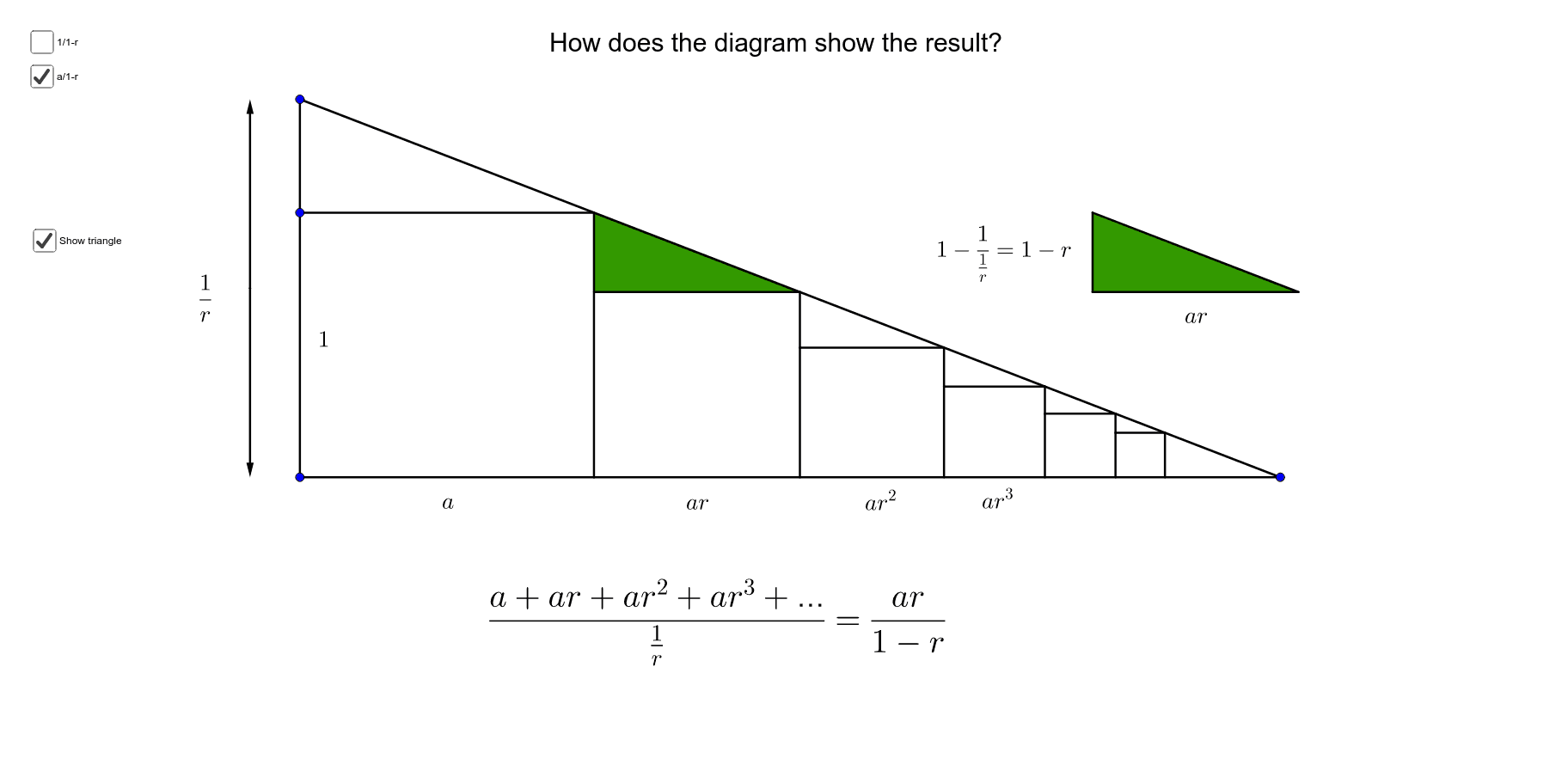
    Visual proofs of the sums of infinite geometric series, r<1 – GeoGebra

    material-mGcA23AB.png

    📌 Worked Example

    Example: Find the sum of the infinite geometric sequence 6 + 3 + 1.5 + …

    1. The first term a = 6.
    2. The common ratio r = 3 / 6 = 0.5.
    3. Since |r| = 0.5 < 1, the infinite sum exists.
    4. Apply the formula: S = 6 / (1 − 0.5).
    5. S = 6 / 0.5 = 12.
    🧠 Examiner Tip:
    Always check that the absolute value of the common ratio is less than 1 before applying the infinite sum formula.
    Many students lose marks by applying the formula when |r| ≥ 1, where the sum does not exist.
    🔍 TOK Perspective:
    Infinite geometric sums rely on the idea of infinity, which cannot be directly experienced in the physical world.
    Yet mathematics treats infinity as something that can be manipulated precisely.
    This raises deep questions about whether mathematical knowledge is discovered or constructed by human reasoning.
    🌍 Real-World Connection:
    The total distance travelled by a bouncing ball can be modeled using an infinite geometric series.
    Each bounce covers a fixed fraction of the previous height, forming a decreasing geometric pattern whose total distance converges to a finite value, even though the bouncing continues indefinitely.
  • 🧠 Neurotransmission

    📌 Definition Table

    TermDefinition
    NeurotransmitterA chemical messenger that transmits signals across the synaptic gap from one neuron to another.
    SynapseThe junction between two neurons where neurotransmission occurs.
    Action PotentialAn electrical impulse that travels down the neuron, triggering neurotransmitter release.
    Excitatory NeurotransmitterIncreases the likelihood that the receiving neuron will fire an action potential (e.g., glutamate).
    Inhibitory NeurotransmitterDecreases the likelihood that the receiving neuron will fire (e.g., GABA).
    ReuptakeThe reabsorption of neurotransmitters by the presynaptic neuron after signal transmission.
    AgonistA chemical or drug that enhances the effect of a neurotransmitter.
    AntagonistA chemical or drug that blocks or reduces the effect of a neurotransmitter.
    SerotoninA neurotransmitter involved in mood regulation, sleep, and arousal.
    DopamineA neurotransmitter linked with reward, motivation, and movement.
    Acetylcholine (ACh)A neurotransmitter involved in muscle contraction, learning, and memory.

    📌Core Concepts
    Neurotransmission is the process of communication between neurons through chemical messengers known as neurotransmitters.
    When an electrical impulse reaches the end of an axon (the presynaptic terminal), it triggers the release of neurotransmitters into the synaptic cleft, where they bind to receptors on the postsynaptic neuron.

    This process allows for rapid, targeted communication, influencing perception, emotion, cognition, and behavior.
    Different neurotransmitters have distinct roles: dopamine in reward and motivation, serotonin in emotion and sleep, acetylcholine in memory, and GABA in anxiety regulation.

    Understanding neurotransmission provides a biological explanation for behavior and insight into treatments for psychological disorders.

    Mechanisms of Neurotransmission

    Action Potential Generation:

    • An electrical signal travels down the axon due to depolarization.

    Vesicle Release:

    • Neurotransmitters stored in vesicles are released into the synaptic cleft.

    Receptor Binding:

    • Neurotransmitters bind to receptor sites on the postsynaptic membrane.

    Signal Transmission:

    • Excitatory neurotransmitters (e.g., glutamate) increase neuron firing; inhibitory neurotransmitters (e.g., GABA) reduce it.

    Reuptake/Degradation:

    • Enzymes break down neurotransmitters or they are reabsorbed for reuse (e.g., serotonin reuptake).

    📌Key Studies


    Rogers and Kesner (2003)

    • Aim: To determine the role of acetylcholine (ACh) in memory formation.
    • Method: Rats were trained to run a maze to find food. They were then injected with either scopolamine (ACh blocker) or saline (control).
    • Findings: The scopolamine group took longer and made more mistakes in maze learning.
    • Conclusion: ACh plays a key role in the formation of spatial memories.

    2. Antonova et al. (2011)

    • Aim: To investigate the effect of blocking acetylcholine receptors on spatial memory in humans.
    • Method: Double-blind, repeated measures fMRI study with 20 healthy males. Each participant received either scopolamine (ACh antagonist) or a placebo before performing a spatial memory task in an fMRI scanner.
    • Findings: Participants under scopolamine showed reduced hippocampal activation.
    • Conclusion: Acetylcholine is essential for encoding spatial memories; fMRI provides neural evidence for this mechanism.

    3. Fisher, Aron & Brown (2005)

    • Aim: To examine dopamine’s role in romantic love.
    • Method: fMRI scans of individuals “intensely in love” shown photos of their partners versus neutral acquaintances.
    • Findings: Activation in dopamine-rich areas (ventral tegmental area, caudate nucleus) associated with reward and motivation.
    • Conclusion: Romantic love involves dopamine pathways similar to addiction and reward circuits.

    4. Crockett et al. (2010)

    • Aim: To investigate the role of serotonin in prosocial behavior.
    • Method: Participants were given citalopram (a selective serotonin reuptake inhibitor, SSRI) or a placebo. They completed moral dilemmas involving harm to others.
    • Findings: Participants on citalopram were less likely to inflict harm, showing increased prosocial responses.
    • Conclusion: Increased serotonin levels promote prosocial and cooperative behavior by modulating emotional processing.

    5. Martinez & Kesner (1991)

    • Aim: To study the role of acetylcholine in memory retrieval.
    • Method: Rats injected with scopolamine (blocks ACh), physostigmine (enhances ACh), or saline before running a maze.
    • Findings: Scopolamine impaired memory; physostigmine improved it.
    • Conclusion: ACh directly facilitates memory encoding and retrieval—critical for learning processes.

    🧩 Evaluation

    Strengths

    • Triangulation of evidence: Both animal and human studies show consistent findings.
    • Use of fMRI and controlled lab conditions enhances reliability.
    • Demonstrates biological basis of learning, emotion, and memory.

    Limitations

    • Reductionist: Focuses narrowly on neurotransmitters, ignoring psychological and social influences.
    • Ethical issues in animal research (injections, induced stress).
    • Drug studies may have side effects that confound results.

    Ethical Considerations

    • Human studies (Antonova, Crockett) used double-blind designs and informed consent.
    • Animal studies (Rogers & Kesner) minimized suffering but must justify the use of invasive techniques.


    🔍Tok link


    Knowledge Question: How can we know that neurotransmitters cause behavior rather than merely correlate with it?
    This highlights the epistemological challenge of correlation vs. causation in biological psychology.
    TOK links include debates on determinism vs. free will, and the extent to which chemical processes define emotions like love or morality.

     🌐 Real-World Connection
    Depression treatment: SSRIs increase serotonin to regulate mood.

    Parkinson’s disease: Linked to dopamine deficits; treated with L-DOPA.

    Addiction research: Overactivation of dopamine pathways underlies dependency.

    Alzheimer’s disease: Linked to loss of acetylcholine-producing neurons.

    These findings underscore how understanding neurotransmitters translates into medical and psychological interventionsthat improve quality of life.

    ❤️ CAS Link
    Students could create awareness campaigns or workshops about how sleep, diet, and stress affect brain chemistry.
    Projects promoting mental health can emphasize serotonin balance through mindfulness, exercise, and positive lifestyle habits.

    🧠  IA Guidance

    A possible IA could investigate the effect of caffeine or music on memory recall, connecting cognitive performance to neurotransmitter activity (dopamine and norepinephrine pathways).
    The IA should discuss ethical considerations and avoid biological interventions.

    🧠 Examiner Tips

    In Paper 1 SAQs, focus on:

    Define neurotransmission clearly.

    Explain how one neurotransmitter affects behavior (ACh or serotonin are most common).

    Support with one study (Rogers & Kesner or Antonova).

    Include one evaluation point or ethical issue for top marks.

    Avoid describing brain structure changes — those belong under neuroplasticity.

  • 🧠 Neuroplasticity

    📌 Definition Table

    TermDefinition
    NeuroplasticityThe brain’s ability to reorganize itself by forming new neural connections throughout life.
    Synaptic PlasticityThe process by which synaptic connections strengthen or weaken over time in response to increases or decreases in activity.
    Cortical RemappingWhen functions previously performed by a damaged area of the brain are taken over by undamaged regions.
    Long-Term Potentiation (LTP)A long-lasting increase in synaptic strength resulting from repeated stimulation.
    Dendritic BranchingGrowth of new dendritic spines that create additional synaptic connections.
    NeurogenesisThe formation of new neurons, especially in the hippocampus and olfactory bulb.
    Experience-Dependent PlasticityBrain structural and functional changes in response to environmental demands and learning.

    📌Core Concepts
    Neuroplasticity describes the dynamic nature of the brain—its capacity to adapt structurally and functionally in response to learning, environmental changes, and injury. Once thought to be fixed after childhood, modern neuroscience has shown that plasticity persists throughout life, enabling recovery from trauma and supporting lifelong learning.

    It involves both functional plasticity (the brain’s ability to move functions from damaged to undamaged areas) and structural plasticity (the brain’s ability to change its physical structure through new connections and dendritic growth).

    Plasticity is influenced by environmental enrichment, learning, stress, and trauma, and is mediated by neurochemical and molecular changes like LTP and neurotrophin release (e.g., BDNF).

    Mechanisms of Neurplasticity

    MechanismDescriptionBiological Process
    LTP (Long-Term Potentiation)Repeated activation of synapses strengthens synaptic transmission.Increased neurotransmitter release and receptor sensitivity.
    Dendritic BranchingFormation of new dendritic spines, increasing synaptic networks.Promotes information storage and learning.
    Cortical RemappingBrain reallocates functional areas after injury or experience.Neighboring regions take over lost functions.
    Environmental EnrichmentStimulating surroundings promote neuron growth.Increased neurogenesis and synaptic density.
    NeurogenesisGrowth of new neurons, primarily in hippocampus.Linked to memory, learning, and mood regulation.

    📌Key Studies

    1. Maguire et al. (2000)

    • Aim: To investigate whether structural changes occur in the hippocampus of London taxi drivers in response to spatial navigation experience.
    • Method: MRI scans of 16 male London taxi drivers compared with 50 matched controls.
    • Findings: Increased grey matter volume in the posterior hippocampus of taxi drivers, positively correlated with years of experience.
    • Conclusion: Experience (navigation) causes structural plasticity; the hippocampus adapts to spatial demands.

    2. Draganski et al. (2004)

    • Aim: To investigate whether learning a new skill (juggling) induces structural changes in the brain.
    • Method: MRI scans before, during, and after participants learned to juggle over three months.
    • Findings: Increased grey matter in mid-temporal areas involved in visual motion; decreases after training stopped.
    • Conclusion: Learning new skills leads to temporary structural brain changes—evidence of experience-dependent plasticity.

    3. Rosenzweig, Bennett & Diamond (1972)

    • Aim: To study the effects of environmental enrichment and deprivation on neuroplasticity in rats.
    • Method: Rats placed in either enriched (toys, social interaction) or deprived environments.
    • Findings: Enriched rats developed thicker cerebral cortices and higher acetylcholine activity.
    • Conclusion: Enriched environments enhance brain growth and synaptic complexity—environment affects neural development.

    4. Merzenich et al. (1984)

    • Aim: To examine cortical remapping in the somatosensory cortex after sensory deprivation in monkeys.
    • Method: Fingers of monkeys were amputated; cortical responses were measured using microelectrodes.
    • Findings: Adjacent cortical areas took over the region previously responsible for the amputated finger.
    • Conclusion: The brain reorganizes functional mapping following injury—demonstrating cortical plasticity.

    🔍 Evaluation

    Strengths

    • Empirical evidence from MRI and animal studies supports both structural and functional plasticity.
    • Cross-species consistency (rats, monkeys, humans) enhances theoretical reliability.
    • Applications to rehabilitation and education are significant.

    Limitations

    • Causation cannot always be inferred (e.g., taxi drivers may have had larger hippocampi to begin with).
    • MRI studies show correlation, not process.
    • Animal research raises ethical concerns regarding deprivation and harm.

    Ethical Considerations

    • Use of animals (Rosenzweig, Merzenich) must adhere to minimization of harm and proper housing.
    • Human studies like Maguire are non-invasive and low-risk, aligning with IB ethical guidelines.

    🔍Tok link


    Neuroplasticity challenges the deterministic view of the brain.

    Knowledge Question: To what extent can scientific evidence of brain plasticity support the idea of free will?
    If the brain changes with experience, are behavior and personality truly fixed?
    This raises TOK debates between biological determinism and personal agency—bridging neuroscience with philosophy.

     🌐 Real-World Connection
    Stroke Recovery: Therapies like constraint-induced movement therapy rely on cortical remapping to restore motor control.

    Education: Learning techniques that encourage repeated practice and spaced recall stimulate long-term potentiation.

    Mental Health: Cognitive-behavioral therapy (CBT) physically alters neural pathways involved in emotion regulation.

    Technology: Neurofeedback and brain-computer interfaces harness plasticity to enhance rehabilitation.

    ❤️ CAS Link
    Students can engage in service projects promoting neurorehabilitation or mental agility in aging populations — such as organizing “Brain Fitness” workshops that involve memory games, puzzles, or mindfulness sessions to demonstrate neuroplastic change through experience.

    🧠  IA Guidance

    An IA could explore memory recall improvement through practice, linking behavioral changes to potential neural adaptation.
    For example, replicating aspects of Maguire or Draganski by testing participants on spatial or skill-based tasks over time.

    🧠 Examiner Tips

    Paper 1 SAQs, focus on:

    1. Define neuroplasticity.
    2. Explain how it occurs (LTP, dendritic branching).
    3. Support with one study (Draganski or Maguire).
    4. Discuss one strength or limitation.

    Avoid confusing neuroplasticity with localization — emphasize change over time rather than fixed structure-function mapping.

  • 🧠 Localisation

    📌 Definition Table

    TermDefinition
    Localization of FunctionThe theory that specific brain areas are responsible for specific psychological functions or behaviors.
    Cortical SpecializationThe distribution of different functions across distinct areas of the cerebral cortex.
    Broca’s AreaBrain region in the left frontal lobe responsible for speech production.
    Wernicke’s AreaRegion in the left temporal lobe essential for speech comprehension.
    HippocampusA structure in the limbic system associated with memory consolidation and spatial navigation.
    AmygdalaPart of the limbic system involved in processing emotions, particularly fear and aggression.
    Corpus CallosumBundle of neural fibers connecting the left and right hemispheres, enabling interhemispheric communication.

    📌Core Concepts

    Definition:
    Localization of function refers to the concept that different parts of the brain perform distinct roles in behavior and cognition. This principle emerged from 19th-century neurology, evolving through studies of brain injury, neuroimaging, and animal research.
    While early theorists like Gall (phrenology) oversimplified this idea, modern neuroscience shows that although specific brain regions are specialized, most behaviors arise from the interaction between localized areas.

    Localization forms the foundation of biological psychology, connecting mental processes like memory, language, and emotion to observable neural structures. Modern neuroimaging techniques (fMRI, PET) have refined our understanding, showing that while certain functions are concentrated, they remain integrated within brain networks.

    Mechanisms and Functional Areas

    Brain RegionFunctionAssociated Behavior / Process
    Frontal LobeDecision-making, impulse control, planningExecutive function, moral reasoning
    Parietal LobeSensory integration, spatial processingTouch, spatial orientation
    Temporal LobeAuditory processing, memorySpeech comprehension, facial recognition
    Occipital LobeVisual processingVisual recognition and perception
    HippocampusMemory formationLong-term memory, spatial navigation
    AmygdalaEmotional processingFear, aggression
    Broca’s AreaSpeech productionLanguage expression
    Wernicke’s AreaSpeech comprehensionLanguage understanding
    Corpus CallosumInter-hemispheric communicationCoordination between hemispheres

      📌Key Studies

      1. Broca (1861) – “Tan” Study
      • Aim: Investigate speech loss in patient “Tan” who could only utter one syllable.
      • Findings: Postmortem examination revealed a lesion in the left frontal lobe (now called Broca’s area).
      • Conclusion: Speech production localized in the left frontal region.

      2. Wernicke (1874)

      • Aim: Examine patients with speech comprehension deficits but intact speech production.
      • Findings: Lesions in the left posterior temporal lobe caused impaired understanding.
      • Conclusion: Language comprehension localized in Wernicke’s area.

      3. Maguire et al. (2000)

      • Aim: Investigate whether London taxi drivers show structural brain differences related to spatial memory.
      • Method: MRI scans compared taxi drivers to control participants.
      • Findings: Taxi drivers had increased grey matter in the posterior hippocampus, correlated with years of navigation experience.
      • Conclusion: The hippocampus is involved in spatial memory and demonstrates experience-dependent plasticity.

      4. HM Case Study (Scoville & Milner, 1957)

      Aim: Explore the effects of hippocampal removal on memory.

      Findings: HM developed anterograde amnesia — inability to form new long-term memories.

      Conclusion: The hippocampus is essential for memory consolidation.

      🔍 Evaluation

      Strengths:

      • Neuroimaging (MRI/fMRI) provides empirical support through correlational evidence.
      • Case studies offer detailed insights into specific brain-behavior relationships.
      • Consistent replication across studies (Broca, Wernicke, Maguire) supports general reliability.

      Limitations:

      • Reductionist – oversimplifies behavior as arising from one area, ignoring network interaction.
      • Individual variation – not all functions are identically localized across individuals.
      • Case studies lack generalizability and sometimes rely on postmortem analysis.

      Ethical Considerations:

      • Brain-injury studies often use patients with limited consent capacity.
      • Modern neuroimaging resolves many ethical issues through non-invasive techniques.


      🔍Tok link


      Localization relies on inference, not direct observation — we cannot see “memory” or “language,” only brain activation patterns.

      This challenges how scientific knowledge is built: Does brain activation cause a behavior or merely correlate with it?

      Knowledge Question: To what extent can we rely on indirect evidence (neuroimaging) to claim causation in psychology?

       🌐 Real-World Connection
      Understanding localization aids neurorehabilitationeducation, and mental health treatment.

      Neurosurgery planning uses localization to avoid damaging critical regions.

      In stroke therapy, knowing which hemisphere controls speech or motor movement helps target recovery strategies.

      ❤️ CAS Link
      Students could design a neuroscience outreach project—for example, creating informational posters or workshops explaining brain regions to younger students or communities. This encourages awareness of brain health, stroke, or trauma recovery, linking CAS service and creativity.

      🧠  IA Guidance

      IB Psychology Internal Assessments can replicate localization studies using memory recall or language tasks (e.g., Stroop test) to explore cognitive performance related to hemispheric processing. Students can relate cognitive outcomes to underlying brain functions..

      🧠 Examiner Tips

      In Paper 1 SAQs, structure your response using:

      • Define localization.
      • Describe the brain region and function.
      • Support with one study (e.g., Maguire or HM).
      • Briefly discuss strengths/limitations

    1. 🧠 Cognition and the digital world

      📌Core Concepts

      Definition:
      Digital technology — such as smartphones, social media, and the internet — affects how we attend to, process, and remember information. The study of digital cognition investigates how constant connectivity influences memory, attention, multitasking, and decision-making.

      Key Focus:

      Potential cognitive decline or restructuring due to technology use.

      Cognitive offloading (relying on technology for memory/storage).

      Effects of digital multitasking on attention span and working memory.

      Online environments shaping identity and social cognition.

      ⚙️ Mechanisms of Influence

      1. Cognitive Offloading:
        • Using digital devices to store or recall information, freeing up working memory.
        • Example: Using reminders, maps, or Google search instead of recall.
        • Sparrow et al. (2011) – “Google Effect.”
          • People remember where to find information better than the information itself.
          • Suggests transactive memory — sharing memory with external sources (devices).
      2. Digital Multitasking:
        • Constant task-switching reduces sustained attention.
        • Overuse can lead to cognitive overload and shallow processing.
        • Ophir et al. (2009) – heavy vs. light media multitaskers.
          • Heavy multitaskers performed worse on attention and task-switching tests.
          • Indicates reduced ability to filter irrelevant information.
      3. Social Media and Memory Encoding:
        • Kramer et al. (2014) – Facebook emotion contagion experiment.
          • Manipulating users’ news feeds affected their mood and content shared.
          • Demonstrates how digital emotional cues can influence cognition and behavior.

      📌Key Studies

      Sparrow et al. (2011) – Google Effect on Memory

      Aim: To test whether people remember information or its location better when using digital sources.
      Method: Participants were told trivia facts; half believed the facts would be saved, others thought deleted.
      Results: Those who thought facts were saved remembered less, but remembered where they were stored.
      Conclusion: Technology encourages memory offloading, altering memory processing patterns.

      Evaluation:

      ⚠️ Overemphasis on Western, tech-dependent populations.

      ✅ Supports transactive memory theory.

      ⚠️ Artificial lab task — low ecological validity.


      Ophir et al. (2009) – Media Multitasking and Attention Control

      Aim: To investigate if heavy media multitasking impairs cognitive control.
      Method: Compared heavy and light media multitaskers using cognitive control tests (task-switching, filtering).
      Results: Heavy multitaskers were more distracted by irrelevant stimuli and showed lower working memory capacity.
      Conclusion: Chronic multitasking may reduce sustained attention and executive control.

      Evaluation:

      ⚠️ Cultural/age bias — university students only.

      ✅ Strong correlation with cognitive control tasks.

      ⚠️ No causation established (pre-existing traits possible).


      🔍Tok link


      Technology reshapes how we know things — Is knowledge stored in the brain or in the cloud?

      Raises epistemological questions about collective memory and dependence on external knowledge systems.

      Also links to ethics of experimentation (e.g., Facebook studies without consent).

       🌐 Real-World Connection

      • Education: Tech-enhanced learning and AI tools support spaced repetition and visual memory.
      • Mental Health: Overstimulation and information overload may contribute to stress and poor sleep.
      • Legal: Cognitive offloading challenges eyewitness reliability (constant recording changes memory rehearsal).

      ❤️ CAS Link

      • Conduct a digital detox challenge and document changes in attention and well-being.
      • Lead workshops promoting balanced screen use and mindfulness in school.
      • Volunteer to teach digital literacy in underprivileged areas, reflecting on technology’s cognitive impact.

      🧠  IA Guidance

      • Possible IA topic: “Does digital multitasking impair short-term memory recall?”
      • Manipulate number of simultaneous tasks (e.g., text + recall test).
      • Ensure ethical compliance: no stress or long exposure to screens.

      🧠 Examiner Tips

      • Distinguish between beneficial and detrimental effects of digital technology.
      • Reference both biological (attention systems) and cognitive (memory encoding) mechanisms.
      • Avoid overgeneralization — effects differ across individuals and contexts.
      • Use at least two studies and one theoretical model (e.g., transactive memory or cognitive load theory).

    2. 🧠 Thinking and Decision making

      📌Definition Table

      Term Definition
      System 1 ThinkingAutomatic, quick, effortless, based on intuition, emotions, and heuristics.

      System 2 Thinking
      Deliberate, slow, logical, analytical, and requires effort.
      HeuristicsCognitive shortcuts or rules of thumb that simplify decision-making but can lead to biases.
      ThinkingThe process of using knowledge and information to make plans, solve problems, and draw conclusions.
      Decision-makingThe process of selecting a course of action among several alternatives.
      Loss AversionThe tendency to prefer avoiding losses over acquiring equivalent gains.
      Dual Process ModelThe theory that there are two systems of thinking: System 1 (fast, intuitive) and System 2 (slow, rational).

      📌Core Concepts

      Thinking and decision-making involve cognitive processes such as reasoning, judgment, and problem-solving.
      According to the Dual Process Model, humans use two systems of thought:

      • System 1: Intuitive, emotional, fast, and automatic.
      • System 2: Logical, analytical, deliberate, and controlled.

      While System 1 helps make quick decisions in daily life, it often leads to cognitive biases, whereas System 2 provides accuracy but requires mental effort.

      📌Key Studies
      📄 Kahneman & Tversky (1974) – Anchoring Bias

      Aim: To investigate the effect of anchoring on numerical estimation.
      Procedure:

      • Participants spun a random number wheel (10 or 65).
      • Then asked if the percentage of African nations in the UN was higher or lower than the number they spun, and to estimate the actual percentage.
        Findings:
      • Group with “10” estimated 25%; group with “65” estimated 45%.
        Conclusion:
      • Initial values (anchors) strongly influenced estimates.
        ✅ Supports the Dual Process Model: System 1 uses heuristics (anchoring), while System 2 adjusts insufficiently.

      Evaluation:

      ⚠️ May not represent complex real-life decisions.

      ✅ Controlled, replicable, supports cognitive bias theory.

      ⚠️ Artificial task (low ecological validity).


      📄 Tversky & Kahneman (1981) – Framing Effect

      Aim: To test how phrasing affects decision-making.
      Procedure:

      • Participants were told about a hypothetical disease outbreak.
      • “Program A” would save 200 lives; “Program B” had a ⅓ chance of saving all, ⅔ chance of saving none.
      • Framed as “lives saved” vs. “lives lost.”
        Findings:
      • When framed in terms of gains, most chose Program A (risk-averse).
      • When framed in terms of losses, most chose Program B (risk-seeking).
        Conclusion:
      • Decisions depend on how information is presented, not actual outcomes.
        ✅ Supports System 1 thinking — quick, emotional responses.

      Evaluation:

      ✅ Real-world applications in marketing and health communication.

      ✅ Highly replicable, foundational study on bias.

      ⚠️ Hypothetical scenario; lacks real-life consequence.


      📄 Englich & Mussweiler (2001) – Judicial Decision Making (Anchoring Bias)

      Aim: To determine whether legal professionals’ judgments are influenced by anchoring.
      Procedure:

      • 19 young trial judges read a legal case summary and were given a prosecutor’s sentencing demand (low: 34 months, high: 12 months).
        Findings:
      • Sentences followed the anchor — higher anchor → longer sentence.
        Conclusion:
      • Even trained professionals are susceptible to cognitive bias.
        ✅ Reinforces the pervasiveness of System 1 bias in reasoning.

      Evaluation:

      • ✅ Realistic application, high ecological validity.
      • ⚠️ Small sample (German judges), limited generalizability.
      • ✅ Strong support for System 1 influence in expert decision-making.

      🔍Tok link


      The Dual Process Model raises key epistemological questions:

      Can intuition (System 1) be considered a valid source of knowledge in ethics or art?

      Are “rational” decisions always better than intuitive ones?

      How do emotion and reason interact in the pursuit of knowledge?

       🌐 Real-World Connection

      • Used to understand consumer behaviorfinancial decisions, and marketing biases.
      • Explains judicial errorsmedical misdiagnoses, and public policy framing.
      • Crucial for risk communication in health and environmental issues — the way information is framed affects public response.

      ❤️ CAS Link

      • Create campaigns that raise awareness about cognitive biases (anchoring, framing, stereotyping).
      • Conduct decision-making workshops to improve rational thinking in community programs.
      • Link to ethical CAS reflection: “How do my biases affect decision-making when helping others?”

      🧠  IA Guidance

      • Excellent basis for an IA using anchoring or framing as an independent variable.
      • Example: Ask participants to estimate values (e.g., cost of items, probabilities) after different anchors.
      • Simple design, easily replicable, with quantitative analysis potential.

      🧠 Examiner Tips

      • Always name and describe a study (Tversky & Kahneman or Englich & Mussweiler).
      • Use key terms like heuristicsbiasSystem 1/2framing, and anchoring.
      • In ERQs, evaluate whether the Dual Process Model explains all decision-making or if it’s too simplistic.
      • Connect to real-life applications for top band answers (marketing, justice, health, etc.).

    3. 🧠 Schema Theory

      📌Definition Table

      Term Definition
      SchemaA mental framework or cognitive structure that organizes knowledge, beliefs, and expectations about the world.

      Schema Theory
      The idea that all knowledge is organized into units (schemas), which influence how information is encoded, stored, and retrieved.
      ReconstructionThe process of piecing together memory based on schemas rather than an exact replay of events.
      Cognitive BiasA systematic error in thinking due to reliance on schemas and heuristics.
      RetrievalAccessing stored information, which can be influenced by existing schemas.
      AssimilationIntegrating new information into existing schemas.
      AccommodationModifying existing schemas to incorporate new information.

      📌Core Concepts

      Schema theory explains how people use stored knowledge (schemas) to interpret new information.

      Schemas help simplify complex information but can also distort recall.

      They act as mental shortcuts guiding attention, encoding, and memory retrieval.

      📌Key Studies

      📄 Bartlett (1932) – “War of the Ghosts”

      Aim: Investigate how memory of a story is influenced by cultural schemas.
      Procedure: British participants read a Native American folk story (“War of the Ghosts”) and recalled it after days or weeks.
      Findings:

      • Story became shorter and more conventional.
      • Culturally unfamiliar details (canoes, ghosts) were changed to fit British expectations.
        Conclusion:
      • Memory is reconstructive.
      • Recall is influenced by pre-existing cultural schemas.
        ✅ Supports schema theory: People actively reconstruct memories using their prior knowledge.

      Evaluation:

      • ✅ Groundbreaking — introduced reconstructive memory concept.
      • ⚠️ Low ecological validity (artificial task).
      • ⚠️ Qualitative analysis open to researcher bias.
      • ✅ Replicated by modern studies (Brewer & Treyens, 1981).

      📄 Brewer & Treyens (1981) – Office Schema

      Aim: Investigate whether people’s memory for objects in a room is influenced by their schemas of what an office should contain.
      Procedure: Participants sat briefly in an office containing typical and atypical items (e.g., skull, brick). Later asked to recall or recognize objects.
      Findings:

      • Recalled schema-consistent items (desk, chair) more than inconsistent ones.
      • Often falsely remembered typical items not actually present (books).
        Conclusion:
      • Schema-driven expectations guide encoding and retrieval.
        ✅ Supports schema theory — memory is biased by schema expectations.

      Evaluation:

      • ✅ High ecological relevance (realistic setting).
      • ⚠️ Artificial recall task.
      • ⚠️ Potential demand characteristics.
      • ✅ Empirically strong — consistent with other schema research.

      📄 Anderson & Pichert (1978) – Role Perspective in Recall

      Aim: Test whether schema activation (house-buyer vs. burglar) affects recall.
      Procedure: Participants read a house description from one of two perspectives, recalled details, then switched perspectives and recalled again.
      Findings:

      • Participants recalled new information relevant to their new schema.
        Conclusion:
      • Schemas can influence retrieval, not just encoding.
        ✅ Shows schema theory explains both selective attention and memory recall.

      🔍Tok link


      Schema theory demonstrates that our “knowledge” is interpretive rather than objective.

      TOK Reflection: How do culture and language shape the schemas that define our understanding of reality?

      If memory is reconstructive, can we ever claim to know the past accurately?

       🌐 Real-World Connection

      • Explains stereotype formation and confirmation bias in social perception.
      • Applied in education — teaching new material is easier when linked to prior schemas.
      • Important in eyewitness testimony — memory may be distorted by schema-driven reconstruction (Loftus & Palmer, 1974).

      ❤️ CAS Link

      • Create awareness projects on bias and memory — e.g., how stereotypes affect perception.
      • Conduct group memory tests showing schema-based distortion and reflect on ethical implications.
      • Volunteer in tutoring programs to help peers use schema activation strategies for learning..

      🧠  IA Guidance

      • Ideal for cognitive IA experiments: use schema recall tasks.
      • Example: Office schema or “story recall” paradigm.
      • Dependent variable: number of accurate vs. schema-consistent false recalls.
      • Ethical, simple, and aligns with original cognitive methods.

      🧠 Examiner Tips

      • Always name and describe a supporting study (Bartlett, Brewer & Treyens, or Anderson & Pichert).
      • Explain how findings support schema theory (link mechanism to result).
      • Evaluate construct validity — schemas can’t be directly observed.
      • Link to cognitive bias and memory distortion for higher-level analysis.

    4. 🧠 Models of Memory

      📌Definition Table

      Term Definition
      MemoryThe process by which information is encoded, stored, and retrieved.
      EncodingTransforming sensory input into a form that can be processed and stored.
      StorageMaintaining encoded information in memory over time.
      RetrievalAccessing stored information for use.
      Working Memory Model (WMM)An updated model that explains active processing within STM (Baddeley & Hitch, 1974).
      Multi-Store Model (MSM)Theoretical model proposed by Atkinson & Shiffrin (1968), describing separate stores for sensory input, STM, and LTM.
      RehearsalThe process of repeatedly practicing information to transfer it from STM to LTM.

      📌Core Concepts

      🧠 Core Theories and Models

      1. The Multi-Store Model (MSM) – Atkinson & Shiffrin (1968)

      Overview:
      The MSM suggests that memory operates in three distinct stores:

      • Sensory Memory – detects information and holds it briefly (iconic, echoic, etc.).
      • Short-Term Memory (STM) – processes information through rehearsal; limited capacity.
      • Long-Term Memory (LTM) – relatively permanent store of encoded information.

      Key Processes:

      • Attention: Transfers information from sensory → STM.
      • Rehearsal: Transfers STM → LTM.
      • Retrieval: LTM → STM for use.


      The Working Memory Model (WMM) – Baddeley & Hitch (1974)

      Overview:
      A more detailed model of STM, emphasizing active processing of information.

      Components:

      • Central Executive: Controls attention and coordinates subsystems.
      • Phonological Loop: Processes auditory/verbal information.
      • Visuospatial Sketchpad: Processes visual/spatial data.
      • Episodic Buffer (added in 2000): Integrates information across domains into coherent episodes.

      📌Key Studies

      📄 Glanzer & Cunitz (1966)

      • Participants recalled word lists immediately or after a delay.
      • Immediate recall showed a primacy and recency effect (first and last words remembered).
      • Delayed recall removed recency effect, showing STM–LTM distinction.
        ✅ Supports MSM — suggests separate memory stores.

      Evaluation:

      ⚠️ Neglects interaction between stores.

      ✅ Empirical support (Glanzer & Cunitz; Milner’s HM case).

      ⚠️ Oversimplifies memory as linear

      ⚠️ Does not explain why some information transfers to LTM better.

      📄 Baddeley, Lewis, & Vallar (1984)

      • Participants asked to perform a reasoning task while repeating a sequence of digits (articulatory suppression).
      • Performance decreased slightly but remained possible — showing two independent components.
        ✅ Supports WMM — multiple active subsystems.

      Evaluation:

      ⚠️ Lacks full biological validation.

      ✅ Supported by dual-task studies.

      ✅ Explains multitasking and active information processing.

      ⚠️ Central Executive is vaguely defined.


      🔍Tok link

      Memory models are theoretical — not directly observable.

      TOK reflection: Is memory a physical construct or a mental abstraction inferred from behavior?
      How can we claim to “know” memory exists as distinct stores if we can’t see them?

       🌐 Real-World Connection

      • MSM principles used in education (chunking, rehearsal).
      • WMM applied to attention disorders like ADHD — deficits in the central executive.
      • Cognitive rehabilitation programs use WMM to improve memory in stroke or trauma patients.

      ❤️ CAS Link

      • Create memory-awareness campaigns in your school community.
      • Demonstrate effects of multitasking or distraction on recall using peer experiments.
      • Reflect on how cognitive strategies improve learning — linking science to well-being.

      🧠  IA Guidance

      • Design IA experiments on serial position effect (MSM) or dual-task interference (WMM).
      • Ethical and low-risk: use word recall, digit span, or multitasking tasks.
      • Quantitative data: mean recall accuracy, t-tests to compare conditions.

      🧠 Examiner Tips

      • Always name the model and study explicitly.
      • Explain mechanisms (rehearsal, attention, encoding).
      • Contrast MSM and WMM to show conceptual understanding.
      • Use critical thinking terms: reductionism, ecological validity, construct validity.

    5. 🧠 Flashbulb Memory

      📌Core Concepts

      Flashbulb Memory (FBM) refers to highly detailed, vivid, and long-lasting memories of emotionally significant events. These memories are thought to be “photographic” in clarity, but may still be prone to distortion.

      Key Ideas:

      However, these memories are not always more accurate—only more confident..

      Emotion can enhance the encoding of certain memories.

      FBMs are linked to physiological arousal (especially the amygdala and adrenaline release).

      The theory suggests that emotionally charged events trigger a biological mechanism that improves memory retention.

      📌Key Studies

      Brown & Kulik (1977) – The Original Theory

      • Proposed that emotional events create a special biological “print” in the brain.
      • Introduced the concept of “surprise” and “personal relevance” as triggers.
      • Identified key antecedent conditions:
        1. Surprise
        2. High emotional arousal
        3. Personal importance
        4. Rehearsal (overt and covert)

      Six main features of FBMs:

      1. Place
      2. Ongoing activity
      3. Informant (who told you)
      4. Own affect
      5. Other’s affect
      6. Aftermath

      They argued that these details are encoded differently than normal memories through a biological mechanism (amygdala activation) and rehearsal.


      2. Sharot et al. (2007) – The 9/11 Study

      Aim: 

      To determine the role of the amygdala in creating FBMs for shocking events.

      Method:

      • Conducted three years after 9/11 with 24 participants in New York.
      • Participants were shown cue words (e.g., “Summer,” “September”) while in an fMRI scanner.
      • Compared people near the World Trade Center (“downtown”) vs. those far away (“midtown”).

      Results:

      • Greater activation of the amygdala in participants close to Ground Zero when recalling 9/11.
      • Their memories were more vivid and emotionally intense.
      • Concluded that proximity and emotional intensity influence FBM formation.

      Evaluation:

      • Strength: Objective measurement through fMRI (biological evidence of amygdala involvement).
      • Limitation: Correlational — can’t prove causation; post-event memory could still be reconstructed.

      3. McGaugh & Cahill (1995) – Adrenaline and Memory

      Aim: Investigate the role of adrenaline and the amygdala in emotional memory formation.

      Method:

      • Participants were shown two stories:
        1. Neutral story (about hospital visit)
        2. Arousing story (child involved in severe accident)
      • Tested recall two weeks later.
      • In follow-up, researchers blocked adrenaline activity using a beta-blocker (propranolol).

      Results:

      • Those who heard the emotional story remembered more details.
      • When adrenaline was blocked, this enhancement disappeared.
      • Concluded that adrenaline activation of the amygdala plays a critical role in forming emotional memories.

      Evaluation:

      • Strength: Strong cause-effect evidence from biological manipulation.
      • Limitation: Lacks ecological validity (lab setting); ethical considerations with drug use.

      🧩 The Interaction Between Emotion and Cognition

      Emotion (biological) → activates amygdala → releases adrenaline and cortisol → enhances encoding in hippocampus → creates stronger emotional memory trace.

      However, later retrieval is still subject to reconstruction and bias, meaning FBMs are vivid but not necessarily accurate.

      🔍Tok link


      Emotion and reason often conflict: people may feel certain about a memory, even when it’s inaccurate.

      What defines “truth” in memory — vividness or verifiable accuracy?

      Raises questions about knowledge reliability in eyewitness testimony, and how emotion affects perception of events.

       🌐 Real-World Connection

      • FBMs explain strong collective memories (e.g., 9/11, assassination of leaders, natural disasters).
      • Used in forensic psychology to understand eyewitness confidence vs. accuracy.
      • Relevant for PTSD research and treatment, as emotional arousal influences memory persistence.

      ❤️ CAS Link

      • Organize a mental health awareness project or interview people about how emotional events shape memory.
      • Reflect on ethical considerations of emotion-triggering research and the importance of empathy when dealing with trauma narratives.

      🧠  IA Guidance

      • Excellent IA base: Compare recall accuracy for emotional vs. neutral images or words.
      • Could test emotional arousal using self-rating scales.
      • Ensure ethical protection—avoid overly distressing stimuli.

      🧠 Examiner Tips

      • Always link emotion to memory processes (encoding and retrieval).
      • Don’t confuse vividness with accuracy — this is a common mistake.
      • Mention biological evidence (amygdala/adrenaline) and cognitive evidence (rehearsal, schema).
      • Use Sharot and McGaugh for biological, Brown & Kulik for theoretical grounding.

    6. 🧠 RECONSTRUCTIVE MEMORY

      📌Definition Table

      Term Definition
      Memory reconstructionThe process of recalling information by building it again from stored knowledge, influenced by schemas and expectations.
      Reconstructive memoryThe idea that memory is not a perfect recording but an active reconstruction that can be distorted by schemas, leading to inaccuracies.
      Misleading informationPost-event information that changes or distorts one’s memory of an event.
      Eyewitness testimonyLegal term for evidence given by people who witnessed an event — often unreliable due to memory reconstruction.
      Post-event informationNew data introduced after an event that alters the memory of it.
      ConfabulationFilling in memory gaps with false details unknowingly.
      SchemaMental frameworks of prior knowledge that help organize and interpret new information.

      📌Core Concepts

      Human memory is not a passive storage system; it is reconstructive, meaning recall involves piecing together information using existing schemas.
      This makes memory prone to distortion, particularly through misleading questions, emotional interference, or post-event exposure.

      📌Key Studies

      📄 Loftus & Palmer (1974) – Eyewitness Testimony and Leading Questions

      Aim: To investigate how wording of questions influences memory reconstruction.
      Procedure:

      • Participants watched car crash videos and answered questions about speed using verbs like smashed, hit, bumped, collided, contacted.
        Findings:
      • Average speed estimates varied by verb (smashed = 40.8 mph, contacted = 31.8 mph).
      • “Smashed” group was more likely to falsely recall broken glass.
        Conclusion:
      • Memory is reconstructive and can be influenced by leading questions.

      Evaluation:
      ✅ Controlled experiment with clear IV manipulation.
      ⚠️ Lacks ecological validity — artificial car crashes.
      ✅ Strong implications for eyewitness testimony reliability.


      📄 Loftus & Pickrell (1995) – Lost in the Mall Study

      Aim: To determine if false memories can be implanted.
      Procedure:

      • Participants received 4 childhood event descriptions (3 true, 1 false about being lost in a mall).
      • Interviewed about their memories.
        Findings:
      • 25% “remembered” the false event.
        Conclusion:
      • False memories can be created through suggestion and familiarity.

      Evaluation:
      ✅ Ethical debriefing, demonstrates reconstructive nature of memory.
      ⚠️ Low ecological validity (minor event).
      ⚠️ Potential emotional discomfort.


      📄 Yuille & Cutshall (1986) – Real-Life EWT Study

      Aim: To test reliability of memory in a real crime.
      Procedure:

      • Interviewed witnesses of a real armed robbery in Vancouver.
      • Compared responses with police reports.
        Findings:
      • Witness accounts were accurate even after months.
        Conclusion:
      • Memory for stressful real-life events can be reliable.

      Evaluation:
      ✅ High ecological validity.
      ✅ Contradicts lab-based findings like Loftus & Palmer.
      ⚠️ Difficult to replicate due to ethical limits.


      💬 Evaluation of Reconstructive Memory Theory

      StrengthsLimitations
      Supported by strong experimental evidence (Loftus & Palmer).Artificial tasks reduce ecological validity.
      Explains EWT inaccuracy and real-world legal implications.Overemphasizes unreliability — ignores consistent memory under stress.
      Integrates schema theory with memory models.Lab experiments lack emotional realism.
      Supported by biological evidence of hippocampal involvement in memory reconstruction.Cultural and individual differences not accounted for.

      🔍Tok link


      How reliable is memory as a source of knowledge?
      Can we ever distinguish between what we remember and what we imagine?
      TOK connects memory reliability to reason, language, and emotion as ways of knowing — highlighting how phrasing (language) can alter recall.

       🌐 Real-World Connection

      • Crucial in legal systems — questioning methods can alter witness memories.
      • Used in therapy to understand false memory syndrome.
      • Applied in advertising and media framing — repeated exposure creates false familiarity.

      ❤️ CAS Link

      • Collaborate with peers to recreate a mock trial, analyzing reliability of eyewitnesses.
      • Design an awareness campaign on memory distortion and justice.
      • Reflect on ethical responsibility in using memory-based evidence.

      🧠  IA Guidance

      • Ideal IA topic: effect of leading questions on memory recall.
      • Use Loftus & Palmer’s verb manipulation to measure mean differences in recall accuracy.
      • Quantitative design suitable for descriptive statistics and t-tests.

      🧠 Examiner Tips

      • Always name Loftus & Palmer (1974) for reconstruction evidence.
      • Link schema theory + leading questions → distortion.
      • In ERQs, balance findings from Loftus (unreliable) and Yuille & Cutshall (reliable) for nuanced argument.
      • Use terms like encodingretrieval, and schema influence precisely.