AHL 1.13: COMPLEX NUMBERS
📌 Key definitions
| Term | Definition | Example |
|---|---|---|
| Complex Number | A number of the form z = a + bi, where a, b ∈ ℝ and i is the imaginary unit (i2 = −1). | z = 3 + 4i |
| Real Part | The a in z = a + bi. | Re(3 + 4i) = 3 |
| Imaginary Part | The b in z = a + bi (note: not ‘bi’). | Im(3 + 4i) = 4 |
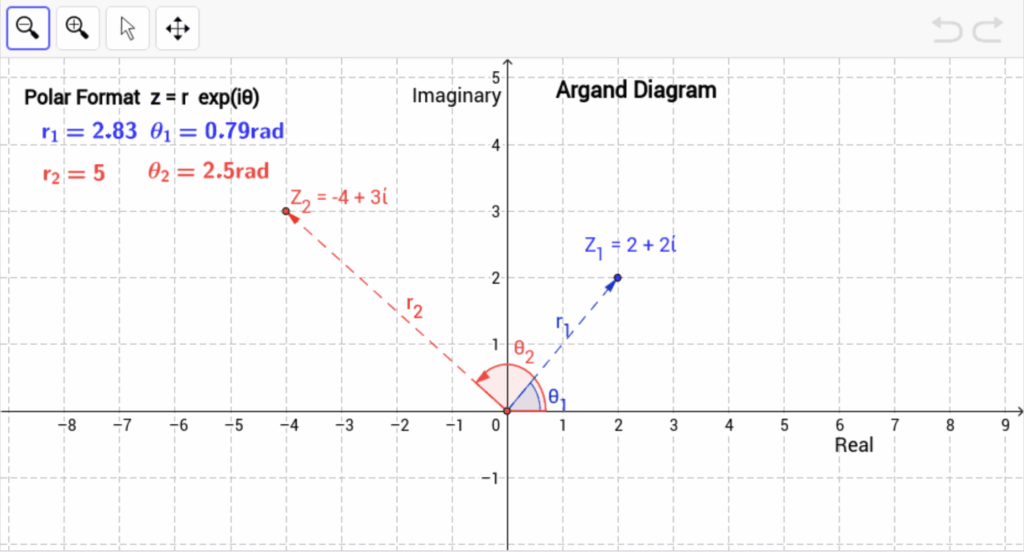
| Modulus | |z| = √(a2 + b2) — distance from origin in Argand plane. | |3 + 4i| = 5 |
| Argument | Angle θ from positive real axis: θ = tan-1(b / a) (adjust for quadrant). | Arg(3 + 4i) ≈ 53.13° |
| Conjugate | z̄ = a − bi. Reflection of z across the real axis. | Conj(3 + 4i) = 3 − 4i |
| Polar Form | z = r (cos θ + i sin θ), where r = |z|. | 5 (cos 53.13° + i sin 53.13°) |
| Exponential Form | z = r eiθ (Euler’s relation). | 5 ei·53.13° |
Engineers model AC circuits using complex numbers (phasors). The modulus gives amplitude and the argument gives phase — this makes adding phase-shifted sinusoids straightforward. (Example: combine two same-frequency voltages with different phases by converting to complex phasors.)
📌 Properties of i
- i1 = i
- i2 = −1
- i3 = −i
- i4 = 1
- Powers of i cycle every 4 terms; use remainders modulo 4 to simplify high powers.
The term “imaginary” historically led to philosophical resistance. Discuss if the label shapes student intuition and whether the usefulness in applications (physics, signals) changes the perceived “reality” of i.
📌 Operations with complex numbers
- Addition: (a + bi) + (c + di) = (a + c) + (b + d)i
- Subtraction: (a + bi) − (c + di) = (a − c) + (b − d)i
- Multiplication: (a + bi)(c + di) = (ac − bd) + (ad + bc)i
- Division: (a + bi)/(c + di) = [(ac + bd) + (bc − ad)i] / (c2 + d2) — derived by multiplying numerator and denominator by conjugate of denominator.
z = 2 + 3i, w = 1 − 4i → z × w = (2 + 3i)(1 − 4i) = 2 − 8i + 3i − 12i2 = 2 − 5i + 12 = 14 − 5i.
An IA could measure how numerical rounding affects complex arithmetic in applied settings (e.g., combining phasors in power analysis). Show both hand derivations and GDC verification.
📌 Modulus, argument, polar & exponential form
- |z|: |a + bi| = √(a2 + b2)
- arg(z): θ = tan-1(b/a) — check quadrant
- Polar: z = r (cos θ + i sin θ)
- Exponential: z = r eiθ (Euler)
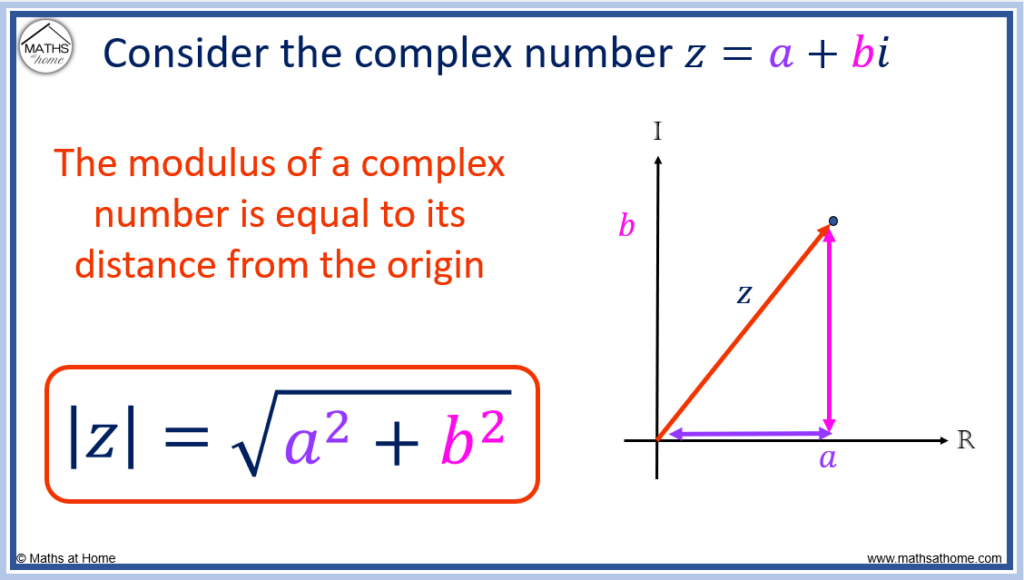
definition-of-the-modulus-of-a-complex-number-1-1024×580.png

argument-of-complex-number-1638955560.png
Use polar/exponential form to add sinusoids with phase shifts. In power engineering the magnitude is RMS voltage/current and argument is phase; combining phasors becomes multiplication/addition in exponential form.
📌 Products, quotients & integer powers (De Moivre)
- Product: r1eiθ1 · r2eiθ2 = (r1r2) ei(θ1+θ2)
- Quotient: (r1eiθ1) / (r2eiθ2) = (r1/r2) ei(θ1−θ2)
- Power (int): (r eiθ)n = rn einθ
De Moivre’s theorem shows an elegant link between algebraic exponentiation and geometric rotation: powering rotates a point about origin. Discuss how algebraic rules encode geometric operations and what that implies about mathematical representation.
Put your calculator in complex mode (a+bi). Use it to compute modulus, argument, convert between forms and check hand work; practice both methods. For powers, use polar form on GDC to avoid repeated expansion.
📌 Worked practice & checks
- High power: i2025 → 2025 mod 4 = 1 → i
- Modulus/arg: z = 1 − i → |z| = √2; arg = −45° (or 315°)
- Division example: (3 + 4i)/(1 + 2i) → multiply by conjugate to obtain (11 − 2i)/5.
An EE could explore roots of unity, their geometric patterns on Argand plane, and implications for discrete Fourier transforms — linking pure math to signal-processing applications.
Know manual methods (division by conjugate, expansion) but use GDC for speed. Always show a brief hand-check on paper for key steps (explain quadrant choice for arg and a final numeric check).