📌 Key Concepts and Definitions
The Imaginary Unit (i)
- The imaginary unit, i, is defined as the number such that i2 = -1.
- From this, we can say i = √(-1). This allows us to find solutions for equations that do not have real roots.
Cartesian Form: z = a + bi
- This is the standard form of a complex number, where a and b are real numbers.
- Real Part (Re(z)): The term ‘a’ is the real part of z.
- Imaginary Part (Im(z)): The term ‘b’ (not bi) is the imaginary part of z.
The Complex Conjugate (z*)
- The conjugate of z = a + bi is z* = a – bi.
- Geometrically, the conjugate is a reflection of z in the real (horizontal) axis.
- A key property is z × z* = (a+bi)(a-bi) = a2 – (bi)2 = a2 – b2i2 = a2 – b2(-1) = a2 + b2. The result is always a real number.
The Modulus (|z|)
- The modulus of z = a + bi is its distance from the origin (0, 0) on the complex plane.
- It is a real, non-negative number.
- Formula: |z| = √(a2 + b2). (This comes from the Pythagorean theorem).
- Note: |z|2 = a2 + b2, which means |z|2 = z × z*.
The Argument (arg(z))
- The argument of z is the angle θ that the line from the origin to z makes with the positive real axis.
- Calculation: tan-1 (b / a) = θ.
| ❤️ CAS Ideas Creativity: Use graphing software or simple code to generate images of fractals like the Mandelbrot set. This can be a project exploring the intersection of mathematics and art. Activity: Research the history of complex numbers, focusing on the initial resistance to “imaginary” numbers and their eventual acceptance and application. Service: Create a tutorial (video or document) for younger students explaining *why* we need imaginary numbers, using the simple example of √(-1) and solving quadratic equations. |
| 🔢 IA Spotlight Topic Selection: A popular and visually stunning IA topic is the exploration of fractals, such as the Mandelbrot set or Julia sets. Methodology: These fractals are generated by iterating a simple complex-number function (e.g., zn+1 = zn2 + c) for many points c in the complex plane and observing whether the sequence |zn| diverges or stays bounded. Analysis: This involves complex number arithmetic (multiplication, addition) and understanding the modulus. You can use technology (like programming or specialized software) to generate and visualize these beautiful and infinitely complex shapes. |
📌 Operations with Complex Numbers
Sums and Differences (By Hand)
- Add or subtract the real parts and imaginary parts separately.
- Example: (3 + 4i) + (2 – 5i) = (3+2) + (4-5)i = 5 – i
- Example: (3 + 4i) – (2 – 5i) = (3-2) + (4 – (-5))i = 1 + 9i
Products (By Hand)
- Multiply as you would binomials (e.g., FOIL), then replace i2 with -1 and simplify.
- Example: (3 + 4i) × (2 – 5i) = 3(2) + 3(-5i) + 4i(2) + 4i(-5i)
- = 6 – 15i + 8i – 20i2
- = 6 – 7i – 20(-1)
- = 6 – 7i + 20 = 26 – 7i
Quotients (By Hand)
- To divide, multiply the numerator and denominator by the conjugate (Z*) of the denominator. This makes the denominator a real number.
- Example: (3 + 4i) ⁄ (1 + 2i)
- = [(3 + 4i) × (1 – 2i)] / [(1 + 2i) × (1 – 2i)]
- Numerator: 3 – 6i + 4i – 8i2 = 3 – 2i – 8(-1) = 11 – 2i
- Denominator: 12 + 22 = 1 + 4 = 5
Powers (With Technology)
- Use your GDC’s complex number mode to calculate powers, e.g., (2+i)5.
- This is much faster than repeated multiplication by hand.
📌 The Complex Plane (Argand Diagrams)
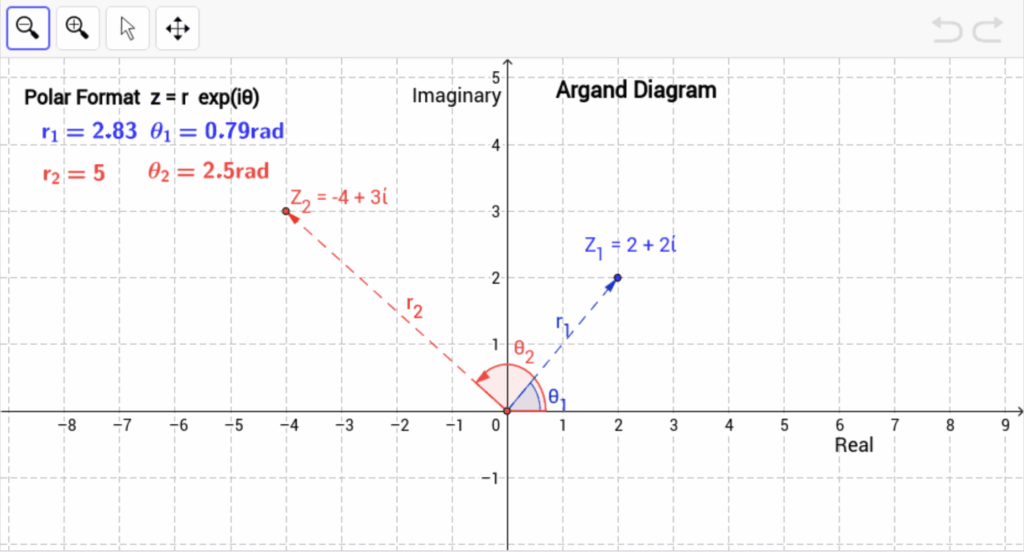
- The complex plane (or Argand diagram) is a 2D coordinate system used to plot complex numbers.
- The horizontal axis is the Real axis (Re).
- The vertical axis is the Imaginary axis (Im).
- A complex number z = a + bi is plotted as the point with coordinates (a, b).
https://www.musclemathtuition.com/wp-content/uploads/2023/09/Argand-diagram.png

| 🔍 TOK Perspective How does language shape knowledge? Do the words “imaginary” and “complex” make the concepts more difficult than if they had different names? What does the “existence” of complex numbers tell us about the nature of mathematics? Are they “real” (discovered) or a useful invention (created) to solve problems? The number i was considered “imaginary” for centuries, yet it is now fundamental to describing “real-world” physics. What does this tell us about the relationship between mathematical models and reality? |
📌 Complex Numbers and Quadratic Equations
The Discriminant (Δ)
- For a quadratic equation ax2 + bx + c = 0 (with real coefficients a, b, c), the discriminant is Δ = b2 – 4ac.
- If Δ < 0 (i.e., b2 – 4ac < 0), there are no real roots.
Complex Solutions
- When Δ < 0, the quadratic equation has two complex solutions (roots).
- The solutions are given by the quadratic formula: x = (-b ± √(b2 – 4ac)) ÷ (2a).
- We use i = √(-1). Example: √(-16) = √(16 × -1) = √16 × √(-1) = 4i.
- The two complex roots will always be a complex conjugate pair. If a + bi is a root, then a – bi is the other root.
Example
- Solve: x2 + 2x + 5 = 0
- Discriminant: Δ = b2 – 4ac = 22 – 4(1)(5) = 4 – 20 = -16.
- Formula: x = (-2 ± √(-16)) ÷ (2(1))
- x = (-2 ± 4i) ÷ 2
- Solutions: x = -1 + 2i and x = -1 – 2i.
Graphical Link
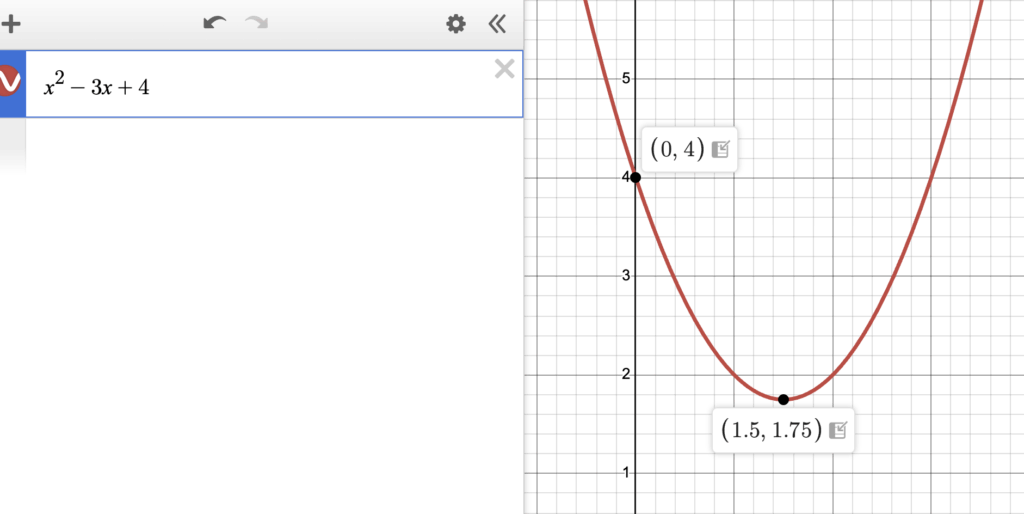
- The graph of the corresponding function, f(x) = ax2 + bx + c, is a parabola that does not intersect the x-axis.
- This lack of x-intercepts visually confirms the absence of real roots.
| 🧠 Examiner Tip All calculations with complex numbers (sums, products, quotients, powers, roots of quadratics) can be done efficiently with technology. Ensure your GDC is in complex number mode (e.g., a+bi mode). You should know how to do simple operations by hand, especially division using the conjugate, but use your GDC to check answers or for complex calculations like powers. |
| 📝 Paper Strategy (All Papers) Since the GDC is allowed on all papers, complex number arithmetic should be fast and accurate. Practice using your calculator’s complex number functions. Be able to draw and interpret Argand diagrams. This includes plotting points, their conjugates, and representing |z| and arg(z). Know how to use the quadratic formula and how to handle a negative discriminant Δ to find the two complex conjugate roots. Be able to find the complex roots of a polynomial using your GDC’s polynomial root finder. |