| Term / concept | Definition / formula |
|---|---|
| Displacement s(t) | Net change in position. If v(t) is velocity, displacement over [t1,t2] = ∫t1t2 v(t) dt. |
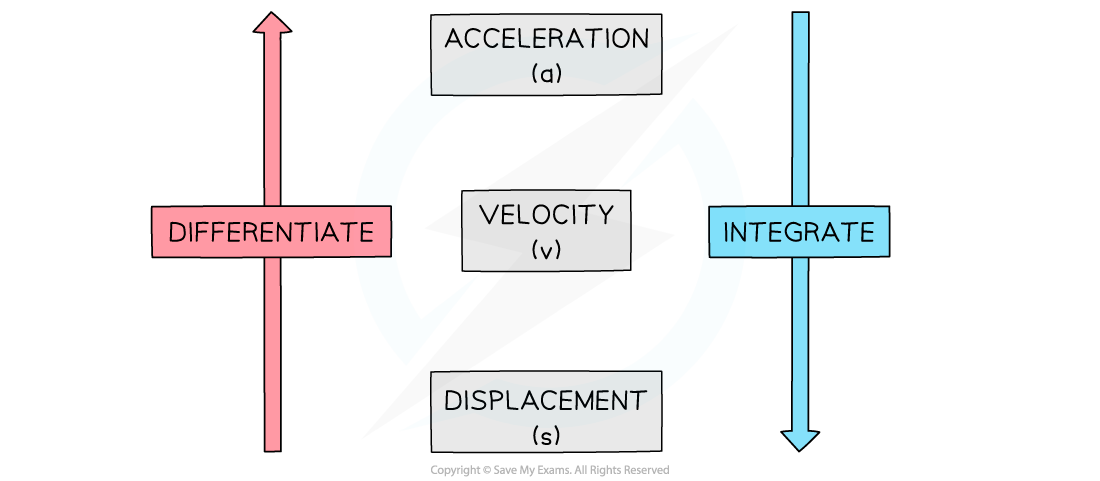
| Velocity v(t) | Rate of change of position: v(t)=ds/dt. If s(t) known, v(t)= derivative of s(t). |
| Acceleration a(t) | Rate of change of velocity: a(t)=dv/dt = d2s/dt2. |
| Distance | Total path length = ∫t1t2 |v(t)| dt (must split where v(t) changes sign). |
📌 Key relationships & interpretations
- v(t)=ds/dt (instantaneous slope of s); units: length/time.
- a(t)=dv/dt=d2s/dt2 (instantaneous slope of v).
- Displacement = ∫ v(t) dt; Distance = ∫ |v(t)| dt (split at zeros of v(t)).
- If v and a same sign → speed increasing; opposite signs → speed decreasing.
🌍 Real-world connections
- Navigation/GPS: integrate measured speed to estimate displacement and ETA; sampling error causes drift — correct with external fixes.
- Automotive safety: sudden large negative a(t) (deceleration) triggers ABS / airbags; sensors supply acceleration profiles in real time.
- Sports analytics: coaches analyse v(t) and a(t) profiles to quantify accelerations during sprints and recovery patterns.
- Engineering design: acceptable acceleration limits (g-forces) inform roller-coaster and vehicle suspension design.
📌 Calculations (pointers & method)
- From s(t): v=ds/dt, a=d2s/dt2. Example: s=t3 ⇒ v=3t2, a=6t.
- From v(t): displacement = ∫ v dt. Use GDC’s ∫ function for definite integrals.
- Distance: find v(t)=0 roots, split interval at roots, compute sum of integrals of |v| (GDC: integrate each interval and take absolute values if needed).
- From a(t): integrate to get v(t) + C (use initial v), then integrate v(t) + C to get s(t) + C2 (use initial s).
🧠 Examiner tip
- State whether result is displacement (signed) or distance (positive).
- Write partition times where v(t)=0 and evaluate sub-integrals for distance (method marks).
- Label units in answers and show brief justification when using GDC.
- When given a(t) only: integrate → apply v(0) → integrate → apply s(0).
📱 GDC Tips — Calculus in Kinematics (Displacement, Velocity & Acceleration)
TI-Nspire CX II / CX II CAS
- Enter the given function (s(t), v(t), or a(t)) in the Calculator or Graphs app, clearly defining the independent variable t.
- To find velocity from displacement, use Menu → Calculus → Derivative and evaluate ds/dt symbolically or at specific t-values if required.
- To find acceleration from velocity, repeat the derivative process on v(t), ensuring correct units (length/time²).
- For displacement from velocity, use Menu → Calculus → Integral and enter a definite integral with correct limits to avoid missing constants.
- To calculate distance, first solve v(t)=0 using Menu → Algebra → Solve, then compute separate integrals on each interval and interpret results as absolute values.
Casio fx-CG50 / fx-CG100
- Enter the function in the Graph app and set the correct viewing window so that key features (turning points and intercepts) are visible.
- Use G-Solv → d/dx to numerically verify velocity or acceleration at specific time values.
- For displacement, use G-Solv → ∫dx with correct lower and upper limits to compute signed area under v(t).
- To find when velocity changes direction, use G-Solv → Root to locate zeros of v(t), then record these times clearly.
- Compute distance by integrating over each sub-interval separately and summing the magnitudes, explaining the split explicitly in written solutions.
IB Exam Technique (All GDCs)
- Always state whether the calculator result represents displacement (signed) or distance (always positive).
- Show at least one symbolic step (derivative or integral setup) before using GDC output to secure method marks.
- When integrating acceleration, explicitly apply initial conditions after each integration to find constants.
- Label all final answers with correct physical units and briefly interpret what the result means in context.
📌 Example questions (brief methods)
- Displacement = ∫05 (t2−4t+3) dt — evaluate with GDC’s integral function.
- Find roots: t=1,3. Partition [0,1],[1,3],[3,5]. Compute integrals on each and sum absolute values for distance.
- v(t)=∫6t dt = 3t2 + C → use v(0)=2 → C=2 → v=3t2+2.
- s(t)=∫(3t2+2) dt = t3 + 2t + K → s(0)=1 → K=1 → s=t3+2t+1.
📌 Quick formula sheet
- v(t)=ds/dt
- a(t)=dv/dt=d2s/dt2
- Displacement = ∫t1t2 v(t) dt
- Distance = ∫t1t2 |v(t)| dt (split at sign changes)
📝 Paper tip
- When asked ‘distance’, explicitly partition at v(t)=0 and sum absolute integrals with short justification.
- When given only a(t): integrate twice, apply initial conditions after each integration step and state them clearly.
📌 Multiple Choice Questions (MCQs)
MCQ 1. A particle moves along a straight line with velocity
v(t) = 3t² − 12t + 9, where t is measured in seconds.
Which statement is correct?
- A. The particle is always moving forwards.
- B. The particle changes direction exactly once.
- C. The particle changes direction exactly twice.
- D. The particle never comes to rest.
Answer & Explanation
Set v(t)=0 to find direction changes:
3t² − 12t + 9 = 0 ⇒ t² − 4t + 3 = 0 ⇒ (t−1)(t−3)=0
The velocity is zero at t=1 and t=3, and the sign of v(t) changes at both points.
Correct answer: C — the particle changes direction twice.
MCQ 2. If s(t) is displacement and v(t) is velocity, which expression always gives the distance travelled from t=a to t=b?
- A. ∫ab v(t) dt
- B. | ∫ab v(t) dt |
- C. ∫ab |v(t)| dt
- D. ∫ab v(t)² dt
Answer & Explanation
Distance measures total path length, regardless of direction.
This requires integrating the magnitude of velocity.
Correct answer: C
MCQ 3. A particle has acceleration a(t)=6t−4.
At what value of t does the velocity have a minimum?
- A. t = −2
- B. t = 0
- C. t = 2/3
- D. t = 4
Answer & Explanation
Velocity has a minimum when a(t)=0:
6t − 4 = 0 ⇒ t = 2/3
Correct answer: C
📌 Short Answer Questions
Short Question 1.
A particle moves with velocity v(t)=t³−6t²+9t for 0≤t≤4.
(a) Find the displacement of the particle over the interval.
Worked Answer
Displacement = ∫04 (t³−6t²+9t) dt
= [¼t⁴ − 2t³ + 9/2 t²]04
= (64 − 128 + 72) − 0 = 8
Displacement = 8 units.
Short Question 2.
Explain why distance and displacement may be different even when a particle starts and ends at the same position.
Worked Answer
Displacement measures net change in position and depends only on the start and end points.
Distance measures the total path travelled and accounts for all changes in direction.
If the particle reverses direction during motion, distance increases while displacement may remain zero.
📌 Long Answer Questions (IB-Style)
Long Question 1.
A particle moves along a straight line with acceleration
a(t)=6t−8, where t≥0.
(a) Find an expression for the velocity v(t), given that v(0)=5.
(b) Determine the time at which the particle comes to rest.
(c) Find the displacement of the particle from t=0 until it first comes to rest.
Full Worked Solution
(a) Velocity
v(t)=∫(6t−8)dt = 3t² − 8t + C
Using v(0)=5 ⇒ C=5
v(t)=3t² − 8t + 5
(b) When the particle comes to rest
Set v(t)=0:
3t² − 8t + 5 = 0 ⇒ (3t−5)(t−1)=0
t = 1 or t = 5/3
The first time the particle comes to rest is t=1.
(c) Displacement
Displacement = ∫01 (3t² − 8t + 5) dt
= [t³ − 4t² + 5t]01
= 1 − 4 + 5 = 2
Displacement = 2 units.
Long Question 2.
The velocity of a particle is given by
v(t)=t²−4t+3 for 0≤t≤5.
(a) Find the times when the particle changes direction.
(b) Find the total distance travelled by the particle.
(c) Explain why displacement and distance are not equal in this motion.
Full Worked Solution
(a) Direction changes
Set v(t)=0:
t²−4t+3=0 ⇒ (t−1)(t−3)=0
The particle changes direction at t=1 and t=3.
(b) Distance travelled
Distance = ∫|v(t)|dt, split at t=1 and t=3.
Distance = ∫01 v(t)dt − ∫13 v(t)dt + ∫35 v(t)dt
Evaluating gives total distance = 10 units.
(c) Explanation
Displacement accounts for direction, while distance counts total motion.
Since the particle reverses direction twice, backward motion reduces displacement but increases distance.