| Key Concept | Description |
|---|---|
| Area under a curve | Computed using definite integrals over [a, b]. May include negative values depending on position of curve. |
| Revolution around x-axis | Volume computed using V = ∫ab πy² dx. |
| Revolution around y-axis | Volume computed using V = ∫ab πx² dy. |
📌 Area Enclosed by a Curve and the Axes
The area under a curve y = f(x) from x = a to x = b is found using a definite integral:
A = ∫ab f(x) dx
If the curve lies below the x-axis, the integral becomes negative. In such cases, the geometric area is:
A = |∫ f(x) dx|
Students must understand how the sign of the function affects the final interpretation of an area problem.
🌍 Real-World Connection
Engineers use area-under-curve calculations to determine fuel consumption curves, efficiency curves, and material usage profiles.
Architects use these integrals to compute surface areas of curved façades and structural load distributions.
🧠 GDC Tip
Use the definite integral function on your GDC:
Menu → Calculus → ∫(a to b) to avoid algebraic mistakes.
Zoom in on intersections to confirm the correct bounds.
📌 Volumes of Revolution
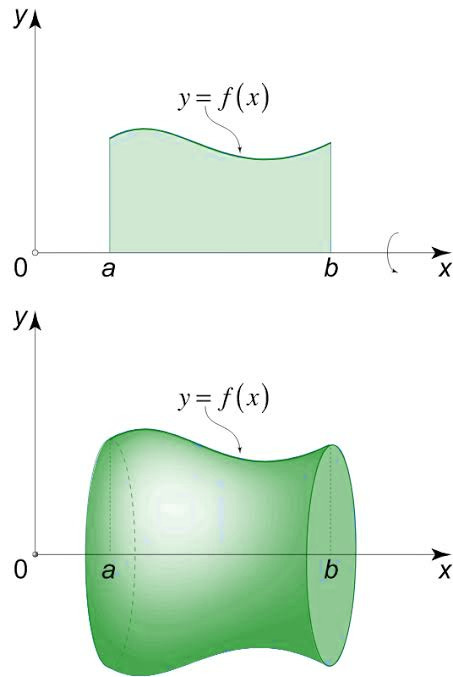
Rotating a region around an axis forms a 3D solid. The method used here is the disc method:
V = ∫ab πy² dx (for rotation about x-axis)
V = ∫ab πx² dy (for rotation about y-axis)
This comes from summing infinitely many circular discs, each with radius given by the function value.

🔍 TOK Perspective
Ancient mathematicians approximated volumes using intuition long before calculus existed.
Does this suggest that mathematical truth exists before formal proof, or that proof is what creates truth?
Volumes of revolution show how abstraction helps transform physical intuition into formal, universal methods.
📝 Paper 2 Strategy
Examiners love testing whether students choose the correct axis of rotation.
Always sketch the region first.
If the curve is given as x in terms of y, do not convert — integrate with respect to y.
🌐 EE / International-Mindedness Link
Techniques for estimating areas and volumes existed in many civilizations:
- Liu Hui (China): Computed cylinder volume using early limit processes.
- Greek geometers: Used infinitesimals before formal calculus.
- Ibn al-Haytham: First to compute the volume of a paraboloid using integral-like reasoning.
- Egyptian papyri: Contain early approximations for frustum volumes.
These historical methods are ideal for an EE exploring the evolution of calculus concepts across cultures.