A line in two or three dimensions can be described easily and elegantly using vectors.
The vector equation captures both the starting point and the direction of the line in a single expression.
This method is more powerful and flexible than purely Cartesian equations, especially in three dimensions.
📌 Vector Equation of a Line
The vector equation of a line is:
r = a + λb
Where:
• a is the position vector of a point on the line.
• b is the direction vector (gives direction of travel).
• λ is a parameter (can vary over all real numbers).
As λ changes, the point r moves along the entire line.
📌 Interpretation of a and b
- a fixes the line to a specific location in space.
- b determines the direction and steepness of the line.
- If b = (0, 0, 0), the object does not move → not a line.
- The magnitude |b| represents the speed if λ is time.
📌 Parametric Form of a Line
Writing the vector equation in coordinates gives the parametric form.
If:
a = (x0, y0, z0) and
b = (l, m, n)
Then the line becomes:
x = x0 + λl
y = y0 + λm
z = z0 + λn
This form clearly shows how each coordinate changes as λ varies.
📌 Cartesian Form of a Line (3D)
Eliminate λ from the parametric equations to obtain:
(x − x0) ÷ l = (y − y0) ÷ m = (z − z0) ÷ n
This expresses the same line but without a parameter.
Useful for comparing two lines or checking intersection/parallelism.
📌 Worked Example
Example: Find the parametric and Cartesian equations of the line passing through
A(2, −1, 3) with direction vector b = (4, 2, −1).
Step 1 — Write vector equation:
a = (2, −1, 3), b = (4, 2, −1)
r = (2, −1, 3) + λ(4, 2, −1)
Step 2 — Parametric:
x = 2 + 4λ
y = −1 + 2λ
z = 3 − λ
Step 3 — Cartesian:
(x − 2) ÷ 4 = (y + 1) ÷ 2 = (z − 3) ÷ (−1)
📌 Angle Between Two Lines
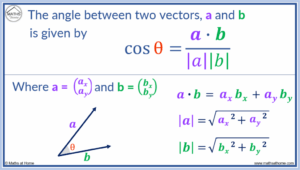
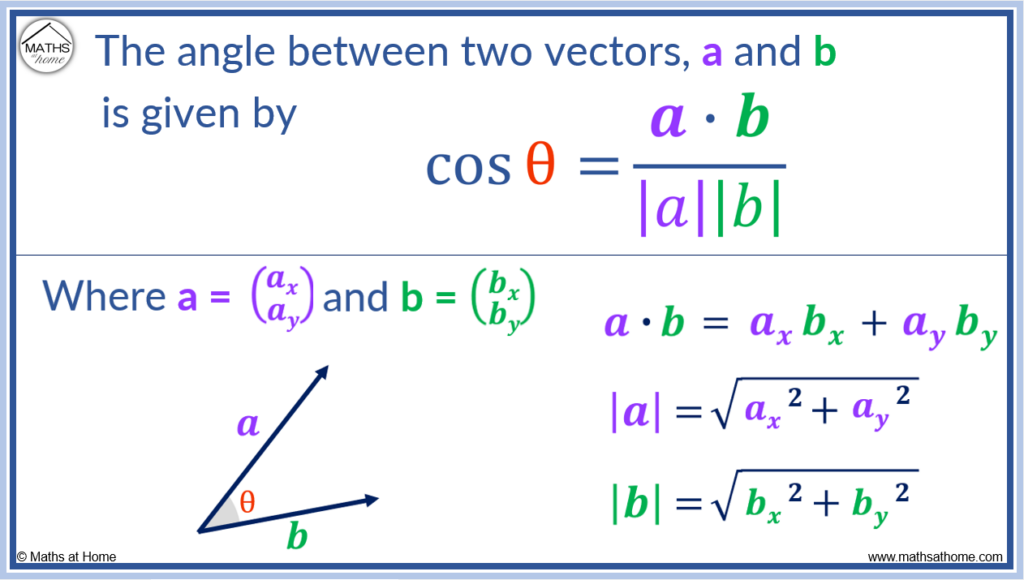
The angle between two lines equals the angle between their direction vectors.
If direction vectors are b and d, then:
cosθ = (b · d) ÷ (|b| × |d|)
• If b · d = 0 → lines are perpendicular.
• If b = k × d → lines are parallel or the same line.
Formula-for-the-angle-between-two-vectors-1024×580.png
📌 Kinematics Interpretation
If λ represents time t, then:
b = velocity vector
|b| = speed
This representation allows modelling of straight-line motion in physics, GPS navigation, and tracking objects in space.
🌍 Real-World Applications
- GPS uses vector equations for movement tracking and directional guidance.
- Aircraft flight paths and autonomous navigation are modelled with vector lines.
- 3D computer graphics use vector lines for camera paths and rendering.
- Kinematics: modelling constant velocity motion.
📐 IA Opportunities
- Investigate collisions of moving particles using vector line intersection.
- Analyse the geometry of 3D camera motion paths.
- Explore shortest distances from points to lines using vector projection.
- Study flight path corrections under wind vectors.
🌐 EE Connections
- How vector equations generalise to lines in higher dimensions.
- Historical development of analytic geometry (Descartes, Fermat).
- Use of parametric equations in advanced physics (motion in fields).
❤️ CAS Ideas
- Run workshops teaching MYP students about lines using interactive 3D models.
- Help physics students model constant velocity motion with vector equations.
- Create a real-world mapping project (e.g., tracking motion in sports).
📱 GDC Usage
- Store vectors a and b using your calculator’s vector menu.
- Plot parametric equations to visualise 3D lines.
- Compute the direction vector of a line instantly.
- Use dot product functions to find the angle between two lines.
- Use graphing mode to check intersections of lines numerically.
🔍 TOK Perspective
- Why do mathematicians use different representations for the same line?
- Does one representation provide “better knowledge” than another?
- How do symbolic forms affect how we perceive geometric objects?
📝 Examiner Tips
- Ensure the direction vector is never (0,0,0).
- When comparing two lines, check direction vectors first (parallel? perpendicular?).
- For angle problems, always normalise using magnitudes.
- Write clearly labelled parametric equations — common marks lost here.
- If one direction vector is a scalar multiple of the other → lines are parallel.