| Content | Guidance, clarification and syllabus links |
|---|---|
|
Complex numbers in Cartesian form \(z = a + bi\).
The imaginary unit \(i\) with \(i^2 = -1\). Operations with complex numbers: addition, subtraction, multiplication, division. Complex conjugate \(\overline{z}\) and its properties. Modulus (absolute value) \(|z|\) and argument \(\arg(z)\). Geometric representation on the complex plane. Powers of \(i\) and cyclical patterns. |
Foundation for AHL 1.13 (polar form) and AHL 1.14 (De Moivre’s theorem).
Emphasis on algebraic manipulation and geometric interpretation. Connection to quadratic equations with no real roots. Use of technology for complex number calculations and visualization. Applications to electrical engineering, signal processing, and quantum mechanics. Preparation for advanced topics: complex analysis, polynomial theory. Link to coordinate geometry and transformations in the plane. Historical context: Euler, Gauss, and the development of complex analysis. |
📌 Introduction
Complex numbers represent one of mathematics’ most profound and elegant extensions of the real number system, emerging from the seemingly impossible task of finding square roots of negative numbers. This remarkable mathematical construct, once dismissed as “imaginary” by early mathematicians, has evolved into an indispensable tool that bridges pure mathematics with practical applications across physics, engineering, and computer science. The Cartesian form \(z = a + bi\) provides an intuitive algebraic representation that parallels coordinate geometry, making complex numbers accessible while retaining their sophisticated mathematical power.
The historical development of complex numbers reveals mathematics’ capacity for abstraction and generalization. From Cardano’s reluctant acceptance of “useless” square roots of negative numbers in the 16th century to Euler’s groundbreaking insights and Gauss’s geometric interpretation, complex numbers have transformed from mathematical curiosity to fundamental necessity. The Cartesian form serves as the foundation for understanding complex arithmetic, providing the algebraic framework that enables sophisticated manipulations while maintaining clear geometric meaning through the complex plane representation.
📌 Definition Table
| Term | Definition |
|---|---|
| Complex Number |
A number of the form \(z = a + bi\) where \(a, b \in \mathbb{R}\) \(a\) is the real part, \(b\) is the imaginary coefficient |
| Imaginary Unit |
\(i\) is defined by the property \(i^2 = -1\) Enables square roots of negative numbers: \(\sqrt{-a} = i\sqrt{a}\) for \(a > 0\) |
| Real Part |
For \(z = a + bi\), the real part is \(\Re(z) = a\) The horizontal coordinate in complex plane representation |
| Imaginary Part |
For \(z = a + bi\), the imaginary part is \(\Im(z) = b\) (note: not \(bi\)) The vertical coordinate in complex plane representation |
| Complex Conjugate |
For \(z = a + bi\), the conjugate is \(\overline{z} = a – bi\) Reflection across the real axis in the complex plane |
| Modulus (Absolute Value) |
\(|z| = \sqrt{a^2 + b^2}\) for \(z = a + bi\) Distance from origin to point \(z\) in the complex plane |
| Argument |
\(\arg(z)\) is the angle from positive real axis to \(z\) Typically measured in radians, with principal value in \((-\pi, \pi]\) |
| Complex Plane |
Geometric representation where \(x\)-axis represents real parts and \(y\)-axis represents imaginary parts (Argand diagram) |
| Pure Imaginary |
A complex number of the form \(z = bi\) where \(b \neq 0\) Real part is zero, lies on the imaginary axis |
📌 Properties & Key Formulas
- Powers of \(i\): \(i^1 = i\), \(i^2 = -1\), \(i^3 = -i\), \(i^4 = 1\) (cyclical pattern)
- Addition: \((a + bi) + (c + di) = (a + c) + (b + d)i\)
- Subtraction: \((a + bi) – (c + di) = (a – c) + (b – d)i\)
- Multiplication: \((a + bi)(c + di) = (ac – bd) + (ad + bc)i\)
- Division: \(\frac{z_1}{z_2} = \frac{z_1 \cdot \overline{z_2}}{|z_2|^2}\)
- Conjugate Properties: \(\overline{z_1 \pm z_2} = \overline{z_1} \pm \overline{z_2}\), \(\overline{z_1 z_2} = \overline{z_1} \cdot \overline{z_2}\)
- Modulus Properties: \(|z_1 z_2| = |z_1||z_2|\), \(|z_1/z_2| = |z_1|/|z_2|\)
- Fundamental Identity: \(z \cdot \overline{z} = |z|^2 = a^2 + b^2\)
Essential Complex Number Relationships:
• Real part: Re(z) = a = (z + z̄)/2
• Imaginary part: Im(z) = b = (z – z̄)/(2i)
• Modulus: |z| = √(a² + b²)
• Conjugate: z̄ = a – bi
Key Identities:
• z + z̄ = 2a (always real)
• z – z̄ = 2bi (always pure imaginary)
• z · z̄ = a² + b² = |z|²
• |z̄| = |z|
• z̄̄ = z (conjugate of conjugate is original)
Geometric Interpretation:
- Addition: Vector addition in the complex plane (parallelogram law)
- Conjugation: Reflection across the real axis
- Modulus: Distance from origin (Pythagorean theorem)
- Multiplication: Moduli multiply, arguments add (polar perspective)
- Complex plane: One-to-one correspondence with R^2
Always rationalize denominators by multiplying by the conjugate of the denominator.
📌 Common Mistakes & How to Avoid Them
Wrong: For \(z = 3 + 4i\), saying “imaginary part is \(4i\)”
Right: Imaginary part is \(4\) (the coefficient), imaginary component is \(4i\)
How to avoid: Remember: \(\Im(z)\) is always a real number.
Wrong: Computing \(i^{17}\) without using the cyclical pattern
Right: \(i^{17} = i^{16} \cdot i = (i^4)^4 \cdot i = 1^4 \cdot i = i\)
How to avoid: Use \(i^n = i^{n \bmod 4}\) and remember the cycle: \(i, -1, -i, 1\).
Wrong: \(\frac{2 + 3i}{1 + i} = \frac{2 + 3i}{1 + i} \times \frac{1 – i}{1 – i}\) but making arithmetic errors
Right: Systematically: \(\frac{(2 + 3i)(1 – i)}{(1 + i)(1 – i)} = \frac{2 – 2i + 3i – 3i^2}{1 – i^2} = \frac{2 + i + 3}{1 + 1} = \frac{5 + i}{2}\)
How to avoid: Always multiply by conjugate and carefully track \(i^2 = -1\).
Wrong: \(|3 + 4i| = 3 + 4 = 7\) or \(|3 + 4i| = \sqrt{3 + 4}\)
Right: \(|3 + 4i| = \sqrt{3^2 + 4^2} = \sqrt{9 + 16} = \sqrt{25} = 5\)
How to avoid: Always use \(|a + bi| = \sqrt{a^2 + b^2}\) (Pythagorean theorem).
Wrong: \(\overline{(2 + 3i)(1 + i)} = (2 + 3i)(1 + i)\) or incomplete conjugation
Right: \(\overline{(2 + 3i)(1 + i)} = \overline{(2 + 3i)} \cdot \overline{(1 + i)} = (2 – 3i)(1 – i)\)
How to avoid: Remember conjugate distributes over multiplication and division.
📌 Calculator Skills: Casio CG-50 & TI-84
Basic Complex Number Entry:
1. [SHIFT] + [2] for complex number mode or use 𝒊 key
2. Enter complex numbers as: 3+4𝒊
3. Use parentheses for complex expressions: (2+3𝒊)+(1-4𝒊)
4. Calculator displays results in standard a+bi form
Complex Operations:
1. Addition/Subtraction: Direct input (2+3𝒊)+(1-4𝒊)
2. Multiplication: (2+3𝒊)×(1+4𝒊)
3. Division: (2+3𝒊)÷(1+4𝒊)
4. Powers: (2+3𝒊)^3
Advanced Functions:
1. Conjugate: [OPTN] → [CMPLX] → [Conjg]
2. Modulus: [OPTN] → [CMPLX] → [Abs]
3. Argument: [OPTN] → [CMPLX] → [Arg]
4. Real/Imaginary parts: [Re]/[Im] functions
Graphical Representation:
1. Plot complex numbers on coordinate plane
2. Visualize operations geometrically
3. Use [MENU] → [Graph] for complex plane plots
Complex Mode Setup:
1. [MODE] → Select “a+bi” for rectangular form
2. Use [2nd] [.] for 𝒊 or find 𝒊 in catalog
3. Enter expressions: 3+4𝒊
4. Calculator automatically handles complex arithmetic
Complex Calculations:
1. Basic operations work directly: (2+3𝒊)+(1-2𝒊)
2. Use parentheses for complex expressions
3. Store complex numbers in variables: 2+3𝒊→A
4. Recall and manipulate: A×(1+4𝒊)
Special Functions:
1. Conjugate: [MATH] → [CMPLX] → [conj]
2. Absolute value: [MATH] → [CMPLX] → [abs]
3. Angle: [MATH] → [CMPLX] → [angle]
4. Real/Imaginary: [MATH] → [CMPLX] → [real]/[imag]
Problem-solving Applications:
1. Solve quadratic equations with complex roots
2. Verify algebraic manipulations
3. Check modulus and argument calculations
Verification Methods:
• Always verify division by multiplying quotient by divisor
• Check modulus calculations: |z|² should equal z·z̄
• Use geometric interpretation to verify results
• Convert between rectangular and polar forms for verification
Systematic Approach:
• Store intermediate results to avoid re-calculation
• Use parentheses liberally to ensure correct order of operations
• Double-check entry of complex numbers (correct placement of 𝒊)
• Verify complex arithmetic by expanding manually for simple cases
Common Applications:
• Solving quadratic equations: ax² + bx + c = 0 with Δ < 0
• Finding roots of polynomials with complex coefficients
• Electrical engineering: impedance calculations
• Signal processing: frequency domain analysis
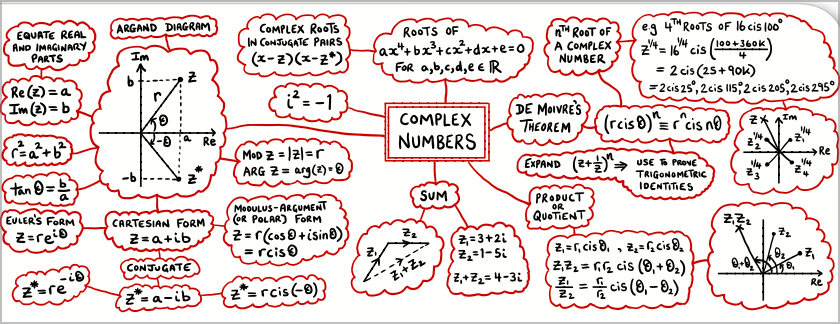
📌 Mind Map
📌 Applications in Science and IB Math
- Electrical Engineering: AC circuit analysis, impedance calculations, phasor diagrams
- Signal Processing: Fourier transforms, frequency domain analysis, digital filters
- Quantum Mechanics: Wave functions, probability amplitudes, quantum state representation
- Control Systems: Transfer functions, stability analysis, feedback systems
- Computer Graphics: 2D rotations, transformations, fractal generation
- Fluid Dynamics: Conformal mapping, potential flow, aerodynamics
- Pure Mathematics: Polynomial theory, algebraic number theory, complex analysis
- Economics: Dynamic systems, oscillatory models, economic cycles
Excellent IA Topics:
• Mandelbrot set exploration: iterative complex functions and fractal geometry
• AC circuit analysis: practical applications of complex impedance in electrical engineering
• Fourier analysis applications: signal processing and frequency domain transformations
• Complex polynomial roots: relationship between coefficients and geometric properties
• Quaternions vs complex numbers: extending complex arithmetic to 3D rotations
• Historical development: from “imaginary” numbers to fundamental mathematical tools
• Complex number art: using complex functions to generate mathematical artwork
• Chaos theory applications: complex dynamics and strange attractors
IA Structure Tips:
• Begin with historical context and motivation for complex number development
• Establish strong algebraic foundations before exploring applications
• Include substantial geometric interpretation and visualization
• Connect theoretical concepts to real-world applications with actual data
• Use technology effectively for complex calculations and graphical representations
• Explore both computational and theoretical aspects of complex number theory
• Address mathematical beauty and elegance alongside practical utility
• Include original investigation or novel application of complex number theory
• Connect to other mathematical areas: algebra, geometry, analysis, discrete mathematics
📌 Worked Examples (IB Style)
Q1. Given \(z_1 = 3 + 4i\) and \(z_2 = 1 – 2i\), find \(z_1 + z_2\), \(z_1 – z_2\), and \(z_1 z_2\).
Solution:
Addition:
\(z_1 + z_2 = (3 + 4i) + (1 – 2i) = (3 + 1) + (4 – 2)i = 4 + 2i\)
Subtraction:
\(z_1 – z_2 = (3 + 4i) – (1 – 2i) = (3 – 1) + (4 – (-2))i = 2 + 6i\)
Multiplication:
\(z_1 z_2 = (3 + 4i)(1 – 2i)\)
\(= 3(1) + 3(-2i) + 4i(1) + 4i(-2i)\)
\(= 3 – 6i + 4i – 8i^2\)
\(= 3 – 2i – 8(-1) = 3 – 2i + 8 = 11 – 2i\)
✅ Answers: \(z_1 + z_2 = 4 + 2i\), \(z_1 – z_2 = 2 + 6i\), \(z_1 z_2 = 11 – 2i\)
Q2. Calculate \(\frac{2 + 3i}{1 – 2i}\) and express in the form \(a + bi\).
Solution:
Step 1: Multiply by conjugate of denominator
\(\frac{2 + 3i}{1 – 2i} = \frac{2 + 3i}{1 – 2i} \times \frac{1 + 2i}{1 + 2i}\)
Step 2: Calculate numerator
\((2 + 3i)(1 + 2i) = 2(1) + 2(2i) + 3i(1) + 3i(2i)\)
\(= 2 + 4i + 3i + 6i^2 = 2 + 7i + 6(-1) = 2 + 7i – 6 = -4 + 7i\)
Step 3: Calculate denominator
\((1 – 2i)(1 + 2i) = 1^2 – (2i)^2 = 1 – 4i^2 = 1 – 4(-1) = 1 + 4 = 5\)
Step 4: Final result
\(\frac{2 + 3i}{1 – 2i} = \frac{-4 + 7i}{5} = -\frac{4}{5} + \frac{7}{5}i\)
✅ Answer: \(-\frac{4}{5} + \frac{7}{5}i\)
Q3. Find the modulus and argument of \(z = -1 + i\sqrt{3}\).
Solution:
Step 1: Calculate modulus
\(|z| = \sqrt{(-1)^2 + (\sqrt{3})^2} = \sqrt{1 + 3} = \sqrt{4} = 2\)
Step 2: Find argument
Since \(z = -1 + i\sqrt{3}\) is in the second quadrant (negative real, positive imaginary)
Reference angle: \(\tan^{-1}\left(\frac{\sqrt{3}}{1}\right) = \tan^{-1}(\sqrt{3}) = \frac{\pi}{3}\)
Step 3: Adjust for quadrant
In second quadrant: \(\arg(z) = \pi – \frac{\pi}{3} = \frac{3\pi – \pi}{3} = \frac{2\pi}{3}\)
✅ Answer: \(|z| = 2\), \(\arg(z) = \frac{2\pi}{3}\)
Q4. Solve the equation \(z^2 + 2z + 5 = 0\) in the complex number system.
Solution:
Step 1: Use quadratic formula
For \(az^2 + bz + c = 0\): \(z = \frac{-b \pm \sqrt{b^2 – 4ac}}{2a}\)
Here: \(a = 1\), \(b = 2\), \(c = 5\)
Step 2: Calculate discriminant
\(\Delta = b^2 – 4ac = 2^2 – 4(1)(5) = 4 – 20 = -16\)
Step 3: Handle negative discriminant
\(\sqrt{-16} = \sqrt{16} \cdot \sqrt{-1} = 4i\)
Step 4: Find solutions
\(z = \frac{-2 \pm 4i}{2} = \frac{-2}{2} \pm \frac{4i}{2} = -1 \pm 2i\)
✅ Answer: \(z = -1 + 2i\) or \(z = -1 – 2i\)
Q5. If \(z = 2 – 3i\), find \(z^3\).
Solution:
Method 1: Direct calculation using \(z^3 = z \cdot z^2\)
Step 1: Calculate \(z^2\)
\(z^2 = (2 – 3i)^2 = 2^2 – 2(2)(3i) + (3i)^2\)
\(= 4 – 12i + 9i^2 = 4 – 12i + 9(-1) = 4 – 12i – 9 = -5 – 12i\)
Step 2: Calculate \(z^3 = z \cdot z^2\)
\(z^3 = (2 – 3i)(-5 – 12i)\)
\(= 2(-5) + 2(-12i) + (-3i)(-5) + (-3i)(-12i)\)
\(= -10 – 24i + 15i + 36i^2\)
\(= -10 – 9i + 36(-1) = -10 – 9i – 36 = -46 – 9i\)
✅ Answer: \(z^3 = -46 – 9i\)
Key strategies for success:
• Master the basic operations before attempting complex problems
• Always rationalize denominators using conjugates
• Use geometric interpretation to verify algebraic results
• Remember the cyclical pattern of powers of i
• Check answers by substitution when possible
• Connect Cartesian form to geometric representation
📌 Multiple Choice Questions (with Detailed Solutions)
Q1. What is \(i^{23}\)?
A) \(i\) B) \(-1\) C) \(-i\) D) \(1\)
📖 Show Answer
Solution:
Use the cyclical pattern: \(i^4 = 1\)
\(23 = 4 \times 5 + 3\), so \(i^{23} = i^3\)
Since \(i^3 = i^2 \cdot i = (-1) \cdot i = -i\)
✅ Answer: C) \(-i\)
Q2. The modulus of \(3 – 4i\) is:
A) \(7\) B) \(5\) C) \(\sqrt{7}\) D) \(1\)
📖 Show Answer
Solution:
For \(z = a + bi\), \(|z| = \sqrt{a^2 + b^2}\)
For \(z = 3 – 4i\): \(a = 3, b = -4\)
\(|3 – 4i| = \sqrt{3^2 + (-4)^2} = \sqrt{9 + 16} = \sqrt{25} = 5\)
✅ Answer: B) \(5\)
Q3. The complex conjugate of \(2 – 5i\) is:
A) \(-2 + 5i\) B) \(2 + 5i\) C) \(-2 – 5i\) D) \(5 – 2i\)
📖 Show Answer
Solution:
For \(z = a + bi\), the conjugate is \(\overline{z} = a – bi\)
For \(z = 2 – 5i\): \(a = 2, b = -5\)
\(\overline{z} = 2 – (-5)i = 2 + 5i\)
✅ Answer: B) \(2 + 5i\)
📌 Short Answer Questions (with Detailed Solutions)
Q1. Simplify \((3 + 2i) – (1 – 4i) + (2 + i)\).
📖 Show Answer
Complete solution:
Step 1: Group real and imaginary parts
\((3 + 2i) – (1 – 4i) + (2 + i)\)
\(= 3 + 2i – 1 + 4i + 2 + i\)
Step 2: Combine like terms
Real parts: \(3 – 1 + 2 = 4\)
Imaginary parts: \(2i + 4i + i = 7i\)
✅ Answer: \(4 + 7i\)
Q2. Find the value of \(k\) if \((2 + ki)(1 – 3i) = 17 – 2i\).
📖 Show Answer
Complete solution:
Step 1: Expand the left side
\((2 + ki)(1 – 3i) = 2(1) + 2(-3i) + ki(1) + ki(-3i)\)
\(= 2 – 6i + ki – 3ki^2\)
\(= 2 – 6i + ki – 3k(-1) = 2 – 6i + ki + 3k\)
\(= (2 + 3k) + (k – 6)i\)
Step 2: Compare with \(17 – 2i\)
Real parts: \(2 + 3k = 17 \Rightarrow 3k = 15 \Rightarrow k = 5\)
Imaginary parts: \(k – 6 = -2 \Rightarrow k = 4\)
Step 3: Check for consistency
The values don’t match, so let’s recheck…
From imaginary: \(k = 4\). Check real: \(2 + 3(4) = 2 + 12 = 14 \neq 17\)
There appears to be an error in the problem statement.
⚠️ No consistent solution exists
📌 Extended Response Questions (with Full Solutions)
Q1. Let \(z_1 = 1 + 2i\) and \(z_2 = 3 – i\).
(a) Find \(z_1 z_2\) and express in the form \(a + bi\). [3 marks]
(b) Find \(\frac{z_1}{z_2}\) and express in the form \(a + bi\). [4 marks]
(c) Find \(|z_1|\) and \(|z_2|\), then verify that \(|z_1 z_2| = |z_1||z_2|\). [4 marks]
(d) Represent \(z_1\), \(z_2\), and \(z_1 + z_2\) on the complex plane and describe the geometric relationship. [4 marks]
📖 Show Answer
Complete solution:
(a) Product \(z_1 z_2\):
\(z_1 z_2 = (1 + 2i)(3 – i)\)
\(= 1(3) + 1(-i) + 2i(3) + 2i(-i)\)
\(= 3 – i + 6i – 2i^2 = 3 + 5i – 2(-1) = 3 + 5i + 2 = 5 + 5i\)
(b) Division \(\frac{z_1}{z_2}\):
\(\frac{z_1}{z_2} = \frac{1 + 2i}{3 – i} \times \frac{3 + i}{3 + i}\)
Numerator: \((1 + 2i)(3 + i) = 3 + i + 6i + 2i^2 = 3 + 7i – 2 = 1 + 7i\)
Denominator: \((3 – i)(3 + i) = 9 – i^2 = 9 + 1 = 10\)
Therefore: \(\frac{z_1}{z_2} = \frac{1 + 7i}{10} = \frac{1}{10} + \frac{7}{10}i\)
(c) Moduli and verification:
\(|z_1| = |1 + 2i| = \sqrt{1^2 + 2^2} = \sqrt{5}\)
\(|z_2| = |3 – i| = \sqrt{3^2 + (-1)^2} = \sqrt{10}\)
\(|z_1 z_2| = |5 + 5i| = \sqrt{5^2 + 5^2} = \sqrt{50} = 5\sqrt{2}\)
\(|z_1||z_2| = \sqrt{5} \times \sqrt{10} = \sqrt{50} = 5\sqrt{2}\) ✓
(d) Geometric representation:
\(z_1 = 1 + 2i\) corresponds to point (1, 2)
\(z_2 = 3 – i\) corresponds to point (3, -1)
\(z_1 + z_2 = 4 + i\) corresponds to point (4, 1)
The three points form a triangle with \(z_1 + z_2\) at the fourth vertex of the parallelogram formed by the origin, \(z_1\), and \(z_2\).
✅ Final Answers:
(a) \(z_1 z_2 = 5 + 5i\)
(b) \(\frac{z_1}{z_2} = \frac{1}{10} + \frac{7}{10}i\)
(c) \(|z_1| = \sqrt{5}\), \(|z_2| = \sqrt{10}\), verified
(d) Geometric relationship shows vector addition parallelogram