A3.1.3 – EVOLUTIONARY RELATIONSHIPS AND BIODIVERSITY
📌Definition Table
| Term | Definition |
|---|---|
| Biodiversity | The variety of life at all levels, from genes to ecosystems. |
| Phylogenetics | The study of evolutionary relationships among organisms. |
| Cladogram | Diagram showing evolutionary relationships based on shared derived traits. |
| Molecular Clock | A method estimating evolutionary time based on mutation rates in DNA or protein sequences. |
| Convergent Evolution | The independent evolution of similar features in unrelated lineages due to similar environmental pressures. |
📌Introduction
Evolutionary relationships underpin modern biology, explaining how species are connected through common ancestry. Biodiversity is shaped by evolutionary processes, environmental changes, and ecological interactions. Studying phylogenetics allows scientists to reconstruct the tree of life, identifying shared ancestry and divergence events. Advances in DNA sequencing and bioinformatics have transformed our understanding of biodiversity, revealing cryptic species and clarifying relationships that morphological studies alone could not resolve. Conservation biology increasingly depends on evolutionary data to prioritise species and habitats for protection.
📌 Phylogenetic Tools and Methods
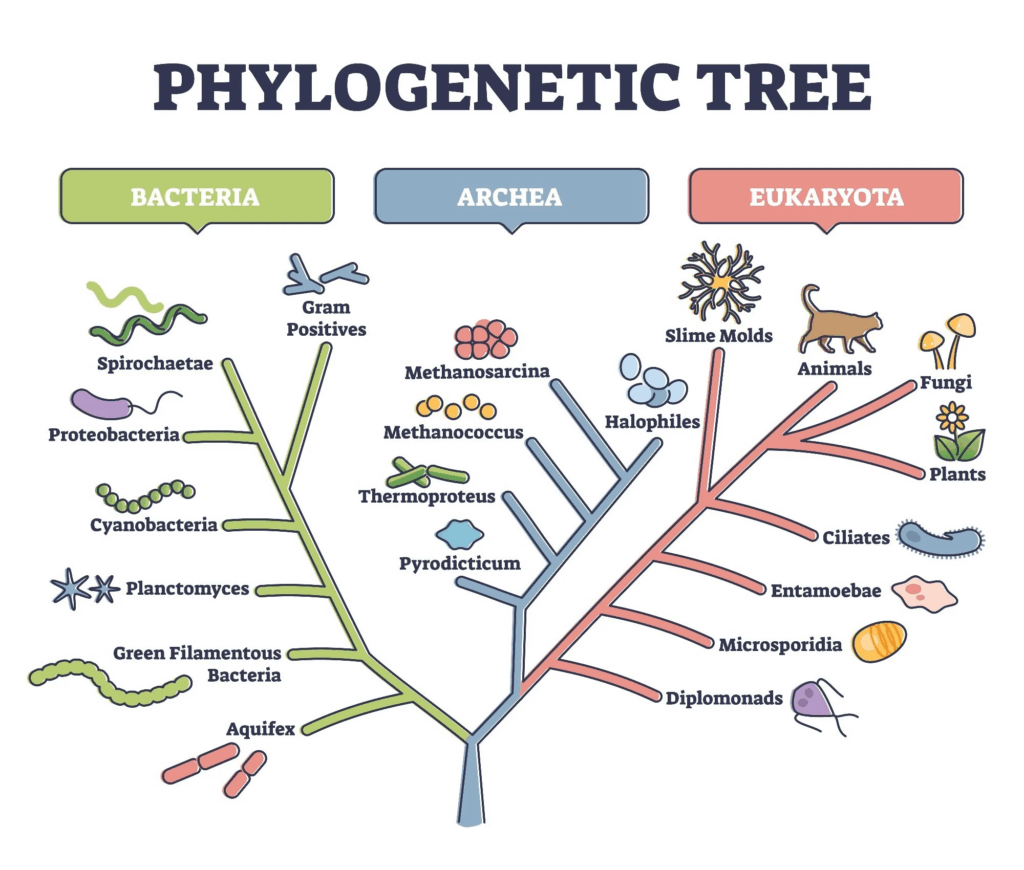
- Morphological analysis: comparing structures to infer relationships.
- Molecular phylogenetics: uses DNA, RNA, or protein sequences to build evolutionary trees.
- Molecular clocks: estimate divergence times based on mutation rates.
- Cladistics: groups organisms by shared derived traits (synapomorphies).
- Fossil calibration: uses fossil ages to anchor phylogenetic timelines.
- Bioinformatics: computational tools for large-scale sequence analysis.
🧠 Examiner Tip: When interpreting cladograms, remember that branch length may or may not indicate evolutionary time — check the diagram’s scale.
📌 Patterns of Evolution
- Divergent evolution: species from a common ancestor become more different over time.
- Convergent evolution: unrelated species evolve similar traits due to similar selection pressures.
- Parallel evolution: related species evolve similar traits independently.
- Adaptive radiation: rapid diversification from a common ancestor into multiple ecological niches.
- Coevolution: two or more species reciprocally influence each other’s evolution.
- Extinction events: can reset evolutionary trajectories and open niches.
🧬 IA Tips & Guidance: A bioinformatics-based IA could compare mitochondrial DNA sequences to infer evolutionary relationships between local species.
📌 Biodiversity Levels
- Genetic diversity: variation in genes within a population.
- Species diversity: number and relative abundance of species in an area.
- Ecosystem diversity: variety of habitats and ecological processes.
- Biodiversity supports ecosystem stability and resilience.
- High biodiversity often correlates with ecosystem productivity.
- Conservation strategies target all three diversity levels.
🌐 EE Focus: An EE could investigate how genetic diversity influences species survival in changing environments, using molecular data for analysis.
📌 Human Impact on Biodiversity
- Habitat loss from agriculture, urbanisation, and deforestation.
- Overexploitation of species for food, medicine, or trade.
- Pollution affecting ecosystems and species health.
- Climate change altering habitats and migration patterns.
- Invasive species outcompeting native organisms.
- Conservation biology aims to mitigate these impacts using evolutionary insights.
❤️ CAS Link: A CAS project could involve participating in biodiversity surveys and using phylogenetic tools to classify observed species.
🌍 Real-World Connection:
Understanding evolutionary relationships is vital for predicting disease spread, managing endangered species, and sustaining ecosystems under climate change.
📌 Evolutionary Relationships in Conservation

- Phylogenetic diversity can be used to prioritise species conservation.
- Protecting evolutionarily distinct species preserves unique traits.
- Genetic data reveal population structure for targeted management.
- Evolutionary history informs restoration ecology projects.
- Endangered species lists increasingly consider evolutionary uniqueness.
- Conservation decisions may integrate both ecological and evolutionary data.
🔍 TOK Perspective: The use of molecular data in biodiversity studies highlights how changing tools and technologies shape our understanding of the natural world and influence policy.