A1.1.3 – ORIGIN OF WATER ON EARTH
📌Definition Table
| Term | Definition |
|---|---|
| Asteroid Hypothesis | Theory that water was delivered to Earth via ice-rich asteroids and meteorites. |
| Carbonaceous Chondrites | Primitive meteorites containing water and organic compounds; isotopes match seawater. |
| Eucrite Achondrites | Ancient meteorites with hydrogen isotope ratios similar to those on Earth. |
| Goldilocks Zone | Region around a star where conditions allow liquid water to exist. |
| Exoplanet | A planet outside our solar system, studied for potential habitability. |
| Transit Spectroscopy | Method of analyzing starlight passing through a planet’s atmosphere to detect water and gases. |
📌Introduction
Earth formed around 4.5 billion years ago under conditions too hot for water to condense into liquid. Today, water covers about 71% of Earth’s surface, but its presence is thought to be partly extraterrestrial in origin. The most widely accepted hypothesis is that asteroids and meteorites containing ice delivered water to Earth. Once captured by Earth’s gravity, this water condensed as the planet cooled, forming oceans that provided the medium for life’s emergence. This extraterrestrial link continues to guide the search for water — and life — on other planets.
📌 Extraplanetary Origin of Water
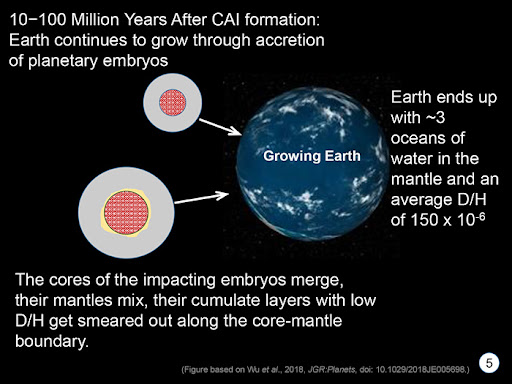
- Early Earth was too hot for water vapor to condense, so water likely came from external sources.
- Asteroids and meteorites carried ice and organic molecules to Earth during heavy bombardment.
- Carbonaceous chondrites contain hydrogen isotopes closely matching those found in seawater.
- Eucrite achondrites also show isotope ratios similar to Earth’s, reinforcing the asteroid hypothesis.
- Upon impact, these bodies released water vapor, which Earth’s gravity trapped in the atmosphere.
- As temperatures cooled, vapor condensed into liquid water, forming oceans.
- This hypothesis is supported by isotopic analysis but is still debated among scientists.
🧠 Examiner Tip: In IB exams, you only need to know the asteroid hypothesis for water’s origin, not alternative theories.
📌 Extraterrestrial Delivery: Comets and Asteroids
- Comets, rich in ice, could have delivered water through high-energy impacts.
- Asteroids, particularly carbonaceous chondrites, are rich in hydrated minerals and match Earth’s D/H ratio more closely.
- Isotopic analysis of water from meteorites supports an asteroidal rather than purely cometary origin.
- Late Heavy Bombardment may have played a key role in delivering additional water and organics essential for life.
- Delivery of extraterrestrial water also introduced organic molecules, supporting prebiotic chemistry.
🧬 IA Tips & Guidance: When designing experiments related to isotopic ratios or mineral hydration, lin
📌 Isotopic Evidence and Ongoing Debate
- The deuterium/hydrogen (D/H) ratio is a “fingerprint” for water’s source.
- Earth’s ocean D/H ratio closely matches that of carbonaceous asteroids but differs from many comets.
- Some recent comet measurements, however, show closer matches, suggesting a mixed source.
- Isotopic evidence also supports early water formation before the Moon-forming impact.
- Ongoing space missions (e.g., Rosetta, OSIRIS-REx) aim to refine the understanding of water’s source.
🌐 EE Focus: An EE could investigate how isotopic ratios from different celestial bodies are measured and interpreted to determine the origin of Earth’s water.
📌 Role in Habitability
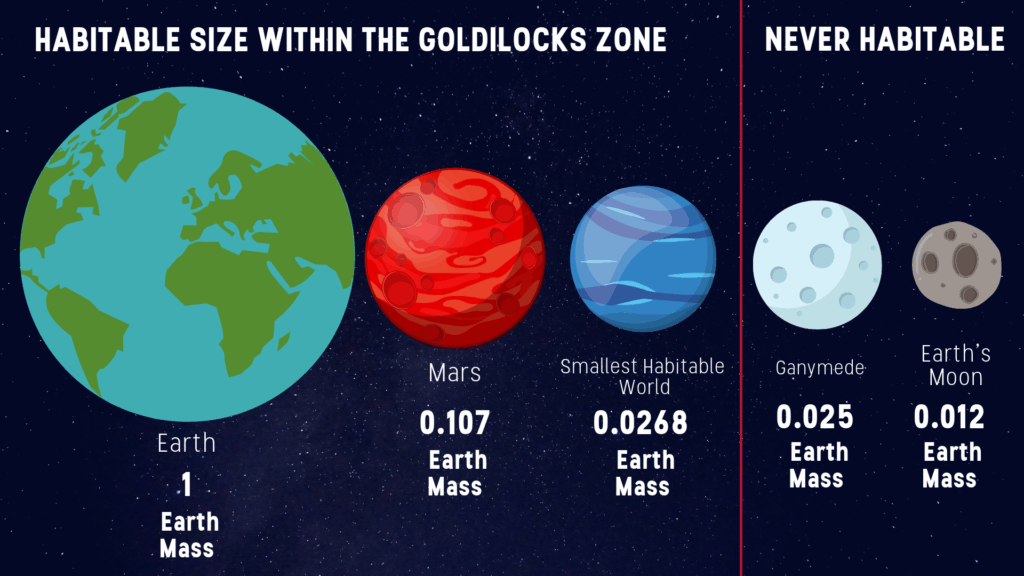
- Water likely existed on Earth by ~4.4 billion years ago, as shown by ancient zircon crystals.
- Early oceans provided a stable environment for chemical evolution and the origin of life.
- Presence of water influenced atmospheric development, plate tectonics, and climate stability.
- Understanding Earth’s water origin informs the search for habitable exoplanets.
❤️ CAS Link: Partner with an astronomy club to create a planet habitability simulation, showing how water origin affects a planet’s life-supporting capacity.
🔍 TOK Perspective: How do scientists decide between competing theories about water’s origin? Does reliance on indirect isotopic evidence introduce bias into our conclusions?