A1.2.1 – STRUCTURE OF NUCLEIC ACIDS
📌Definition Table
| Term | Definition |
|---|---|
| Nucleic Acid | A polymer of nucleotides that stores and transmits genetic information. |
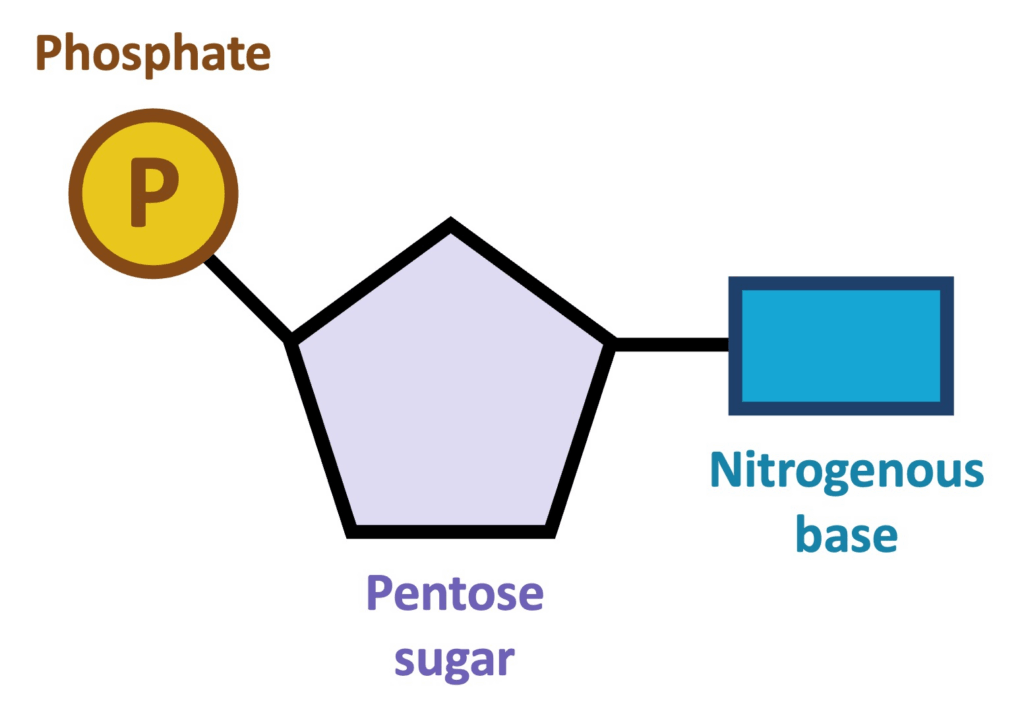
| Nucleotide | Monomer unit of nucleic acids composed of a phosphate group, pentose sugar, and nitrogenous base. |
| Nucleoside | A nitrogenous base covalently bonded to a sugar, without a phosphate group. |
| Phosphodiester Bond | Covalent linkage between the 3′ hydroxyl group of one sugar and the 5′ phosphate group of another nucleotide. |
| Antiparallel | Orientation of the two DNA strands in opposite 5′ → 3′ directions. |
| Base Pairing | Specific hydrogen bonding between complementary nitrogenous bases (A–T or A–U, G–C). |
📌Introduction
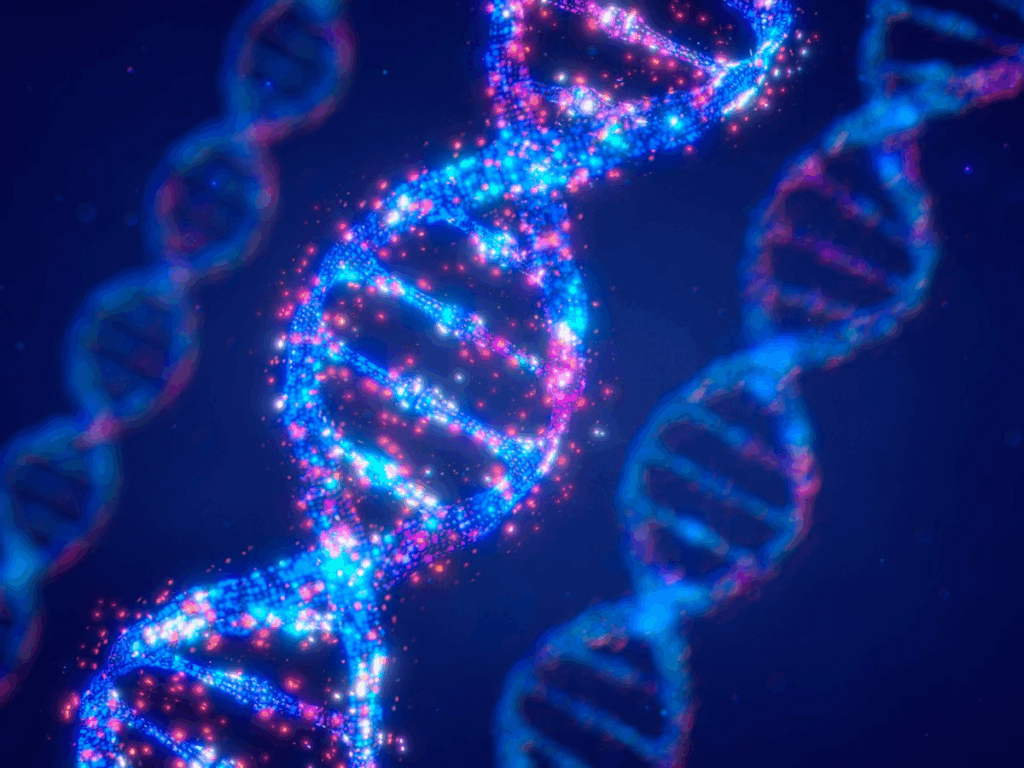
Nucleic acids are the essential molecules that store, transmit, and express genetic information in all living organisms. DNA serves as the long-term storage molecule, while RNA plays diverse roles in decoding, regulation, and catalysis, with their structures directly determining their biological functions.
📌 Components of Nucleotides
- Phosphate Group:
- Negatively charged at physiological pH.
- Imparts acidic nature to nucleic acids.
- Links sugars via phosphodiester bonds.
- Part of the sugar–phosphate backbone.
- Can be mono-, di-, or triphosphate in energy molecules like ATP.
- Pentose Sugar:
- Ribose in RNA (–OH at 2′ and 3′ carbons → more reactive).
- Deoxyribose in DNA (–H at 2′ carbon → more stable).
- Numbered carbons guide bond locations.
- Influences chemical stability and function.
- Determines type of nucleic acid.
- Nitrogenous Bases:
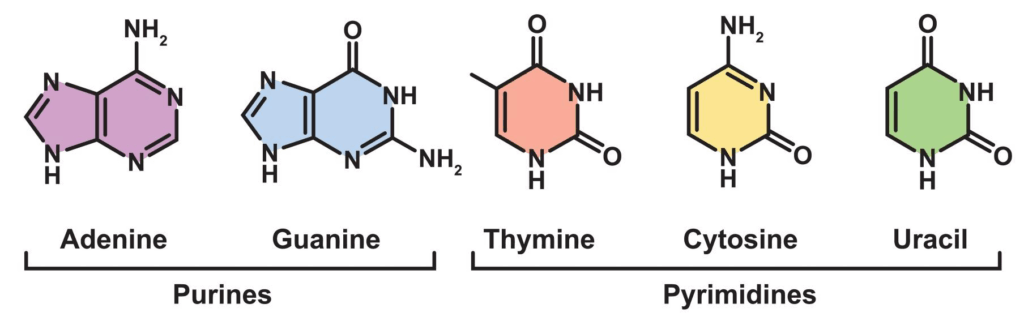
- Purines (A, G) – double ring.
- Pyrimidines (C, T, U) – single ring.
- Uracil replaces thymine in RNA.
- Sequence encodes genetic information.
- Hydrogen bonding specificity ensures replication accuracy.
🧠 Examiner Tip: Always label the sugar type and number carbons correctly when drawing nucleotides.
📌 DNA Structure
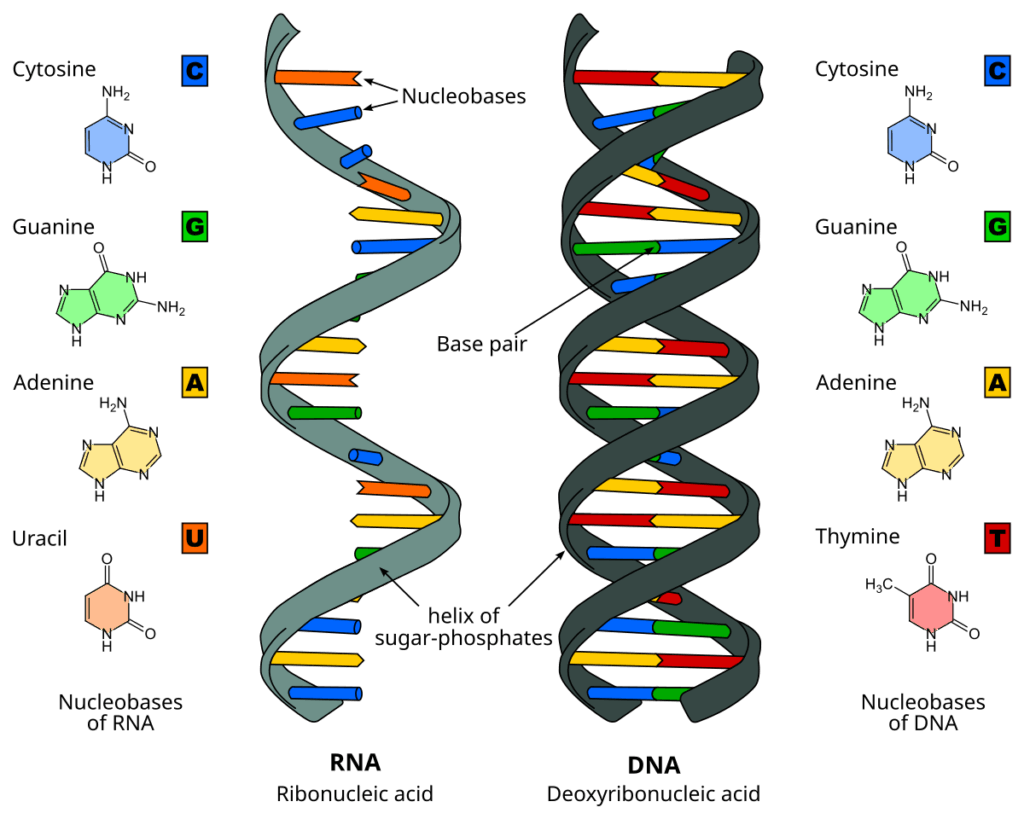
- Two polynucleotide strands form a right-handed double helix.
- Strands are antiparallel (5′ → 3′ and 3′ → 5′).
- Complementary base pairing: A–T (2 H bonds), G–C (3 H bonds).
- GC-rich DNA is more thermally stable.
- Sugar–phosphate backbone is hydrophilic and faces outward.
- Bases are hydrophobic and stacked inward for stability.
- Major and minor grooves allow protein binding.
🧬 IA Tips & Guidance: Investigate DNA melting temperature with different GC contents using spectrophotometry at 260 nm.
📌 RNA Structure
- Usually single-stranded but folds into hairpins and loops.
- Contains ribose sugar (more reactive than deoxyribose).
- Bases: A, G, C, U (uracil instead of thymine).
- Types: mRNA, tRNA, rRNA, miRNA, siRNA.
- mRNA carries genetic code to ribosomes.
- tRNA links codons to amino acids.
- rRNA forms ribosomal structure and catalyzes peptide bonds.
🌐 EE Focus: Study RNA degradation under different pH or temperatures to link structure to stability.
📌 Phosphodiester Bonds and Backbone Formation
- Covalent bonds between 3′ OH of one sugar and 5′ phosphate of the next.
- Backbone is highly stable in DNA.
- RNA is more prone to hydrolysis due to 2′-OH group.
- Requires polymerase enzymes for synthesis.
- Directionality dictates replication and transcription.
- Protects genetic information from random cleavage.
❤️ CAS Link: Organize a DNA/RNA model-building activity to teach base pairing and backbone structure.
📌 DNA Packaging in Cells
- Prokaryotes: Circular DNA, supercoiled in nucleoid region.
- Eukaryotes: Linear DNA wrapped around histones → nucleosomes → chromatin → chromosomes.
- Euchromatin is loosely packed and transcriptionally active.
- Heterochromatin is tightly packed and inactive.
- Packaging controls accessibility for gene expression.
- Protects DNA from damage.
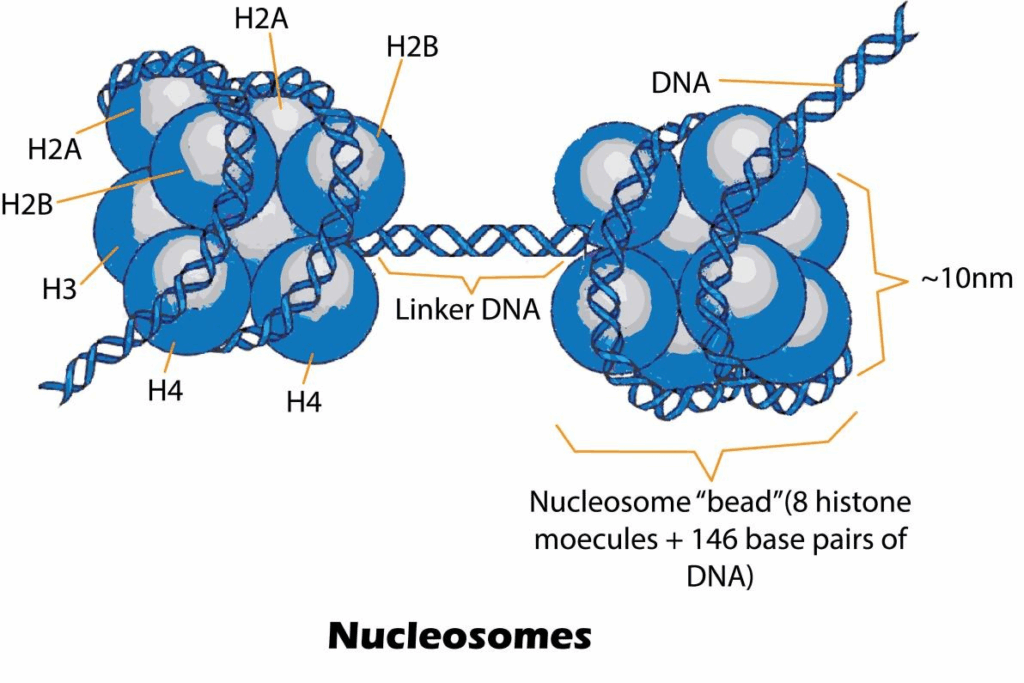
🌍 Real-World Connection: Epigenetic changes to DNA or histones can alter gene expression without changing sequence.
📌 Central Dogma Connection
- Information flows: DNA → RNA → Protein.
- Transcription uses RNA polymerase to make RNA from DNA.
- Translation uses ribosomes to build proteins from mRNA.
- Reverse transcription (RNA → DNA) occurs in retroviruses.
- RNA editing and alternative splicing modify genetic output.
🔍 TOK Perspective: The Central Dogma is a guiding principle, but exceptions remind us that scientific knowledge evolves.