B4.2.1 – FUNDAMENTALS OF ECOLOGICAL NICHES
📌Definition Table
| Term | Definition |
|---|---|
| Ecological Niche | The role and position of a species within its environment, including interactions with biotic and abiotic factors. |
| Fundamental Niche | The full range of environmental conditions and resources a species could theoretically use without competition or predation. |
| Realised Niche | The actual conditions and resources a species occupies due to competition, predation, and other limiting factors. |
| Competitive Exclusion | Principle stating that two species competing for the same resource cannot coexist indefinitely under constant environmental conditions. |
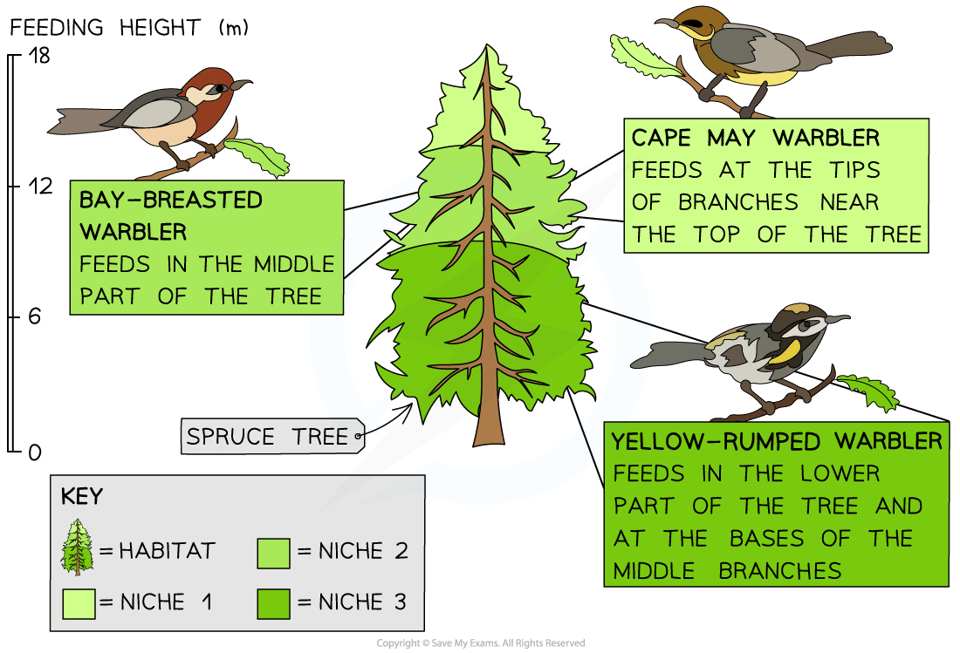
| Resource Partitioning | Differentiation of ecological niches to reduce competition and allow coexistence of similar species. |
📌Introduction
An ecological niche defines how a species interacts with its environment and other organisms, encompassing its habitat, resource use, and role in energy and nutrient cycles. The distinction between a fundamental niche and a realised niche highlights the gap between theoretical potential and ecological reality. Studying niches is crucial for understanding biodiversity patterns, predicting species distributions, and managing ecosystems under environmental change.
❤️ CAS Link: Organise a local biodiversity survey and map the niches of key species in a nearby park, linking species presence to specific habitat features and resources.
📌 Fundamental vs. Realised Niches
- Fundamental Niche represents the total possible conditions a species can tolerate, determined by its physiological limits and resource needs.
- Realised Niche is narrower due to interspecific competition, predation, parasitism, and human disturbance.
- Example: Barnacle species — Chthamalus occupies higher shore (fundamental niche broader but restricted by competition), while Balanus dominates lower shore.
- Abiotic factors (temperature, salinity, pH) primarily shape the fundamental niche, while biotic factors constrain the realised niche.
- Niche modelling uses environmental data to predict potential distributions, crucial for conservation planning.
🧠 Examiner Tip: In application questions, always mention both abiotic and biotic influences when explaining why a realised niche is smaller than a fundamental niche.
📌 Competitive Exclusion Principle
- States that two species with identical niches cannot coexist in the same habitat long-term.
- Leads to local extinction of one species or evolutionary divergence into different niches.
- Example: Paramecium aurelia outcompetes Paramecium caudatum in lab experiments when grown together.
- Encourages natural selection for traits that minimise direct competition.
- Forms the basis for predicting invasive species impacts on native communities.
🌍 Real-World Connection: The decline of native red squirrels in the UK is partly due to competitive exclusion by the invasive grey squirrel, which is more efficient at exploiting certain food resources.
📌 Resource Partitioning
- Occurs when species divide resources by specialising in different aspects of the niche.
- Can be spatial (different habitats), temporal (different activity times), or dietary (different prey or plant species).
- Example: Anole lizards in the Caribbean occupy distinct vertical zones of forest to avoid competition.
- Reduces direct competition, allowing coexistence of ecologically similar species.
- Often associated with morphological adaptations, such as beak size in Darwin’s finches.
🔍 TOK Perspective: The concept of a “niche” is a human framework — how might different cultures or indigenous knowledge systems describe species’ ecological roles differently?
📌Measuring and Modelling Niches

- Niche Breadth — range of resources used; broad niches indicate generalists, narrow niches indicate specialists.
- Niche Overlap — degree to which species share resources; higher overlap increases competition.
- Ecological Modelling Tools — e.g., MaxEnt software uses occurrence records to predict distributions based on environmental parameters.
- Field Experiments — manipulation of resource availability or competitor presence tests niche limits.
- Applications in Conservation — niche models guide reintroduction programs and habitat restoration efforts.
⚗️ IA Tips & Guidance: An IA could test the effect of resource availability (e.g., seed size) on foraging preference in birds, linking observed behaviour to niche specialisation and partitioning.