B4.1.2 – ADAPTATIONS FOR WATER AND SALT BALANCE
📌Definition Table
| Term | Definition |
|---|---|
| Osmoregulation | Control of water and solute concentrations in the body to maintain homeostasis. |
| Osmoconformer | Organism whose internal osmotic conditions match the surrounding environment. |
| Osmoregulator | Organism that actively regulates internal osmotic conditions regardless of environment. |
| Hypoosmotic Regulation | Maintenance of internal solute concentration lower than the surrounding medium (marine animals). |
| Hyperosmotic Regulation | Maintenance of internal solute concentration higher than the surrounding medium (freshwater animals). |
| Excretory Organ | Organ responsible for removing metabolic wastes and regulating water and ion balance (e.g., kidney, Malpighian tubules). |
📌Introduction
Water and salt balance is crucial for maintaining osmotic pressure, enzyme function, and metabolic processes. Different environments — freshwater, marine, and terrestrial — present unique challenges to organisms. Adaptations can be structural, physiological, or behavioural, enabling organisms to survive and reproduce while conserving or excreting water appropriately.
❤️CAS Link: Design an awareness campaign on sustainable freshwater use, linking it to how animals adapt to water scarcity and salinity challenges.
📌 Osmoregulation in Freshwater Animals
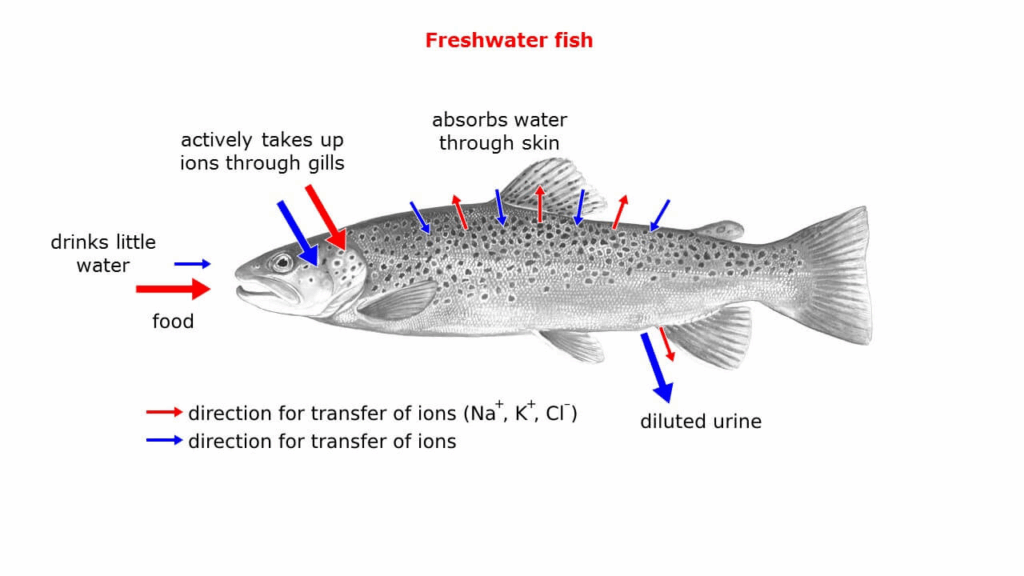
- Hyperosmotic to Environment — Body fluids contain more salts than surrounding water, causing water influx and ion loss.
- Active Ion Uptake — Gills absorb salts through specialised chloride cells.
- Large Volume Dilute Urine — Kidneys excrete excess water while retaining salts.
- Low Permeability to Water — Mucus-covered skin reduces water influx.
- Behavioural Strategies — Freshwater fish avoid areas with strong currents that increase water influx.
🧠 Examiner Tip: When comparing osmotic strategies, always specify the direction of water and ion movement for full marks.
📌 Osmoregulation in Marine Animals
- Hypoosmotic to Environment — Body fluids contain less salt than seawater, causing water loss and ion gain.
- Drinking Seawater — Compensates for water loss; excess salts actively excreted.
- Salt Glands — Found in seabirds and reptiles for excreting concentrated salt solutions.
- Small Volume Concentrated Urine — Conserves water while removing salts.
- Countercurrent Exchange in Gills — In fish, aids in salt excretion and oxygen uptake simultaneously.
🌍 Real-World Connection: Desalination technology mimics ion transport mechanisms found in marine animals to remove salt from seawater.
📌 Adaptations in Terrestrial Animals
- Water Conservation — Thick cuticles in insects, keratinised skin in reptiles and mammals.
- Efficient Kidneys — Long loops of Henle in desert mammals maximise water reabsorption.
- Nocturnal Behaviour — Reduces water loss through evaporation during cooler nights.
- Metabolic Water — Produced during oxidation of food molecules, important for desert animals like kangaroo rats.
- Excretion of Concentrated Waste — Uric acid in birds and reptiles minimises water loss compared to urea excretion.
🔍 TOK Perspective: The idea of “waste” in biology is relative — uric acid in reptiles is not just excretory but also aids in water conservation.
📌 Specialised Osmoregulatory Adaptations
- Euryhaline Species — Tolerate a wide range of salinities (e.g., salmon migrating between rivers and oceans).
- Anhydrobiosis — Ability to survive extreme dehydration (e.g., tardigrades, brine shrimp).
- Salt-Excreting Crustaceans — Use antennal glands to remove excess ions.
- Halophyte Plants — Store salt in vacuoles and secrete excess through salt glands.
- Amphibians — Rely on moist skin for water absorption but limit exposure during dry conditions.
⚗️ IA Tips & Guidance: An IA could test model kidneys (dialysis tubing setups) with different solute gradients to simulate water and salt movement in osmoregulation.
📌 Kidney Function in Osmoregulation
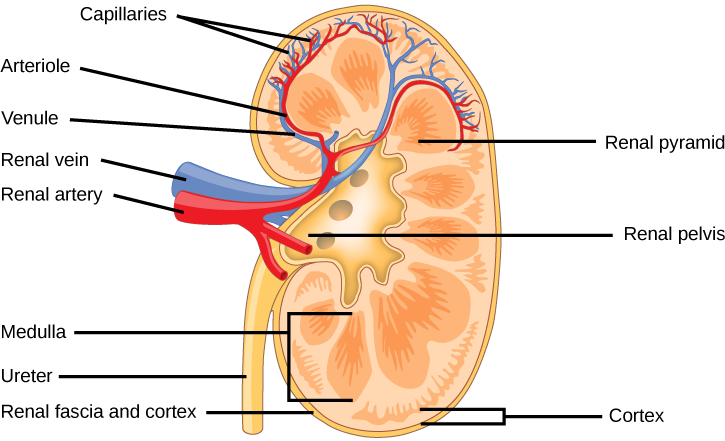
- Filtration — Glomerulus filters blood under high pressure.
- Selective Reabsorption — Proximal tubule reabsorbs glucose, amino acids, and most water.
- Loop of Henle — Generates concentration gradient in medulla; longer in desert species for maximal water reabsorption.
- Distal Tubule and Collecting Duct — Adjust salt and water balance under hormonal control (ADH, aldosterone).
- Urine Concentration — Final osmolarity reflects both water needs and environmental demands.