B3.3.1 – ADAPTATIONS AND REQUIREMENTS FOR MOVEMENT
📌Definition Table
| Term | Definition |
|---|---|
| Motility | The ability of an organism to move spontaneously and actively using energy. |
| Sessile | Describes organisms that are fixed in one place and incapable of active movement. |
| Endoskeleton | Internal skeleton made of bone and/or cartilage that provides structural support and facilitates movement. |
| Exoskeleton | External skeleton composed of chitin, calcium carbonate, or other materials that supports and protects the body. |
| Synovial Joint | A freely movable joint in vertebrates containing synovial fluid to reduce friction between articular surfaces. |
| Antagonistic Muscles | Pairs of muscles that produce opposite movements at a joint (e.g., flexion vs. extension). |
| Lever System | Mechanical system in which bones act as levers, joints as fulcrums, and muscles apply force to produce movement. |
📌Introduction
Movement in animals depends on a coordinated interaction between skeletal structures, joints, muscles, and nervous control. Structural adaptations optimise the balance between stability, speed, strength, and range of motion depending on the organism’s ecological niche. While motile animals actively seek food, mates, and shelter, sessile organisms rely on other strategies such as filter feeding or reproductive dispersal to survive.
❤️ CAS Link: Develop an interactive movement demonstration for younger students, using joint and muscle models to show how antagonistic muscles work during bending and straightening.
📌 Motile vs. Sessile Organisms
- Motile organisms actively move to forage, escape predators, find mates, and explore new habitats.
- Sessile organisms (e.g., corals, barnacles) remain fixed but may have moving parts such as tentacles or cilia for feeding and defence.
- Motility is energy-intensive, requiring specialised muscles, skeletons, and nervous systems.
- Sessility often involves structural adaptations for attachment and resistance to environmental forces like currents or waves.
- Some organisms switch strategies during their life cycle (e.g., barnacle larvae are motile, adults sessile).
🧠 Examiner Tip: In comparison questions, always relate mobility strategy to ecological advantage and survival.
📌 Skeletal Systems – Endoskeletons and Exoskeletons
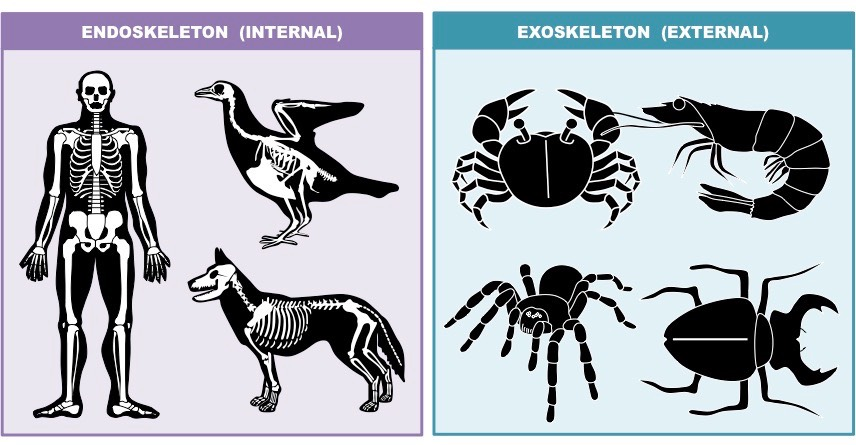
- Endoskeletons — Found in vertebrates; composed of bone and cartilage; grow with the organism; provide sites for muscle attachment; protect internal organs.
- Exoskeletons — Found in arthropods and molluscs; composed of chitin or calcium carbonate; provide external protection; must be shed and replaced in moulting (ecdysis).
- Endoskeletons allow large body sizes due to internal support; exoskeletons limit size due to weight and moulting constraints.
- Both systems enable muscle leverage for movement, but their structural organisation differs.
- Bone is living tissue capable of repair and mineral storage; chitin is non-living and secreted by epidermal cells.
🌍 Real-World Connection: Research into synthetic materials for body armour is inspired by the structure of arthropod exoskeletons and mollusc shells.
📌 Lever Systems in Movement
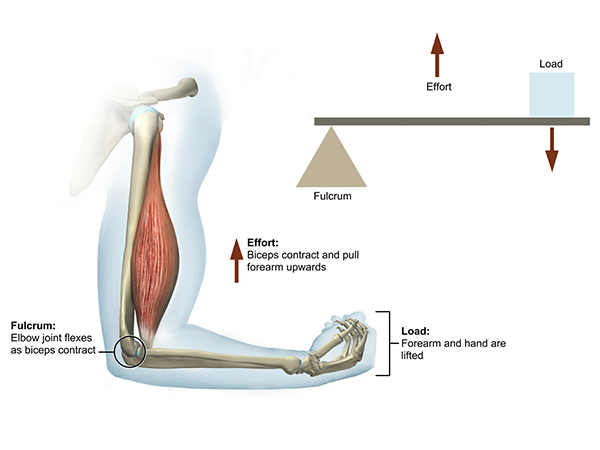
- Bones act as levers to amplify force or speed depending on the lever class.
- Joints serve as fulcrums, muscles apply effort, and body parts or loads provide resistance.
- First-class levers — Fulcrum between load and effort (e.g., neck muscles raising the head).
- Second-class levers — Load between fulcrum and effort (e.g., calf muscles raising the heel).
- Third-class levers — Effort between fulcrum and load (e.g., biceps flexing the forearm) — most common in the body.
🔍 TOK Perspective: Lever classification is a human framework — real joints may not perfectly fit textbook categories but are approximations for understanding biomechanics.
📌 Synovial Joints
- Freely movable joints enclosed in a fibrous capsule containing synovial fluid.
- Synovial fluid lubricates articular cartilage, reducing friction during movement.
- Ligaments connect bones, providing stability and limiting excessive movement.
- Types include hinge (elbow, knee), ball-and-socket (shoulder, hip), pivot (neck), gliding, and saddle joints.
- Cartilage acts as a shock absorber, distributing load across the joint.
🌐 EE Focus: An EE could compare the range of motion in synovial joints between athletes in different sports to assess sport-specific adaptations.
📌 Antagonistic Muscles
- Muscles can only contract, not push, so they work in antagonistic pairs.
- One muscle contracts (agonist) while the other relaxes (antagonist) to produce movement.
- Example: Biceps (flexor) and triceps (extensor) control forearm flexion and extension.
- Provide controlled movement and stability at joints.
- Found in limbs, jaws, eyes, and many other systems requiring precise control.