B3.1.1 – GAS EXCHANGE IN SINGLE-CELLED AND SIMPLE MULTICELLULAR ORGANISMS
📌Definition Table
| Term | Definition |
|---|---|
| Gas Exchange | The process of obtaining oxygen from the environment and removing carbon dioxide. |
| Diffusion | Passive movement of particles from an area of high concentration to an area of low concentration. |
| Surface Area-to-Volume Ratio (SA:V) | The relationship between the surface area available for diffusion and the volume of the organism; a key factor in gas exchange efficiency. |
| Respiratory Surface | The part of an organism where gases are exchanged between the internal and external environment. |
| Simple Multicellular Organism | Organism made of more than one cell, with limited specialisation, and lacking complex transport systems. |
📌Introduction
Single-celled organisms and small multicellular organisms rely primarily on diffusion for gas exchange. Their relatively high surface area-to-volume ratio means that gases can move directly across the cell membrane or body surface without the need for specialised respiratory organs or circulatory systems. The efficiency of gas exchange depends on the thickness of the diffusion path, the concentration gradient, and the surface area available. Studying these simple systems reveals the fundamental principles upon which more complex respiratory systems are built.
❤️ CAS Link: Create a science club demonstration showing diffusion using coloured dyes in agar blocks of different sizes to model SA:V effects in gas exchange.
📌 Gas Exchange in Single-Celled Organisms
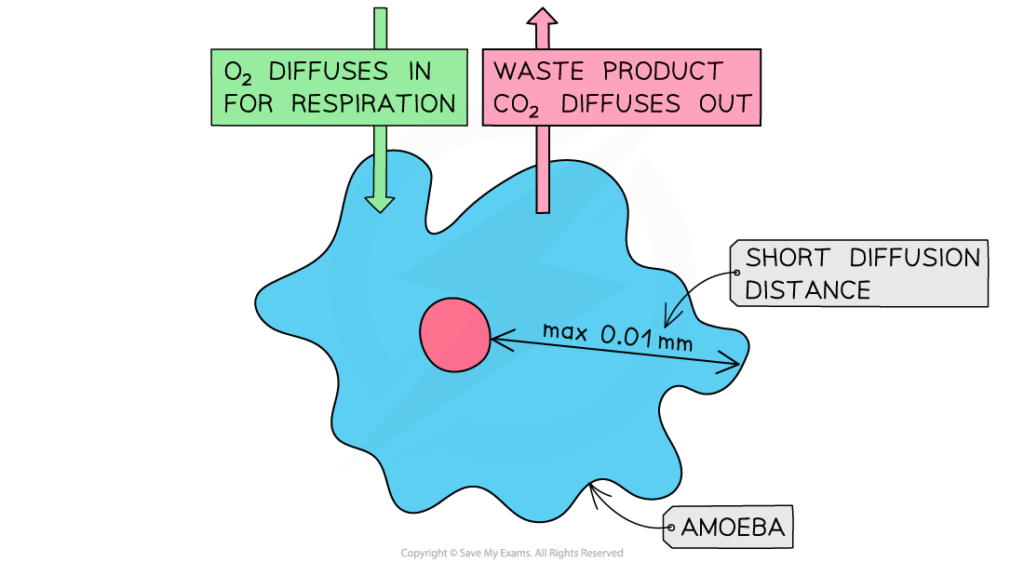
- Unicellular organisms such as amoebas rely on simple diffusion across the plasma membrane.
- Their small size means SA:V ratio is high, allowing oxygen and carbon dioxide to diffuse rapidly enough to meet metabolic needs.
- Cell membranes are moist and thin, ensuring a short diffusion path.
- Movement within the cytoplasm helps distribute gases evenly, maintaining concentration gradients.
🧠 Examiner Tip: Always connect SA:V to diffusion efficiency — small organisms have less difficulty meeting metabolic demands via diffusion alone.
📌 Gas Exchange in Simple Multicellular Organisms
Some small multicellular organisms can still rely on diffusion due to their body plan:
- Flatworms (Platyhelminthes) — dorsoventrally flattened body increases surface area and minimises diffusion distance.
- Cnidarians (e.g., jellyfish) — thin body wall with cells close to the water allows diffusion directly across surfaces.
- Sponges — water flows through body canals, bringing oxygen close to cells and removing CO₂.
🌍 Real-World Connection: Understanding these simple systems helps in designing bio-inspired microfluidic devices for gas exchange in medical and engineering applications.
📌 Adaptations for Maximising Diffusion
- Thin exchange surfaces — reduces path length for gases.
- Moist surfaces — gases dissolve before diffusing across membranes.
- Maintained concentration gradients — achieved by movement of water or body fluids.
- Large SA:V ratio — body shape and size are key in ensuring sufficient diffusion.
🔍 TOK Perspective: The classification of organisms by complexity (unicellular vs. multicellular) is based on structure, but functional overlap in gas exchange challenges rigid definitions.
📌Limitations of Diffusion-Only Systems
- Effective only for organisms with low metabolic demands or small body sizes.
- Larger organisms require specialised respiratory structures and circulatory systems to maintain adequate gas supply.
- As body size increases, SA:V ratio decreases, making diffusion insufficient on its own.
⚗️ IA Tips & Guidance: An IA could model diffusion rates in differently shaped agar blocks containing an oxygen-sensitive dye, quantifying the relationship between SA:V ratio and oxygen penetration depth.