B2.1.2 – MEMBRANE TRANSPORT
📌Definition Table
| Term | Definition |
|---|---|
| Passive Transport | Movement of molecules down a concentration gradient without energy input. |
| Simple Diffusion | Passive movement of molecules directly through the lipid bilayer. |
| Facilitated Diffusion | Passive movement through a membrane via channel or carrier proteins. |
| Osmosis | Passive movement of water molecules through a selectively permeable membrane. |
| Active Transport | Movement of molecules against their concentration gradient using ATP. |
| Endocytosis | Bulk transport of substances into the cell via vesicle formation. |
| Exocytosis | Bulk transport of substances out of the cell via vesicle fusion with the membrane. |
📌Introduction
Membrane transport mechanisms regulate the movement of substances into and out of cells, maintaining homeostasis. Transport can be passive (no energy required) or active (requires ATP). Bulk transport processes allow cells to move large molecules or whole particles using vesicles.
❤️ CAS Link: Design a lab demonstration for younger students showing osmosis using dialysis tubing and coloured solutions.
📌 Passive Transport
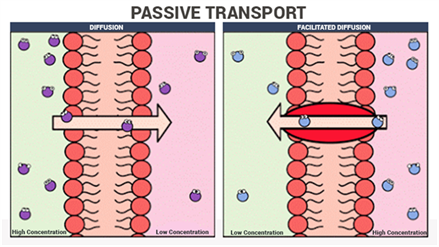
- Molecules move down their concentration gradient.
- Simple diffusion: Small, nonpolar molecules (O₂, CO₂) pass directly through the lipid bilayer.
- Facilitated diffusion: Polar molecules and ions move through channel proteins (pores) or carrier proteins (shape change).
- Rate of facilitated diffusion depends on number and availability of transport proteins.
- Osmosis: Movement of water through aquaporins or directly across bilayer; driven by solute concentration differences.
- Hypotonic, hypertonic, and isotonic solutions affect cell water balance.
🧠 Examiner Tip: For osmosis questions, always mention water potential differences rather than just “concentration.”
📌 Active Transport
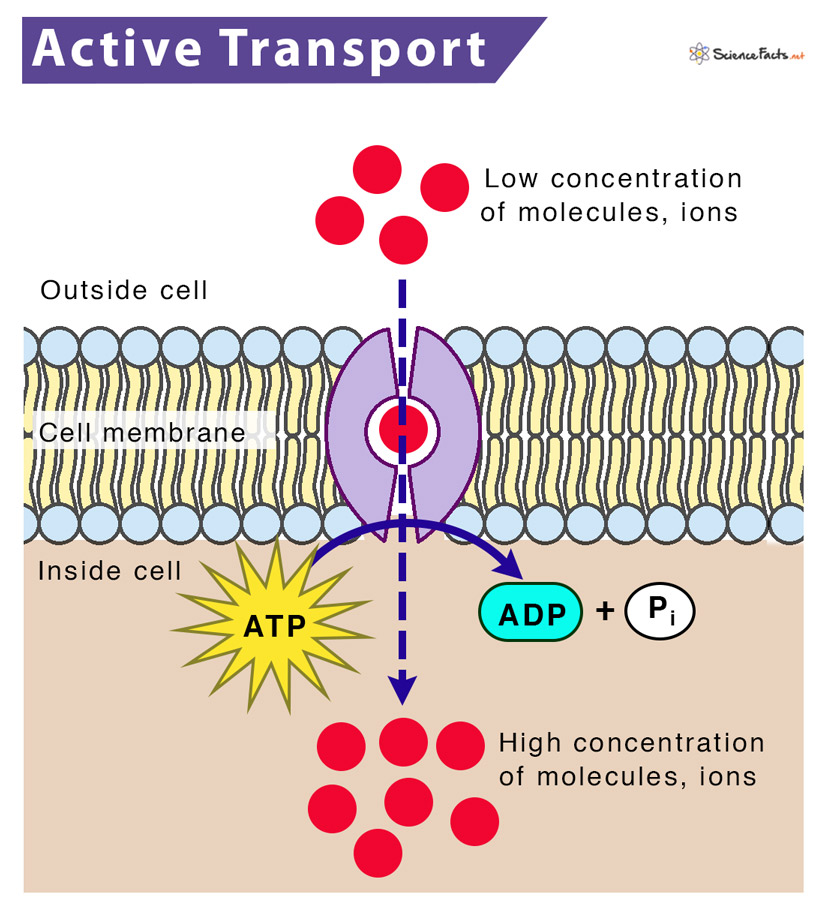
- Moves molecules against their concentration gradient using ATP.
- Performed by carrier proteins (pumps) — undergo conformational changes powered by ATP hydrolysis.
- Example: Sodium-potassium pump in neurons (3 Na⁺ out, 2 K⁺ in per ATP).
- Maintains electrochemical gradients critical for processes like nerve impulses and muscle contraction.
- Active transport allows uptake of nutrients even when external concentrations are low.
- Selective and tightly regulated by the cell.
🌍 Real-World Connection: Active transport is vital for nutrient absorption in the small intestine, especially in nutrient-poor environments.
📌 Bulk Transport
Endocytosis:
- Phagocytosis: Engulfing large particles or cells.
- Pinocytosis: Uptake of extracellular fluid and small molecules.
- Receptor-mediated endocytosis: Specific uptake using membrane receptors.
Exocytosis: Vesicles fuse with membrane to release contents (e.g., neurotransmitters).
Requires ATP for vesicle movement and membrane fusion.
Involves cytoskeleton for vesicle transport.
Enables rapid and large-scale material exchange.
Critical in immune responses (e.g., macrophage engulfing bacteria).
🌐 EE Focus: An EE could study vesicle trafficking rates in yeast or plant cells under different temperature conditions.