The vector product, or cross product, takes two vectors and produces a
new vector. This new vector is:
- Perpendicular to both original vectors.
- Has a magnitude related to the area formed by the two vectors.
- Points in a direction decided by a consistent rule (the right–hand rule).
So while the dot product measures “how aligned” two vectors are, the
cross product measures “how perpendicular” and “how much area” they span.
📌 1. Geometric Meaning of the Vector Product
Imagine two vectors v and w drawn from the same starting point. They form a
parallelogram. The cross product v × w is defined so that:
- The direction of v × w is perpendicular to the plane containing v and w.
- The length of v × w equals the area of that parallelogram.
The magnitude is given by:
|v × w| = |v| × |w| × sin(θ), where θ is the angle between v and w (0 ≤ θ ≤ π).
This formula comes from the idea that the area of a parallelogram is
base × height. Here, take |v| as the base, and the height is the component of w
that is perpendicular to v, which has length |w| × sin(θ).
🌍 Real-World Connection
- Torque: The turning effect of a force is given by τ = r × F. The magnitude |τ| = |r| × |F| × sin(θ) shows how “off–centre” the force is.
- Magnetic Forces: A charged particle moving in a magnetic field experiences a force F = q(v × B), whose direction is perpendicular to both velocity and field.
- Computer Graphics: Cross products find normal vectors to surfaces, which are essential for lighting and shading in 3D rendering.
📌 2. Direction: The Right–Hand Rule
The cross product must choose one of two possible perpendicular directions (up or down relative to the plane).
We use the right–hand rule to choose this direction consistently:
- Point your index finger in the direction of v.
- Point your middle finger in the direction of w.
- Your thumb (at right angles to both) points in the direction of v × w.
Reversing the order of the cross product reverses the direction:
v × w = −(w × v)
🔍 TOK Perspective
- The choice of the right hand rule instead of the left is a convention. How much of mathematics depends on such human choices?
- Even though the direction of v × w is convention–based, the relationships (perpendicularity, area) are not. Does this show a mix of invention and discovery?
📌 3. Component Formula and What It Represents
In coordinates, if:
v = (v1, v2, v3) and w = (w1, w2, w3)
Then the cross product is defined as:
v × w = (v2 × w3 − v3 × w2,
v3 × w1 − v1 × w3,
v1 × w2 − v2 × w1)
This formula is not random. It is chosen so that:
- v × w is perpendicular to both v and w (so its dot product with each is 0).
- |v × w| gives the correct area |v| × |w| × sin(θ).
- It respects the right–hand rule and properties like v × w = −(w × v).
Example 1 — Computing a cross product from components
Let v = (2, 1, 3) and w = (1, −1, 2).
v × w = (1×2 − 3×(−1), 3×1 − 2×2, 2×(−1) − 1×1)
= (2 + 3, 3 − 4, −2 − 1)
= (5, −1, −3)
Check perpendicularity (conceptually):
v · (v × w) = 0 and w · (v × w) = 0 (if you compute, both sums are zero),
so the new vector is perpendicular to both v and w, as required.
📊 IA Spotlight
- Use cross products to analyse torque in a real mechanical system (for example, a door, a wrench, or a bicycle pedal).
- Investigate how the area of a parallelogram or triangle changes as one vector rotates around another.
- Model 3D surfaces and compute normal vectors to study reflection or lighting in a simple graphics or physics simulation.
📌 4. Parallel Vectors and the Zero Vector
If v and w are parallel, then the angle between them is 0 or π, so sin(θ) = 0.
From the magnitude formula:
|v × w| = |v| × |w| × sin(θ) = 0
Therefore:
v × w = 0 vector
This gives a test for parallelism: if v × w = 0 (and v, w are not both zero), then v and w are parallel or anti–parallel.
Example 2 — Using the cross product to test parallel vectors
v = (2, 4, −2), w = (−1, −2, 1)
Notice that w = −1 × (2, 4, −2) = (−2, −4, 2) ❌ (this does not match exactly), so check with cross product:
v × w = (4×1 − (−2)×(−2), (−2)×(−1) − 2×1, 2×(−2) − 4×(−1))
= (4 − 4, 2 − 2, −4 + 4)
= (0, 0, 0)
The result is the zero vector, so v and w are parallel (one is a scalar multiple of the other).
📌 5. Area of Parallelograms and Triangles Using Cross Product
If two vectors v and w represent sides of a parallelogram from the same starting point, then:
Area of parallelogram = |v × w|
Area of triangle = |v × w| ÷ 2
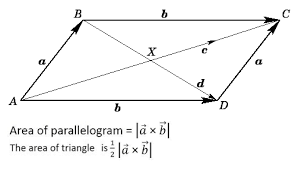

This is a very efficient way to find areas in 3D when coordinates are known.
Example 3 — Area of a triangle with vertices in 3D
Let the triangle have vertices A(1, 0, 0), B(3, 1, 0), C(2, 3, 0).
Form vectors:
AB = (3 − 1, 1 − 0, 0 − 0) = (2, 1, 0)
AC = (2 − 1, 3 − 0, 0 − 0) = (1, 3, 0)
AB × AC = (1×0 − 0×3, 0×1 − 2×0, 2×3 − 1×1)
= (0, 0, 6 − 1) = (0, 0, 5)
|AB × AC| = 5 → area of parallelogram = 5 → area of triangle = 5 ÷ 2 = 2.5
🌐 EE Focus
- Explore cross products in the context of surface geometry, such as normals to curved surfaces or surface area approximations.
- Investigate the role of vector products in physics, for example in electromagnetism or rotational dynamics, as a basis for a mathematics or physics EE.
❤️ CAS Ideas
- Design an interactive session where younger students use arrows, sticks or 3D models to see perpendicular vectors and areas formed by them.
- Collaborate with the physics department to help model torque and magnetic forces using vector products in lab demonstrations.
🧠 Examiner Tip
Many marks are lost on sign errors when expanding the component formula for v × w.
Write each component separately and check that the resulting vector is perpendicular to the originals if possible.
📝 Paper 2 Strategy
- When asked for an area, check if vectors are given or can be formed between points — using |v × w| is often quicker than coordinate geometry.
- If vectors are parallel, state clearly that v × w = 0 and conclude that the area or torque is zero.
- In multi–step questions, underline which vector comes first in v × w to avoid accidentally reversing the direction.