This topic explores how the trigonometric functions behave when angles are reflected or shifted on the unit circle.
Understanding these symmetries makes it easier to predict graph shapes, simplify expressions, and solve equations across multiple rotations.
| Concept | Meaning / Identity |
|---|---|
| Reflection identity (sine) | sin(π − θ) = sinθ
This shows symmetry about the vertical line x = π ÷ 2. |
| Reflection identity (cosine) | cos(π − θ) = −cosθ
This shows cosine is reflected and negated across x = π ÷ 2. |
| Reflection identity (tangent) | tan(π − θ) = −tanθ
This matches tangent’s odd symmetry. |
📌 Understanding the symmetry of trig graphs
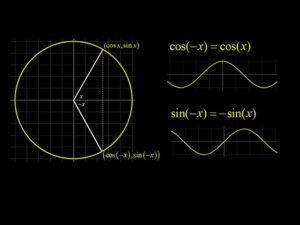
- Sine is symmetric about the line x = π ÷ 2 because reflecting an angle across this line keeps the y-coordinate the same.
- Cosine changes sign when reflected across x = π ÷ 2 because cosine represents the x-coordinate on the unit circle.
- Tangent inherits the properties of sine ÷ cosine and therefore also changes sign under π − θ.
- These identities are powerful shortcuts for evaluating trig values in different quadrants without full unit circle diagrams.
640 × 480
📌 Quick Example (Exam-Style)
Example: Without using a calculator, find cos(π − π ÷ 6).
Step 1 — Use the identity:
cos(π − θ) = −cosθ
Step 2 — Substitute θ = π ÷ 6:
cos(π − π ÷ 6) = −cos(π ÷ 6)
Step 3 — Use known value:
cos(π ÷ 6) = √3 ÷ 2
Final answer:
cos(π − π ÷ 6) = −√3 ÷ 2
🌍 Real-World Applications
- Simple harmonic motion (springs, pendulums) uses symmetric sine and cosine graphs.
- Electrical engineering (AC circuits) relies on cosine and sine wave symmetry to analyse voltage and current behaviour.
- Rotational motion in physics uses trig symmetries to determine positions over time.
📐 IA Spotlight
- Investigation of symmetry in periodic functions and its role in modelling real oscillations.
- Comparing sine vs cosine modelling for different physical systems (pendulum vs mass-spring).
- Exploring how symmetry simplifies solving trig equations in applied contexts.
🔍 TOK Perspective
- Trig graphs repeat infinitely, yet we summarise them with a small set of identities — what does this say about patterns in mathematics?
- How does the concept of symmetry influence the way mathematics describes natural phenomena?
- Are mathematical symmetries discovered in nature or invented as a framework for understanding it?
📝 Exam Tips
- Remember quadrant rules: sine stays positive in quadrants I and II, while cosine becomes negative in II.
- Use these symmetry identities to check answers quickly in multiple-choice questions.
- Correctly identifying the quadrant is the key step before applying any identity.