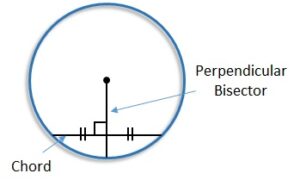
A perpendicular bisector is a line that cuts a line segment into two equal halves and is at 90° to the original line.
It is a foundational tool in coordinate geometry, used to find equidistant points, construct geometric loci, and solve circle-related problems.
| Concept | Meaning |
|---|---|
| Midpoint | For points (x1, y1) and (x2, y2), midpoint = ((x1 + x2) ÷ 2, (y1 + y2) ÷ 2) |
| Gradient of original line | m = (y2 − y1) ÷ (x2 − x1) |
| Gradient of perpendicular bisector | m⊥ = −1 ÷ m (negative reciprocal) |
📌 1. What a perpendicular bisector represents
- It contains all points equidistant from the endpoints of the segment.
- It forms the basis for finding the centre of a circle by intersecting perpendicular bisectors of chords.
- It is a geometric locus used in design, surveying, navigation and triangulation.
- Many coordinate problems rely on identifying the perpendicular bisector to locate points that satisfy distance conditions.
📌 2. Worked example: perpendicular bisector from two points
Example
Find the perpendicular bisector of the segment joining A(2, 3) and B(8, 9).
Step 1: Midpoint
Midpoint = ((2 + 8) ÷ 2, (3 + 9) ÷ 2) = (10 ÷ 2, 12 ÷ 2) = (5, 6)
Step 2: Gradient of AB
m = (9 − 3) ÷ (8 − 2) = 6 ÷ 6 = 1
Step 3: Gradient of perpendicular bisector
m⊥ = −1 ÷ 1 = −1
Step 4: Equation
Use point-slope form with midpoint (5, 6):
y − 6 = −1 × (x − 5)
Expand:
y − 6 = −x + 5
y = −x + 11
Perpendicular bisector: y = −x + 11
📌 3. Worked example: given midpoint and gradient of segment
Example
A line segment has midpoint M(4, −2). The gradient of the segment is 2.
Find the equation of the perpendicular bisector.
Step 1: Perpendicular gradient
m⊥ = −1 ÷ 2 = −0.5
Step 2: Equation through midpoint
y + 2 = −0.5 × (x − 4)
y + 2 = −0.5x + 2
y = −0.5x
Perpendicular bisector: y = −0.5x
🧮 GDC Use
- You can use the GDC to check midpoints and gradients quickly by plugging values into tables or geometry tools.
- Graph both the segment AB and your perpendicular bisector to visually confirm the line crosses the midpoint and is at 90°.
- Useful especially in exam settings to verify your negative reciprocal gradient and avoid sign errors.
🌍 Real-World Applications
- Used in locating equidistant points between two transmitters, towers or landmarks.
- Base method in triangulation and surveying for mapping and positioning.
- Essential for finding the centre of a circle formed by three non-collinear points.
- Appears in design and engineering when constructing perpendicular supports or symmetrical shapes.
🔍 TOK Perspective
- The perpendicular bisector represents a set of points defined by a logical rule: “equidistant from two points”. Is this mathematical locus an invention or a discovery?
- Coordinate geometry allows us to express geometric ideas algebraically. Does representing a geometric idea in algebra change how we understand it?
📝 Paper Tips
- Write the midpoint first—it anchors the perpendicular bisector.
- Always double-check the perpendicular gradient: it must be the negative reciprocal.
- Simplify the equation neatly and give final answer in the form y = mx + c unless instructed otherwise.
- A sketch (even small) helps prevent sign mistakes with gradients.