A3.1.2 – DOMAINS AND KINGDOMS OF LIFE
📌Definition Table
| Term | Definition |
|---|---|
| Domain | Highest taxonomic rank grouping organisms based on fundamental differences in cell type and genetics. |
| Kingdom | Second-highest rank in taxonomy grouping related organisms within a domain. |
| Prokaryote | Organism without a true nucleus or membrane-bound organelles. |
| Eukaryote | Organism with a true nucleus and membrane-bound organelles. |
| Extremophile | Organism (often Archaea) that thrives in extreme environments. |
| Phylogenetic Tree | Diagram showing evolutionary relationships based on shared traits and genetic data. |
📌Introduction
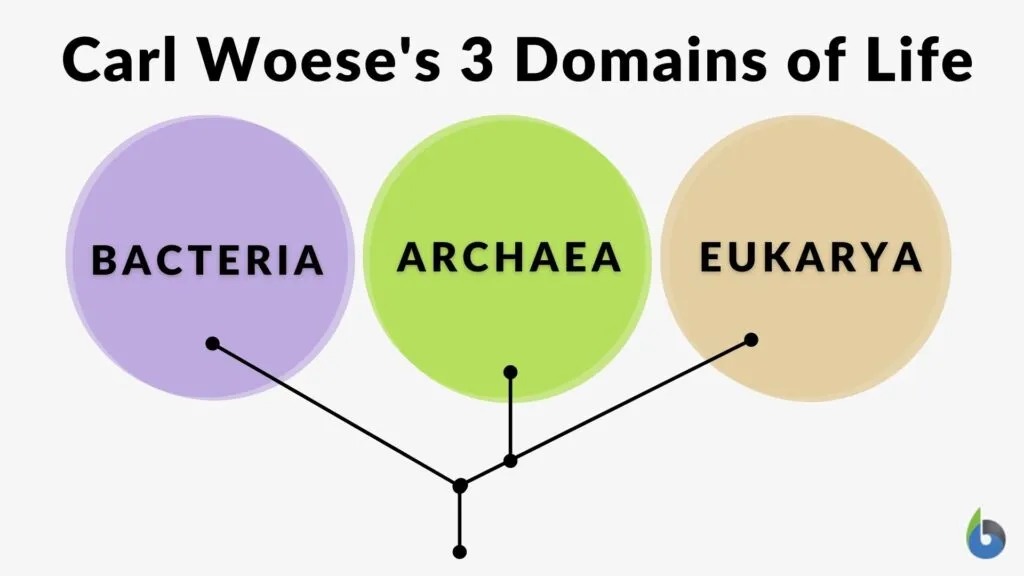
The three-domain system — Bacteria, Archaea, and Eukarya — reflects fundamental differences in genetic makeup, cell structure, and metabolism. Within these domains, organisms are divided into kingdoms based on shared characteristics. Understanding these divisions helps biologists map the tree of life and explore evolutionary relationships.
❤️ CAS Link: Create a classroom display mapping the three domains and their kingdoms, using local examples of species where possible.
📌 Three-Domain System
- Bacteria: Prokaryotic, cell walls with peptidoglycan, diverse metabolic pathways.
- Archaea: Prokaryotic, no peptidoglycan in cell walls, often extremophiles (e.g., thermophiles, halophiles).
- Eukarya: Eukaryotic cells with nuclei and membrane-bound organelles.
- Domains were proposed by Carl Woese based on molecular evidence (16S rRNA analysis).
- Reflects the deepest evolutionary splits among living organisms.
- Each domain contains multiple kingdoms.
🧠 Examiner Tip: When asked for differences between domains, always include cell wall composition, membrane lipids, and genetic machinery.
📌 Kingdoms of Life in the Three-Domain System
- Bacteria: Single kingdom, highly diverse, includes cyanobacteria and heterotrophic bacteria.
- Archaea: Single kingdom, includes methanogens, extreme halophiles, and thermophiles.
- Eukarya: Multiple kingdoms — Animalia, Plantae, Fungi, Protista.
- Protista is a diverse group, often considered “miscellaneous” eukaryotes.
- Each kingdom is defined by cell type, nutrition mode, and reproduction methods.
- Molecular studies are reshaping traditional kingdom classifications.
🌍 Real-World Connection: Understanding bacterial diversity aids in biotechnology applications, such as antibiotic production and waste treatment.
📌 Key Features of Each Domain
- Bacteria: Circular DNA, 70S ribosomes, peptidoglycan cell walls, reproduce by binary fission.
- Archaea: Unique membrane lipids, no peptidoglycan, histone-like proteins, live in diverse and extreme environments.
- Eukarya: Linear DNA, 80S ribosomes, compartmentalised organelles, complex reproduction cycles.
- Distinguishing features often determined through molecular data.
- Genetic differences support the ancient divergence of domains.
- Cell wall and membrane composition are critical identifiers.
🔍 TOK Perspective: The decision to move from a two- to three-domain system shows how paradigm shifts occur in science when new evidence challenges old models.
📌 Examples and Ecological Roles
- Bacteria: Nitrogen-fixing Rhizobium, decomposers, pathogens (E. coli).
- Archaea: Methanogens in cow guts (methane production), thermophiles in hot springs.
- Animalia: Multicellular heterotrophs, from sponges to mammals.
- Plantae: Autotrophic producers, base of food chains.
- Fungi: Decomposers, symbionts (mycorrhizae), pathogens.
- Protista: Diverse aquatic organisms like algae and protozoa.
- Each group plays essential roles in nutrient cycling, energy flow, and ecosystem stability.