A2.3.2 – VIRUS REPLICATION
📌Definition Table
| Term | Definition |
|---|---|
| Lytic Cycle | Viral replication process resulting in destruction of the host cell and release of new viruses. |
| Lysogenic Cycle | Viral replication strategy where viral DNA integrates into the host genome and remains dormant before activation. |
| Provirus | Viral genome integrated into the host DNA. |
| Latency | Period where a virus remains dormant in host cells without producing new viruses. |
| Reverse Transcriptase | Enzyme that synthesises DNA from an RNA template (in retroviruses). |
| Lysozyme | Enzyme used by bacteriophages to break bacterial cell walls during infection. |
📌Introduction
Viral replication requires host cell machinery because viruses lack the enzymes and structures necessary for independent reproduction. Depending on the virus, replication may follow a lytic pathway, where new viruses are made immediately, or a lysogenic pathway, where the viral genome integrates into the host cell and remains inactive until triggered.
❤️ CAS Link: Develop a school science outreach activity where students model viral replication using simple props to show lytic vs lysogenic cycles.
📌 General Process of Viral Replication
- Attachment: Virus recognises and binds to specific host cell receptors.
- Entry: Virus injects its genome or enters the host via endocytosis/membrane fusion.
- Replication: Host cell machinery is hijacked to replicate viral genetic material.
- Assembly: Viral components self-assemble into new virions.
- Release: Viruses exit the cell via lysis (bursting) or budding (enveloped viruses).
- Cycle repeats upon infection of new host cells.
🧠 Examiner Tip: Always include attachment → entry → replication → assembly → release in sequence when describing viral replication for full marks.
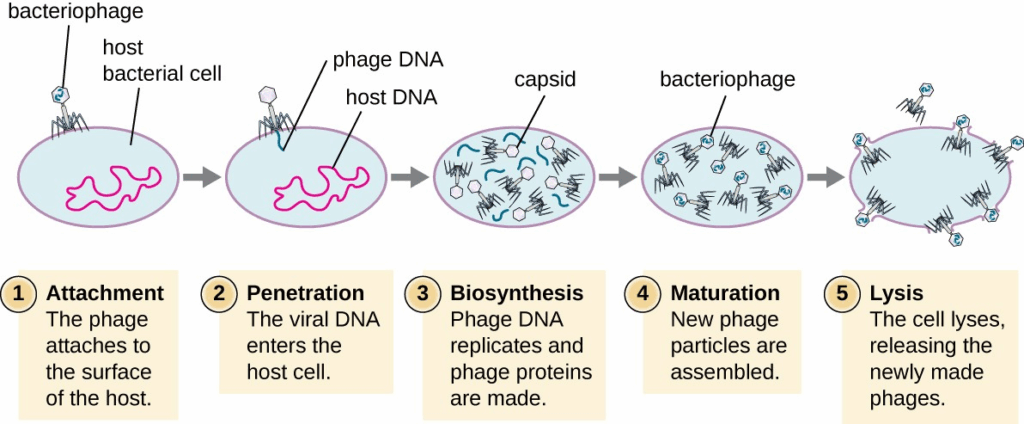
📌 Lytic Cycle
- Immediate replication upon infection.
- Host cell is destroyed at the end of the cycle.
- Steps:
- Attachment to host cell surface.
- Injection or entry of viral genome.
- Replication of genome and synthesis of viral proteins.
- Assembly of new viral particles.
- Host cell lysis via enzymes like lysozyme, releasing new viruses.
- Example: T4 bacteriophage.
- Rapidly produces many new viruses, often causing acute infections.
🌍 Real-World Connection: The lytic cycle explains why some viral diseases (e.g., influenza) cause sudden, severe symptoms.
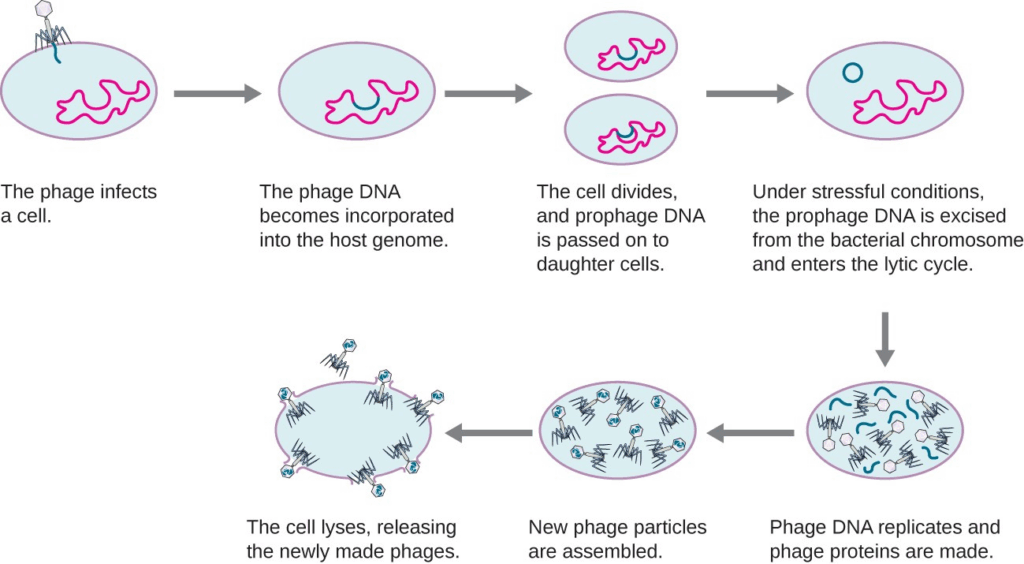
📌 Lysogenic Cycle
- Viral DNA integrates into the host genome as a provirus (in eukaryotes) or prophage (in bacteria).
- Host cell continues normal functions while replicating viral DNA along with its own.
- The virus can remain dormant for years (latency).
- Environmental triggers (e.g., UV light, stress) can activate the lytic cycle.
- Lysogeny allows viruses to persist without killing the host.
- Example: Lambda bacteriophage, herpesviruses.
🔍 TOK Perspective: The existence of lysogeny challenges the idea that all viruses cause immediate harm — should “infection” always be equated with “disease”?
📌 Differences Between Lytic and Lysogenic Cycles
- Lytic: Immediate replication, cell death, rapid spread.
- Lysogenic: Dormancy, viral genome integration, potential later activation.
- Lytic is common in acute infections; lysogenic in latent or recurring infections.
- Some viruses can switch between cycles depending on host conditions.
- Lytic infections often have more obvious symptoms.
- Lysogeny may contribute to genetic variation in hosts (via horizontal gene transfer).
🌐 EE Focus: An EE could explore how environmental conditions affect switching from lysogenic to lytic cycles in bacteriophages.