A2.1.2 – EVOLUTION OF CELLS
📌Definition Table
| Term | Definition |
|---|---|
| Protocell | A membrane-bound structure thought to be a precursor to modern cells. |
| RNA World Hypothesis | Theory that self-replicating RNA was the first genetic material. |
| Compartmentalisation | Separation of internal chemistry from the environment via membranes. |
| Metabolism-First Model | Hypothesis that life began with metabolic networks before genetic material. |
| Gene-First Model | Hypothesis that self-replicating genetic molecules appeared before metabolism. |
| Abiogenesis | The origin of living organisms from non-living matter. |
📌Introduction
The evolution of cells marks the transition from non-living chemistry to living systems capable of growth, reproduction, and metabolism. This process involved the development of self-replicating molecules, the formation of protective membranes, and the emergence of the first prokaryotic cells. While several hypotheses exist, evidence points to RNA as playing a key early role in life’s origin.
📌 Stages in the Origin of Cells
- Abiotic synthesis of organic molecules (amino acids, nucleotides) in early Earth conditions.
- Polymerisation into macromolecules such as proteins and nucleic acids.
- Self-replication: first genetic material likely RNA due to its dual role as information carrier and catalyst.
- Compartmentalisation: formation of membranes/vesicles to protect and concentrate reactions.
- Development of metabolic pathways to harness energy and resources.
- Transition from protocells to the Last Universal Common Ancestor (LUCA).

🧠 Examiner Tip: Always mention compartmentalisation as a key step — many students forget it and lose marks in origin-of-life questions.
📌 RNA World Hypothesis
- RNA can store genetic information and act as an enzyme (ribozyme).
- This dual role supports the idea that RNA preceded DNA and proteins.
- RNA ribozymes could catalyse their own replication in early life.
- DNA likely evolved later for greater stability in information storage.
- Proteins took over most catalytic functions due to greater versatility.
- Lab experiments have shown that short RNA sequences can self-replicate under certain conditions.
📌 Compartmentalisation and Protocells
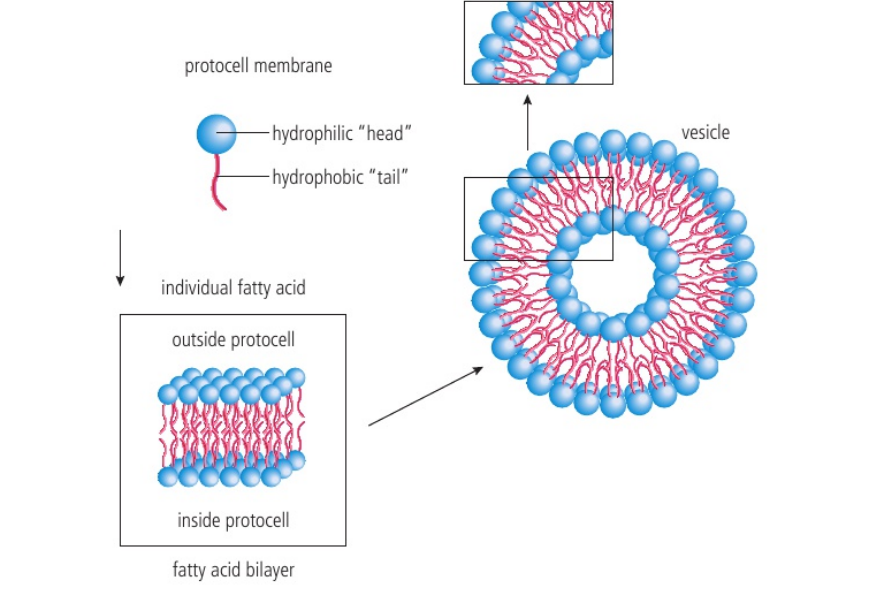
- Fatty acids can spontaneously form vesicles in water.
- Vesicles can encapsulate RNA, proteins, and other molecules.
- This separation from the environment allows controlled internal chemistry.
- Vesicles can grow and divide without complex machinery.
- Early membranes were likely more permeable than modern phospholipid bilayers.
- Protocells could have formed naturally in volcanic pools or oceanic hydrothermal vents.
⚗️ IA Tips & Guidance: Simple lipid vesicle experiments can be modelled in the lab using micelle and emulsion formation — ideal for chemistry–biology crossover IAs.
📌 Competing Hypotheses: Gene-First vs Metabolism-First
- Gene-First Model: Self-replicating molecules (RNA/DNA) appeared first, later supported by metabolism.
- Metabolism-First Model: Self-sustaining chemical cycles evolved first, creating a framework for genetic material to develop.
- Hydrothermal vents could have supported metabolism-first life by providing continuous chemical gradients.
- Both models may have operated together — early metabolic cycles could stabilise and support genetic molecules.
- Debate continues due to limited fossil and experimental evidence.
🌐 EE Focus: An EE could explore metabolism-first vs gene-first origins using modern synthetic biology studies as evidence.