A1.2.3 – HISTORICAL EXPERIMENTS AND SCIENTIFIC ADVANCES
📌 Definition Table
| Term | Definition |
|---|---|
| Hershey–Chase Experiment | An experiment using bacteriophages to confirm DNA is the genetic material. |
| Radioisotope Labeling | Using radioactive elements to trace molecules in biological systems. |
| Chargaff’s Rules | Observations that in DNA, %A ≈ %T and %G ≈ %C. |
| Tetranucleotide Hypothesis | An early, incorrect theory that DNA consisted of repeating units of four bases. |
| Molecular Visualization | Software or techniques used to model and study DNA/protein structures. |
| Falsification | The process of disproving a hypothesis through evidence. |
📌 Introduction
The history of nucleic acids is shaped by key experiments and technological advances that proved DNA, not protein, is the genetic material, and revealed its structure and function. These discoveries illustrate how scientific knowledge evolves through falsification, technological innovation, and collaboration.
📌 Hershey – Chase Experiment
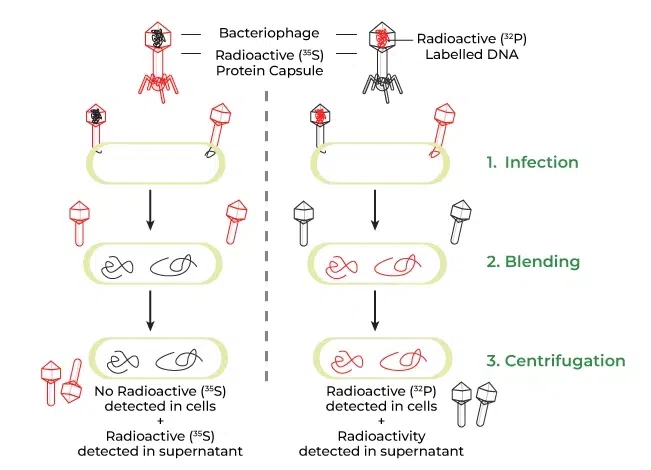
- Used bacteriophages (viruses that infect bacteria) to test whether protein or DNA carried genetic information.
- DNA was labeled with radioactive phosphorus (³²P), protein coat with radioactive sulfur (³⁵S).
- After infection, ³²P was found inside bacteria, ³⁵S remained outside.
- Conclusion: DNA is the genetic material passed to offspring, not protein.
- Provided final confirmation after earlier evidence from other studies.
🧠 Examiner Tip: State both radioisotopes and which macromolecule each labels — examiners award marks for detail.
🌍 Real-World Connection: Radioisotope tracing is now used in medicine (PET scans) and forensic science.
📌 Chargaff’s Rules
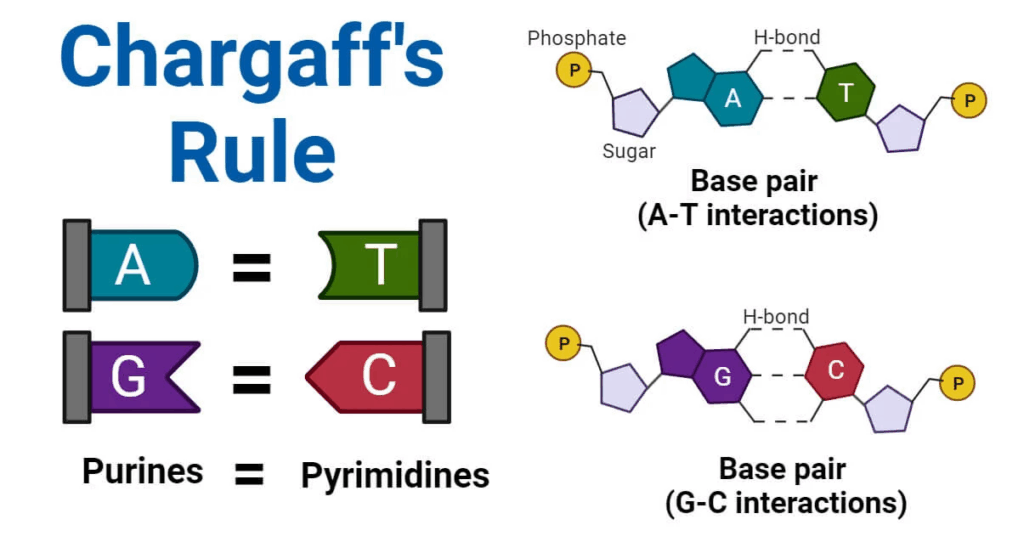
- Erwin Chargaff discovered that in any DNA sample: %A ≈ %T and %G ≈ %C.
- Ratios vary between species, but A always pairs with T and G with C.
- This disproved the tetranucleotide hypothesis (equal quantities of all bases).
- Provided key evidence for complementary base pairing in the double helix.
- Also explained why purines pair with pyrimidines for uniform helix width.
🔍 TOK Perspective: Chargaff’s work shows how unexpected data can challenge accepted theories, raising the question — how open should science be to overturning long-held beliefs?
📌 Falsification of the Tetranucleotide Hypothesis
- Early scientists believed DNA was too simple to carry genetic information.
- Proposed repeating units of four bases in equal amounts.
- Chargaff’s data disproved this — base composition is species-specific.
- This paved the way for the Watson–Crick model of DNA.
- Shows how scientific theories are discarded when evidence contradicts them.
🌐 EE Focus: Explore the process of falsification in biology by comparing historical theories about DNA with modern understanding.
📌 Technological Advances in Molecular Biology
- X-ray diffraction (Franklin & Wilkins) revealed DNA’s helical structure.
- Molecular visualization software now models DNA and proteins in 3D.
- Computer modelling helps predict protein folding and genetic interactions.
- Databases store genome sequences for research and biotechnology.
- These tools improve our understanding of structure–function relationships in biology.
⚗️ IA Tips & Guidance: Consider using online DNA modeling tools or protein databases in IAs to investigate structural properties.