📌 Key Definitions
| Term | Meaning |
|---|---|
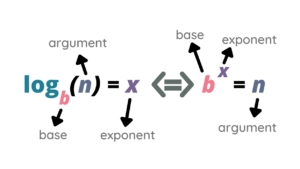
| logax | The power to which the base a must be raised to obtain x. If ak = x, then logax = k. |
| Base | The fixed number a in logax. In this topic, a = 10 or a = e only. |
| Domain | We must have a > 0, a ≠ 1, and x > 0. Logarithms of 0 or negatives are not real. |
🌍 Real-World Connection: Logarithms appear in pH (chemistry), Richter scale (earthquakes),
decibels (sound), and in analysing exponential growth and decay in biology and economics.
decibels (sound), and in analysing exponential growth and decay in biology and economics.
📌 Understanding Logarithms
Logarithms are the inverse of exponentials.
If 103 = 1000, then log10(1000) = 3.
If e2 ≈ 7.389, then ln(7.389) = 2.
- They answer the question: “What exponent produced this number?”
- Using laws of logarithms lets us simplify expressions, solve equations, and transform data.
- In AHL 1.9, we assume the base is 10 (log) or e (ln).
🧠 Examiner Tip: Always check that the argument of a log is positive.
If you get log(−2) or log(0), something has gone wrong in your working.
If you get log(−2) or log(0), something has gone wrong in your working.
📌 Law 1 – Product Law
Statement (for a > 0, a ≠ 1, x > 0, y > 0):
loga(x·y) = logax + logay
Intuition:
- Multiplying inside the log becomes adding exponents.
- If ap = x and aq = y, then xy = ap·aq = ap+q.
- Therefore loga(xy) is the single exponent p+q, i.e. logax + logay.
Worked Example 1: Simplify log10(2000).
- Write 2000 as 2 × 1000 = 2 × 10³.
- log(2000) = log(2 × 10³) = log(2) + log(103).
- log(103) = 3, so log(2000) = log(2) + 3.
Worked Example 2: Expand ln(5e).
- ln(5e) = ln(5 × e) = ln(5) + ln(e).
- ln(e) = 1, so ln(5e) = ln(5) + 1.
📌 Law 2 – Quotient Law
Statement (for a > 0, a ≠ 1, x > 0, y > 0):
loga(x ÷ y) = logax − logay
Intuition:
- Division inside the log becomes subtracting exponents.
- If ap = x and aq = y, then x ÷ y = ap−q.
- So loga(x ÷ y) = p − q = logax − logay.
Worked Example: Simplify log(50) − log(2).
- Combine using the quotient law in reverse: log(50) − log(2) = log(50 ÷ 2).
- 50 ÷ 2 = 25, so log(50) − log(2) = log(25).
📌 Law 3 – Power Law
Statement (for a > 0, a ≠ 1, x > 0):
loga(xm) = m·logax
Intuition:
- Raising x to a power multiplies the exponent.
- If x = ak, then xm = akm.
- So loga(xm) = km = m·logax.
Logarithms-1.png

Worked Example 1: Expand log(√x) (base 10).
- √x = x1/2, so log(√x) = log(x1/2).
- Using the power law: log(x1/2) = (1/2)·log(x).
Worked Example 2: Simplify ln(e−3).
- ln(e−3) = −3·ln(e).
- ln(e) = 1, so ln(e−3) = −3
📱 GDC Tip: Use your calculator to check simplified expressions numerically.
For example, confirm that log(24) and log(3) + log(8) give the same decimal value.
For example, confirm that log(24) and log(3) + log(8) give the same decimal value.
📐 IA Spotlight:
You can model exponential growth/decay data (e.g. cooling, bacteria growth, finance)
and then use logarithms to linearise the relationship, allowing you to fit a straight line and estimate parameters.🌐
You can model exponential growth/decay data (e.g. cooling, bacteria growth, finance)
and then use logarithms to linearise the relationship, allowing you to fit a straight line and estimate parameters.🌐
📝 Paper 1 Strategy:
When simplifying an expression with logs:
When simplifying an expression with logs:
- First, rewrite products, quotients and powers using the three laws.
- Then combine like terms (for example 2logx − logx = logx).
- Keep the base consistent: do not mix log base 10 and ln unless the question explicitly changes base.