A1.2.2 – FUNCTION AND ROLE OF THE GENETIC CODE
📌 Definition Table
| Term | Definition |
|---|---|
| Genetic Code | The set of rules by which information in DNA or RNA is translated into proteins. |
| Codon | A sequence of three nucleotides that codes for a specific amino acid or stop signal. |
| Anticodon | A complementary three-nucleotide sequence on tRNA that pairs with a codon on mRNA. |
| Universal Code | The genetic code is the same in almost all organisms. |
| Redundant Code | Multiple codons can code for the same amino acid. |
| Genome | The complete set of DNA, including all genes, of an organism. |
📌 Introduction
The genetic code is the link between the information stored in nucleic acids and the proteins that carry out cellular functions. Its structure, universality, and redundancy allow life to exist and evolve while maintaining accuracy in protein synthesis. The way DNA is transcribed and translated is fundamental to understanding heredity, gene expression, and biotechnology.
📌 Nature of the Genetic Code
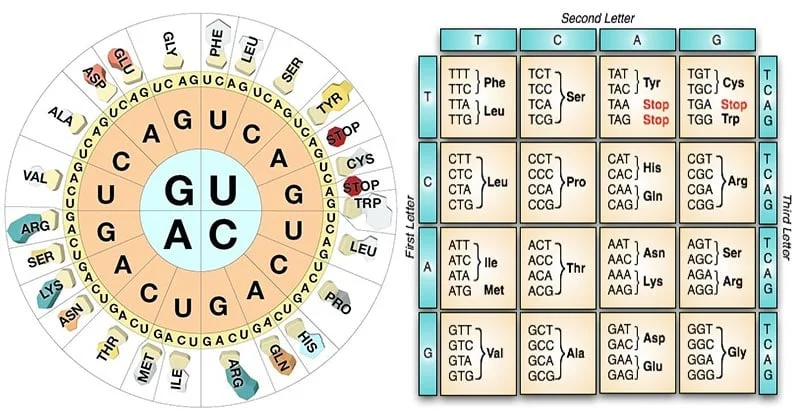
- Made of triplet codons — each codon specifies one amino acid or a stop signal.
- Code is universal — the same in nearly all organisms, evidence for common ancestry.
- Code is redundant — multiple codons can code for the same amino acid.
- Code is non-overlapping — codons are read sequentially in sets of three.
- Start codon AUG codes for methionine and begins translation.
- Stop codons UAA, UAG, UGA terminate protein synthesis.
🧠 Examiner Tip: Always include “triplet, non-overlapping, universal, redundant” when defining the genetic code in exams.
📌 Storage and Transmission of Information
- DNA stores instructions for building proteins in the sequence of its bases.
- Complementary base pairing ensures faithful replication during cell division.
- mRNA carries a temporary copy of a gene from DNA to ribosomes.
- The sequence of bases in DNA directly determines protein structure.
- Changes in base sequence can alter amino acid sequence, potentially affecting function.
- Genome size and gene number vary widely across organisms.
🌍 Real-World Connection: Genome sequencing projects help identify genes linked to diseases, enabling targeted therapies and personalized medicine.
📌 Protein Synthesis Overview
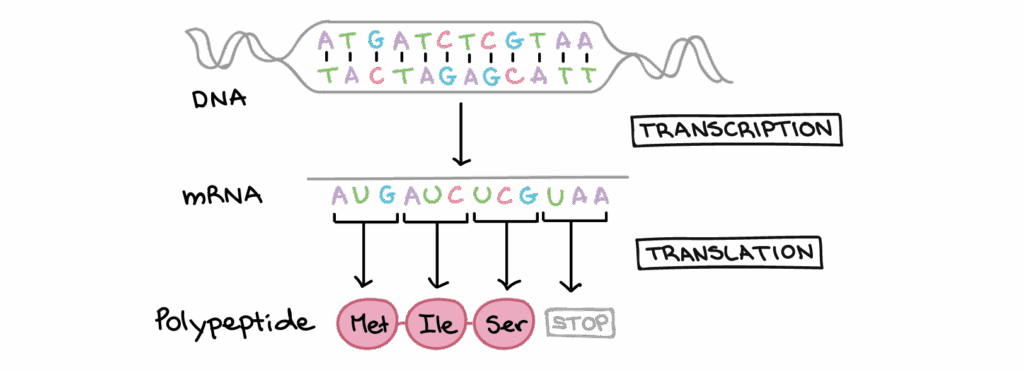
- Transcription: DNA sequence is copied into mRNA by RNA polymerase.
- mRNA processing in eukaryotes includes splicing, capping, and poly-A tail addition.
- Translation: Ribosomes read codons on mRNA to assemble amino acids in sequence.
- tRNA molecules match their anticodons to mRNA codons, delivering amino acids.
- Ribosomes catalyse peptide bond formation to create a polypeptide chain.
- Folding and modifications create a functional protein.
⚗️ IA Tips & Guidance: In protein synthesis modelling or bioinformatics IAs, link codon sequences to protein structure and function.
📌 Universality and Biotechnology
- The universality of the genetic code allows gene transfer between species.
- Bacteria can produce human proteins like insulin when given the human gene.
- Genetically modified crops use foreign genes to gain desired traits.
- The redundancy of the code reduces harmful effects of some mutations.
- Ethical debates arise over the use of genetic engineering in food and medicine.
- The universality also supports the theory of evolution.
🌐 EE Focus: An EE could investigate mutation effects on protein function using in-silico translation tools.
📌 Errors and Mutations in the Code
- Mutations are changes in DNA base sequence — may be silent, missense, or nonsense.
- Silent mutations do not change the amino acid sequence due to redundancy.
- Missense mutations replace one amino acid with another, possibly altering function.
- Nonsense mutations create premature stop codons, shortening proteins.
- Frameshift mutations (insertion/deletion) alter the reading frame, often severely damaging function.
- Mutation effects depend on location, type, and protein function.
🔍 TOK Perspective: Are “errors” in the genetic code always harmful, or can they be a source of creativity in evolution?