A1.2.1 – STRUCTURE OF NUCLEIC ACIDS
📌 Definition Table
| Term | Definition |
|---|---|
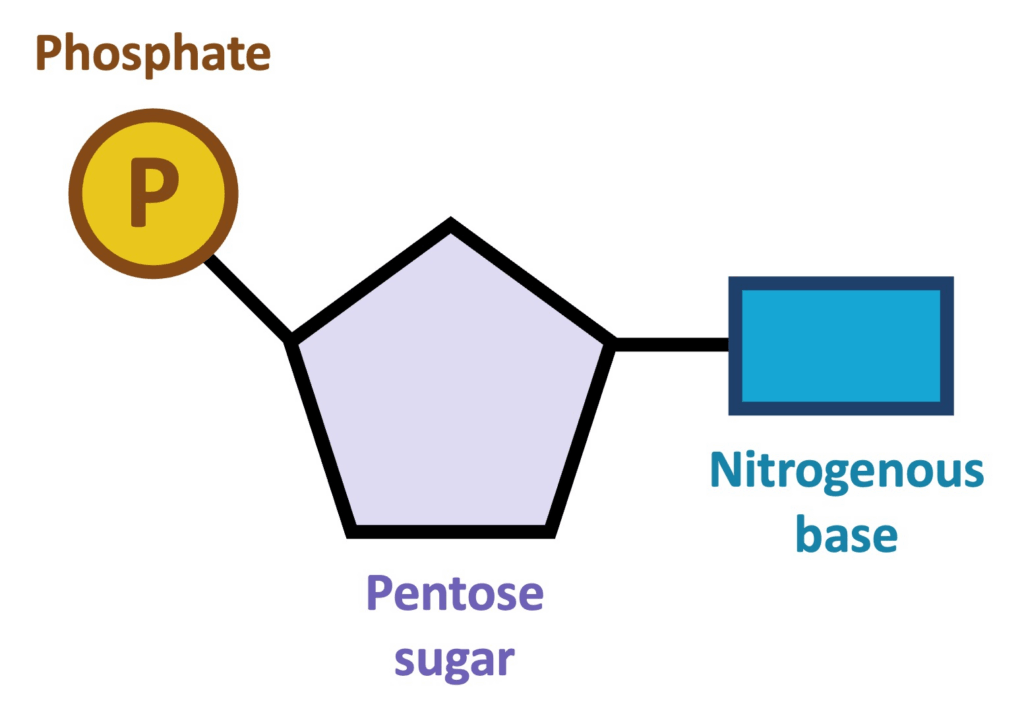
| Nucleotide | The basic unit of nucleic acids, consisting of a phosphate group, a pentose sugar, and a nitrogenous base. |
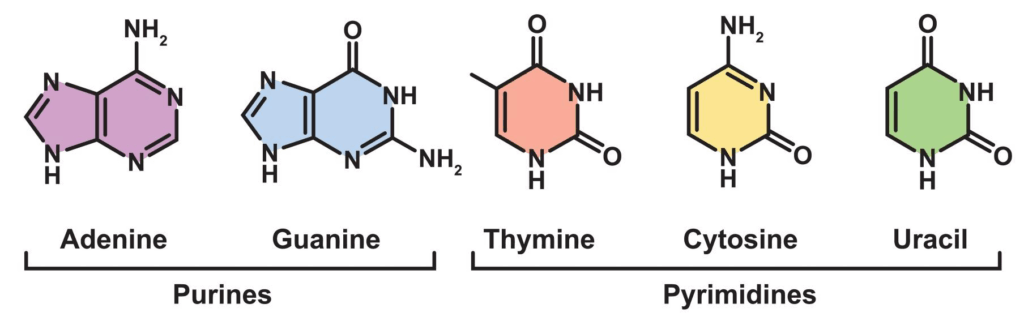
| Purine | A nitrogenous base with a double-ring structure (adenine, guanine). |
| Pyrimidine | A nitrogenous base with a single-ring structure (cytosine, thymine, uracil). |
| Antiparallel | Arrangement where the two strands of DNA run in opposite directions (5’→3’ and 3’→5’). |
| Complementary Base Pairing | Hydrogen bonding between specific bases (A–T or A–U, and G–C). |
| Nucleosome | A structural unit of DNA wrapped around histone proteins, aiding packaging in eukaryotes. |
📌 Introduction
Nucleic acids are the molecules of heredity — storing, transmitting, and expressing genetic information in all living organisms. Their structure, composed of nucleotides arranged in specific sequences, determines how genetic instructions are preserved and used. The structure of DNA and RNA underpins every process in molecular biology, from replication to protein synthesis.
📌 DNA as Genetic Material
- DNA is found in the nucleus of eukaryotes and the cytoplasm of prokaryotes.
- It stores hereditary information in the form of base sequences.
- Viruses may have DNA or RNA as their genetic material.
- The double helix structure allows stability and long-term information storage.
- DNA’s complementary base pairing supports accurate replication.
- Its stability allows it to persist for generations without rapid degradation.
🧠 Examiner Tip: In “structure–function” questions, link double helix stability to information storage and complementary base pairing to accurate replication.
📌 Components of Nucleotides
- Each nucleotide contains a pentose sugar (deoxyribose in DNA, ribose in RNA).
- A phosphate group forms the sugar–phosphate backbone.
- Nitrogenous bases are either purines (A, G) or pyrimidines (C, T, U).
- Bases attach to the 1′ carbon of the sugar; phosphate attaches to the 5′ carbon.
- The sugar–phosphate backbone is connected by phosphodiester bonds.
- Nitrogenous bases form the genetic code through specific sequences.
⚗️ IA Tips & Guidance: In gel electrophoresis or molecular modeling IAs, discuss how nucleotide structure (size, charge) influences DNA movement or stability.
📌 Structure of DNA
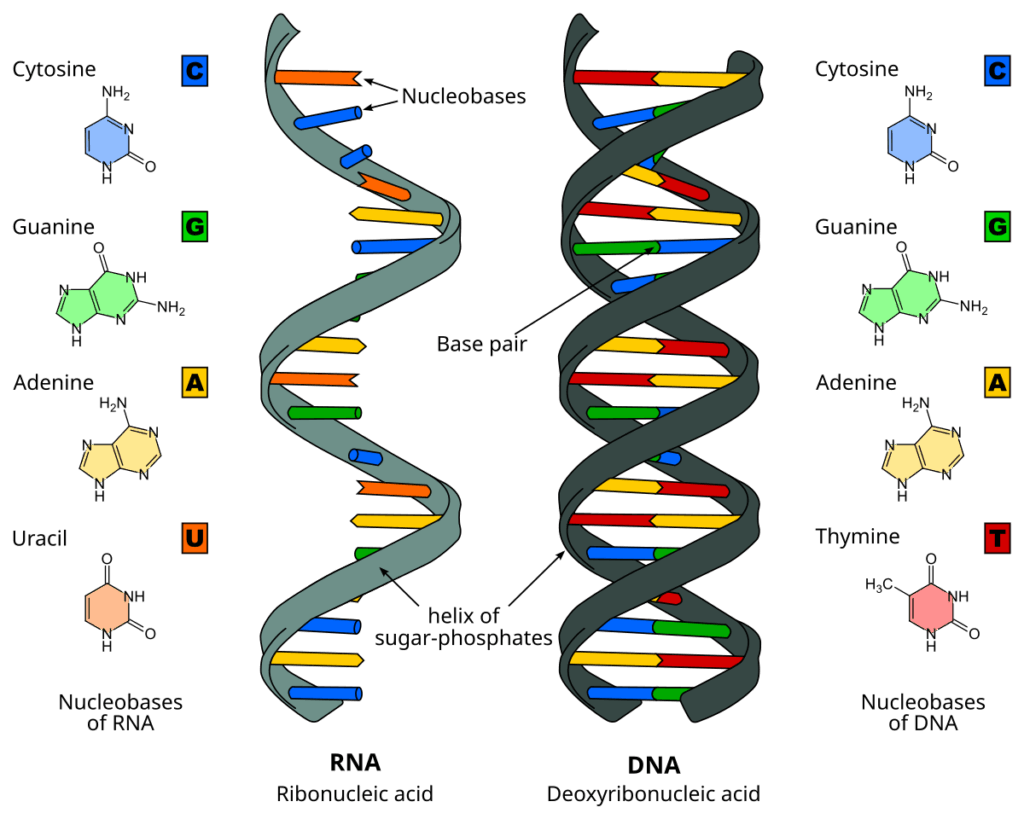
- DNA consists of two antiparallel strands forming a double helix.
- Strands are held together by hydrogen bonds between complementary bases.
- Adenine pairs with thymine (A–T) via two hydrogen bonds.
- Guanine pairs with cytosine (G–C) via three hydrogen bonds.
- The helical twist creates major and minor grooves where proteins can bind.
- DNA is always read and replicated in the 5′→3′ direction.
🌐 EE Focus: Explore how GC content affects DNA melting temperature in organisms adapted to extreme environments.
📝 Paper 2: Data Response Tip: If a diagram shows DNA, label the 5′ and 3′ ends, indicate hydrogen bonds, and state the number of bonds in each base pair for full marks.
📌 Structure of RNA
- RNA is usually single-stranded and shorter than DNA.
- Contains ribose sugar and uracil instead of thymine.
- Three main types: mRNA (codes for proteins), tRNA (transfers amino acids), and rRNA (structural component of ribosomes).
- Can fold into secondary structures due to internal base pairing.
- Less stable than DNA — suited for short-term genetic instructions.
- RNA can act as an enzyme (ribozymes) as well as an information carrier.
❤️ CAS Link: Create a school science workshop using models to show differences between DNA and RNA, highlighting their roles in cells.
📌 Nucleosomes and DNA Packaging
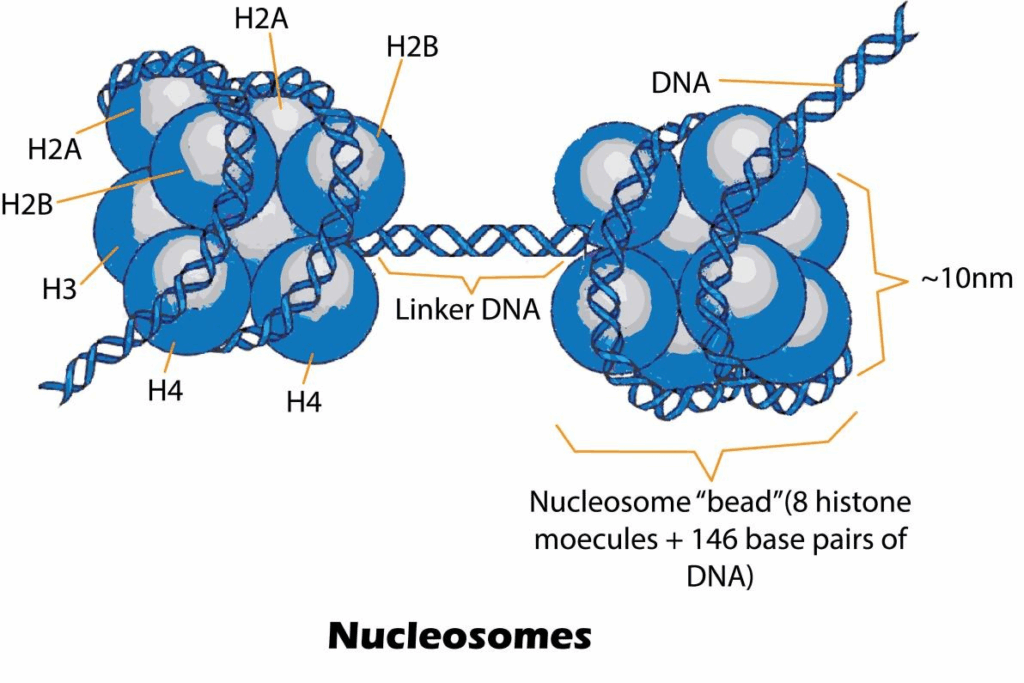
- In eukaryotes, DNA wraps around histone proteins to form nucleosomes.
- Each nucleosome contains eight histone subunits.
- Nucleosomes compact DNA so it fits inside the nucleus.
- They help regulate gene expression by controlling accessibility to DNA.
- DNA between nucleosomes is called linker DNA.
- Histone modifications can activate or silence genes.
🌍 Real-World Connection: Epigenetic research studies how histone modifications change gene expression, which is important in cancer and aging.
🔍 TOK Perspective: Models of DNA simplify its structure for understanding. To what extent does this simplification distort the reality of how DNA functions in the cell?