7.1 NATURAL RESOURCES USES AND MANAGEMENT
📌 Definitions Table
| Term | Definition |
|---|---|
| Reed Bed Buffer Zones | Wetland areas planted with reeds to filter runoff and reduce nutrient and pollutant flow into water bodies. |
| Cultural Heritage | The legacy of physical artifacts and intangible attributes of a group or society, often tied to natural landscapes or resources. |
| Saltwater Intrusion | The movement of seawater into freshwater aquifers due to groundwater depletion, contaminating freshwater supplies. |
| Resource Conflicts | Disputes arising from competition over access, control, or use of natural resources like water, land, or minerals. |
| Sustainable Development | Development that meets present needs without compromising the ability of future generations to meet their own needs. |
| GMOs (Genetically Modified Organisms) | Organisms whose DNA has been altered using genetic engineering to enhance desired traits like yield or pest resistance. |
| Subsidies | Financial support provided by governments to reduce the cost of producing goods, often used in agriculture or resource sectors. |
- 🧠 Exam Tips:
For sustainable development, always link to the three pillars (environmental, social, economic) when elaborating.
Use case studies or examples when asked to apply terms like GMOs, subsidies, or resource conflicts in context.
📌 Natural Capital & Natural Income
- Natural resources are the sources of energy and raw materials that society uses and consumes
- In other words, the term natural resources applies to anything that comes from nature that can be used to benefithumans
- Examples include:
- Sunlight is essential for photosynthesis, solar energy
- Air: oxygen for breathing, wind energy
- Water: drinking, irrigation, hydroelectric power
- Land: soils, agriculture, construction, habitat for wildlife
- Rocks: minerals, construction materials
- Ecosystems: forests, wetlands and coral reefs
- Living things: plants for food and medicine, animals for food and clothing
- In the environmental sciences, these resources are sometimes referred to as natural capital
- Examples include:
- Definition: natural capital is the stock of natural resources available on Earth
- Types of natural capital:
- Renewable resources are resources that can be replenished naturally
- Examples: forests (timber), fish populations
- Non-renewable resources are resources that are finite and cannot be replenished
- Examples: fossil fuels (coal, oil), minerals (gold, iron ore)
- Ecosystem services are the benefits provided by ecosystems that support human life and economic activity
- Examples: pollination of crops, water purification, carbon sequestration
- Renewable resources are resources that can be replenished naturally
What is natural income?
- Definition: natural income is the flow of goods and services produced by natural capital
- Examples of goods:
- Fish: harvested from oceans and rivers
- Timber: harvested from forests for building and paper products
- Examples of services:
- Climate regulation: forests reduce global warming by absorbing CO2
- Flood prevention: wetlands reducing flood risk by absorbing excess rainfall, or mangroves buffering against storm surges
- Examples of goods:
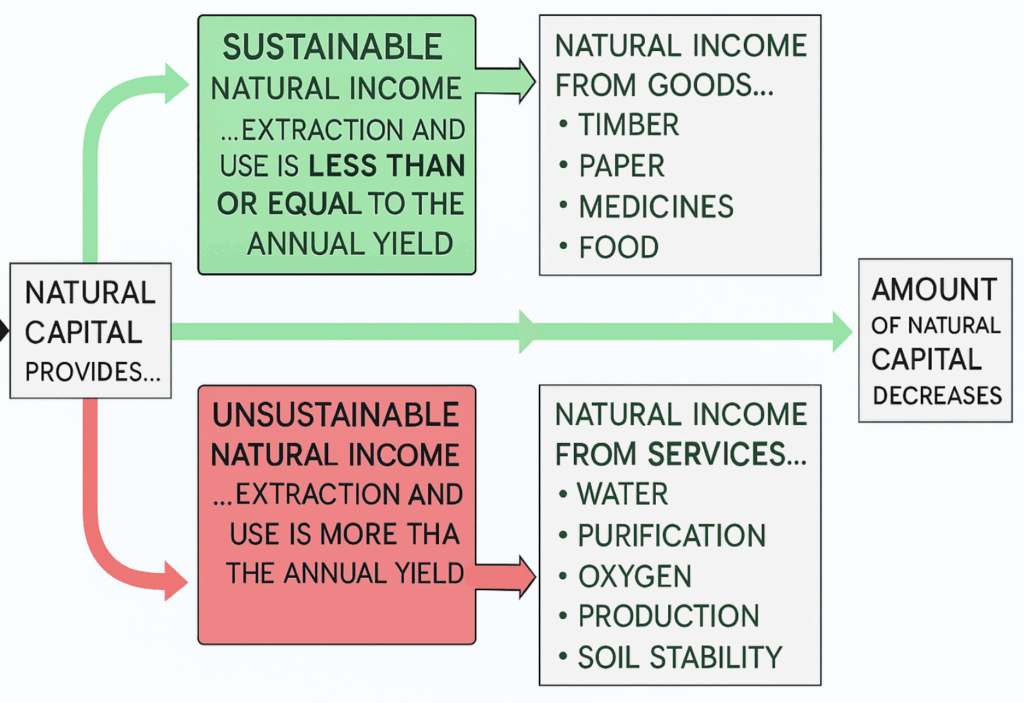
Sustainable natural income
- If these natural goods and services are carefully and sustainably managed, they can provide even more resources over time
- This is referred to as sustainable natural income
- For example:
- Trees are cut down for timber but forests are also re-planted or left to recover
- The rate of new tree growth is greater than the rate of timber production
- Timber production is a sustainable source of income that can be marketed and used to benefit humans
- In other words, natural income is the term used to describe the sustainable income produced by natural capital
- Again, using the timber production example:
- Our forests are the natural capital
- The sustainable timber we can obtain from these forests is our natural income
- Again, using the timber production example:
- Non-renewable resources, such as fossil fuels, can be used to generate wealth but can only be used once and cannot be sustainably managed
- Therefore, even if they can be considered as natural capital, non-renewable resources cannot produce sustainable natural income
Perspectives on nature
- Economic value:
- Viewing nature as natural capital highlights the economic value of resources
- Encourages investment in their preservation and sustainable use
- It helps policymakers and businesses recognise financial benefits of maintaining healthy ecosystems
- Sustainable management:
- Emphasising natural capital and natural income encourages sustainable management practices
- By valuing natural resources as capital, societies are more likely to invest in conservation efforts
- Ensures a continuous flow of natural resources, such as clean water, air and fertile soil
- Anthropocentrism:
- This perspective may imply that nature exists solely for human use and exploitation
- This is an extreme anthropocentric view
- It suggests that the environment’s primary purpose is to serve human needs and economic interests
- Leads to over-exploitation and degradation of natural resources
- This perspective may imply that nature exists solely for human use and exploitation
- Intrinsic value:
- Some argue that this anthropocentric view reduces nature’s intrinsic value
- I.e. it ignores the inherent worth of ecosystems and species beyond their use to humans
- Some argue that this anthropocentric view reduces nature’s intrinsic value
Ecosystem services
- Definition: benefits provided by ecosystems that support life and human well-being
- Ecosystem services usually fall into one of four main categories:
- Supporting services
- Regulating services
- Provisioning services
- Cultural services
| Ecosystem Service | Description | Examples |
|---|---|---|
| Supporting | Essential ecological processes for supporting life | Primary productivity (photosynthesis)Soil formationCycling of nutrients (e.g. carbon cycle, nitrogen cycle) |
| Regulating | A diverse set of services that shape and stabilise ecosystems | Climate regulationFlood regulationWater quality regulationAir quality regulationErosion controlDisease and pest control |
| Provisioning | The goods humans obtain from ecosystems | FoodFibresFuelFresh waterTimber |
| Cultural | These services derive from humans interacting with nature in a culturally beneficial way | Recreation and tourismEducationHealth benefitsSense of place, national identity and cultural heritageEmployment |
Examples of Regulating Ecosystem Services
| Ecosystem service | Description | Further information | Examples |
|---|---|---|---|
| Water replenishment | Natural process of replenishing water in aquifers, rivers and lakes | Provides clean drinking waterSupports agriculture and industry | Mountain watersheds—snowmelt and rainfall replenish rivers and groundwater, e.g. glacial meltwater |
| Flood and erosion protection | Ecosystems absorb excess rainfall and prevent soil erosion | Wetlands and floodplains reduce flood risksCoastal mangroves and vegetation protect against storm surges | Coastal Mangroves in Southeast Asia protect shorelines and support fisheriesForest tree root networks stabilise soil and prevent erosion on hillsides |
| Pollution mitigation | Ecosystems help remove pollutants from the environment | Improves water quality in rivers and lakes | Reed bed buffer zones filter water, removing inorganic nutrients and pollutantsWetlands e.g. saltmarshes, absorb pollution |
| Carbon sequestration | Process of capturing and storing atmospheric carbon dioxide | Forests and oceans act as carbon sinksReduces greenhouse gases, mitigating climate change | Tropical rainforests, e.g. Amazon rainforest is a major carbon sink, regulating global climateSeagrass meadows |
📌 The Value of Natural Capital
- Natural capital provides natural income in the form of goods (tangible products such as timber and crops) and services
- These goods and services have great value to human societies
- This value may be aesthetic, cultural, economic, environmental, health, intrinsic, social, spiritual, or technological
Natural Capital Value Types
| Value type | Description | Example |
|---|---|---|
| Aesthetic | Value from the beauty, visual appeal and enjoyment of natural landscapes and biodiversity | Appreciating a stunning sunset over a pristine beachEnjoying the vibrant colours of a diverse coral reef |
| Cultural | Value in shaping cultural practices, traditions and identities of communities | Indigenous communities relying on forests for their livelihoods and incorporating traditional ecological knowledge in their practices |
| Economic | Contribution to economic activities through provision of raw materials, fuels, food and other tangible products | Logging industry relying on forests for timber productionAgriculture relying on fertile soils for crop cultivation |
| Environmental | Provision of essential ecosystem services that support the health and functioning of ecosystems | Wetlands purifying water by filtering pollutantsForests sequestering carbon dioxide and mitigating climate change |
| Health | Supporting physical and mental health through clean air, water and natural spaces | Access to clean air and water and green spaces for exercise and relaxation contributes to overall health and well-being |
| Intrinsic | Inherent worth of natural capital, independent of its instrumental value to humans | Appreciating untouched wilderness as an essential and irreplaceable part of our planet |
| Social | Contribution to human well-being, including recreational spaces, opportunities for maintaining physical and mental health and fostering social cohesion | Parks, woodlands and beaches can provide spaces for people to connect with nature and strengthen social bonds |
| Spiritual | Spiritual significance and connection to nature, essential to some communities | Sacred mountains revered for their spiritual significanceOther natural places where people seek solace, reflection and spiritual experiences |
| Technological | Inspiration and utilisation of natural capital in technological advancements and innovations | Biomimicry, e.g. where the design of a building is inspired by the cooling properties of termite mounds, leading to energy-efficient architecture |
- This diverse range of values associated with natural capital highlights the importance of preserving and sustainably managing these resources
- This is for the benefit of both present and future generations
The dynamic nature of natural capital
- The concept of natural capital is highly dynamic
- This is because the value of natural capital can change regionally and over time
- Cultural factors can influence the value of certain natural resources
- E.g. cork forests in Portugal have been recognised as valuable natural capital due to their importance in the wine industry
- The cultural heritage associated with this is significant
- Social factors can influence value of natural capital
- E.g. in certain regions, uranium mining is seen as a threat to human health and the environment
- As a result, uranium may be regarded as negative or harmful natural capital
- Economicfactors play a significant role in determining the market value of natural capital
- E.g. lithium, which is essential for battery production in the rapidly growing electric vehicle industry, has seen increased market value and demand
- Environmentalfactors, such as the physical scarcity or abundance of a resource, can influence its value
- E.g. in areas with significant lithium deposits, such as the lithium triangle in South America, lithium has become highly valuable natural capital due to its critical role in batteries
- Initially valued for industrial use, coal is now facing scrutiny due to environmental impacts
- Technologicalfactors, such as advancements in technology, can influence the value of natural capital
- For example, flint was once an important resource used for hand tools
- It is now redundant, as it was replaced by the development of metal extraction from ores
- Politicalfactors, including regulations and policies, can change the market value of natural capital
- Governments can impose restrictions or incentives that affect the extraction and use of certain resources, e.g. limiting uranium mining due to environmental concerns
🔍 TOK Tip: How do ethical considerations affect the way we manage natural resources?
📌 Resource Sustainability
Renewable natural capital
- Renewable natural capital includes natural resources that can be replaced or regenerated at a rate equal to or faster than they are being used
- Living species and ecosystems:
- These include forests, wetlands, coral reefs and grasslands, which can regenerate through natural processes
- These systems are able to do this as they harness solar energy and use photosynthesis to convert it into biomass
- E.g. forests provide fuel wood for many communities and are harvested for timber
- They have the capacity to regenerate through seed dispersal and natural growth
- This allows new trees to replace the ones that have been harvested
- Wetlands play a vital role in maintaining water quality, regulating floods and providing habitat for diverse species
- They can self-sustain and regenerate, through natural processes like sedimentation and nutrient cycling
- They can even regenerate after disturbances such as droughts or human activities like mining or construction
- E.g. forests provide fuel wood for many communities and are harvested for timber
- Non-living systems:
- These include renewable resources such as groundwater and the ozone layer
- These can be replenished through natural processes
- E.g. groundwater is recharged by precipitation and infiltration
- This ensures that it can be sustainably used as a freshwater resource
- The ozone layer can also regenerate itself naturally
- This can occur if the emissions of ozone-depleting substances are significantly reduced
- This allows the stratospheric ozone concentration to recover over time
- E.g. groundwater is recharged by precipitation and infiltration
Non-renewable natural capital
- Non-renewable natural capital includes natural resources that cannot be replaced or regenerated at a rate equal to or faster than they are being used
- This is because these resources are either irreplaceable or can only be replenished over geological timescales (i.e. extremely long periods of time)
- Fossil fuels:
- Coal, oil and natural gas are finite resources formed over millions of years from the remains of plants and animals
- Once extracted and burned for energy production, they cannot be replaced within human timescales
- Although not a fossil fuel, uranium, used in nuclear power plants, is also considered as non-renewable natural capital
- Uranium reserves are also not replenishable within human timescales
- Coal, oil and natural gas are finite resources formed over millions of years from the remains of plants and animals
- Soil:
- Soil is a renewable resource to some extent
- However, it can become non-renewable when it is degraded or eroded at a faster rate than it can be naturally replenished
- Unsustainable agricultural practices, such as excessive tilling and deforestation, can lead to soil erosion and depletion
- Urbanisation and construction activities can result in the permanent loss of fertile soil
- This effectively removes its ability to regenerate in these areas
- Minerals:
- These include various elements and metals extracted from the Earth’s crust
- These are finite and cannot be replenished within human timescales
- Rare-earth minerals used in electronics, e.g. lithium, have finite reserves
- Precious metals, e.g. gold and silver, will have to be recycled or obtained from existing stockpiles once natural reserves have been completely extracted
Sustainable and unsustainable use of natural capital
- It is crucial to manage and use renewable natural capital sustainably to ensure its long-term availability
Sustainable use of renewable natural capital
- Forest management:
- Implementing sustainable forestry practices, e.g. selective logging, reforestation and maintaining biodiversity
- This preserves the integrity of forest ecosystems
- This ensures continued provision of timber, non-timber forest products and ecosystem services
- Fisheries management:
- Strategies can help maintain fish populations at sustainable levels
- This allows for continued fishing activities and the preservation of marine biodiversity
- These include:
- Setting catch limits
- Implementing seasonal fishing restrictions
- Establishing marine protected areas
- Renewable energy:
- Harnessing renewable energy sources such as solar, wind and hydroelectric power
- This helps reduce reliance on fossil fuels and minimises environmental impacts, providing a sustainable energy alternative
Unsustainable use of renewable natural capital
- Deforestation:
- Examples of unsustainable use include:
- Unsustainable logging practices
- Large-scale conversion of forests for agriculture or infrastructure development
- Clearing forests at a rate faster than their regeneration can contribute to:
- Habitat loss
- Soil erosion and desertification
- Climate change
- Examples of unsustainable use include:
- Overfishing:
- Excessive fishing beyond the natural reproduction rate of fish populations can:
- Depleted fish stocks
- Disrupt marine ecosystems
- Impact the livelihoods of fishing communities
- Excessive fishing beyond the natural reproduction rate of fish populations can:
- Water extraction:
- Excessive withdrawal of groundwater from aquifers can result in:
- Freshwater depletion
- Saltwater intrusion
- Long-term water scarcity
- When water is used beyond its natural replenishment rate, it becomes unsustainable
- Excessive withdrawal of groundwater from aquifers can result in:
📌 Resource Security and Choices
- Resource security is the ability of societies to ensure long-term availability of sufficient natural resources to meet demand
- Key natural resources include water, food, energy and raw materials
Importance of resource security
- Ensures stable supply to meet current and future needs
- Prevents resource conflicts
- Supports sustainable development
Case Study
Resource security in contrasting societies
Example 1: Food security in the United States
- The US is a high-income country with advanced agricultural technology
- Factors contributing to food security:
- Economic: high investment in agricultural research and development
- Technological: use of GMOs and advanced irrigation systems
- Political: government subsidies and support for farmers
- Environmental: diverse climate allows a variety of crops
Example 2: Water security in Ethiopia
- Ethiopia is a low-income country with challenges in water accessibility
- Factors affecting water security:
- Economic: limited funds for water infrastructure
- Geographical: arid regions with irregular rainfall
- Political: dependency on upstream countries for water sources
- Technological: lack of advanced water purification and distribution systems
Factors affecting resource choices
- Various factors influence how societies choose to use natural resources
- These factors include economic, sociocultural, political, environmental, geographical, technological and historical considerations
- Economic factors:
- Cost and availability: resources that are cheaper and readily available are preferred
- Market demand: high demand for certain resources drives their usage
- Sociocultural factors:
- Cultural preferences: traditional foods and materials influence resource choices
- Population growth: increased population raises resource demand
- Political factors:
- Government policies: regulations and subsidies affect resource use
- International relations: trade agreements and conflicts influence resource access
- Environmental factors:
- Sustainability: focus on using resources that do not harm the environment
- Climate change: affects the availability and viability of certain resources
- Geographical factors:
- Resource distribution: proximity to natural resources affects their use
- Natural disasters: areas with more frequent disasters may have limited resource choices
- Technological factors:
- Innovation: advances in technology can create new resources, enable resource extraction or improve resource use efficiency
- Infrastructure: availability of technology and infrastructure influences resource use
- Historical factors:
- Historical usage: long-term use of certain resources can establish dependency
- Colonial history: past exploitation can affect current resource availability and control
Impact of international agreements on resource choices
- International agreements, like the Paris Agreement, aim to reduce greenhouse gas (GHG) emissions
- Different countries have set varied dates for achieving carbon neutrality (also know as net zero)
- These targets are crucial for meeting global climate goals
- They influence the resource choices of countries
- Net zero emissions goals:
- Encourage use of renewable energy over fossil fuels
- Promote sustainable agricultural practices to reduce carbon footprint
- Influence local and national policies to align with global sustainability targets