4.3 AQUATIC FOOD PRODUCTION SYSTEMS
📌 Definitions Table
| Term | Definition |
|---|---|
| Autotrophic | Describes organisms that produce their own food from inorganic substances using energy from light or chemicals. |
| Prokaryotic | Organisms, like bacteria, that lack a membrane-bound nucleus and organelles. |
| Sediment Pollution | Water pollution caused by excessive soil or mineral particles entering water bodies, reducing water quality and harming aquatic life. |
| Ghost Nets | Abandoned or lost fishing nets that continue to trap marine organisms, causing ecological harm. |
| Moratorium | A temporary ban or suspension of an activity, such as commercial fishing, to allow resource recovery. |
| Fishing Quotas | Legally set limits on the amount or number of fish species that can be caught to promote sustainable fisheries. |
| Bycatch | Non-target species unintentionally caught during commercial fishing operations. |
| Leach | The process by which soluble substances are washed out of soil or waste into water bodies, potentially causing contamination. |
| Eutrophication | Nutrient enrichment of water bodies leading to excessive algal growth, oxygen depletion, and ecosystem degradation. |
| Biocides | Chemical substances that kill or control harmful organisms, often used in agriculture or aquaculture. |
| Biosecurity | Measures taken to protect ecosystems from invasive species, diseases, or biological threats. |
| Biorights | Ethical principle that all forms of life have the right to exist and be protected, regardless of their utility to humans. |
- 🧠 Exam Tips:
When defining pollution or environmental damage terms, include impact on ecosystems or biodiversity for a complete answer.
Terms like bycatch, quotas, moratorium often appear in fisheries case study questions—link to sustainability when possible.
📌 Aquatic Food Webs
- Aquatic food webs show how energy and nutrients move through freshwater and marine ecosystems
Phytoplankton
- Phytoplankton are microscopic organisms found in marine and fresh water bodies that can perform photosynthesis
- Phytoplankton are not plants
- They include a variety of autotrophic microorganisms, such as:
- Algae (e.g. diatoms)
- Cyanobacteria (prokaryotic organisms that are also known as blue-green algae)
- Role in food webs:
- They form the base of most aquatic food webs
- They capture solar energy and convert it into biomass through photosynthesis
- They are consumed by primary consumers (zooplankton and small fish)
- They contribute to oxygen production and nutrient cycling
Macrophytes
- Macrophytes are aquatic plants that are visible to the naked eye
- They can be:
- Emergent: plants that grow above the water surface (e.g. cattails or bulrushes)
- Submerged: plants that grow completely underwater (e.g. seagrass)
- Floating: plants that float on the water surface (e.g. water lilies or duckweed)
- Role in food webs:
- They provide habitat and food for various aquatic organisms
- They capture solar energy and convert it into biomass through photosynthesis
- They contribute to oxygen production and nutrient cycling
Energy flow in aquatic food webs
- Producers: phytoplankton and macrophytes capture energy from sunlight through photosynthesis
- Primary consumers: zooplankton, small fish and some invertebrates and birds feed on primary producers
- Secondary consumers: larger fish and birds consume primary consumers
- Tertiary consumers: top predators like sharks and birds of prey eat secondary consumers
- Decomposers: aquatic bacteria and fungi break down dead organisms, recycling nutrients back into the ecosystem
📌 Human Consumption and Increasing Demand
- Humans consume a variety of organisms (flora and fauna) from both freshwater and marine environments
- These organisms provide essential nutrients and form a significant part of many cultures’ diets
- Consumption patterns vary locally and globally
- This reflects availability, tradition and sustainability concerns
Examples of aquatic food resources
Local and Global Examples of Aquatic Flora and Fauna Consumed by Humans
| Organism | Type of organism | Type of aquatic environment | How widely consumed | Description |
|---|---|---|---|---|
| Watercress | Flora | Freshwater | Local | Leafy green plantPopular in the UKGrown in shallow, flowing water beds fed by natural springs or streamsUsed in salads and soups |
| Spirulina | Flora | Freshwater | Global | Blue-green algae (cyanobacteria)Consumed worldwideGrown in freshwater ponds and lakesHarvested by filtering the water and then drying the algaeUsed as a dietary supplement |
| Dulse | Flora | Marine | Local | Type of red seaweedTraditionally eaten in IrelandHand-harvested from rocks during low tide along the coastlineDried in the sun or indoorsConsumed dried or cooked |
| Nori | Flora | Marine | Global | Type of red seaweedPopular globally, especially in JapanFarmed in coastal waters on nets suspended from bamboo poles or floating raftsHarvested, then dried and processed into sheetsUsed in sushi and snacks |
| Trout | Fauna | Freshwater | Local | Freshwater fishCommonly consumed in the UKRaised in freshwater ponds or tanks with controlled water qualityHarvested by netting when they reach market size |
| Tilapia | Fauna | Freshwater | Global | Freshwater fishConsumed worldwideRaised in freshwater ponds or recirculating aquaculture systemsHarvested by draining the ponds or using nets |
| Orkney Scallops | Fauna | Marine | Local | Type of shellfishA delicacy in Scotland, UKCollected by divers from the seabed around the Orkney Islands (ensures minimal environmental impact) |
| Shrimp | Fauna | Marine | Global | Small crustaceanFound in oceans worldwide and consumed globallyRaised in coastal ponds or tanksHarvested by draining the ponds and collecting the shrimp with nets |
Demand for aquatic food resources
- The demand for aquatic food resources has significantly increased in over the last 50–100 years
- This is due to the combined effects of a growing human population and dietary changes
- As populations expand and economies develop, there is a higher demand for seafood products to meet nutritional needs and culinary preferences
- The main factors behind the increase in demand for aquatic food resources are:
- Growing human population
- The global population has rapidly increased, resulting in a larger consumer base for aquatic food resources
- Changing dietary patterns
- As countries undergo economic growth, there is often a shift in dietary patterns towards increased consumption of protein-rich foods, including seafood
- Nutritional benefits of seafood
- Seafood is recognised as a valuable source of essential nutrients, such as omega-3 fatty acids, vitamins and minerals
- These all contribute to human health and well-being
- Urbanisation and the rising middle class
- Urbanisation and the emergence of a middle class in many regions have led to changes in dietary preferences
- This has increased demand for diverse and higher-value food options, including seafood
- Global trade and supply chains
- Advances in transportation and the expansion of global trade networks have made it easier to import and export seafood products
- This has increased their availability to communities
- Aquaculture production
- Aquaculture, the farming of aquatic organisms, has experienced significant growth to meet the rising demand for seafood
📌 Unsustainable Harvesting Practices & Overexploitation
Unsustainable harvesting practices
- The rising global demand for seafood has led to the use of unsustainable harvesting practices
- These methods often damage marine ecosystems and lead to overexploitation of fish stocks
- Bottom trawling:
- This method involves dragging heavy nets along the seabed
- Impacts:
- Destroys habitats such as coral reefs
- Results in significant bycatch (catching non-target species)
- Disturbs sediment, causing sediment pollution and releasing other trapped pollutants
- Ghost fishing:
- This occurs when abandoned or lost fishing gear continues to catch marine life
- E.g. ghost nets
- Impacts:
- Continues to catch fish and other marine animals, leading to unnecessary deaths
- Causes entanglement of marine organisms, including endangered species
- Contributes to marine debris and pollution
- This occurs when abandoned or lost fishing gear continues to catch marine life
- Use of poisons:
- Some fishermen use poisons and toxic substances, such as cyanide, to stun or kill fish, making them easier to catch
- Impacts:
- Poisons kill or damage a wide range of marine life
- Cyanide kills coral polyps and other organisms that form the coral reef structure, leading to reef degradation and overall loss of biodiversity
- This method is highly unsustainable and illegal in many places
- Use of explosives:
- Some fishermen use explosives, such as dynamite, to stun or kill fish, making them easier to catch
- Impacts:
- Explosives destroy marine habitats and kill indiscriminately (kill non-target species)
- Causes extensive damage to coral reefs and other important marine habitats
- This method is also highly unsustainable and illegal in many places
Overexploitation
- Developments in fishing equipment and increased use of unsustainable fishing methods have led to declining fish stocks and damage to habitats
- Fish stocks in the oceans are rapidly decreasing in size
- This is mainly due to overfishing
- Overexploitation happens when fish are harvested at a rate faster than they can reproduce
- This can eventually lead to the collapse of fisheries, where the fish population drops so low that it cannot recover
Maximum sustainable yield
- The annual yield for a natural resource (such as a forest) is the annual gain in biomass or energy,through growth
- The maximum sustainable yield (MSY) is the maximum amount of a renewable natural resource that can be harvested annually without compromising the long-term productivity of the resource
- It is the level of harvest that can be maintained indefinitely
- The concept of maximum sustainable yield applies to various resources, such as crops, fish, timber, and game animals
- For example, in fisheries, the concept of maximum sustainable yield is used to determine the maximum amount of fish that can be harvested sustainably from a given population
- This is calculated based on the population size, growth rate and reproduction rate
- If the fishing rate exceeds the maximum sustainable yield, the population may decline, and the long-term productivity of the fishery may be affected
- In summary, the maximum sustainable yield is the highest possible annual catch that can be sustained over time without depleting the fish stock
- Calculating the maximum sustainable yield is important as it helps in setting appropriate limits on fishing quotas to ensure sustainable fishing practices
📌 Mitigation Strategies
- Unsustainable exploitation of aquatic systems can be mitigated at a variety of levels (international, national, local and individual)
- This can be achieved through policy, legislation and changes in consumer behaviour
- For example, control of net size and the introduction of fishing quotas play important roles in the conservation of fish stocks
- Strategies like these can keep fish stocks at a sustainable level
- This can be achieved through policy, legislation and changes in consumer behaviour
International and national level actions
- Increasing the size of gaps in fishing nets can help in two main ways:
- Fewer unwanted species (that are often discarded) will be caught and killed
- This is because they can escape through larger net gaps (as long as they are smaller than the species being caught)
- The accidental capture and killing of larger, unwanted species is still a problem
- Juvenile fish of the fish species being caught can escape through larger net gaps
- This means they can reach breeding age and have offspring before they are caught and killed
- This ensures the population of the fish species being caught can be replenished
- Fewer unwanted species (that are often discarded) will be caught and killed
- Fishing quotas limit the number and size of particular fish species that can be caught in a given area
- Many nations have introduced quotas to prevent overfishing of certain species
- There are several ways to enforce governmental regulations:
- Establishing fishing quotasAgreeing zones or areas of the ocean where fishing is banned (e.g. spawning grounds) and permitted (e.g. within a country’s territorial waters)Agreeing specific times of the year when fishing is not allowed to let fish populations recover (e.g. spawning season)Regulating mesh size of nets (to allow undersized/juvenile fish to escape)Limiting the size of the fishing fleet by issuing licences and permitsInspecting the catch as a fishing boat returns to portBanning certain practices, e.g. gillnets (static nets that catch anything that swims past),Promoting sustainable practices such as trolling (different to trawling) that reduce bycatch
- Sustainable seafood choices:
- Encouraging consumers to buy seafood that is certified as sustainable
- For example, the Marine Stewardship Council (MSC) label indicates sustainably sourced seafood
- Encouraging consumers to buy seafood that is certified as sustainable
- Food labelling:
- Providing clear information on the origin and sustainability of seafood products to help consumers make informed choices
- For example, the UK’s “Blue Fish” label signifies fish caught using sustainable practices
- Providing clear information on the origin and sustainability of seafood products to help consumers make informed choices
- Community initiatives:
- Educating the public about the importance of sustainable fishing and responsible seafood consumption
- Supporting local fishing communities that practice sustainable fishing
- Participating in local conservation efforts
- Involving local communities in managing and protecting their own fisheries
- For example, in the Philippines, community-based coastal resource management has successfully increased fish stocks and biodiversity
Marine protected areas
- Marine protected areas (MPAs) are designated regions of seas and oceans where human activities are restricted or managed
- This is to protect marine ecosystems and biodiversity
- MPAs play a crucial role in supporting aquatic food chains and maintaining sustainable yields
- They do this by providing safe areas for marine life
Benefits of marine protected areas
Biodiversity conservation
- Habitat protection:
- MPAs protect critical habitats like coral reefs, seagrass beds and mangroves
- For example, the Great Barrier Reef Marine Park protects one of the most biodiverse ecosystems on the planet
- MPAs protect critical habitats like coral reefs, seagrass beds and mangroves
- Species protection:
- MPAs protect endangered and vulnerable species by reducing human-induced pressures such as fishing and pollution
- For example, the Galápagos Marine Reserve protects unique species found nowhere else in the world
- It does this by imposing fishing restrictions and carefully managing tourism
- MPAs protect endangered and vulnerable species by reducing human-induced pressures such as fishing and pollution
Support for aquatic food chains
- Spawning and nursery grounds:
- MPAs provide safe areas for fish and other marine organisms to reproduce and for juveniles to grow
- Feeding grounds:
- By protecting areas rich in food sources, MPAs ensure that marine species have access to enough food
Spillover effect
- Population growth beyond MPA boundaries:
- Healthy and abundant populations within MPAs can migrate to nearby areas
- This replenishes fish stocks and benefits fisheries outside the protected zones
- Genetic diversity:
- MPAs maintain genetic diversity by protecting breeding populations
- This contributes to the resilience of marine species
- For example, the Chagos Marine Reserve in the Indian Ocean supports genetically diverse populations of fish and coral
Sustainable yields
- Fisheries management:
- MPAs can help maintain sustainable fishery yields by preventing overfishing and allowing fish populations to recover
- Sustainable fish populations lead to more stable and long-term economic benefits for fishing communities
📌 Aquaculture
What is aquaculture?
- Aquaculture, also known as fish farming or aquafarming, refers to the cultivation of aquatic organisms in controlled environments such as ponds, tanks, or ocean enclosures
- It involves the rearing, breeding, and harvesting of various species of fish, shellfish, algae and other aquatic organisms for commercial, recreational, or conservation purposes
- Aquatic flora and fauna, both freshwater and marine, are harvested by humans through various methods to meet different needs and purposes
- Aquatic organisms that are farmed include:
- Fish
- e.g. salmon, tilapia and catfish
- Molluscs
- e.g. oysters, mussels, scallops and clams
- e.g. snails
- e.g. octopus and squid
- Crustaceans
- e.g. shrimp, prawns, lobsters and crabs
- Aquatic plants
- E.g. seaweed and algae
- Fish
The growth of aquaculture
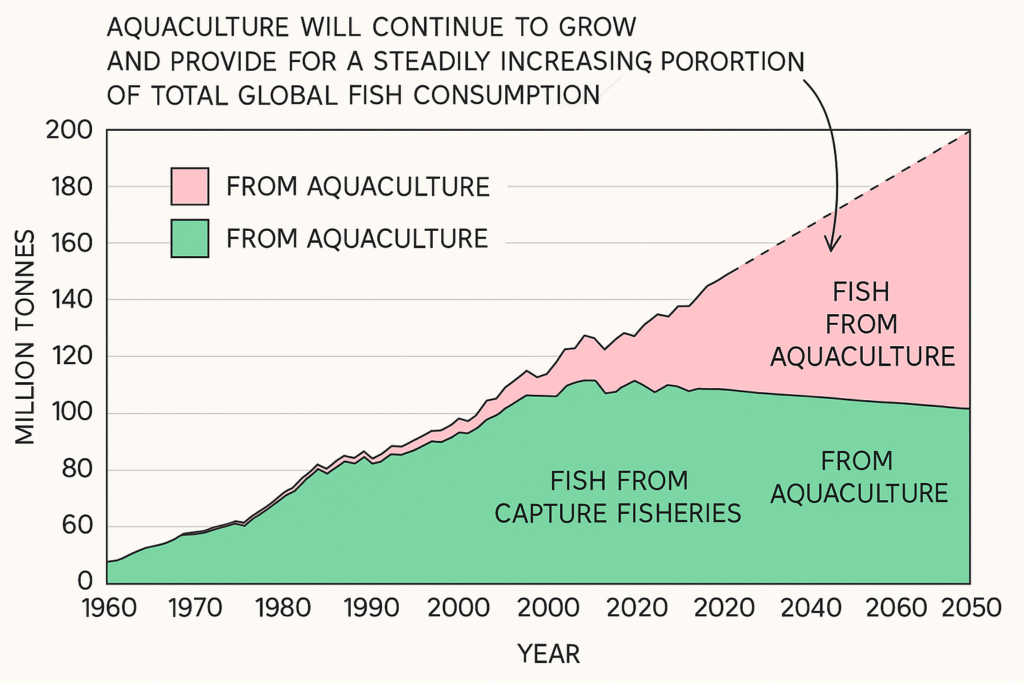
- Aquaculture has experienced significant growth to meet the increasing global demand for seafood
- This is driven by population growth, changing dietary preferences and rising incomes
- Aquaculture has the potential to provide a reliable and sustainable source of seafood
- This can help to meet the protein needs of a growing population
- At the same time, minimise the impact on wild fish stocks
- By cultivating aquatic organisms through aquaculture, the pressure on wild fish populations can be reduced
- This allows them to recover and the ecological balance of these marine ecosystems to be restored
1. Providing additional food resources:
- Aquaculture contributes to global food security by providing an additional source of nutritious food resources
- Cultivating fish and shellfish through aquaculture offers a consistent supply of protein-rich seafood
- This can help address nutritional deficiencies and improve human health in many parts of the world
- The controlled environments of aquaculture systems allow for efficient production and reduced waste
2. Supporting economic development:
- Aquaculture has emerged as a significant sector in the global economy
- It generates employment opportunities, income and economic growth
- It provides livelihoods for millions of people, particularly in coastal and rural communities, where fishing and aquaculture activities are integral to the local economy
- Aquaculture encourages trade and investments, contributing to the overall development and prosperity of regions and whole countries
Food for future generations
- The growth of aquaculture is expected to continue in the coming years due to several factors:
- Rising global demand for seafood: the growing population, urbanisation and changing dietary preferences drive the need for increased seafood production
- Technological advancements: ongoing research and technological developments in aquaculture practices, breeding techniques, feed formulations and disease management are enhancing production efficiency and sustainability
- Environmental considerations: aquaculture is evolving towards more environmentally friendly and sustainable practices, addressing concerns such as waste management and habitat impacts
- Innovation and diversification: the development of new species for aquaculture, such as high-value fish and seaweed, opens up opportunities for market expansion
- Policy support: governments and international organisations are promoting and investing in aquaculture development to address food security, reduce pressure on wild fish stocks and support economic growth
Aquaculture issues
- Issues caused by aquaculture include:
- Habitat loss
- Pollution (with feed, antifouling agents, antibiotics and other medicines added to fish pens)
- Spread of diseases
- Escaped species (sometimes involving genetically modified organisms)
- Ethical Issues and biorights
Issues in Aquaculture
| Issue | Description |
|---|---|
| Habitat loss | Aquaculture facilities often require the conversion of natural habitats such as wetlands, mangroves, or coastal areas into fish farmsThese habitats are cleared or modified to create suitable spaces for aquaculture operationsThis habitat loss can have negative impacts on biodiversity, ecosystem functions and the livelihood of local communities |
| Pollution | Excess nutrients from uneaten feed and fish waste can leach into the surrounding water bodies, leading to eutrophication, algal blooms and oxygen depletionSome feed formulations may contain additives, such as growth enhancers or colourants, that can potentially negatively impact water qualityPowerful chemicals known as antifouling agents are used to prevent the growth of marine organisms (e.g. mussels and barnacles) on aquaculture infrastructureThese biocides can leach into the surrounding water, potentially causing harm to marine lifeTo prevent and treat diseases, aquaculture operations may use antibiotics and other medicines, which can enter the surrounding waters, posing risks to aquatic organisms and contributing to antibiotic resistance |
| Spread of diseases | The high density of fish in aquaculture facilities facilitates the spread of diseases among farmed fishThis leads to increased disease risks and the need for disease management strategiesIf proper biosecurity measures are not in place, pathogens can also spread from aquaculture facilities to wild fish populations, impacting their health and survival |
| Escaped species | Escape of farmed fish from aquaculture facilities can lead to genetic interactions with wild populationsThis impacts wild species through competition, interbreeding, or transmission of genetic diseasesSome aquaculture operations involve the use of genetically modified fishThis raises concerns about potential ecological impacts and ethical considerations if these fish breed with wild populations |
| Ethical Issues and biorights | Aquaculture raises ethical questions regarding the treatment and welfare of farmed animals, particularly in intensive farming systemsConcerns centre around the confinement and stress experienced by farmed species, the use of antibiotics and growth enhancers, and the overall quality of life for the animals |
- In addition, issues in aquaculture can often arise regarding international conservation legislation
- Aquaculture must comply with international conservation legislation and regulations to ensure the sustainable use of resources and to protect biodiversity
- Compliance with these regulations helps prevent the exploitation of threatened species, maintain ecological balance and ensure the long-term viability of aquaculture practices
- Balancing environmental sustainability, animal welfare and legal obligations is crucial to maintaining an equitable and socially responsible aquaculture sector
📌 Climate Change & Ocean Acidification
- Climate change refers to significant changes in global temperatures and weather patterns over time
- Mostly driven by human activities such as burning fossil fuels, deforestation and industrial processes
- Leads to global warming, which is an increase in Earth’s average surface temperature
What is ocean acidification?
- Ocean acidification is the ongoing decrease in the pH of Earth’s oceans
- Caused by absorption of excess carbon dioxide (CO2) from the atmosphere
- When CO2 dissolves in seawater, it forms carbonic acid, which lowers the pH
Impacts on ecosystems
Climate change effects
- Temperature rise:
- Warmer waters can alter habitat ranges for marine species
- For example, many fish populations are migrating to cooler waters, impacting local fishing industries
- Warmer waters can alter habitat ranges for marine species
- Melting ice caps:
- Polar ice is important for the survival of many species
- For example, the loss of important ice habitats will affect polar bears and seals that need them for hunting, avoiding predators and raising offspring
- Walruses are increasingly forced to rest on land, leading to overcrowding and increased mortality
- Leads to sea level rise, threatening coastal ecosystems
- For example, rising sea levels are threatening the coastal mangrove forests in Bangladesh, which serve as crucial habitats for many species and protect the coastline from erosion
- Polar ice is important for the survival of many species
- Hurricane damage:
- Increased intensity and frequency of hurricanes is damaging coral reefs (e.g. in the Caribbean)
- For example, hurricane Irma in 2017 caused widespread coral destruction, particularly affecting the coral reefs around the Florida Keys and the Virgin Islands
- Increased intensity and frequency of hurricanes is damaging coral reefs (e.g. in the Caribbean)
Ocean acidification effects
- Coral bleaching:
- Warmer temperatures and acidification cause coral to expel the algae that live in their tissues
- This causes the coral to turn white (known as bleaching)
- This often leads to coral death if the stressful conditions persist
- For example, the Great Barrier Reef is currently experiencing massive coral bleaching events
- Shellfish vulnerability:
- Acidic waters weaken calcium carbonate shells of marine organisms like oysters, clams, and sea urchins
- This makes them more vulnerable to predation, disease and environmental stress,
- This can lead to population declines and disruption of marine food webs
- For example, oyster populations in the Pacific Northwest (USA) are in decline partly due to ocean acidification
- Oyster farms here are struggling with reduced harvests due to shell degradation