5.2 AGRICULTURE AND FOOD
📌 Definitions Table
| Term | Definition (Exam-Ready, 2 Marks) |
|---|---|
| Finite Resource | A natural resource that exists in limited quantity and cannot be replenished within a human timescale (e.g., fossil fuels). |
| Caste | A rigid social stratification system that can affect access to land, resources, and food security in some societies. |
| Vertical Farms | Multi-layered indoor farming systems using controlled environments to grow crops, often in urban settings. |
| Pastures | Grazing lands covered with grass or similar vegetation, used primarily for feeding livestock. |
| Soil Erosion | The removal of topsoil by wind, water, or human activity, reducing soil fertility and structure. |
| Toxification | The accumulation of harmful substances, such as pesticides or heavy metals, in soil or ecosystems. |
| Salinisation | The build-up of salts in soil, often due to irrigation, which can reduce soil fertility and crop yield. |
| Desertification | The degradation of land in arid areas, turning productive land into desert due to climatic or human factors. |
| Infiltration | The process by which water enters the soil surface and moves downward into the ground. |
| Surpluses | Quantities of agricultural or resource outputs that exceed the immediate demand or consumption. |
| Ruminants | Herbivorous mammals (e.g., cows, sheep) that digest plant matter in a specialized stomach via fermentation. |
| Social Safety Nets | Public or community-based programs that provide support (e.g., food, income) during times of economic or environmental stress. |
| Resource Depletion | The exhaustion of natural resources due to overuse, exceeding their natural regeneration rate. |
- 🧠 Exam Tips:
For degradation terms (e.g., salinisation, toxification), mention impact on soil health or productivity.
Link finite resource and resource depletion to sustainability for stronger evaluation.
📌 Land Use and Agricultural Systems
Land as a finite resource
- Land is limited and cannot be expanded (i.e. it is a finite resource)
- Efficient land use is crucial to meeting growing food requirements
- About 70% of ice-free land is used for agriculture and forestry
- Agricultural land is used to grow crops (arable) and raise livestock
- As the human population grows, the demand for food increases
- This puts pressure on available land for food production
- Urbanisation leads to the conversion of agricultural land into urban areas
- This further reduces the availability of land for food production per capita
Agricultural land use
- Not all land is suitable for crop production
- land must be fertile, flat, and have adequate water supply
- Unsuitable land for crops:
- Steep slopes:
- Risk of erosion
- It is difficult to use machinery
- Nutrient-poor soils:
- Cannot support crop growth without significant fertilisation
- Steep slopes:
- These lands are often used for livestock production instead
- For example, in the UK, hilly areas like Eryri (Snowdonia, Wales) and the Scottish Highlands are used for sheep grazing due to unsuitable conditions for arable farming
Vulnerability of marginalised groups
- Marginalised groups:
- These include:
- Indigenous peoples
- Low socio-economic status groups
- Women farmers
- People in low-income countries
- Often have limited access to land and resources
- These include:
- Impact of land-use decisions:
- Land-use policies can increase inequalities
- Marginalised groups are more vulnerable to changes and restrictions
- For example, in India, many Dalits (members of a lower caste) face significant barriers to land ownership and agricultural resources
- This is limiting their ability to improve their economic status and sustain their livelihoods
- Indigenous peoples:
- Indigenous groups often depend on land for their livelihoods
- Indigenous land rights are often ignored in favour of large-scale agricultural projects
- For example, the Maasai in Kenya and Tanzania have faced land encroachment
- This is due to expanding agriculture and tourism projects
- This is threatening their traditional way of life
Other examples of land-use impacts on marginalised groups
- Deforestation in the Amazon:
- Driven by agricultural expansion
- It affects Indigenous tribes like the Yanomami
- Leads to loss of biodiversity and traditional lands
- Land grabs in Africa:
- Foreign investors acquire large areas of land for industrial-scale agriculture
- Displaces local farmers and communities
- Impacts their food security
- Urban sprawl in China:
- Rapid urbanisation consumes agricultural land
- Affects rural communities’ access to arable land
Variability in agricultural systems
- Global variation:
- Agriculture systems vary globally due to differences in soil and climate
- Soils in different biomes support different crop types and productivity levels
- Soil and climate influence:
- Tropical soils may be nutrient-poor, affecting crop choices
- This limits the types of crops that can be grown successfully without heavy fertilisation
- For example, in Brazil, nutrient-poor tropical soils require heavy fertilisation for crops like soybeans
- Temperate climates with fertile soils can support diverse crops
- For example, in the UK, temperate climates support a variety of crops like wheat and barley
- Tropical soils may be nutrient-poor, affecting crop choices
Classification of agricultural systems
- Agricultural systems can be classified in a number of ways, including:
- Outputs from the farm system:
- Arable farming: growing crops (e.g., wheat, rice)
- Pastoral/livestock farming: raising animals (e.g., cattle, sheep)
- Mixed farming: combining crops and livestock
- Monoculture: growing a single type of crop
- Diverse farming: growing multiple types of crops
- Reasons for farming:
- Commercial farming: producing food for sale
- Subsistence farming: producing food for the farmer’s own use
- Sedentary farming: farmers stay in one place
- Nomadic farming: farmers move with their livestock
- Types of inputs required:
- Intensive farming:
- High inputs of labour, capital and technology
- E.g. dairy farming in the Netherlands
- Extensive farming:
- Low input per unit area
- E.g. sheep farming in Australia
- Irrigated farming:
- Requires artificial water supply
- E.g. Central Valley, California: large-scale irrigation systems support the cultivation of crops such as almonds, grapes and tomatoes in this semi-arid region
- Rain-fed farming:
- Relies on natural rainfall
- E.g. wheat farming in Canada
- Soil-based farming:
- Traditional farming in soil
- E.g. vegetable farms in the UK
- Hydroponic farming:
- Growing plants without soil, using nutrient solutions
- E.g. hydroponic lettuce farms or vertical farms in urban areas
- Organic farming:
- Avoids synthetic chemicals
- E.g. organic tea plantations in India: many use natural fertilisers, compost and biological pest control methods to maintain soil fertility and produce high-quality tea without synthetic pesticides or herbicides
- Inorganic farming:
- Uses synthetic chemicals and fertilisers
- E.g. large-scale corn farms in the US
- Intensive farming:
Implications of agricultural systems
- Economic sustainability:
- Varies with farming type and market access
- Monoculture can be profitable but risky due to crop failure, e.g. due to disease
- Diversified farming reduces risk and can be more economically sustainable
- Social sustainability:
- Agricultural systems affect community stability and employment in different ways
- Subsistence farming supports local communities but can limit economic growth
- Commercial farming can create jobs but may displace small farmers
- Environmental sustainability:
- Intensive farming can lead to soil degradation and pollution
- Organic farming promotes biodiversity and soil health
- Extensive farming generally has a lower environmental impact
📌 Traditional and Modern Agricultural Practices
Nomadic pastoralism
- Nomadic pastoralism is a form of agriculture where livestock is herded to different pastures in a seasonal cycle
- For example, Bedouin tribes in the Middle East traditionally move their camels, goats and sheep across desert regions to find grazing land
- Characteristics:
- Relies on natural pasture and water sources
- Adapted to arid or semi-arid environments
- Minimal permanent settlements
- Seasonal changes control movement
Slash-and-burn agriculture (shifting cultivation)
- Slash-and-burn agriculture is a method of agriculture where forests are cut down and burned
- Crops are grown on the cleared land for a few years until the soil is depleted of nutrients
- For example, some Indigenous peoples in the Amazon rainforest traditionally practice slash-and-burn to grow crops like cassava and maize
- Characteristics:
- Sustainable in low-density populations
- Allows regeneration of forest over time
- Relies on a rotating cycle of land use
Challenges with traditional practices
- Environmental impacts:
- Deforestation and loss of biodiversity from slash-and-burn
- Overgrazing and soil erosion can occasionally result from nomadic pastoralism
- Modernisation and population growth:
- Traditional agricultural methods become unsustainable as populations grow and land becomes scarce
- Some Indigenous peoples have been observed transitioning to more sedentary lifestyles
- This leads to overuse of land and resources
The green revolution
What was the green revolution?
- The green revolution refers to a series of research, development and technologyinitiatives that took place between the 1950s and 1960s
- These initiatives aimed to increase agricultural production and food security globally
- It is also known as the third agricultural revolution
Key initiatives of the green revolution
- High-yielding varieties (HYVs):
- Breeding of crops like wheat, rice and maize to produce higher yields
- E.g. IR8 rice, known as ‘Miracle Rice’, developed in the Philippines
- Improved irrigation systems:
- Development and expansion of irrigation infrastructure
- Helped transform arid and semi-arid lands into highly productive agricultural areas
- E.g. the Indus Basin Irrigation System in Pakistan
- Synthetic fertilisers:
- Use of chemical fertilisers to provide essential nutrients to crops
- The production of synthetic fertilisers is dependent on nitrogen fixation
- This means their production relies on fossil fuels
- Pesticides:
- Application of chemical pesticides to protect crops from pests and diseases
Positive consequences of the green revolution
- Increased food production:
- Significant increase in crop yields and food availability
- Helped alleviate hunger and food shortages in many regions
- Economic growth:
- Boosted agricultural economies and increased farmer incomes
- For example, Mexico became a major wheat exporter due to green revolution practices
- Technological advancements:
- Led to further agricultural research and innovation
Negative consequences of the green revolution
- Environmental impacts:
- The overuse of chemical fertilisers and pesticides led to soil degradation and water pollution
- Loss of biodiversity due to intense monoculture practices
- Economic inequality:
- Resulted in greater economic benefits for larger, wealthier farmers compared to small-scale farmers
- Increased debt for farmers who could not afford new technologies
- Sociocultural effects:
- Displacement and loss of traditional farming practices
- Increase in rural to urban migration due to changes in agricultural labour demands
- Selective implementation:
- The green revolution was not universal
- It did not reach all developing nations
- Regions without access to necessary resources and infrastructure saw limited benefits
Synthetic fertilisers & sustainable methods
- Synthetic fertilisers are chemical compounds applied to soil to supply essential nutrients for plant growth
- Their purpose is to maintain high commercial productivity in intensive farming systems
- Advantages:
- Immediate nutrient supply to crops
- Increased crop yields and faster growth
- Disadvantages:
- Soil degradation over time
- Water pollution from runoff
- Dependency on fossil fuels for production
Sustainable methods for improving soil fertility
- In sustainable agriculture, there are many alternative methods for improving soil fertility
Sustainable Methods for Improving Soil Fertility
| Method | Definition | Benefits |
|---|---|---|
| Fallowing | Leaving land uncultivated for a period | Allows soil to recover and regain nutrientsReduces need for synthetic fertilisers |
| Organic Fertiliser | Using manure from farm animals or human waste (humanure) | Improves soil structure and fertilityReduces need for synthetic fertilisers |
| Herbal Mixed Leys | Planting a mixture of herbs and grasses | Provides diverse nutrients to the soilImproves soil health and biodiversity |
| Mycorrhizae | Symbiotic fungi that enhance plant nutrient uptake | Increases plant access to nutrientsReduces need for synthetic fertilisers |
| Continuous Cover Forestry | Maintaining a continuous canopy of trees | Prevents soil erosion due to root systems binding soil and interception of rain by forest canopyIncreases soil organic matter and fertility |
| Agroforestry | Integrating trees and shrubs into agricultural landscapes | Improves soil healthReduces soil erosionProvides additional sources of income (e.g. fruit, timber) |
🔍 TOK Tip: How do different knowledge systems define “sustainable agriculture”?
📌 Soil Conservation
Soil conservation techniques
- Soil conservation techniques are used to maintain the health and productivity of our soils
- As soil fertility declines, various detrimental processes can occur, such as:
- Soil erosion
- Toxification
- Salinisation
- Desertification
- These processes lead to significant environmental and agricultural challenges
- Soil conservation techniques can be used to:
- Mitigate soil degradation
- Preserve the important characteristics of fertile soils
- Soil conservation techniques can be classified in several ways, including:
- Techniques that reduce soil erosion
- Techniques that increase soil fertility (using soil conditioners)
- Cultivation techniques
❤️ CAS Tip: Set up a school composting system or a permaculture garden.
Protecting Soils from Erosion
| Soil conservation technique | Type of erosion reduced | Description | Effect |
|---|---|---|---|
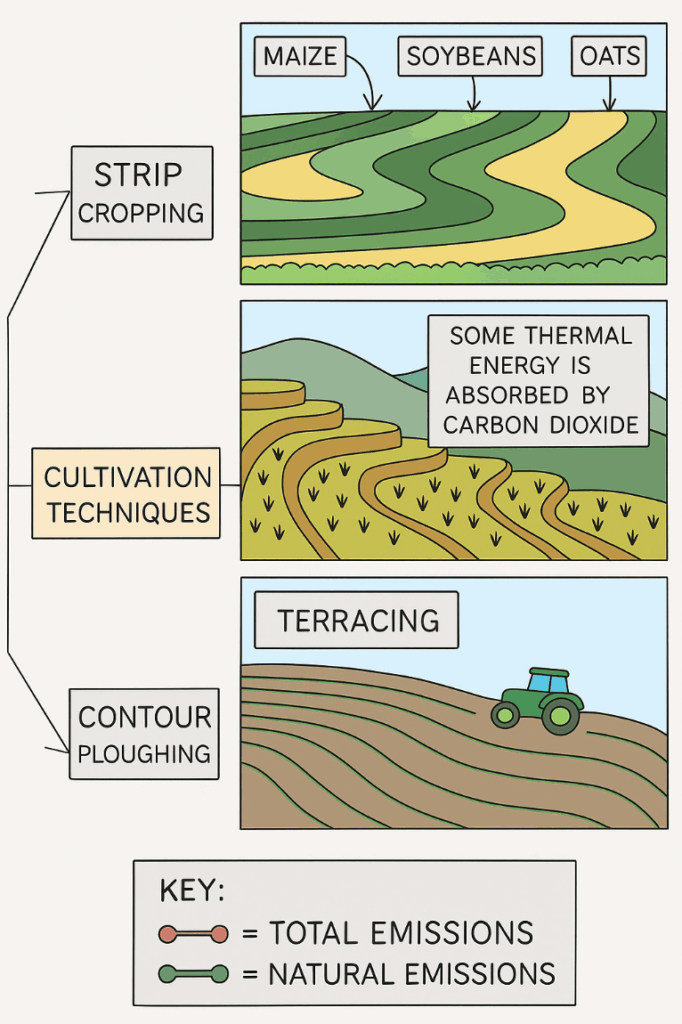
| Strip cultivation | Water | Planting crops in alternating strips or bands, leaving natural vegetation between the strips | Reduces soil erosion by trapping water, slowing down runoff and increasing infiltrationwhile still allowing for crop production in the cultivated stripsIncreases biodiversity |
| Terracing | Water | Creating levelled steps on sloped lands | Reduces soil erosion by slowing down water movement and increasing infiltrationMinimises soil loss on steep slopes |
| Contour ploughing | Water | Ploughing parallel to the contour lines of the land instead of up and down slopes | Minimises soil erosion by reducing length and speed of water flow downhillPrevents gully formation and increases infiltration |
| Bunding | Water | Building embankments or barriers along fields | Controls water flowPrevents soil erosion and waterlogging |
| Drainage systems | Water | Installing systems to manage excess water | Prevents waterloggingReduces erosion and nutrient loss |
| Cover crops | Water | Planting crops that cover the soil | Reduces water erosionImproves soil structure |
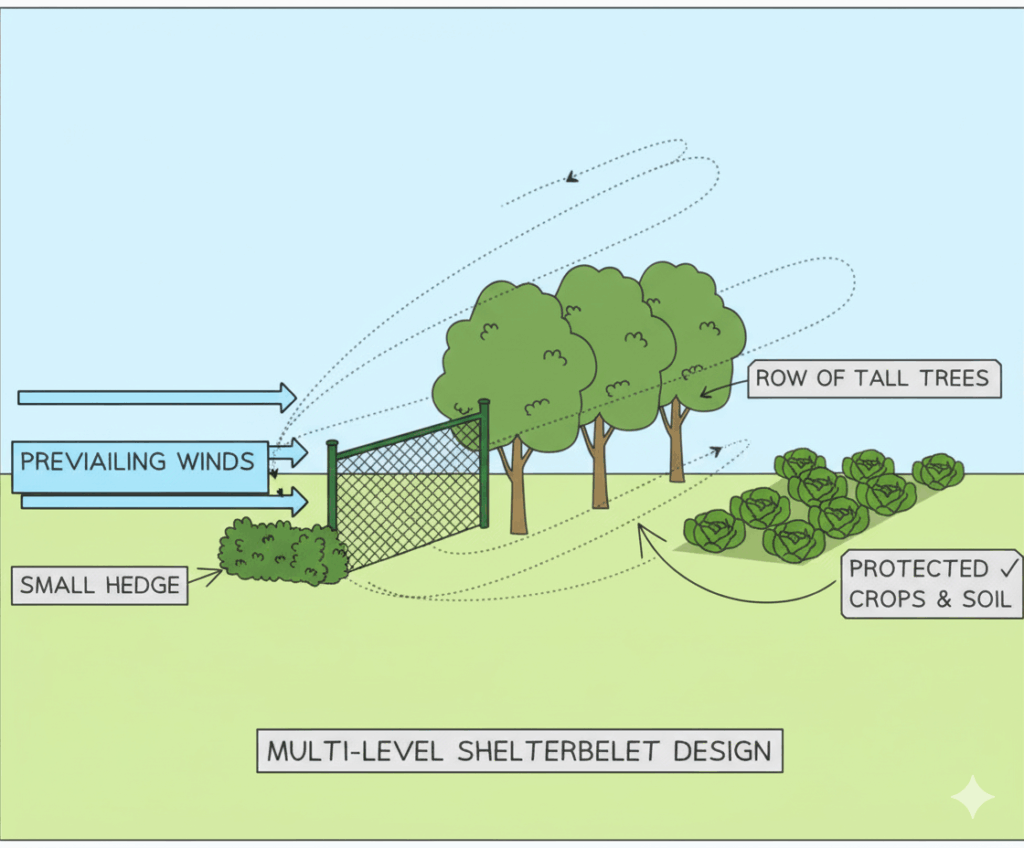
| Windbreaks | Wind | Planting trees or hedges to block and reduce wind speed | Provides physical barrier to windReduces wind erosionProtects topsoilProtects crops from wind damage |
Conservation of Fertility with Soil Conditioners
| Soil conservation technique | Description | Effect |
|---|---|---|
| Lime | Adding lime to soil | Improves soil pH, reducing soil acidityEnhances nutrient availabilityPromotes beneficial microbial activity |
| Compost | Using decomposed organic matter | Enriches soil with nutrientsImproves soil structureIncreases water-holding capacityPromotes beneficial microbial activity |
| Green manure | Growing plants (e.g. cover crops) specifically to be ploughed into the soil | Increases organic matterEnhances soil fertility |
Cultivation Techniques
| Soil conservation technique | Description | Effect |
|---|---|---|
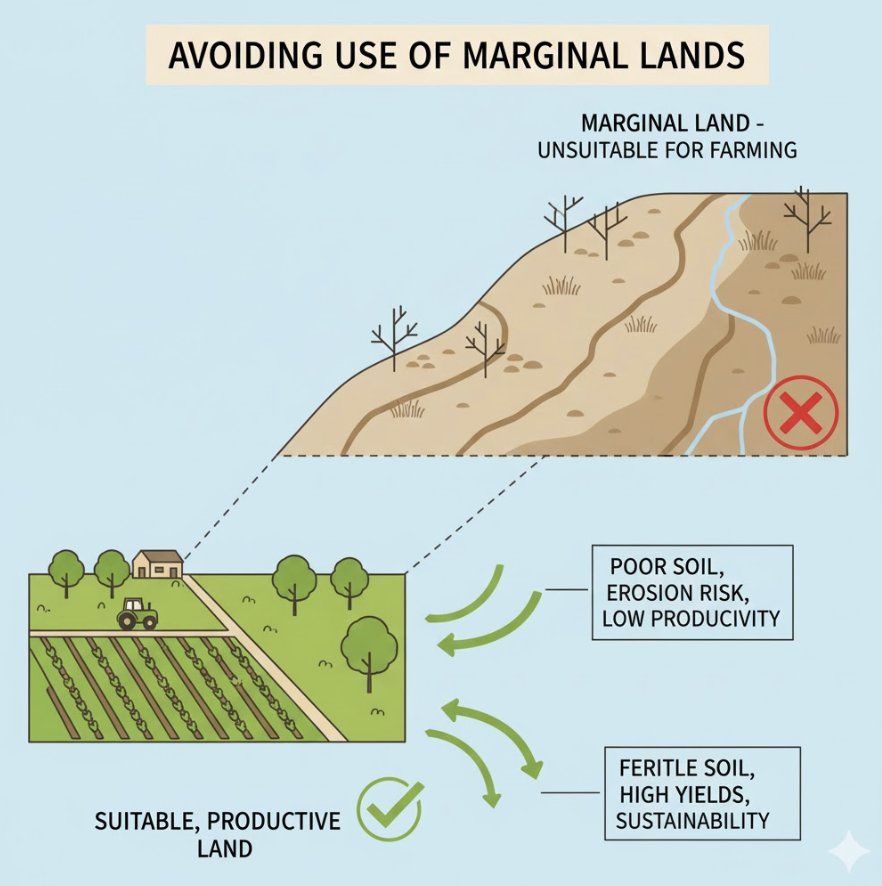
| Avoid marginal land | Not farming on land that is vulnerable to erosion or poor in nutrients | Protects fragile ecosystemsPrevents soil degradationMaintains soil health |
| Avoid overgrazing / overcropping | Managing livestock and crop levels to prevent depletion | Maintains soil coverPrevents soil erosion and compaction |
| Mixed cropping | Growing different types of crops together | Improves soil healthReduces pest and disease issues |
| Crop rotation | Rotating different crops on the same land | Maintains soil nutrientsReduces disease and pest buildup |
| Reduced tillage | Minimising ploughing and soil disturbance | Preserves soil structureMaintains moisture levels |
| Agroforestry | Integrating trees and shrubs into farming systems | Enhances soil structureProvides shade and wind protection |
| Reduced use of heavy machinery | Minimising the use of heavy equipment on fields | Prevents soil compactionMaintains soil structure |
🌐 EE Tip: Compare soil health under different farming systems (organic vs conventional) using physical and chemical indicators.
📌 Sustainability of Food Production Systems
Increasing sustainability of terrestrial food production
- Humans are omnivores, consuming a variety of foods, including:
- Fungi
- Plants
- Meat
- Fish
- Diets that include more food from lower trophic levels, such as plant-based diets, are generally more sustainable
- This is due to their reduced environmental impact
Crop vs. livestock production
- Yield and cost:
- Crops:
- The yield of food per unit of land area is significantly higher with crops than with livestock
- Crop production also has lower financial costs associated with it
- Livestock:
- Producing food through livestock requires more land and resources
- It is usually more expensive
- Crops:
Plant-based diets
- Increasing the proportion of plant-based foods in diets can make agriculture more sustainable
- This is because plant-based diets decrease the demand for resource-intensive livestock farming
- Energy efficiency is greater in a plant-based diet compared to a meat-eating diet due to several factors:
- Trophic levels:
- Energy is lost at each trophic level as it moves up the food chain
- When we consume plant-based foods directly, we bypass the energy loss associated with raising animals for meat
- By consuming plants (the primary producers) directly, we utilise energy more efficiently
- Feed conversion efficiency:
- Animals raised for meat require significant amounts of feed to grow and develop
- However, a large portion of the energy from the feed is used for the animals’ own bodily functions and metabolic processes, rather than being converted into edible biomass
- This inefficiency in feed conversion results in higher energy losses when obtaining nutrition from meat
- Land use efficiency:
- Producing meat requires vast amounts of land for grazing or growing animal feed crops
- This land could otherwise be used more efficiently to cultivate plant-based foods directly for human consumption
- By consuming plant-based foods, we optimise land use and reduce the energy required for livestock farming
- By focusing on lower-trophic-level food production, such as promoting plant-based diets, it is possible to:
- Maximise food production per unit area
- At the same time, mitigating the pressure on land resources

Global food production and distribution
- Current production:
- Global agriculture currently produces enough food to feed approximately eight billion people (the global population currently stands at 8.1 billion in 2024)
- Despite this, food is not distributed equitably around the world
- Some regions experience surpluses, while others face severe shortages
- Food waste:
- It is estimated that at least one-third of all food produced is wasted
- This can be during:
- Post-harvest
- Storage
- Transport and distribution
- SDG goal:
- The United Nations’ Sustainable Development Goal 12 aims to:
- “…ensure sustainable consumption and production patterns.”
- Target 12.3 within this goal focuses on:
- Reducing global food waste by 50% per capita at the retail and consumer levels (i.e. halving global food waste) by 2030
- By minimising food losses throughout production and supply chains (including post-harvest losses)
- The United Nations’ Sustainable Development Goal 12 aims to:
Strategies for sustainable food supply
- Reducing demand and food waste:
- Encouraging plant-based diets: shifting towards plant-based diets can reduce the demand for resource-intensive animal products
- Improving food distribution systems: increasing the efficiency of food distribution can help ensure that food reaches those in need and reduce waste. For example:
- Using refrigerated transport to keep food fresh longer
- Optimising delivery routes to reduce transport time
- Collecting and redistributing surplus food to those in need
- Educating consumers: raising awareness about the importance of reducing food waste at the consumer level can have a significant impact
- Reducing greenhouse gas emissions:
- Plant-based meat substitutes: developing and promoting plant-based alternatives to meat can reduce greenhouse gas emissions associated with livestock
- These products mimic the taste and texture of meat but are made from plants
- Low methane rice cultivation: using rice cultivation practices that produce less methane can help reduce agricultural emissions. For example:
- Periodically draining and re-flooding rice fields
- Applying additives that reduce methane emissions
- Reducing methane release by ruminants: adjusting livestock diets and using dietary additives like seaweed can lower methane emissions from ruminants
- Plant-based meat substitutes: developing and promoting plant-based alternatives to meat can reduce greenhouse gas emissions associated with livestock
- Increasing productivity without expanding agricultural land use:
- Extending shelf life: improving preservation methods to extend the shelf life of food can help reduce waste. For example:
- Improved packaging
- Improved refrigeration
- Genetic modification: using genetic modification to create crops with increased productivity. For example:
- Crops that produce higher yields with the same inputs
- Crops that are more resistant to pests and diseases
- In-field solar-powered fertiliser production: using solar energy to produce fertilisers on-site
- Reduces the need for synthetic fertilisers
- Reduces reliance on fossil fuels (required for production of synthetic fertilisers)
- Reduces production and transport costs
- Extending shelf life: improving preservation methods to extend the shelf life of food can help reduce waste. For example:
📌 Food Security
- Food security can be defined as:
Key components of food security
- Availability: ensuring that enough food is produced and supplied to meet the population’s needs
- Access: ensuring that individuals have the resources (economic means) to obtain the food they need (i.e. food is affordable)
- Use: ensuring food is used properly alongside a healthy diet, clean water, sanitation and healthcare to achieve good nutritional health
- Stability: ensuring consistent and reliable access to food at all times, without disruptions from economic or climate-related issues
🔍 TOK Tip: Is food security a scientific or ethical problem?
Regional food security
- Developed regions:
- Generally high levels of food security
- Good infrastructure, economic stability and social safety nets ensure food availability and access
- Examples: North America, Western Europe
- Developing regions:
- Varying levels of food security, often lower than in developed regions
- Issues include poverty, poor infrastructure and political instability
- Examples: Sub-Saharan Africa, parts of South Asia, Latin America
Factors affecting food security
- Economic factors:
- Income levels, food prices and employment opportunities impact individuals’ ability to purchase food
- Environmental factors:
- Climate change, natural disasters and resource depletion impact food production and availability
- Social and political factors:
- Government policies, conflict and social inequality impact food distribution and access