5.1 SOIL
📌 Definitions Table
| Term | Definition |
|---|---|
| Parental Rock | The original rock material that breaks down through weathering to form soil. |
| Natural Soil Mineralisation | The process by which organic matter decomposes, releasing nutrients into the soil in mineral form. |
| Parent Material | The base geological material from which soil develops, including rock or transported sediments. |
| Natural Seed Bank | A reserve of viable seeds present in the soil that can germinate under suitable conditions. |
| Sink | A part of the system where matter or energy is absorbed and stored for a significant period. |
| Stores | Components of a system that hold energy or matter temporarily, such as soil, biomass, or atmosphere. |
| Sources | Components of a system that release matter or energy into other parts of the system. |
| Primary Productivity | The rate at which producers convert solar energy into biomass through photosynthesis. |
- 🧠 Exam Tips:
When discussing sources and sinks, link them to nutrient cycles (e.g., carbon or nitrogen).
For productivity terms, distinguish between GPP and NPP if specified.
📌 Components and Structure of Soil
Soil components
- Soil is made up of a complex mixture of interacting components, including inorganic and organic components, water and air
Inorganic components
- Mineral matter:
- Rock fragments
- Sand
- Silt
- Clay
- These components come from the weathering of parental rock
Organic components
- Living organisms:
- Bacteria
- Fungi
- Earthworms
- Dead organic matter:
- Decaying plants
- Animal remains
- Animal waste (faeces)
Other components
- Water:
- Essential for chemical reactions and life
- Air:
- Oxygen and other gases necessary for organism survival
Soils as systems
- Soils are dynamic systems within larger ecosystems
- As with any system, soil systems can be simplified by breaking them down into the following components:
- Storages
- Flows (inputs and outputs)
- Transfers (change in location) and transformations (change in chemical nature, state or energy)

Image source: savemyexams.com
Soil System Storages
| Storage | Description |
|---|---|
| Organic matter | Accumulation of plant and animal matter in various stages of decompositionProvides nutrients, improves soil structure and enhances water-holding capacity |
| Organisms | Includes microorganisms, fungi, bacteria, insects and other living organisms present in the soilThey play essential roles in nutrient cycling, organic matter decomposition and soil structure formation |
| Nutrients | Elements necessary for plant growth, such as nitrogen, phosphorus and potassiumNutrients are stored in the soil and are made available to plants through various biological and chemical processes |
| Minerals | Inorganic components of the soil derived from weathering of rocks and mineralsContribute to the physical properties and fertility of the soil |
| Air | Pore spaces within the soil are filled with air, allowing oxygen to be available for root respiration and microbial activities |
| Water | Soil acts as a reservoir for water, holding it for plant uptake and providing a suitably moist habitat for soil organisms |
Soil System Inputs
| Input | Description |
|---|---|
| Dead organic matter | Inputs of plant material (e.g. leaf litter) and other organic materials (e.g. dead animal biomass or animal faeces) that contribute to the organic matter content in the soil |
| Inorganic matter from rock material | Contributes to the mineral composition of soil, derived from parent materials (e.g. bedrock) and the weathering of exposed rock at the soil surface |
| Precipitation | Rainfall or snowfall that provides water (containing dissolved minerals) to the soil system |
| Energy | Solar radiation and heat influence soil temperature and biological activities |
| Anthropogenic inputs | E.g. compost, fertilisers, agrochemicals, water from irrigation |
Soil System Outputs
| Output | Description |
|---|---|
| Leaching | Loss of dissolved minerals and nutrients from the soil into streams, rivers, lakes and oceans through water movement |
| Uptake by plants | Absorption of minerals and water by plant roots for growth and development |
| Soil erosion | Removal of soil particles by water or wind, leading to the loss of topsoil and degradation of soil quality |
| Diffusion and evaporation | Diffusion of gases and evaporation of water from soil |
Soil System Transfers
| Transfer | Description |
|---|---|
| Infiltration | Process by which water enters the soil from the surface |
| Percolation | Movement of water through the soil and its layers, typically downward through the soil profile |
| Groundwater flow | Movement of water through the subsurface soil layers, often feeding into aquifers and other groundwater reserves |
| Biological mixing | Movement of soil particles and materials by soil organisms, including burrowing animals, earthworms and root growthContributes to the mixing of organic matter and minerals, enhancing soil structure and nutrient distribution |
| Aeration | Process by which air is circulated through and mixed with soil |
| Erosion | Process by which soil particles are detached and transported by wind or water |
| Leaching | Process in which minerals dissolved in water are moved downwards or horizontallythrough the soil profileResults in the loss of nutrients from the root zone, particularly in areas with high rainfall or excessive irrigation |
Soil System Transformations
| Transformation | Description |
| Decomposition | The process of organic matter breakdown by microorganisms, results in the release of carbon dioxide, water and nutrientsInvolves the conversion of complex organic compounds into simpler forms |
| Weathering | Physical and chemical processes that break down rocks and minerals into smaller particles, contribute to soil formationIncludes physical weathering (mechanical breakdown) and chemical weathering (alteration of minerals through chemical reactions) |
| Nutrient cycling | The cycling of nutrients within the soil-plant system involves uptake, assimilation, release and recycling of elements like nitrogen, phosphorus and potassiumEnsures the availability and redistribution of essential nutrients for plant growth |
| Salinisation | Accumulation of soluble salts in the soil, which can be detrimental to plant growth and soil structureIt often results from improper irrigation practices, high evaporation rates, or natural soil mineralisation |
| Humification | Process of organic matter transformation into stable humusIt involves the accumulation of complex organic compounds, leading to the dark colouration and improved water-holding capacity of soilContributes to soil fertility and structure |
Soil profiles
- Soil profiles develop as a result of long-term interactions within the soil system
- These interactions and processes form distinct layers known as horizons
- These layers vary in composition and characteristics from the surface downward
- This reflects the processes of soil formation over time
- Profiles usually transition from organic-rich layers near the surface to more mineral-rich layers deeper down
- These lower layers generally contain more inorganic material
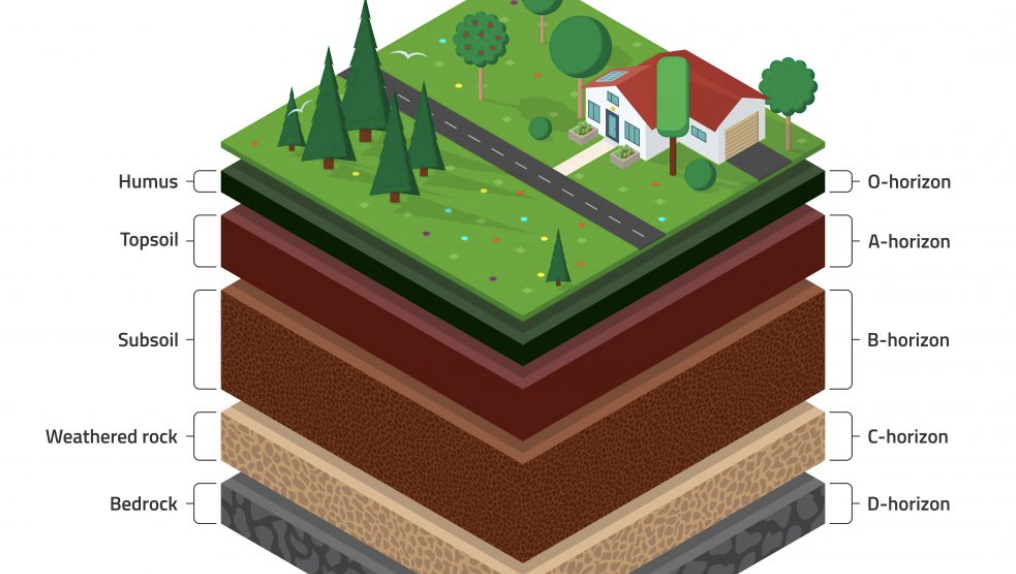
Image source: savemyexams.com
- The development of soil profiles is influenced by factors such as:
- Climate
- Vegetation
- Parent material
- Time
Real-world examples
- Tropical rainforests:
- Often have thick, organic-rich top soils due to rapid decomposition and high biological activity
- Desert regions:
- Characterised by shallow, mineral-dominated soils with distinct horizons due to low organic matter input and minimal leaching
- Peat soils in boreal forests (e.g. Scandinavia):
- Soils characterised by thick layers of partially decomposed organic matter (peat)
- This is due to the cold, wet conditions that slow down decomposition rates, resulting in highly acidic and nutrient-poor soils
- Prairie soils in the Great Plains, USA:
- Soils known for their deep, dark topsoil have developed over millennia
- This is due to the accumulation of organic matter from grassland vegetation and the semi-arid climate
📌 Functions and Properties of Soil
Soil functions
- Soils carry out important functions in terrestrial ecosystems
- Soils support plant growth, biodiversity and biogeochemical cycles
Medium for plant growth
- Soils act as a natural seed bank, providing a substrate for germination and root development
- They store water crucial for plant hydration, nutrient uptake and photosynthesis
- They store essential nutrients for plants such as nitrogen, phosphorus and potassium
- These essential nutrients support healthy plant growth
- For example, in the Amazon rainforest, the fertile soils contain high levels of nutrients
- This allows these soils to support diverse plant life
- This has led to the Amazon’s status as the world’s largest tropical rainforest
Contribution to biodiversity
- Soils provide habitats and niches for a wide range of species
- Soil communities support high biodiversity, including microorganisms, animals and fungi
- For example, in the UK, ancient woodlands are rich in soil biodiversity
- Their soils support rare fungal species that play important roles in nutrient cycling
Role in biogeochemical cycles
- Soils allow the recycling of elements essential for life, such as carbon, nitrogen and phosphorus
- Dead organic matter from plants is a major input into soils, where it decomposes and releases nutrients
Carbon storage dynamics
- Soils can function as carbon sinks, stores, or sources, depending on environmental conditions
- For example, tropical forest soils generally have low carbon storage due to rapid decomposition rates
- This is because the warm and moist conditions accelerate the decomposition of organic matter by microorganisms
- This causes carbon to be released back into the atmosphere quickly
- Tundra, wetlands and temperate grasslands can accumulate large amounts of carbon in their soils
- This is because colder temperatures and waterlogged conditions slow down the decomposition process
- This allows organic matter to build up in the soil over time without being fully decomposed and released as CO2
Soil texture
- Soil texture describes the physical make-up of soils
- It depends on the proportions of sand, silt, clay and humus within the soil
- Soil texture influences various soil properties and plant growth
Components of soil texture
- Sand: larger particles that feel gritty
- Silt: medium-sized particles that feel smooth
- Clay: very fine particles that feel sticky when wet
- Humus: organic matter, dark brown or black, crumbly texture from partially decayed plant material
Determining soil texture
- Soil texture can be determined using several methods
- Each method provides insight into:
- The soil’s properties
- How suitable the soil is for different plants and crops
- Using a soil key:
- A soil key is a more systematic and detailed method
- It uses a step-by-step guide to classify soil texture based on specific criteria
- The key helps identify the proportions of sand, silt, and clay by guiding the soil tester (the user) through a series of questions or observations
- It often includes descriptions of soil behaviour when moistened and manipulated
- Soil keys are often used in more formal or scientific settings where precise classification is needed
- Feel test:
- The feel test is a simpler method
- It involves rubbing moistened soil between the fingers to assess its texture
- Sand feels gritty, silt feels smooth and clay feels sticky
- It is a quick, informal assessment that can be done in the field without additional tools
- The feel test is commonly used by farmers, gardeners, and others needing a quick assessment
- Laboratory test:
- The laboratory test involves mixing soil with water and allowing it to settle into distinct layers
- This method provides a clear visual representation of the proportions of sand, silt and clay
- Any large debris like rocks, roots, or organic matter, are first removed from the sample
- The sample is added to a transparent container
- Water is added and the container is shaken vigorously
- The container is left on a flat surface and left undisturbed (e.g. for 24 hours)
- Silt settles first, then clay, and finally sand
- The thickness of these layers can be measured to determine their proportions

Image source: savemyexams.com
- In the example above:
- The sand layer is 2.5 cm
- The silt layer is 2 cm
- The clay layer is 2.5 cm
- The total thickness is 7 cm
- These measurements can be used to calculate the percentage of each soil component:
- The percentage of sand is (2.5 ÷ 7) × 100 = 35.7%
- The percentage of silt is (2 ÷ 7) × 100 = 28.6%
- The percentage of clay is (2.5 ÷ 7) × 100 = 35.7%
Influence of soil texture on primary productivity
- Soil texture affects primary productivity by influencing:
- Nutrient availability
- Water retention
- Soil aeration
- Nutrient retention vs. leaching:
- Humus contributes significantly to the nutrient content of soils
- It lies beneath leaf litter and has a loose, crumbly texture
- It is formed by the partial decay of dead plant material
- Soils with more humus retain nutrients better
- Less humus means nutrients are more likely to be washed away
- For example, forest floors, like those in the New Forest in Hampshire, UK, have rich humus layers that support diverse plant life
- Water retention vs. drainage:
- Clay and humus-rich soils retain water well
- Sandy soils drain quickly but may not retain enough moisture for some plants
- For example, sandy soils in East Anglia, UK, require more frequent irrigation for crops
- Aeration vs. compaction or waterlogging:
- Well-aerated soils support root growth and beneficial microbial activity
- Clay soils can become compacted, limiting aeration
- Humus helps improve aeration in clay soils
- For example, compacted clay soils in urban areas often need organic matter added to improve their structure and aeration