3.2 HUMAN IMPACT ON BIODIVERSITY
📌 Definitions Table
| Term | Definition |
|---|---|
| Invasive Species | Non-native species that spread rapidly in a new environment, outcompeting native species and disrupting ecosystem balance. |
| Arboreal | Organisms that live in or primarily use trees as their habitat. |
| IUCN (International Union for Conservation of Nature) | A global organization that assesses the conservation status of species and publishes the Red List of Threatened Species. |
| Tragedy of the Commons | The overexploitation of shared, open-access resources due to individual self-interest, leading to resource depletion. |
- 🧠 Exam Tips:
For invasive species, always mention their impact on native biodiversity.
For tragedy of the commons, include key terms like “shared resource” and “depletion” for full marks.
📌 Threats to Biodiversity
- Biodiversity is crucial for ecosystem stability, resilience and functioning
- However, biodiversity is being negatively affected by both direct and indirect human influences
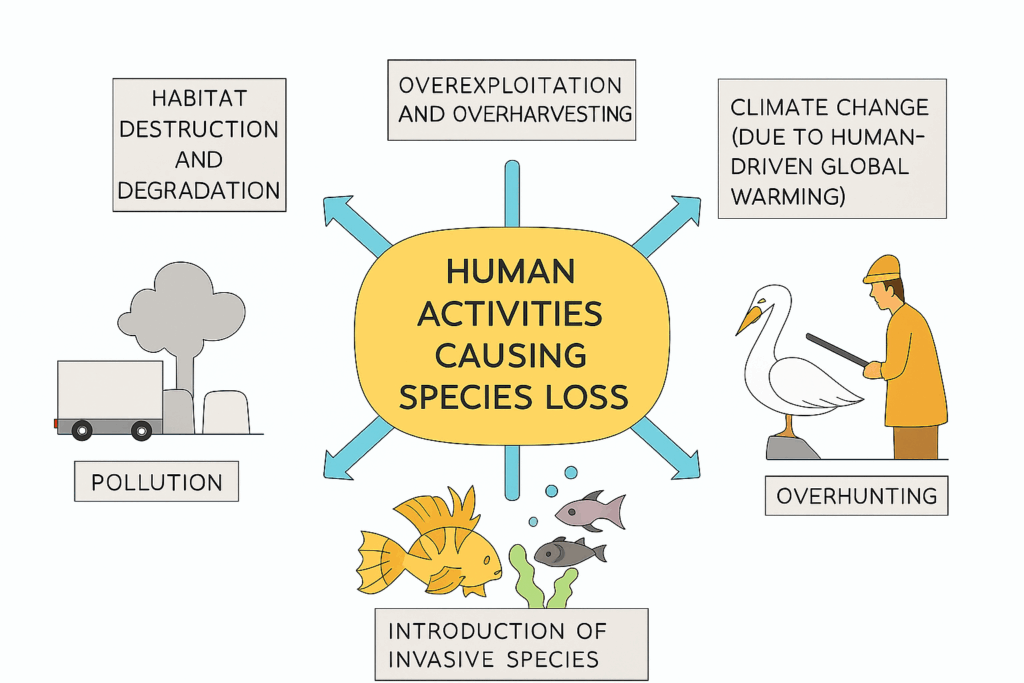
Direct threats
- Overharvesting:
- Harvesting of species at a rate faster than their natural reproduction, leading to population decline
- For example, overfishing of Atlantic cod in the North Sea, leading to population collapse
- Many tropical rainforests are also under threat from overexploitation
- They have major ecological and economic value
- The trees are being cut down and harvested at a rate much faster than reforestation takes place
- Continued overexploitation of a species can drive it to become extinct
- Harvesting of species at a rate faster than their natural reproduction, leading to population decline
- Poaching:
- Illegal hunting or capturing of wildlife, often for trade or consumption
- For example, poaching of African elephants for their tusks, leading to a decline in elephant populations
- If too many individuals within a species are killed then the population will become so small that it is no longer able to survive and the species may go extinct
- Illegal hunting or capturing of wildlife, often for trade or consumption
- Illegal pet trade:
- Trafficking of live animals for the exotic pet market
🌐 EE Tip: Investigate human impact on a local endangered species or protected area, comparing primary and secondary data sources.
Indirect threats
- Habitat loss:
- Destruction or fragmentation of natural habitats due to human activities such as deforestation, urbanisation, or agriculturalexpansion
- For example, clearing of rainforests in the Amazon for cattle ranching
- Causes of aquatic habitat loss include: destructive fishing techniques, dredging of wetlands, damage from ships, tourism and pollution
- Causes of terrestrial habitat loss include: inland dams, deforestation, desertification, agriculture and pollution
- When a species’ habitat is destroyed or degraded, they no longer have the support systems and resources they need to survive
- Destruction or fragmentation of natural habitats due to human activities such as deforestation, urbanisation, or agriculturalexpansion
- Climate change:
- The change in global climate patterns due to greenhouse gas emissions, leading to habitat disruption, shifts in species distributions and increased frequency of extreme weather events
- For example, melting of polar ice caps, threatening species like polar bears
- The change in global climate patterns due to greenhouse gas emissions, leading to habitat disruption, shifts in species distributions and increased frequency of extreme weather events
- Pollution:
- Introduction of harmful substances or contaminants into the environment, including air, water and soil pollution
- For example, plastic pollution in oceans, endangering marine species
- Introduction of harmful substances or contaminants into the environment, including air, water and soil pollution
- Invasive alien species:
- Non-native species introduced into an ecosystem that disrupt native species and ecosystems
- For example, Japanese knotweed in the UK, which outcompetes native plants and causes damage to buildings
- When humans travel between countries and continents, they often exchange (either intentionally or unintentionally) animal and plant species between their home country and the foreign country
- These non-native species can be highly problematic as they often have no natural competitors, predators or pathogens that help limit population growth
- Without these natural population checks, non-native species can massively increase in number
- The large numbers of non-native species can negatively affect the native species through factors such as competition and disease
- Non-native species introduced into an ecosystem that disrupt native species and ecosystems
Grey Squirrel Invasion in the UK
- Alien species:
- Grey squirrels (Sciurus carolinensis) were introduced to the UK from North America in the 19th century
- Originally brought over as ornamental additions to estates, they have since become a major invasive species
- Impact:
- Grey squirrels outcompete native red squirrels (Sciurus vulgaris) for resources such as food and habitat
- They also carry the squirrelpox virus, which is fatal to red squirrels but does not affect grey squirrels
- Management strategies:
- Culling programs: some areas have introduced culling programs to reduce grey squirrel populations, aiming to protect red squirrels and restore native biodiversity
- Forest management: habitat management practices such as selective tree planting and creating corridors for red squirrels help to create more favourable conditions for the native species, as they are more arboreal than grey squirrels
- Research and monitoring: continual research and monitoring of squirrel populations and their impacts can help to develop effective management strategies over time
Combined impacts
- Most ecosystems face multiple human impacts simultaneously
- This leads to cumulative effects
- This is when negative effects are amplified when different threats act together, reducing ecosystem resilience
- For example, in a coral reef ecosystem, overfishing by human populations weakens the resilience of the coral reef to coral bleaching caused by climate change, making ecosystem collapse more likely
📌 Assessing Conservation Status
- International cooperation is essential if conservation is to be successful
- There are several agreements and authorities that exist within and between countries with the aim of protecting and conserving species worldwide
IUCN
- The International Union for the Conservation of Nature (IUCN) is the global authority on the status of the natural world and the measures needed to safeguard it
- One of the duties that the IUCN carries out is assessing the conservation status of animal and plant species around the world:
- Scientists use data and modelling to estimate the category each species should be in
- Factors used to determine the conservation status of a population include:
- Population size (smaller populations are usually at a greater risk of extinction)
- Rate of increase or decrease of the population
- Degree of specialisation
- Distribution (geographic range)
- Reproductive potential and behaviour (breeding potential)
- Geographic range
- Degree of endemicity (i.e. if the species is only found in a single specific area)
- Degree of habitat fragmentation
- Quality of habitat
- Trophic level (animals in higher trophic levels are usually at a greater risk of extinction)
- Known threats
- The IUCN has their own classification system:
- There are several different categories and levels that a species can fall into depending on its population numbers and the threats and risks to those populations
- Species that have been assessed are categorised by the IUCN as:
- LC = least concern
- NT = near threatened
- VU = vulnerable
- EN = endangered
- CR = critically endangered
- EW = extinct in the wild
- EX = extinct
- Species can also be classed as DD (data deficient) when there is not enough data on which to base a category choice, or as NE (not evaluated)
- Animals that are on the IUCN Red List of Threatened Species™ can be seen online as this list is made public
- Giving a global conservation status highlights how vulnerable certain species are
- This helps governments, NGOs and individuals to select appropriate conservation priorities and management strategies
🔍 TOK Tip: Should species be conserved based on ecological value or emotional appeal (e.g. flagship species)?
📌 Conservation Case Studies
Extinct species
- Passenger Pigeon (Ectopistes migratorius):
- The Passenger pigeon was once one of the most abundant bird species in North America, numbering in the billions of individuals
- However, due to overhunting and habitat destruction, the passenger pigeon went extinct in the early 20th century
- The hunting of these birds for meat, as well as the destruction of their forest habitats, led to a sharp decline in their numbers
- By the late 1800s, the species was in serious decline, and despite some attempts at conservation, it went extinct in 1914
- Tasmanian Tiger (Thylacinus cynocephalus):
- The Thylacine, also known as the Tasmanian Tiger or Tasmanian Wolf, was a carnivorous marsupial that once inhabited the Australian island of Tasmania
- Human activity such as hunting, habitat loss and disease transmission by introduced species caused their population to decline
- The last known Tasmanian tiger died in captivity in 1936, marking the extinction of the species
Critically endangered species
Sumatran Orangutan (Pongo abelii):
- The Sumatran orangutan is one of three species of orangutan and is found only on the Indonesian island of Sumatra
- Habitat destruction and fragmentation due to logging, conversion of forests to agriculture, and infrastructure development have been the primary causes of its decline
- In addition, illegal hunting and capture of orangutans for the pet trade have also contributed to their decline
- The Sumatran orangutan is now critically endangered, with only around 14 000 individuals remaining in the wild
- Black rhinoceros (Diceros bicornis):
- The black rhinoceros is a large mammal native to Africa and is critically endangered due to poaching for their horns, habitat loss, and civil unrest in the countries of their range
- Their population has declined by over 90% since the 1960s, and there are currently only around 3 000 mature individuals remaining in the wild
- Conservation efforts such as anti-poaching patrols, habitat restoration and captive breeding programs are underway to try to save this species from extinction
Improving species
Southern white rhinoceros (Ceratotherium simum):
- The Southern white rhinoceros was once on the brink of extinction due to poaching for their horns, with only a handful of individuals surviving in the wild in South Africa in the early 20th century
- However, conservation efforts including increased law enforcement, habitat protection, and captive breeding programs have helped their population recover to over 18 000 individuals today
- While they are still threatened by poaching and habitat loss, the Southern white rhinoceros’ conservation status has greatly improved thanks to human intervention
- Bald eagle (Haliaeetus leucocephalus):
- The bald eagle is a bird of prey native to North America and was once on the brink of extinction due to habitat destruction, hunting, and pesticide use, which caused eggshell thinning and reproductive failure
- Conservation efforts such as habitat protection, captive breeding programs, and the banning of harmful pesticides like DDT have helped their population recover from less than 500 pairs in the 1960s to over 10 000 pairs today
- The bald eagle’s conservation status has greatly improved thanks to human intervention
📌 Tragedy of the Commons
Tragedy of the commons
- The tragedy of the commons describes the overuse and depletion of a shared resource
- It occurs when individuals act in their own self-interest rather than considering the common good
- It leads to the degradation of the resource, making it unavailable for future use
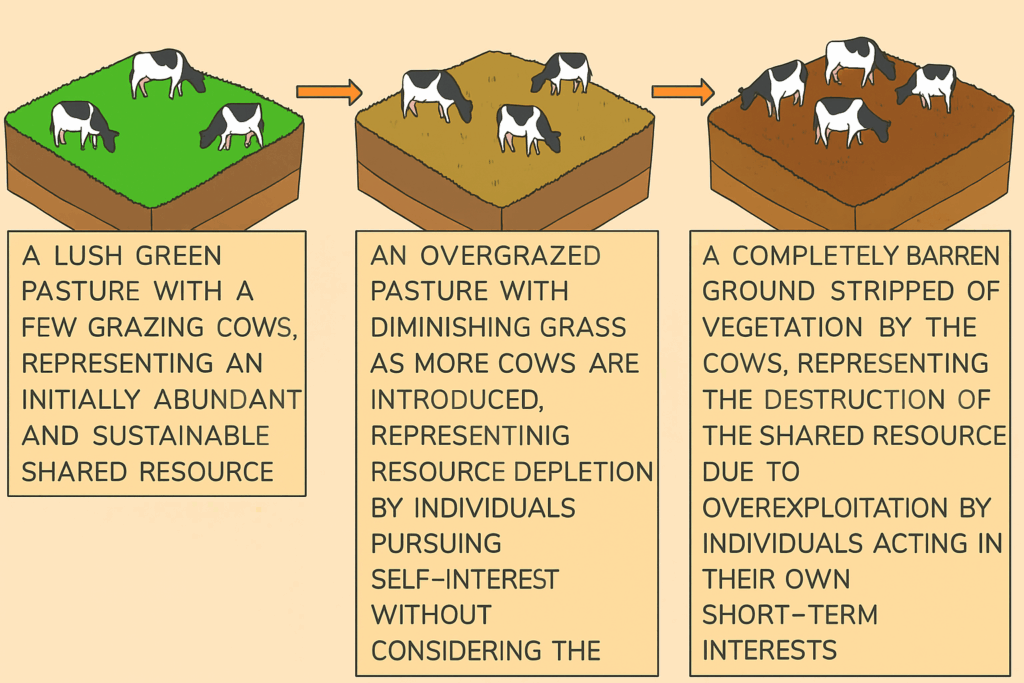
Implications for sustainability
- Overexploitation:
- Many natural resources are used faster than they can be replenished
- This is resulting in resource depletion and could eventually lead to the collapse of certain ecosystems
- Impact on biodiversity:
- Result in the loss of habitats and species
- It can also lead to reduced genetic diversity
- These factors can weaken ecosystem resilience, threatening biodiversity