2.5 ZONATION, SUCCESSION AND CHANGE IN ECOSYSTEMS
📌 Definitions Table
| Term | Definition |
|---|---|
| Soil Horizons | Distinct layers of soil that differ in texture, structure, composition, and color, forming through processes like leaching and organic matter accumulation. |
| Moraines | Accumulations of glacial debris (rock and soil) deposited by moving glaciers, forming ridges or mounds in post-glacial landscapes. |
| Climax Community | A stable and self-sustaining ecosystem at the end of ecological succession, in dynamic equilibrium with its environment. |
📌 Zonation
- Zonation refers to the gradual change in the composition of species and communities across a landscape, based on a gradient of environmental factors such as:
- Elevation (altitude)
- Latitude
- Tidal level
- Soil horizons
- Distance from water source
- Temperature
- Moisture
- Light
- As these factors change, the species present in an ecosystem also change
- This leads to distinct zones or bands of organisms that can be observed in the ecosystem
- This process occurs due to the interactions between the physical environment (abiotic factors) and the biological components (biotic factors) of an ecosystem
- An example of zonation can be observed in a rocky intertidal zone
- Here, the physical and biological characteristics of the ecosystem change gradually from the high tide mark to the low tide mark
- At the highest point (sometimes referred to as the spray zone), the zone is usually dry and dominated by lichen and other hardy plants that can withstand long periods of exposure to air and sunlight
- In the high tide zone, the environment becomes more hospitable for other organisms such as barnacles, mussels, chitons, limpets and sea snails that can attach themselves to the rocks and withstand waves
- Further down towards the low tide zone, the environment becomes even more favourable for marine organisms such as sea stars, anemones, and sea urchins that require the constant presence of water
- Here, the physical and biological characteristics of the ecosystem change gradually from the high tide mark to the low tide mark
Representing results
- The results of an investigation into the distribution and abundance of organisms can be represented visually using a type of graph known as a kite diagram
- Kite diagrams can show both distribution and abundance
- The distribution of a species along a transect can be shown by its position along a central horizontal line in each section of a kite diagram
- Each section represents a different species
- The distance along the transect is given on the x-axis, to which the horizontal line is parallel
- The abundance of a species can be shown by the width of the ‘kite‘ around the central horizontal line
- The shape is referred to as a kite because it extends an equal distance on each side of the central horizontal line
- Additional sections can be added to a kite diagram to show the changes in abiotic factors at different points along a transect e.g. the height above sea level or the pH of soil
📌 Succession
- Ecosystems are dynamic, meaning that they are constantly changing
- Ecosystems change from being very simple to being relatively complex
- This process is known as succession
- During succession, the biotic conditions (i.e. the living factors) and the abiotic conditions (i.e. the non-living factors) change over time
- Primary succession is the process that occurs when newly formed or newly exposed land (with no species present) is gradually colonised (inhabited) by an increasing number of species
- This new uninhabited land can be created in several ways. For example:
- The magma from erupting volcanoes cools and often leads to the formation of new rock surfaces or even new rocky islands in the sea
- Another way new land can be exposed is by sea-level dropping or the drying up of a lake, leaving areas of bare rock
- When glaciers retreat, they also leave bare rock or moraines
- Primary succession does not only occur on bare rock—any barren terrain that is slowly being colonised by living species is undergoing succession. For example:
- Sand dunes in coastal areas
- Marram grasses are the pioneer species in these environments as they have deep roots to access water that other plants can’t reach
- They are also able to tolerate the salty environment i.e. the high concentrations of sodium and calcium ions caused by sea spray
- Sand dunes in coastal areas
- Secondary succession is a very similar process but happens on bare soil where there has been a pre-existing community, such as:
- An agricultural field that has stopped being used
- A forest area after an intense forest fire
The stages of succession
- A seral community (also known as a sere) is a temporary and intermediate stage in the ecological succession of an ecosystem
- Each seral community, in succession, causes changes in environmental conditions
- These changes allow the next community to replace it (e.g. through competition) until a stable climax community is reached
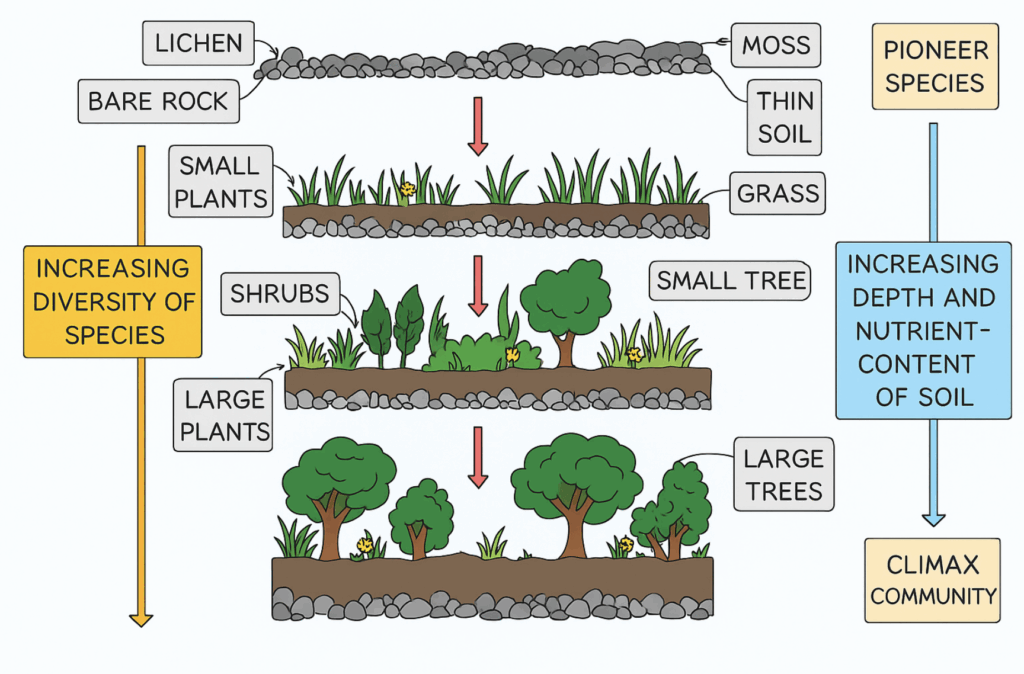
- First, seeds and spores carried by the wind land on the exposed rock and start to grow
- These first species to colonise the new land (often moss and lichens) are known as pioneer species
- As these pioneer species die and decompose, the dead organic matter (humus) forms a basic soil
- Seeds of small plants and grasses, sometimes also carried in the wind or transported other ways (e.g. in bird faeces), land on this basic soil and begin to grow (these smaller plants are adapted to survive in shallow, relatively nutrient-poor soils)
- As these small plants and shrubs die and decompose, the new soil becomes deeper and more nutrient-rich
- The roots of these small plants and shrubs also form a network that helps to hold the soil in place and prevent it from being washed away
- Larger plants and shrubs, as well as small trees that require deeper, more nutrient-rich soil, can now begin to grow
- These larger plants and small trees also require more water, which can be stored in deeper soils
- Finally, the soil is sufficiently deep, contains enough nutrients and can hold enough water to support the growth of large trees
- These final species to colonise the new land become the dominant species of the now relatively complex ecosystem
- The final community formed, containing all the different plant and animal species that have now colonised the new land, is known as the climax community
🌐 EE Tip: Conduct a field-based EE on succession or species diversity in a local park, wetland, or urban green space.
Changes occurring during succession
- As the the structure and species composition of an ecosystem changes during succession, so do the patterns of energy flow, productivity, species diversity and nutrient cycling that ecosystem
- Energy flow:
- During the early stages of succession, the energy flow in the ecosystem is relatively low
- This is because there are only a few species present and most of the energy is used to build biomass
- As the ecosystem becomes more complex, energy flow increases
- Productivity:
- During the early stages of succession, gross productivity and net productivity are low because there are only a few species present
- This means the ecosystem’s overall gain in energy and biomass per unit area per unit time is relatively small
- As the ecosystem becomes more complex, gross productivity and net productivity increase
- Species diversity:
- Diversity refers to the number of species present in an ecosystem
- During the early stages of succession, diversity is low because there are only a few species present
- As the ecosystem becomes more complex, diversity increases because there are more niches available
- This means more species are able to coexist within the same habitats in the ecosystem
- Nutrient cycling:
- Nutrient cycling refers to the movement of nutrients through an ecosystem
- During the early stages of succession, nutrient cycling is relatively simple
- This is because there are only a few species present and abiotic processes dominate nutrient cycling
- As the ecosystem becomes more complex, nutrient cycling becomes more complex
- This is because there are more species present and each species has unique nutrient requirements and cycling processes
📌 Resilience and Stability of Ecosystems
Resilience & stability of ecosystems
- An ecosystem’s capacity to tolerate disturbances and maintain equilibrium depends on its diversity and resilience
- Diversity refers to the variety of species, genetic variations, habitats and ecological functions within an ecosystem
- Resilience refers to the ability of an ecosystem to recover after a disturbance
- High resilience = ecosystem quickly returns to its original state after disturbance
- Low resilience = ecosystem takes a long time to recover or does not fully recover after disturbance
- Greater diversity often means greater resilience—two main reasons for this include:
- Species redundancy:
- Multiple species perform similar roles, so if one species is lost, others can fill its ecological role
- Genetic variation:
- More genetic diversity within a species can help it adapt to changing conditions
- Species redundancy:
🔍 TOK Tip: Can we ever fully measure ecosystem complexity?
Human impacts on succession
- Human activities can divert the progression of succession to an alternative stable state by modifying the ecosystem through various activities, such as:
- Burning
- Agriculture
- Grazing pressure
- Resource use (such as deforestation)
- These activities can have both direct and indirect impacts on the ecosystem
- They lead to changes in the biotic and abiotic components, ultimately altering the course of ecological succession within the ecosystem
- For example, controlled fires are often used to clear land for agricultural purposes or to manage the spread of wildfires
- However, fire can have serious negative effects on the ecosystem by killing off plants, reducing soil fertility and altering nutrient cycles
- Similarly, agriculture and grazing can cause soil erosion, loss of vegetation cover and changes in nutrient cycling
- This can, in turn, affect the composition of the species in the ecosystem
- They lead to changes in the biotic and abiotic components, ultimately altering the course of ecological succession within the ecosystem
- These activities, which divert the progression of succession, may be temporary or permanent, depending upon the resilience of the ecosystem
- If the human disturbance is mild and the ecosystem is highly resilient, it may be able to recover and return to its original state
- If the disturbance is severe and the ecosystem is less resilient, the ecosystem will be permanently changed
- This eventually leads to a new stable state with a different set of species and ecological interactions
- This is one reason why it is so important to carefully consider the environmental impacts of human activities in order to minimise their negative effects on the ecosystem
- It is essential to protect natural ecological processes, such as succession