2.3 BIOCHEMICAL CYCLES
📌 Definitions Table
| Term | Definition (Exam-Ready, 2 Marks) |
|---|---|
| Storages | Components of a system where energy or matter is accumulated or held, such as biomass or soil nutrients. |
| Flows | Movements of energy or matter between storages in a system, either as transfers or transformations. |
| Biosphere | The global ecological system integrating all living organisms and their relationships with the atmosphere, hydrosphere, and lithosphere. |
| Residence Times | The average time a substance remains in a particular storage within a system before moving on. |
| Regenerative Agriculture | A farming approach that restores soil health, enhances biodiversity, and increases carbon sequestration while producing food. |
| Crop Rotation | The practice of growing different types of crops sequentially on the same land to maintain soil fertility and reduce pests. |
| Cover Cropping | Growing crops like legumes or grasses to cover soil between harvests, preventing erosion and improving soil health. |
| No-Till Farming | An agricultural method where the soil is not plowed, reducing disturbance, preserving structure, and preventing erosion. |
| Intensive Tillage | Frequent and deep plowing of soil for crop production, which can lead to soil degradation and loss of organic matter. |
| Monoculture Farming | The cultivation of a single crop species over a large area, often leading to reduced biodiversity and increased pest vulnerability. |
| Ocean Acidification | The lowering of ocean pH due to increased absorption of atmospheric CO₂, affecting marine organisms and ecosystems. |
🧠 Examiner Tip:
For systems terms (storages, flows, residence times), include systems language (input, output, feedback).
For farming terms, always highlight impact on soil, biodiversity, or sustainability to show relevance to ESS.
📌 Biogeochemical Cycles
- Biogeochemical cycles are natural processes that circulate the chemical elements necessary for life
- They include cycles such as:
- The carbon cycle
- The nitrogen cycle
- The hydrological cycle
- These cycles ensure that these elements continue to be available to living organisms
- This means they play a very important role in maintaining the balance of ecosystems and supporting life on Earth
- They include cycles such as:
Human impact
- Human activities such as burning fossil fuels, deforestation, urbanisation and agriculture can disruptbiogeochemical cycles
- This can lead to environmental imbalances and threaten the sustainability of ecosystems
- For example, deforestation can disrupt the carbon cycle by reducing the number of trees available to absorb carbon dioxide from the atmosphere
- This can lead to environmental imbalances and threaten the sustainability of ecosystems
Components of biogeochemical cycles
- Biogeochemical cycles are made up of:
- Stores
- Sinks
- Sources
- Stores:
- Also known as storages
- They are “reservoirs” where elements are held for varying periods of time
- They represent areas where the element remains in equilibrium with the environment i.e. the total input of the element is equal to the total output
- Examples include oceans, atmosphere, soil and living organisms
- For example, the ocean serves as a major store of carbon in the carbon cycle, with dissolved carbon dioxide being absorbed by seawater
- At the same time, an equivalent amount of carbon dioxide is released back into the atmosphere, maintaining equilibrium
- They can either be natural or artificial
- Sinks:
- Sinks represent parts of the cycle where a particular element accumulates over time
- They are areas where the total input of the element is greaterthan the total output
- This results in the net accumulation of the element
- For example, fossil fuel deposits act as sinks for carbon in the carbon cycle, storing carbon that was once part of living organisms
- They can either be natural or artificial
- Sources:
- Sources release elements into the cycle
- They represent parts of the cycle where the total output of the element is greater than the total input
- This results in net release of the element
- For example, volcanic eruptions release large amounts of carbon dioxide into the atmosphere, acting as a source in the carbon cycle
- They can either be natural or artificial
📌 Carbon Cycle
- Many different materials cycle through the abiotic and biotic components of an ecosystem
- All materials in the living world are recycled to provide the building blocks for future organisms
- Elements such as carbon are not limitless resources
- There is a finite amount of each element on the planet
- Elements need to be recycled in order to allow new organisms to be made and grow
- Carbon is constantly being recycled around the biosphere so that the total amount of carbon in the biosphere is essentially constant
- Carbon is transferred from one form to another by the various processes in the carbon cycle
Organic and inorganic carbon stores
- Organisms, crude oil and natural gas contain organic stores of carbon
- Organic stores refer to the carbon-containing compounds found in organisms and fossil fuels
- For example, carbon in these stores may exist as carbohydrates in organisms or hydrocarbons in fossil fuels
- Inorganic stores exist in the atmosphere, soils and oceans
- Inorganic stores refer to reservoirs of carbon that exist in other non-living components of the biosphere
- For example, carbon in these stores may exist as carbon dioxide or carbonates
Equilibrium and residence time
- A carbon store is in equilibrium when absorption (uptake) is balanced by the release
- For example, the carbon stored in trees through photosynthesis is balanced by the carbon released during respiration
- Residence time is the average time that a carbon atom remains in a store
- Without human interference like mining, the residence time in fossil fuels would be measured in hundreds of millions of years
Carbon flows in ecosystems
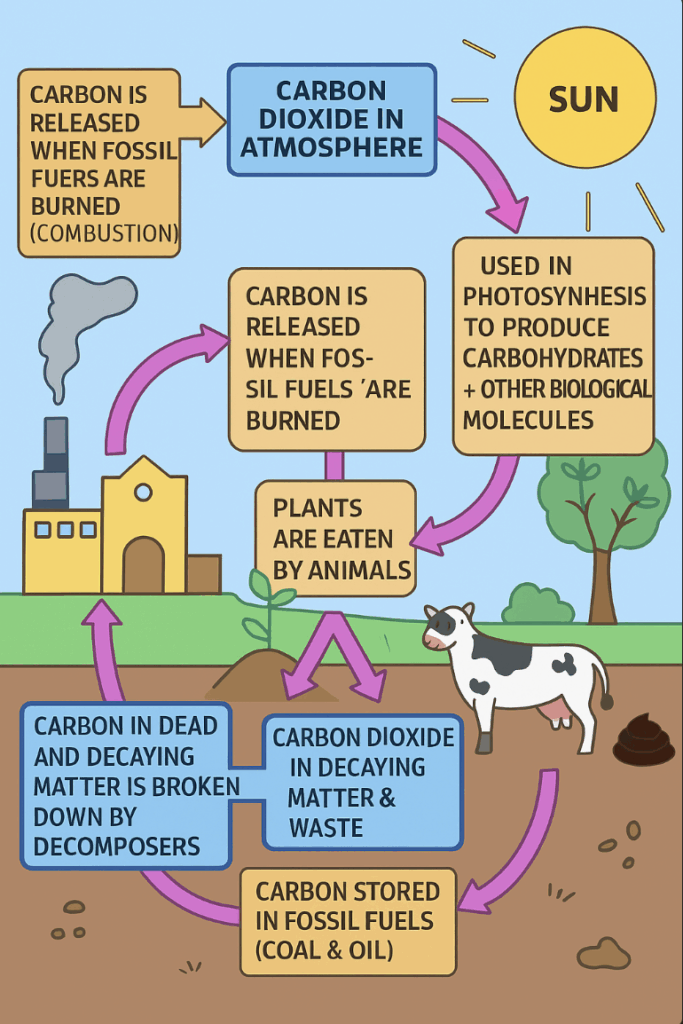
- Carbon flows between stores in ecosystems through various processes
- The main processes include:
- Photosynthesis (transformation)—plants absorb CO2 and convert it into organic compounds (carbohydrates)
- Cellular respiration (transformation)—both plants and animals release CO2 during respiration
- Feeding (transfer)—animals consume organic matter, transferring carbon through the food chain
- Defecation (transfer)—carbon is returned to the soil through waste products
- Death and decomposition (transfer)—decomposers break down dead organisms, releasing carbon back into the soil
- Other processes include:
- Fossilisation—if animals and plants die in conditions where decomposing microorganisms are not present, the carbon in their bodies can be converted, over millions of years and significant pressure, into fossil fuels such as peat and coal
- Aquatic organisms that die also form sediments on the sea bedThese can go on to form other fossil fuels like oil and gas
- Combustion—when fossil fuels are burned, the carbon locked within them combines with oxygen to form CO₂, which is released into the atmosphere
- Fossilisation—if animals and plants die in conditions where decomposing microorganisms are not present, the carbon in their bodies can be converted, over millions of years and significant pressure, into fossil fuels such as peat and coal
Carbon sequestration
- Carbon sequestration is the process of capturing atmospheric CO2 and storing it in solid or liquid forms
- For example, trees naturally sequester carbon by absorbing CO2 during photosynthesis and storing it in their biomass
- Organic matter can be fossilised over millions of years to form coal, oil and natural gas, resulting in carbon being stored underground
Ecosystems as stores, sinks or sources
- Ecosystems can act as stores, sinks or sources of carbon depending on the balance between inputsand outputs
- Net accumulation of carbon or net release of carbon is determined by the difference between total inputs and outputs
- For example:
- Young forest ecosystem: acts as a sink, as photosynthesis exceeds respiration, leading to net uptake of CO2
- Mature forest ecosystem: acts as a store, with carbon cycling between living organisms, soil and atmosphere
- Forest destruction (fire or deforestation): acts as a source, releasing stored carbon back into the atmosphere
📌 Human Impacts on the Carbon Cycle
Fossil fuels
- Fossil fuels like coal, oil and natural gas are stores of carbon with virtually unlimited residence times
- Fossil fuels were formed when past ecosystems acted as carbon sinks, trapping organic carbon over millions of years
- They were created from ancient plants and animals that lived millions of years ago
- Over time, their remains got buried deep underground
- As they were buried, pressure and heat turned them into fossil fuels
- Humans burn fossil fuels for energy production
- When burned, these fuels release heat energy
- The heat energy can be harnessed to generate electricity, power vehicles, heat buildings and fuel industrial processes
- When burned, fossil fuels become carbon sources, releasing stored carbon back into the atmosphere as carbon dioxide
Agricultural systems
- Agricultural systems can act as carbon sinks or carbon sources depending on the type of agricultural and the management techniques used:
- Carbon sinks: regenerative agriculture techniques like crop rotation, cover cropping, and no-till farming result in soil acting as a carbon sink
- This is because these methods increase the amount of organic matter in the soil
- Carbon sources: drainage of wetlands, monoculture farming and intensive tillage result in soil acting as a carbon source
- This is because these methods increase the release of carbon from soils
- Carbon sinks: regenerative agriculture techniques like crop rotation, cover cropping, and no-till farming result in soil acting as a carbon sink
- Longer-term cropping practices, such as timber production, also affect carbon cycling and storage in ecosystems
- When forests are managed sustainably for timber production, they can act as significant carbon sinks
- This is because they sequester carbon dioxide from the atmosphere through photosynthesis and store it in woody biomass and soil organic matter
- However, if forests are clear-cut or managed unsustainably, they can become carbon sources
- This is because stored carbon is released back into the atmosphere (when the harvested wood is burned) quicker than it is stored in new tree growth
- When forests are managed sustainably for timber production, they can act as significant carbon sinks
Oceanic carbon dynamics
- Carbon dioxide is absorbed into oceans by dissolving in sea water
- It can also come out of the solution and is released as a gas when conditions change (e.g. when ocean temperature increases)
- Normally, oceans act as a significant carbon sink, absorbing CO2 from the atmosphere and helping to regulate atmospheric carbon levels
- However, the burning of fossil fuels by humans is releasing CO2 at a faster rate than oceans can absorb
- This is leading to rising CO2 levels in the atmosphere
- In addition to warming ocean temperatures caused by human-induced climate change, this is reducing the ability of oceans to act as carbon sinks
- However, the burning of fossil fuels by humans is releasing CO2 at a faster rate than oceans can absorb
Ocean acidification
- Increased concentrations of dissolved CO2 in oceans lowers the pH of the sea water, leading to ocean acidification
- This is causing threats to marine organisms:
- Small decreases in ocean pH reduce calcium carbonate deposition in mollusc shells and coral skeletons
- This can lead to weakened shells, increased vulnerability to predators and smaller and less diverse reef structures
📌 Reducing Human Impacts on the Carbon Cycle
- Human activities have significantly altered the carbon cycle
- This has led to increased atmospheric carbon dioxide levels and climate change
- Measures are urgently needed to reduce these impacts and restore balance to the carbon cycle
- Example of these measure include:
- Human activities have significantly altered the carbon cycle
- This has led to increased atmospheric carbon dioxide levels and climate change
- Measures are urgently needed to reduce these impacts and restore balance to the carbon cycle
- Example of these measure include:
- Low-carbon technologies:
- Adopting low-carbon technologies is important for reducing carbon emissions from energy production, transportation, industry and buildings (heating, cooling etc.)
- Examples include renewable energy sources like solar, wind and hydropower, as well as more energy-efficient technologies and practices (e.g. better insulation and heatpumps)
- Adopting low-carbon technologies is important for reducing carbon emissions from energy production, transportation, industry and buildings (heating, cooling etc.)
- Reduction in fossil-fuel burning:
- Decreasing the burning of fossil fuels is an essential step in reducing carbon emissions
- Transitioning to cleaner energy sources, such as renewables can help achieve this
- Decreasing the burning of fossil fuels is an essential step in reducing carbon emissions
- Using biomass as a fuel source:
- Promoting sustainable cultivation of bioenergy crops that does not cause deforestation—bioenergy crops absorb carbon dioxide from the atmosphere as they photosynthesise
- Utilising bioenergy with carbon capture and storage (BECCS) technology
- This involves producing energy from biomass
- The carbon dioxide emissions from biomass combustion are also captured and stored underground
- Together these processes effectively remove carbon dioxide from the atmosphere
- Reduction in soil disruption:
- Decreasing soil disruption through sustainable agricultural practices is vital for preserving soil health and maintaining the ability of soils to sequester carbon
- Practices such as crop rotation and cover cropping can minimise soil disturbance, erosion and loss of organic matter
- Healthy soils with high organic carbon content act as carbon sinks, storing carbon and mitigating greenhouse gas emissions
- Decreasing soil disruption through sustainable agricultural practices is vital for preserving soil health and maintaining the ability of soils to sequester carbon
- Reduction in deforestation:
- Implementing programs like the UN Collaborative Programme on Reducing Emissions from Deforestation and Forest Degradation in Developing Countries (UNREDD)
- This prevents deforestation and promotes sustainable forest management
- Implementing programs like the UN Collaborative Programme on Reducing Emissions from Deforestation and Forest Degradation in Developing Countries (UNREDD)
- Carbon capture through reforestation:
- Reforestation involves planting trees on deforested or degraded lands to sequester carbon from the atmosphere
- Trees absorb CO2 during photosynthesis, storing carbon in their biomass and surrounding soils
- Forests act as important carbon sinks
- Reforestation involves planting trees on deforested or degraded lands to sequester carbon from the atmosphere
- Artificial sequestration:
- Artificial sequestration technologies capture CO2 emissions from industrial processes and power plants, preventing them from entering the atmosphere
- Methods include carbon capture and storage (CCS), where CO2 is captured, transported and injected underground for long-term storage
- Artificial sequestration technologies capture CO2 emissions from industrial processes and power plants, preventing them from entering the atmosphere
- Enhancing carbon dioxide absorption by the oceans:
- Ocean fertilisation techniques involve adding compounds like nitrogen, phosphorus and iron to stimulate the growth of phytoplankton
- These phytoplankton then absorb carbon dioxide through photosynthesis
- Using methods to increase ocean upwellings
- These upwellings bring nutrient-rich deep waters to the surface
- This has the same effect of promoting the growth of phytoplankton and enhancing carbon dioxide absorption
- Ocean fertilisation techniques involve adding compounds like nitrogen, phosphorus and iron to stimulate the growth of phytoplankton