2.2 ENERGY AND BIOMASS
📌 Definitions Table
| Term | Definition |
|---|---|
| Photosynthesis | The process by which green plants convert carbon dioxide and water into glucose and oxygen using sunlight energy. |
| Autotrophs | Organisms that produce their own food from inorganic substances, typically through photosynthesis or chemosynthesis. |
| Aerobic Respiration | The process of breaking down glucose using oxygen to release energy, producing carbon dioxide and water. |
| Entropy | A measure of disorder or randomness in a system; it increases as energy is transformed and becomes less available for work. |
| Trophic Levels | Hierarchical levels in an ecosystem based on feeding positions, from producers to various levels of consumers. |
| Egestion | The removal of undigested food material from an organism’s body as waste. |
| Leach | The process by which water dissolves and carries away nutrients or contaminants from soil. |
| Primary Productivity | The rate at which producers convert solar energy into chemical energy (biomass) in an ecosystem. |
| Carbon Sink Capacity | The ability of a natural system, like a forest or ocean, to absorb and store atmospheric carbon dioxide. |
| Impervious Surfaces | Surfaces such as concrete or asphalt that prevent water infiltration into the soil, increasing runoff. |
| Heat Islands | Urban areas that are significantly warmer than surrounding rural areas due to human activities and impervious surfaces. |
📌 Energy Flow in Ecosystems
Energy flow in ecosystems
- Ecosystems rely on a constant supply of energy and matter to maintain their structure and function
- Energy is essential for driving biological processes, while matter cycles through the ecosystem, being reused and recycled
- Ecosystems are considered open systems, meaning they exchange both energy and matter with their surroundings
- Energy enters ecosystems primarily from the sun, entering as sunlight and being converted into chemical energy by producers through photosynthesis
- This energy is then transferred between trophic levels as organisms consume one another, with some energy lost as heat at each transfer
- Decomposers break down organic matter, releasing energy and returning nutrients to the environment
- Matter, such as nutrients and water, flows into and out of ecosystems through various processes like decomposition, nutrient cycling and precipitation
- Energy enters ecosystems primarily from the sun, entering as sunlight and being converted into chemical energy by producers through photosynthesis
The first law of thermodynamics
- Energy exists in many different forms, including light energy, heat energy, chemical energy, electrical energy and kinetic energy
- The way in which energy behaves within systems can be explained by the laws of thermodynamics
- There are two laws of thermodynamics
- The first law of thermodynamics is as follows:
Energy can neither be created nor destroyed, it can only be transformed from one form to another
- This is also known as the principle of conservation of energy
- It means that the energy entering a system equals the energy leaving it
- It means that as energy flows through ecosystems, it can only change from one form to another
- The transfer of energy in food chains within ecosystems demonstrates the principle of conservation of energy:
- Energy enters the system (the food chain or food web) in the form of sunlight
- Producers convert this light energy into biomass (stored chemical energy) via photosynthesis
- This chemical energy is passed along the food chain, via consumers, as biomass
- All energy ultimately leaves the food chain, food web or ecosystem as heat energy
The second law of thermodynamics
- The second law of thermodynamics states that:
Energy transfers in ecosystems are inefficient
- This is because energy transfers in any system are never 100% efficient
- The second law of thermodynamics explains the decrease in available energy within ecosystems:
- In a food chain, energy is transformed from a more concentrated (ordered) form (e.g. light energy from the Sun), into a more dispersed or disordered form (heat energy lost by organisms)
- Initially, light energy from the Sun is absorbed by producers
- However, even at this initial stage, energy absorption and transfer by producers is inefficient
- This is due to reflection, transmission (light passing through leaves) and inefficient energy transfer during photosynthesis
- The energy that is converted to plant biomass is then inefficiently transferred along the food chain due to respiration and the production of waste heat energy
- In ecosystems, the biggest losses occur during cellular respiration
- When energy is transformed, some must be degraded into a less useful form, such as heat
- As a result of these inefficient energy transfers, food chains are often short (they rarely contain more than five trophic levels)
📌 Photosynthesis
What is photosynthesis?
- Primary producers in the majority of ecosystems convert light energy into chemical energy in the process of photosynthesis
- Producers are typically plants, algae and photosynthetic bacteria that produce their own foodusing photosynthesis
- They are also known as autotrophs
- Producers form the first trophic level in a food chain
- Producers are typically plants, algae and photosynthetic bacteria that produce their own foodusing photosynthesis
- The inputs and outputs are:
- Inputs: sunlight as an energy source, carbon dioxide, and water
- Processes: inside chloroplasts, chlorophyll captures certain visible wavelengths of sunlight energy and stores this as chemical energy
- Outputs: glucose and oxygen
- Transformations: light energy is transformed into stored chemical energy (in the form of glucose)
- Photosynthesis produces the raw material for producing biomass
- The glucose produced during photosynthesis is used as an energy source for the plant but also as the basic starting material for other organic molecules (e.g. cellulose and starch)
- In ecosystems where sunlight and water are available, the process of photosynthesis enables plants to synthesise these organic compounds (glucose and other sugars) from carbon dioxide
- Most of these sugars synthesised by plants are used by the plant as respiratory substrates
- A respiratory substrate is a molecule (such as glucose) that can be used in respiration, to release energy for growth
📌 Respiration
- Respiration is the conversion of organic matter into carbon dioxide and water in all living organisms, releasing energy
- Cellular respiration releases energy from glucose by converting it into a chemical form that can easily be used in carrying out active processes ( such as growth and repair) within living cells
- The aerobic respiration reaction is:

- The inputs and outputs are:
- Inputs: organic matter (glucose) and oxygen
- Processes: oxidation processes inside cells
- Outputs: release of energy for work (movement) and heat
- Transformations: stored chemical energy is transformed into kinetic energy and heat
- Some of the chemical energy released during cellular respiration is transformed into heat
- Heat is generated by cellular respiration because it is not 100% efficient at transferring energy from substrates, such as carbohydrates, into the chemical form of energy used in cells
- Heat generated within an individual organism cannot be transformed back into chemical energy and is ultimately lost from the body
- The heat energy released increases the entropy in the ecosystem, following the second law of thermodynamics, while enabling organisms to maintain relatively low entropy (high organisation)
📌 Trophic levels and food chains
What are trophic levels?
- The trophic level is the position that an organism occupies in a food chain (or food web)
- If multiple organisms occupy the same position in a food chain, they are in the same trophic level
| Trophic Level | Name of Trophic Level | Description of Organisms in Trophic Level |
|---|---|---|
| 1 | Producers | Plants and algae—produce their own biomass using energy from sunlight |
| 2 | Primary consumers | Herbivores—feed on producers |
| 3 | Secondary consumers | Predators—feed on primary consumers |
| 4 | Tertiary consumers | Predators—feed on secondary consumers |
- Producers are typically plants or algae and produce their own food using photosynthesis
- They form the first trophic level in a food chain
- The chemical energy stored in producers is then transferred to primary consumers as they consume(eat) producers
- The chemical energy is then transferred from one consumer to the next as they eat one another
- Consumers have diverse strategies for obtaining energy-containing carbon compounds
| Type of Consumer | Description | Examples |
|---|---|---|
| Herbivores | Feed primarily on plants and plant-derived material | Deer: graze on grasses, leaves, and shrubsRabbits: consume grasses, herbs, and vegetables |
| Detritivores | Consume decomposing organic matter (detritus) and help break it down further | Earthworms: feed on decaying plant material and enhance soil structureDung beetles: consume animal dung, aiding in nutrient recycling |
| Predators | Hunt and consume other organisms (prey) for food | Lions: prey on various herbivores such as gazelles and zebrasWolves: hunt animals like deer and elk in packs |
| Parasites | Depend on a host organism for survival, often harming but not immediately killing it | Tapeworms: live in the intestines of mammals, absorbing nutrients from the host’s foodMosquitoes: feed on the blood of animals, including humans, for nourishment |
| Saprotrophs and decomposers | Saprotrophs: decompose dead organic matter externally and absorb nutrientsDecomposers: break down organic matter into simpler substances, playing a vital role in nutrient recycling | Fungi: break down dead plant material, such as fallen leaves and wood, into simpler compoundsBacteria: decompose organic matter, releasing nutrients for plant uptake |
| Scavengers | Consume dead animal carcasses, helping to clean up ecosystems | Vultures: feed on the remains of dead animals, scavenging carrionHyenas: opportunistic scavengers known to consume a wide range of animal remains |
Food chains
- Feeding relationships in ecosystems can be modelled using food chains
- Because producers in ecosystems make their own carbon compounds by photosynthesis, they are at the start of food chains
- Consumers obtain carbon compounds from producers or other consumers, so are placed in the higher trophic levels
- In a food chain, carbon compounds and the energy they contain are passed from primary producers to primary consumers to secondary consumers, and so on
- Apex predators are at the very top of the food chain—they are carnivores or omnivores with no predators
- The chemical energy stored within apex predators can be passed on to decomposers when apex predators die and are decomposed
- Traditionally, decomposers are not included in food chains as they gain carbon compounds from a variety of trophic levels
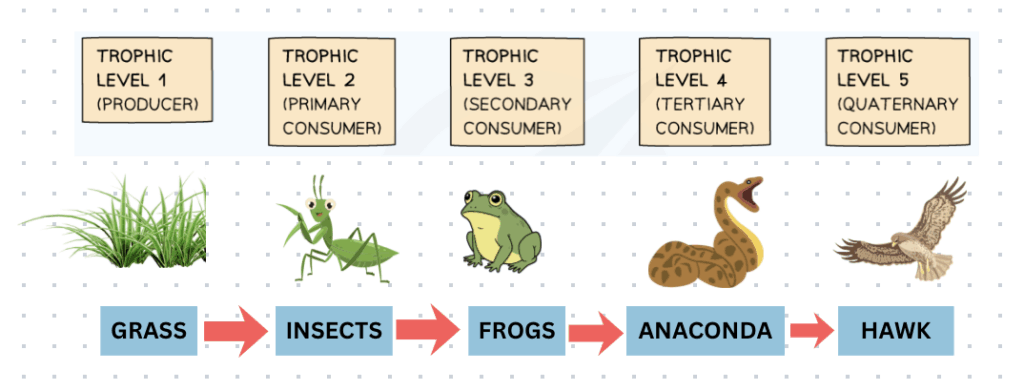
Image source: savemyexams.com
📌 Food Webs
- A food web is a network of interconnected food chains
- Food webs are more realistic ways of showing connections between organisms within an ecosystem as consumers rarely feed on just one type of food source
- Compared to food chains, food webs give us a lot more information about the transfer of energy in an ecosystem
- They also show interdependence (how a change in one population can affect others within the food web)
- For example, in the food web above, if the population of earthworms decreased:
- The population of grass plants would increase as there are now fewer species feeding off them
- The populations of frogs and mice would decrease significantly as earthworms are their only food source
- The population of sparrows would decrease slightly as they eat earthworms but also have another food source to rely on (caterpillars)

Image source: savemyexams.com
📌 Energy Losses in Food chains
Energy losses in food chains
- The total organic matter transferred from one trophic level to the next is never 100% because:
- Not all the food available to a given trophic level is harvested
- Of what is harvested, not all is consumed
- Of what is consumed, not all is absorbed
- Of what is absorbed, not all is stored
- For example, if we take the example of caterpillars (the primary consumer) eating the leaves of an oak tree (the producer):
- The caterpillars do not eat every leaf available to them (there may simply be too many leaves, not enough caterpillars, or some leaves may be in locations that are difficult for the caterpillars to access)
- The caterpillars may not eat the entire leaf (they might eat only the softer, more nutritious parts and leave behind tougher portions or parts with toxins)
- Once the caterpillars eat the leaves, not all of the nutrients are absorbed by their bodies (some parts of the leaves may be indigestible or contain compounds that the caterpillars cannot process, which are then egested by the caterpillars)
- When the caterpillars digest the leaves and convert the nutrients into energy, not all of the energy from the leaves is stored for growth and development, as some of that energy is lost as heat during cellular respiration
📌 Productivity and Biomass
Productivity
- Gross productivity (GP) is the total gain in biomass by an organism or community in a given area or time period
- It includes all the energy captured by organisms
- E.g. by plants through photosynthesis or by consumers feeding on other organisms
- For example, in a pond ecosystem, the total amount of energy captured by the aquatic plants and other species in the pond represents the gross productivity of that ecosystem
- Net productivity (NP) is the amount of energy or biomass remaining after losses due to cellular respiration
- These energy losses are subtracted from the gross productivity
- Net productivity reflects the energy available for growth and reproduction
- For example, if a plant has captured 1 000 kJ of energy through photosynthesis (gross productivity) but has used 300 kJ for cellular respiration, its net productivity would be 700 kJ
- Losses due to cellular respiration are usually greater in consumers than in producers
- This is due to the more energy-requiring activities of consumers
- For example, herbivores need to spend energy on activities such as digestion and movement, resulting in higher respiratory losses compared to plants
- This is due to the more energy-requiring activities of consumers
Net productivity and sustainable yield
- The NP of any organism or trophic level represents the maximum sustainable yield that can be harvested without decreasing the availability of resources for the future
- To maintain ecosystem stability and biodiversity, it is important to avoid harvesting beyond the sustainable yield of populations
- For example, in fisheries management, the sustainable yield of fish populations is determined by considering the net productivity of the fishery
- Harvesting beyond the sustainable yield can lead to overexploitation and depletion of fish stocks
- This affects both the ecosystem itself and human livelihoods
- To maintain ecosystem stability and biodiversity, it is important to avoid harvesting beyond the sustainable yield of populations
Measuring biomass
- Estimating the biomass and energy of trophic levels in a community is an important step in understanding the structure and function of an ecosystem
- There are several methods for measuring the biomass of a particular trophic, including:
- Measurement of dry mass
- Controlled combustion
- Extrapolation from samples
Measurement of dry mass
- One common method for estimating biomass is to measure the dry mass of organisms
- This involves collecting samples of organisms from a particular trophic level and drying them in an oven to remove all water within the tissues
- The dry weight of the sample is then measured
- This can then be used to estimate the total biomass of the populations that have been sampled
- Dry mass of samples is approximately equal to the mass of organic matter (biomass) since water represents the majority of inorganic matter in most organisms
- For example:
- If the dry mass of one daffodil plant is found to be 0.1 kg, then the dry mass (i.e. the biomass) of 200 daffodils would be 20 kg (0.1 x 200 = 20)
- If the dry mass of the grass from 1 m² of a field is found to be 0.2 kg, we can say that the grass has a dry mass (i.e. biomass) of 0.2 kg m⁻² (this means 0.2 kg per square metre)
- If the grass field is 200 m² in size, then the biomass of the whole field must be 40 kg (0.2 x 200 = 40)
Controlled combustion
- Another method for estimating biomass is controlled combustion
- This involves burning a known quantity of biomass and measuring the heat produced
- By knowing the heat value of the biomass, it is possible to estimate the total biomass of a population or trophic level, based on the amount of heat produced
- A piece of equipment known as a calorimeter is required for this process
- The burning sample heats a known volume of water
- The change in temperature of the water provides an estimate of the chemical energy the sample contains
Limitations of calorimetry
- It can take a long time to fully dehydrate (dry out) a biological sample to find its dry mass
- This is partly because the sample has to be heated at a relatively low temperature to ensure it doesn’t burn
- Depending on the size of the sample, the drying process could take several days
- Precise equipment is needed, which may not be available and can be very expensive
- A very precise digital balance should be used to measure the mass of the sample as it is drying
- This is to detect even extremely small changes in mass
- It is preferable to use a very precise digital thermometer when measuring the temperature change of the water in the calorimeter
- This is to detect even very small temperature changes
- A very precise digital balance should be used to measure the mass of the sample as it is drying
- The more simple and basic the calorimeter, the less accurate the estimate will be for the chemical energy contained within the sample
- This is due to heat energy from the burning sample being lost and not being transferred efficiently to the water
- A bomb calorimeter ensures that almost all the heat energy from the burning sample is transferred to the water, giving a highly accurate estimate
📌 Ecological Pyramids
Ecological pyramids
- Ecological pyramids include:
- Pyramids of numbers
- Pyramids of biomass
- Pyramids of energy (also known as pyramids of productivity)
- They are quantitative models usually measured for a given time and area
Pyramids of numbers
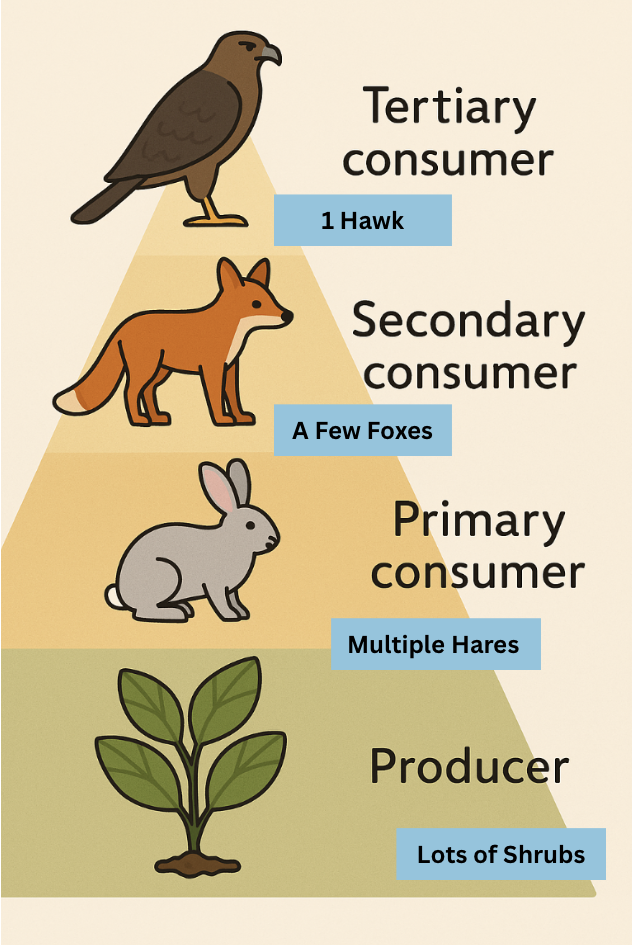
- A pyramid of numbers shows how many organisms we are talking about at each level of a food chain
- The width of the box indicates the number of organisms at that trophic level
- For example, consider the following food chain:
shrubs → hare → foxes → hawk
- A pyramid of numbers for this food chain would look like the one shown below
- Often, the number of organisms decreases along food chains, as there is a decrease in available energy since some energy is lost to the surrounding environment at each trophic level
- Therefore pyramids of numbers usually become narrower towards the apex (the top)
- Despite the name, a pyramid of numbers doesn’t always have to be pyramid-shaped
- For example, consider the following food chain:
oak tree → insects → woodpecker
- The pyramids of numbers for this food chain will display a different pattern to the first food chain
- When individuals at lower trophic levels are relatively large, like the oak tree, the pyramid becomes inverted:
- Only a single oak tree is needed to support large numbers of insects (which can then support large numbers of woodpeckers)
Image source: savemyexams.com
Pyramids of biomass
- A pyramid of biomass shows how much mass the organisms at each trophic level would have without including all the water that is in the organisms:
- This is known as their ‘dry mass’
- As per the second law of thermodynamics, the quantities of biomass generally decrease along food chains, so the pyramids become narrower towards the top
- If we take our first food chain as an example, it would be impossible to have 10kg of grass feeding 50kg of voles feeding 100kg of barn owls
- Being able to construct accurate pyramids of biomass from appropriate data is an important skill
- Pyramids of biomass are usually pyramid-shaped, regardless of what the pyramid of numbers for that food chain looks like
- However, they can occasionally be inverted and show higher quantities at higher trophic levels
- These inverted pyramids sometimes occur due to marked seasonal variations
- For example, in some marine ecosystems, the standing crop of phytoplankton, the major producers, is lower than the mass of the primary consumers, such as zooplankton
- This is because the phytoplankton reproduce very quickly and are constantly being consumed by the primary consumers, which leads to a lower standing crop but higher productivity
- This can occur because phytoplankton can vary greatly in productivity (and therefore biomass) depending on sunlight intensity

Image source: savemyexams.com
Pyramids of energy
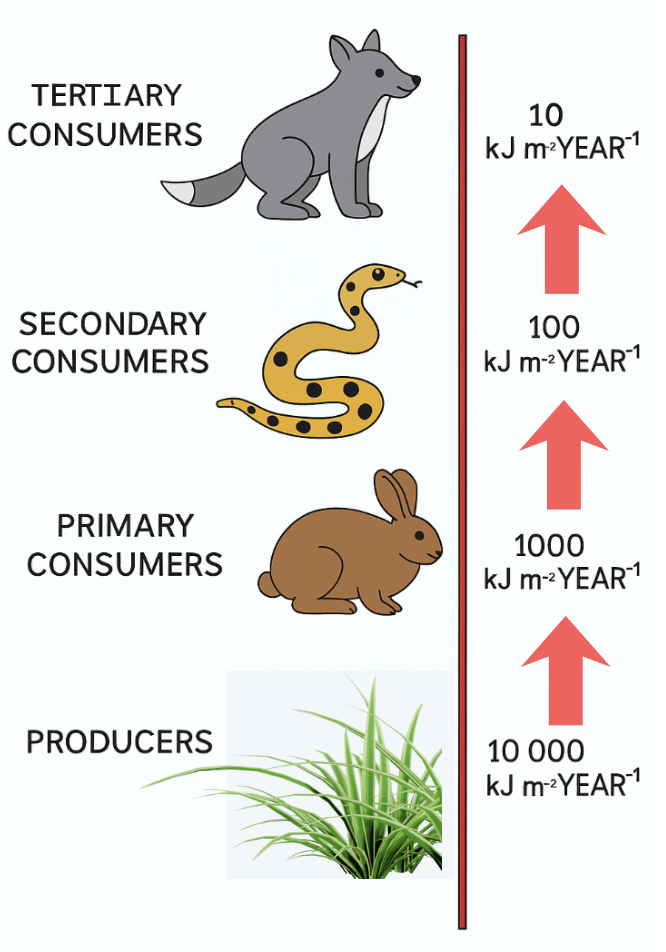
- Pyramids of energy (also referred to as pyramids of productivity) show the flow of energy through trophic levels, indicating the rate at which that energy is being generated
- Pyramids of productivity illustrate the amount of energy or biomass of organisms at each trophic level per unit area per unit time
- Productivity is measured in units of flow
- The units are mass or energy per metre squared per year (g/kg m-2 yr-1 or J/kJ m-2 yr-1)
- The length of each box, or bar, represents the quantity of energy present
- These pyramids are always widest at the base and decrease in size as they go up
- This is because pyramids of productivity for entire ecosystems over a year always show a decrease along the food chain, following the second law of thermodynamics
- The base is wide due to the large amount of energy contained within the biomass of producers
- As you move up the pyramid to higher trophic levels, the quantity of energy decreases as not all energy is transferred to the biomass of the next trophic level (roughly 10 % of the energy is passed on)
- Energy is lost at each trophic level due to:
- Incomplete consumption
- Incomplete digestion
- Loss of heat energy to the environment during respiration
- Excretion of the waste products of metabolism e.g. carbon dioxide, water, and urea
📌 Human Impacts on energy and Matter flows
Bioaccumulation and biomagnification
- Bioaccumulation is the build-up of persistent or non-biodegradable pollutants within an organism or trophic level because they cannot be broken down
- Biomagnification is the increase in the concentration of persistent or non-biodegradable pollutants along a food chain
- As pollutants are passed up the food chain from one trophic level to the next, they become more concentrated
- This means that organisms at higher trophic levels (such as top predators) accumulate higher concentrations of pollutants than those at lower trophic levels
- This is due to the decrease in the total biodegradable biomass of organisms at higher trophic levels
- Pollutants that are persistent and non-biodegradable can accumulate along food chains
- Examples include:
- Polychlorinated biphenyl (PCB)
- Dichlorodiphenyltrichloroethane (DDT)
- Mercury
- Examples include:
- They can cause changes to ecosystems through the processes of bioaccumulation and biomagnification
- For example, DDT was a widely used insecticide in the mid-20th century that was found to have harmful effects on birds of prey such as eagles and falcons
- When DDT was sprayed on crops, it would leach into waterways and eventually enter freshwater and marine ecosystems
- DDT would then enter food chains (via plankton) and accumulate in the bodies of fish
- These fish would then be eaten by birds, which would accumulate higher concentrations of DDT
- Because DDT is persistent and does not break down easily, it can continue to accumulate in the bodies of animals at higher trophic levels (such as birds of prey), leading to harmful effects such as thinning of eggshells and reduced reproductive success
- Mercury is another example of a pollutant that can accumulate along food chains
- Mercury is released into the environment through activities such as coal-fired power plants and gold mining
- Once in the environment, mercury can be converted into a highly toxic form called methylmercury
- This accumulates in the bodies of fish
- As larger fish eat smaller fish, the concentration of methylmercury within the tissues of these fish increases, leading to potential harm for humans who eat large predatory fish such as tuna or swordfish
- In 1956, for example, a chemical factory released toxic methylmercury into waste water entering Minamata Bay in Japan
- Mercury accumulation in fish and shellfish caused mercury poisoning in local people (who ate the fish and shellfish) and resulted in severe symptoms (paralysis, death, or birth defects in newborns)
Non-biodegradable pollutants and microplastics
- One concerning aspect of many non-biodegradable pollutants is that they can be absorbed by microplastics
- This can increase the transmission of these pollutants within food chains (i.e. increase the level of biomagnification)
- Microplastics are tiny plastic particles, often less than 5mm in size
- They come from various sources like plastic bottles, packaging and synthetic clothing
- When in the environment, these microplastics act a bit like sponges, absorbing non-biodegradable pollutants such as polychlorinated biphenyls (PCBs), pesticides and heavy metals such as lead and mercury
Effect on the food chain
- Marine animals often ingest microplastics as they feed
- As smaller organisms consume microplastics containing pollutants, these toxins accumulate in their bodies
- Larger predators then consume these contaminated organisms, leading to biomagnification, where the concentration of toxins increases at higher trophic levels
- This can have negative consequences for organisms in food chains
- For example, a study found that oysters exposed to microplastics containing pollutants experienced:
- Lower feeding rates
- Altered growth patterns
- Reduced reproductive success
- This was found to negatively impact the fitness of individual oysters and the success of the population as a whole
- For example, a study found that oysters exposed to microplastics containing pollutants experienced:
Human activities and ecosystem impacts
- Human activities can significantly change the natural flows of energy and matter within ecosystems
- Burning fossil fuels:
- Releases carbon dioxide into the atmosphere, contributing to global warming
- Increased CO2 availability can increase photosynthesis rates
- However, other pollutants and climate change effects (e.g. temperature rise and changing rainfall patterns) can outweigh this benefit, reducing primary productivity
- For example, burning coal to generate electricity emits CO2 but also releases sulfur dioxide (SO2)
- This pollutant contributes to acid rain and affects soil pH, which in turn impacts plant health and nutrient availability
- This further reduces photosynthesis rates
- Deforestation:
- Clearing forests for agriculture, urbanisation, or logging disrupts ecosystems
- As well as causing habitat loss and disruption of food webs, deforestation reduces the carbon sink capacity of forests
- This contributes to climate change
- Clearing forests for agriculture, urbanisation, or logging disrupts ecosystems
- Urbanisation:
- Urban development replaces natural habitats with impervious surfaces like concrete, leading to increased runoff and reduced infiltration
- Urban areas generate “heat islands”, increasing local temperatures
- Agriculture:
- Intensive agriculture involves the use of fertilisers, pesticides and monoculture practices
- This can lead to soil degradation, water pollution and loss of biodiversity