1.3 SUSTAINABILITY
📌 Definitions Table
| Term | Definition |
|---|---|
| Socioecological Systems | Integrated systems that include both human (social) and ecological components interacting to sustain environmental and societal functions. |
| Resilience | The ability of a system to resist or recover from disturbance while maintaining its structure and function. |
| Replenishment | The natural or managed process of restoring depleted resources or stocks within an environmental system. |
| Biodiversity | The variety and variability of life at genetic, species, and ecosystem levels within a given area. |
| Brundtland Report | The 1987 UN report “Our Common Future” that defined sustainable development as meeting present needs without compromising future generations. |
| Quantitative Measures | Numerical indicators used to assess environmental data, such as biocapacity, ecological footprint, or CO₂ emissions. |
| Biocapacity | The capacity of an area to generate renewable resources and absorb waste, especially carbon emissions, under current technology. |
| Ecological Footprint | The total area of biologically productive land and water required to support an individual or population’s resource use and waste assimilation. |
| Carbon Dioxide Equivalents (CO₂e) | A standard unit expressing the global warming potential of different greenhouse gases relative to CO₂. |
| Phenology | The study of periodic biological events (e.g., flowering, migration) and their relationship to seasonal or climatic changes. |
| SDGs (Sustainable Development Goals) | A set of 17 global goals adopted by the UN in 2015 to promote sustainability, equality, and environmental protection by 2030. |
| PCB (Polychlorinated Biphenyls) | Persistent organic pollutants once used in industrial processes, now banned due to their toxicity and bioaccumulation. |
| Transboundary Pollution | Pollution that originates in one country and crosses borders through air, water, or soil to affect other nations. |
| Carbon Sequestration | The process of capturing and storing atmospheric CO₂ in vegetation, soils, or geological formations to mitigate climate change. |
| Decouple | To separate economic growth from environmental degradation through sustainable production and consumption practices. |
| Natural Capital | The world’s natural resources—such as soil, air, water, and biodiversity—that provide ecosystem goods and services. |
| Natural Sustainable Yield | The rate at which natural capital can be exploited without depleting the original stock or its long-term productivity. |
📌 Introduction to Sustainability
Understanding sustainability
- Sustainability refers to the ability of a system to endure and remain viable (i.e. maintain its functionality and integrity) over time
- In the context of socio-ecological systems, sustainability involves responsible practices that ensure resources are not depleted and conditions for future generations are not compromised
Sustainability of systems
- All human activities are interconnected within systems
- Enhancing the resilience of these systems increases sustainability
- This can be achieved by making sure the system’s components are properly maintained
- For example, a sustainable agricultural system must take into account multiple factors, such as soil health, water management and biodiversity, to ensure long-term productivity without degrading the environment
The three pillars of sustainability
- Sustainability includes three pillars:
- Environmental sustainability
- Social sustainability
- Economic sustainability
- These pillars are interdependent and must be balanced for overall sustainability
- For example, a business implementing green practices (environmental) might also improve employee well-being (social) and reduce unnecessary spending (economic) to improve the overall long-term sustainability of the business
Environmental sustainability
- Environmental sustainability focuses on the responsible use and management of natural resources to ensure their replenishment and the preservation of these resources
- It also focuses on allowing whole ecosystems to recover and regenerate
- Strategies to achieve environmental sustainability include the following:
- Resource management:
- Practices that allow for the replacement of resources used, such as sustainable forestry practices
- Example: sustainable aquaculture and fishery management, where fishing quotas and habitat restoration efforts ensure the replenishment of fish stocks and the preservation of marine ecosystems
- Pollution control:
- Efforts that aim to minimise pollution and its harmful effects on ecosystems and human health
- Example: waste management schemes, like recycling programmes and waste-to-energy plants, reduce landfill waste and pollution, e.g. plastic pollution
- Biodiversity conservation:
- Preserving biodiversity ensures the resilience of ecosystems and supports their ability to adapt to changing conditions
- Example: conservation projects, like the reintroduction of native species or habitat restoration initiatives, enhance biodiversity in local ecosystems
- Active regeneration:
- Beyond conservation efforts, active regeneration involves interventions aimed at restoring degraded ecosystems to a more natural state
- Example: wetland restoration projects, such as those undertaken in the Norfolk Broads (UK), involve re-establishing native vegetation and hydrological patterns to enhance ecosystem functions like flood control and water purification
- Ecosystem services:
- Sustainable practices recognise the value of ecosystem services, such as clean water, air purification and carbon sequestration; they should aim to maintain or enhance these services
- Example: urban green spaces, like London’s parks and gardens, provide essential ecosystem services by absorbing pollutants, mitigating urban heat island effects and supporting biodiversity
- Long-term perspectives:
- Environmental sustainability requires consideration of long-term impacts and planning for the continued health and resilience of ecosystems
- Example: afforestation programmes, like the UK’s Northern Forest initiative, aim to plant millions of trees to enhance biodiversity, sequester carbon and mitigate climate change impacts over the coming decades
- Resource management:
Social sustainability
- Social sustainability focuses on creating inclusive structures and systems that support human well-being and the longevity of societies and cultures
- Strategies to achieve social sustainability include the following:
- Community development:
- Sustainable communities prioritise equitable access to resources, services and opportunities for all members
- Example: community gardens not only promote access to fresh produce but can also help build social connections and local resilience (e.g. by enhancing local food security)
- Cultural preservation:
- Sustainability includes efforts to maintain cultural traditions, languages and practices that contribute to the identity and cohesion of societies
- Example: initiatives to revive Indigenous languages or protect cultural heritage sites can promote social sustainability by preserving cultural diversity
- Health and education:
- Access to healthcare, education and other essential services is crucial for social sustainability
- Example: public health campaigns targeting issues like quitting smoking or adopting healthy eating habits can improve community well-being
- Community development:
Economic sustainability
- Economic sustainability involves creating economic systems that meet present needs without compromising the ability of future generations to meet their own needs
- Strategies to achieve economic sustainability include the following:
- Resource efficiency:
- Sustainable economic practices prioritise resource efficiency, reducing waste and reducing environmental impacts
- Example: adoption of circular economy principles in manufacturing, where products are specifically designed for reuse or recycling, promotes economic sustainability
- Long-term planning:
- Economic sustainability requires planning for the long term, considering factors like resource availability, technological advancements and market stability
- Example: investment in renewable energy infrastructure not only reduces greenhouse gas emissions but also creates long-term economic opportunities in the clean energy sector
- Equitable growth:
- Sustainable economic development seeks to reduce inequalities and ensure fair distribution of resources and opportunities
- Example: microfinance initiatives can help marginalised communities by providing access to financial capital for entrepreneurial activities and promoting economic sustainability at the grassroots level
- Resource efficiency:
🧠 Exam Tips:
1. Always link definitions to real-world examples in extended responses (e.g., transboundary pollution — Chernobyl fallout, 1986).
2. For “sustainability” terms, mention time scale and future generations to gain full marks.
3. When relevant, include keywords like capacity, productivity, equilibrium, stock, or flow to show conceptual understanding.
📌 Sustainable Development
Sustainable development
- Sustainable development is a concept that aims to balance economic, social and environmental factors to meet the needs of the present generation without compromising the ability of future generations to meet their own needs
- Examples of sustainable development include:
- The use of renewable energy sources, such as wind, solar, or hydropower, instead of non-renewable energy sources, such as fossil fuels
- Sustainable agriculture involves using techniques that minimise the negative impact of agriculture on the environment, such as crop rotation, soil conservation and reduced use of pesticides and fertilisers
- Sustainable urban planning aims to create cities that are more liveable, efficient and environmentally friendly, such as through the use of public transportation, green spaces (e.g. public parks or green roofs) and energy-efficient buildings to mitigate climate change impacts
- The concept of sustainable development gained wider recognition with the publication of the Brundtland Report in 1987 by the World Commission on Environment and Development
- The report introduced the idea of sustainable development by highlighting the importance of addressing social and economic issues alongside environmental concerns
- Sustainable development requires a long-term perspective and a commitment to understanding the highly complex interactions between the economic, social and environmental aspects of our growing and developing societies
- It is an ongoing process that requires the cooperation and involvement of individuals, organisations and governments at all levels
Environmental, Social and Economic Aspects of Sustainable Development
| Environment | Renewable energyWaste managementWater treatmentReduce, reuse, and recycleNature reservesUrban wildlifeEcosystem services |
|---|---|
| Society | Cultural diversitySocial stabilityEducationHealthcareCrimePersonal freedomGender equality |
| Economy | Economic growthDeveloping nationsCost of urban infrastructureEnergy-efficient buildingsEconomic policiesInternational tradeLabour market |
Unsustainable use of natural resources
- Unsustainable exploitation of natural resources poses significant threats to ecosystems and human well-being
- When natural resources are overused or mismanaged, it can lead to irreversible damage and ecosystem collapse
- A clear example of this is the Newfoundland cod fisheries
Economic indicators and sustainability
- Traditional economic indicators, like gross domestic product (GDP), provide a limited view of economic progress and development
- While GDP measures the value of goods and services produced within a country’s borders, it does not account for the depletion of natural resources or the costs of environmental degradation
- This can lead to patterns of unsustainable development that prioritise short-term economic gains over long-term sustainability
Green GDP
- Economists are increasingly using alternative measures that take environmental factors into account
- Green GDP adjusts traditional GDP calculations by accounting for environmental costs and depletion of natural resources
- By subtracting the environmental costs associated with economic activities, Green GDP provides a more accurate measure of economic progress that considers both long-term economic and environmental sustainability
- For example, in China, policymakers have begun to incorporate environmental considerations into economic planning by developing measures such as Green GDP
- This shows that they are starting to properly recognise the importance of sustainability in achieving long-term economic prosperity
📌 Environmental Justice
Environmental justice
- Environmental justice refers to the right of all people to live in a pollution-free environment and to have equitable (i.e. fair and equal) access to natural resources
- This is regardless of issues such as race, gender, socio-economic status or nationality
Inequalities and disparities
- Inequalities in income, race, gender and cultural identity within and between different societies lead to disparities in access to water, food and energy
- For example: Some communities cannot afford reliable access to clean water or electricity
- Privatisation of water sources can make this issue worse, leading to higher costs and unequal access
- In some regions, rural communities often struggle to afford electricity, limiting job opportunities and opportunities for development
Environmental injustice
- Environmental injustice refers to the unequal distribution of environmental burdens and benefits, often due to factors such as race, class, or other social factors
- It includes situations where marginalised communities experience a greater number of environmental hazards or lack access to environmental goods and services
- At the local level, environmental injustice can occur in various ways, such as:
- The presence of hazardous facilities such as landfills, incinerators, or industrial plants in or near to low-income or minority neighbourhoods
- Pollution hotspots mainly harm poorer communities, causing health problems
- Lack of access to clean water, safe housing, or green spaces in economically disadvantaged areas
- Environmental injustice is not limited to local contexts but also occurs on a more global scale, such as:
- Exploitation of natural resources in developing countries by multinational corporations, leading to environmental degradation and displacement of Indigenous communities
- Export of general or hazardous waste from wealthier nations to poorer countries, exposing vulnerable populations to health risks
- Climate change impacts disproportionately affecting low-income countries and communities with limited resources to adapt or mitigate
- In general, environmental injustice increases existing social inequalities and undermines human rights, particularly for vulnerable populations
- It often leads to negative health outcomes, economic disparities and challenges to the well-being and resilience of the communities affected
Application of sustainability and environmental justice
- The principles of sustainability and environmental justice can be applied across various scales, from individual actions and decision-making to national policies to global policy frameworks
Operating scales
- Individual scale:
- Personal actions greatly affect the environment
- Everyday choices and behaviours can shape environmental outcomes and contribute to broader patterns of consumption and resource depletion
- Choices like reducing waste, saving energy and supporting eco-friendly products can make a difference
- For example, choosing reusable products, using public transport and backing local green projects can help create a more sustainable world
- Global scale:
- International efforts like the United Nations Sustainable Development Goals (SDGs) tackle major environmental issues
- By working together and being more accountable for their actions, countries can protect the environment and work towards removing environmental injustices
- For example, SDG 13 focuses on fighting climate change and building a greener future for everyone
📌 Sustainability Indicators
Sustainability indicators
- Sustainability indicators are quantitative measures used to assess various aspects of sustainability
- These indicators can be specific to biodiversity, pollution, human population, climate change and many other factors
- Some well-known sustainability indicators include ecological footprints, carbon footprints and water footprints
- Sustainability indicators can be applied across different scales, from local to global, to evaluate the environmental, social and economic dimensions of sustainability
- For example, they can help us understand if something is environmentally friendly, socially fair and economically viable
- These indicators can be specific to biodiversity, pollution, human population, climate change and many other factors
Ecological footprints
- An ecological footprint (EF) is a theoretical concept that acts as a valuable tool used to assess the environmental impact of human populations
- It quantifies the area of land and water required to support a specific population at a particular standard of living
- An EF is measured in global hectares (gha) per capita (i.e. hectares per person) per unit time
- The ecological footprint provides a comprehensive measure of the demands that human populations place on the environment
- It takes into account the resources consumed by individuals, such as food, energy, water and materials, as well as the waste generated and the ecosystem services required to absorb that waste
- By considering these factors, ecological footprints help to evaluate the sustainability of human activities
Lifestyle choices, including diets and consumption patterns, affect a region’s ecological footprint size—countries that have very high consumption rates of highly processed foods have large ecological footprints due to both the resources required to sustain this diet or lifestyle and the large amount of solid domestic waste this lifestyle produces
- EFs can be used to compare the sustainability of different lifestyles, businesses and even whole countries
- If the EF of a lifestyle, business or country exceeds the area available to the population (also known as the biocapacity—the amount of resources that the planet can provide sustainably), it means that it is not sustainable in the long-term
- In the UK, for example, the ecological footprint is estimated to be about 4.2 global hectares (gha) per person per year, whilst the biocapacity is only around 1.7 gha per person per year, indicating that the UK population is living unsustainably
- To reduce an EF, it is important to adopt more sustainable practices, such as reducing meat consumption, using renewable energy sources and using public transport or walking instead of driving
- EFs are a useful tool for promoting sustainable development and for raising awareness about the impact of human activities on the environment
Other sustainability indicators
Carbon footprints
- The carbon footprint measures the amount of greenhouse gases (GHGs) produced by a person, activity, business or country
- Carbon footprints are usually measured in carbon dioxide equivalents (in tonnes) per year
- Carbon footprints can help us understand how much our actions contribute to global climate change
- For example, the carbon footprint of a UK citizen is approximately 5.5 tonnes of CO2 per year
Water footprints
- Water footprints measure the amount of water used directly or indirectly to produce certain goods and services
- For example, this could include water used for crop irrigation or water used for manufacturing processes
- Understanding water footprints helps us manage water resources more sustainably
- Water footprints are usually measured in cubic metres per year
📌 Citizen Science
Citizen science
- Citizen science involves members of the public participating in scientific research projects, contributing data, observations, or resources
- Citizen science has the potential to play a very important role in monitoring Earth systems and assessing whether resources are being used sustainably
Monitoring earth systems
- Local relevance:
- Citizen science projects are often used to gather data relevant to local environmental issues and conditions
- For example, the UK’s Open Air Laboratories (OPAL) network engages citizens in monitoring air and water quality, biodiversity and climate change impacts in their local areas
- Citizen science projects are often used to gather data relevant to local environmental issues and conditions
- Global impact:
- Data collected through citizen science initiatives can also contribute significantly to research on more global-scale environmental issues
- For example, the Global Learning and Observation to Benefit the Environment (GLOBE) Programme involves students and citizens worldwide in collecting and sharing environmental data, contributing to our understanding of global climate patterns
- Data collected through citizen science initiatives can also contribute significantly to research on more global-scale environmental issues
Integration with scientific research
- Complementing professional research:
- Citizen science projects can complement traditional scientific research by engaging a larger pool of participants and increasing data collection capacity
- For example, the UK Ladybird Survey uses citizen scientists from across England, Scotland, Wales and Northern Ireland to monitor ladybird populations, aiding researchers in studying the impact of invasive species and climate change on native biodiversity
- Citizen science projects can complement traditional scientific research by engaging a larger pool of participants and increasing data collection capacity
- Diverse data collection:
- Citizen scientists provide valuable insights due to their varied backgrounds, locations and perspectives, contributing to morecomprehensive datasets
- For example, the UK “Bioblitz” events bring together scientists and the public to survey and record species in specific areas, enhancing our understanding of local biodiversity
- Citizen scientists provide valuable insights due to their varied backgrounds, locations and perspectives, contributing to morecomprehensive datasets
📌 Sustainability Frameworks and Models
UN Sustainable Development Goals
- There are a range of frameworks and models that support our understanding of sustainability
- Sustainability models, like all models, are simplified versions of reality
- This means they have both uses and limitations
- The United Nations created one of these models, known as the Sustainable Development Goals (SDGs), in 2015
- In 2015, the United Nations Member States committed to a shared plan for peace and prosperity for people and the planet, now and into the future
- This plan is called the 2030 Agenda for Sustainable Development
- The UN Sustainable Development Goals (SDGs) are a comprehensive set of social and environmental objectives that were established as targets for the 2030 Agenda
- These goals aim to provide a universal framework for addressing urgent global challenges whilst promoting sustainable development and environmental justice
- The SDG model recognises that ending poverty must go hand-in-hand with strategies that improve health and education, reduce inequality and generate economic growth—all while tackling climate change and working to preserve ecosystems such as our oceans and forests
The 17 Sustainable Development Goals
- The SDG model consists of 17 goals and 169 targets covering various aspects of sustainable development
- Goals range from eradicating poverty and hunger to promoting sustainable cities and combating climate change
- The SDGs provide both a target for sustainable development and a metric to measure the progress made
Uses of the SDGs
- Common ground for policymaking:
- The SDGs provide a shared agenda for governments, organisations (NGOs and IGOs) and communities to develop policies and initiatives
- Global relevance:
- The SDGs are applicable to both developed and developing countries, encouraging a universal approach to sustainability
- Galvanising the international community:
- The SDGs encourage collaboration and collective action among nations and stakeholders to address economic and social inequalities
Limitations of the SDGs
- Insufficient ambition:
- Criticisms suggests that the SDGs do not go far enough in addressing the magnitude of global challenges
- Top-down approach:
- Some argue that the SDGs are bureaucratic and fail to adequately involve local communities in decision-making processes
- Ignoring local contexts:
- The SDGs may overlook the unique socio-cultural, economic and environmental contexts of different regions
- Data deficiency:
- The lack of comprehensive and accurate data hinders monitoring and evaluation of progress towards achieving the SDGs
Planetary boundaries model
- The planetary boundaries model outlines nine critical processes and systems that have regulated the stability and resilience of the Earth system during the Holocene epoch
- Scientists created the model to specify the ecological systems on Earth within which humanity could operate safely.
- It identifies limits to human disturbance on these processes and systems to prevent abrupt and irreversible changes
Explanation of the Nine Planetary Boundaries
| Planetary boundary | Explanation | Example |
|---|---|---|
| Climate change | The human-induced alteration of Earth’s climate systemEvidenced by rising global temperatures, sea level rise and extreme weather events | Increasing frequency and intensity of hurricanes |
| Erosion of biosphere integrity (biodiversity loss) | The reduction in Earth’s variety of life due to human activityDue to habitat destruction, species extinction and ecosystem degradation | Deforestation of the Amazon rainforest leading to loss of species diversity |
| Biogeochemical flows (nitrogen and phosphorus cycles) | The disruption of natural nutrient cycles due to agricultural and industrial activitiesExcessive use of fertilisers leads to water pollution, algal blooms and dead zones | “Dead Zone” in the Gulf of Mexico brought on by Mississippi River nutrient runoff |
| Stratospheric ozone depletion | The thinning of Earth’s ozone layer due to human-made chemicals like chlorofluorocarbons (CFCs)Ozone depletion increases exposure to UV radiation, harming ecosystems and human health | Antarctic ozone hole formed by CFC emissions |
| Ocean acidification | The lowering of pH levels due to increased carbon dioxide absorption by oceansAcidification damages marine life, especially organisms with calcium carbonate shells | Coral bleaching in the Great Barrier Reef due to ocean acidification |
| Freshwater use | The unsustainable extraction and use of freshwater resourcesOveruse leads to the depletion of aquifers, reduced river flows and ecosystem degradation | Aral Sea shrinking due to excessive irrigation withdrawals |
| Land system change | The conversion of natural ecosystems into urban, agricultural and industrial areasLeads to loss of biodiversity, soil erosion and disruption of carbon and water cycles | Deforestation of the Amazon for cattle ranching and soy production |
| Chemical pollution (introduction of novel entities in the environment) | The release of synthetic chemicals into the environmentPollutants harm human health, ecosystems and wildlife | PCB contamination in rivers affecting fish populations |
| Atmospheric aerosol loading | The emission of particulate matter and aerosols into the atmosphereAerosols impact climate, air quality and human health | Smog formation in cities is due to industrial emissions |
Uses of the planetary boundary model
- Identifies science-based limits:
- Provides clear boundaries based on scientific understanding of Earth systems
- Highlights of the need for comprehensive action:
- Shifts focus beyond climate change (which dominates current discussion) to address other critical environmental issues
- Raises awareness:
- Alerts the public and policymakers about the urgency of protecting Earth’s systems
Limitations of the planetary boundary model
- Ignores societal factors:
- It focuses only on ecological systems and does not consider the human dimension necessary to take action for environmental justice
- Work in progress:
- Assessments of boundaries are constantly changing as new data becomes available
- Global focus may not suit local action:
- Boundaries may not align with local or national priorities, making necessary actions challenging to implement at these smaller scales
📌 Alternative Economic Models
Doughnut economics model
- The doughnut economics model provides a framework for building an economy that meets the needs of all people while staying within the ecological limits of the planet
- It emphasises the importance of creating a regenerative and distributive economy
Regenerative economy
- A regenerative economy is one that works within the natural cycles and limits of the planet
- It aims to restore and renew (i.e. regenerate) resources rather than deplete them
- For example, transitioning from fossil fuels to renewable energy sources like solar and wind power
Distributive economy
- A distributive economy is one that shares value and opportunities more equitably among all stakeholders
- It aims to reduce inequality and ensure a fair distribution of resources.
- For example, implementing policies such as universal basic income to provide economic security for all citizens
Social foundation
- The inner ring or inner boundary of the doughnut model is known as the “social foundation”
- It is based on the social Sustainable Development Goals (SDGs)
- This boundary represents the minimum standards for human well-being, including access to education, healthcare and social protection
- For example, ensuring everyone has access to clean water and sanitation
Ecological ceiling
- The outer ring or outer boundary of the doughnut model is known as the “ecological ceiling”
- It is based on planetary boundaries science (i.e. the theory behind the planetary boundaries model)
- This boundary represents the limits of the Earth’s ecosystems and resources
- For example, adopting water conservation measures to sustainably manage freshwater resources and prevent depletion
- Together, the social foundation and the ecological ceiling represent the minimum conditions for an economy that is ecologically safe and socially just
- This is why the middle of the doughnut is referred to as the “safe and just space for humanity”


Image source: savemyexams.com
Moving into the doughnut
- Today, billions of people still fall short of the social foundation, while humanity has collectively overshot most of the planetary boundaries (we have “broken through” the ecological ceiling)
- Therefore, as this model illustrates, humanity’s objective is to “move into the doughnut” and establish an economy that enables all societies to prosper in harmony with the rest of the living world
- Making economies that are regenerative and distributive by design is the only way to achieve it
- This requires drastic changes but needs to start with the implementation of policies and practices that promote sustainability and equity
Uses of the doughnut economics model
- Supports environmental justice:
- The model includes both ecological and social elements, so it supports the concept of environmental justice
- Raises awareness:
- The model has reached popular awareness and highlights the interconnectedness of social and environmental issues, raising public understanding and engagement in sustainable development efforts
- Applied at various scales:
- From countries to cities to individual businesses, the model helps sustainable development efforts by providing a flexible framework adaptable to different contexts and scales
- Promotes interdisciplinary collaboration:
- Encourages collaboration between economists, environmentalists, policymakers and communities to address complex sustainability challenges
Limitations of the doughnut economic model
- Lacks specificity:
- The model is a work-in-progress that offers broad principles but lacks detailed guidance on specific policies and actions needed for implementation. Some critics argue that the model is too theoretical and lacks practical solutions for complex economic issues
- Challenges in application:
- Different contexts may require specific approaches and translating the model into realistic and effective strategies at local or national levels can be complex
- Changing nature:
- As our understanding of sustainability evolves and new data emerges, the boundaries of the model may need adjusting
Circular economy model
- The circular economy model is a sustainable economic system designed to minimise waste and maximise resource efficiency
- It aims to decouple economic growth from the consumption of finite resources, promoting long-term environmental sustainability
Principles of the circular economy
- The circular economy model has three main principles:
- Eliminating waste and pollution:
- Focuses on reducing waste generation and minimising environmental pollution
- Encourages the redesign of products and processes to eliminate waste at the source
- For example, designing products that use biodegradable materials, in order to reduce landfill waste
- Circulating products and materials:
- It involves maintaining products, components and materials at their highest utility and value, for as long as possible
- Promotes reuse, repair, remanufacturing and recycling to extend product lifecycles
- For example, furniture companies offer repair services to extend the lifespan of their products
- Regenerating nature:
- Aims to restore and enhance natural capital while promoting economic growth
- Includes practices such as reforestation, sustainable agriculture and ecosystem restoration
- For example, using regenerative agriculture techniques to improve soil health and biodiversity
Butterfly diagram
- The Ellen MacArthur Foundation introduced the butterfly diagram to represent the circular economy idea visually.
- It contrasts with the linear economic model (take–make–waste) by illustrating the continuous flow of resources in a circular manner
- Within the circular economy, there are two cycles:
- The biological cycle is where the biodegradable products are returned to the natural environment
- The technical cycle where products are recycled, reused, repaired or remanufactured
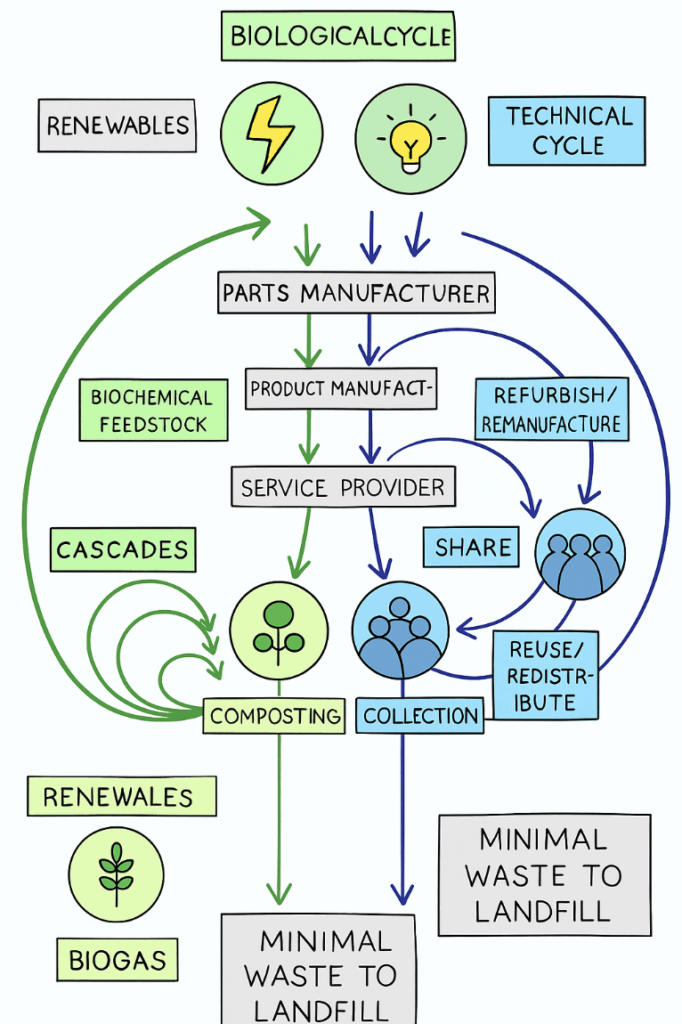
Image source: savemyexams.com
Uses of the circular economy model
- Regeneration of natural systems:
- Supports ecosystem restoration and biodiversity conservation
- Reduction of greenhouse gas emissions:
- Promotes energy efficiency and the use of renewable resources
- Improvement of local food networks and support of local communities:
- Encourages sustainable agricultural practices and local food production
- Reduction of waste by extending the product life cycle:
- Emphasises product durability, repairability and recyclability
- Changed consumer habits:
- Encourages mindful consumption and responsible product choices
Limitations of the circular economy model
- Lack of environmental awareness by consumers and companies:
- Challenges in educating consumers and businesses about the importance of circular practices
- Lack of regulations enforcing the recycling of products:
- Inadequate policies and regulations to incentivise and enforce recycling
- Some waste is not recyclable (technical limitations):
- Certain materials pose challenges for recycling due to technical constraints
- For example, mixed-material packaging that is difficult to separate and recycle effectively
- Certain materials pose challenges for recycling due to technical constraints
- Lack of finance:
- Financial barriers to implementing circular economy initiatives, especially for small businesses
- For example, there can be high upfront costs for transitioning to circular production methods
- Financial barriers to implementing circular economy initiatives, especially for small businesses