1.1 PERSPECTIVES
📌 Definitions Table
| Term | Definition |
| Perspectives | Viewpoints shaped by environmental value systems (EVSs), influenced by culture, education, and experience, determining how environmental issues are interpreted. |
| Assumptions | Unverified ideas or beliefs underpinning interpretations, decisions, or models in environmental management. |
| Sociocultural norms | Shared cultural beliefs and practices influencing individual and societal interactions with the environment. |
| Sustainability | The use of resources at a rate that allows natural regeneration and ensures ecosystem integrity for future generations. |
| Patagonia | A region known for ecological significance and conservation efforts; also a company promoting corporate environmental responsibility. |
| Likert | A scale-based tool used in surveys to quantify subjective data, typically used in social research within IAs. |
| Moral Compass | An individual’s internalized ethical framework guiding value judgments about environmental issues. |
| EVS | Environmental Value System – A worldview influencing environmental perceptions, decisions, and evaluations of environmental threats. |
| Ecocentrism | An EVS prioritizing ecological integrity and the intrinsic value of all living organisms and ecosystems. |
| Technocentrism | An EVS that promotes technological and scientific solutions to manage and solve environmental problems. |
| Anthropocentrism | An EVS viewing humans as central, where nature is valued primarily for its usefulness to human societies. |
| Inherent Worth | The intrinsic value of species or ecosystems, independent of their utility to humans. |
| Sustainable Development | Development that balances environmental, social, and economic needs without compromising future generations’ ability to meet theirs. |
| Primatology | The scientific study of primates, often contributing to biodiversity conservation and ethical debates in environmental science. |
| DDT | A persistent organic pollutant and insecticide that bioaccumulates and causes ecological harm, especially to avian species. |
| Bioaccumulation | The build-up of non-biodegradable pollutants in an organism’s tissues over time, often leading to biomagnification. |
📌 Factors Influencing Perspectives
What is a perspective?
- A perspective is how an individual sees and understands a particular situation
- Perspectives are formed based on individual assumptions, values and beliefs
- They are shaped by a combination of personal experiences, cultural background and societal influences
- For example, perspectives are often informed and justified by various factors including:
- Sociocultural norms
- Scientific understandings
- Laws
- Religion
- Economic conditions
- Local and global events
- Lived experience (i.e. events someone has personally experienced during their lives)
- Perspectives are not fixed and can evolve over time as individuals gain new experiences and insights
Environmental perspectives
- Different perspectives on environmental issues can lead to contrasting approaches to conservation and resource management
- For example, those with a more human-based perspective may prioritise human interests and well-being in environmental decision-making
- This perspective might support conservation measures that benefit humans directly, such as clean water initiatives
- In contrast, those with an environmentalist perspective may place great value on the intrinsic worth of nature and ecosystems
- Supporters of this perspective may prioritise biodiversity conservation and ecosystem health, even if it does not directly benefit humans
- For example, those with a more human-based perspective may prioritise human interests and well-being in environmental decision-making
Social perspectives
Social perspectives shape attitudes and responses to social issues such as poverty, inequality and justice
- For example, a collectivist perspective may prioritise the well-being of the community over individual rights
- Policies based on this perspective might focus on social welfare programs and taxes
- In contrast, an individualistic perspective emphasises personal responsibility and freedom of choice
- Policies based on this perspective might involve promoting entrepreneurship and reducing government intervention
Distinction between perspectives and arguments
On the other hand, someone opposing these regulations might present counterarguments based on economic concerns or individual freedoms
🧠 Examiner Tip: It is important to note that a perspective is not the same as an argument. Arguments are constructs used to support or challenge a particular perspective
They are logical or reasoned explanations presented to persuade other people of the validity of a perspective (i.e. that a particular viewpoint is credible and true)
Arguments can be constructed to defend a personally held perspective or to criticise and counter an opposing viewpoint
For example, someone who is advocating for stricter environmental regulations might present arguments based on scientific evidence to support their perspective
📌 Values and Environmental Perspectives
What are values?
- Values are qualities or principles that people believe have worth and importance in life
- They guide our behaviours, attitudes and decisions
- Examples include honesty, integrity, fairness and compassion
Influence of values
- Values affect people’s priorities, judgements, perspectives and choices
- They are deeply personal, but a variety of cultural and social factors also play a role.
- For example, in some cultures, respect for elders is highly valued, shaping how individuals interact within society
- In line with the principles of sustainability and conservation, movements like Greta Thunberg’s Fridays for the Future call for immediate action on climate change
Values in community
- Within our communities, we share and shape our values
- They are reflected in how we communicate and interact with others, both within our own community and with external communities
- For example, a community that values environmental sustainability may organise clean-up events or support green policies
Values in organisations
- Organisations also have values, which can be seen in their communication and actions
- These values are often expressed through advertisements, social media, policies and organisational decisions
- For example, a company that values diversity and inclusion may have policies supporting equal opportunities and representation in their workforce
- Companies like Patagonia demonstrate values of environmental stewardship through initiatives like donating a portion of profits to environmental causes
- These values are often expressed through advertisements, social media, policies and organisational decisions
Tensions from different values
- Different values often lead to tensions between individuals or between organisations
- Conflicts can happen when important values clash, like when some people want to freely express themselves but others want to be respectful of different cultures
- In multicultural societies, navigating these tensions requires understanding and respecting diverse values
Value Surveys
Understanding perspectives on environmental issues
- Values surveys investigate the perspectives of social groups towards various environmental issues
- They help us understand how environmental concerns are viewed and prioritised by individuals or communities
- For example, a survey could explore attitudes towards renewable energy adoption, waste reduction, or conservation efforts
- Another survey could ask about attitudes towards using public transportation to reduce carbon emissions
Effective design of value surveys
- A well-designed environmental value survey is able to:
- Take different viewpoints into account
- Look at the whole range of opinions within a group about environmental matters
- The results of an effective survey should be able to:
- Give insights into attitudes, beliefs and values that influence how people view and respond to local and global environmental challenges
Implementation of surveys
- Surveys, questionnaires, or interviews can be used to gather data on environmental attitudes
- Using online survey tools can be very useful for:
- Collecting data from a wider audience
- Collecting a greater volume of data
- Collecting data in a shorter amount of time
- Efficient analysis of data
- Using online survey tools can be very useful for:
- Closed-ended questions are good for quantitative analysis (i.e. they provide structured data that can be easily quantified and analysed statistically)
- Closed-ended questions are those that provide respondents with a fixed set of options to choose from
- Examples include multiple-choice questions, rating scales and Likert scale items
- For example, in a survey about environmental attitudes, closed-ended questions could include:
- Which of the following renewable energy sources do you believe is most effective in reducing carbon emissions? (a) Solar (b) Wind (c) Hydroelectric (d) Geothermal
- Indicate the extent to which you agree or disagree with the statement: “Using public transportation is an effective way to reduce air pollution”. Strongly agree, Agree, Neutral, Disagree, Strongly disagree
- On a scale of 1 to 5, with 5 being very likely, how likely are you to recycle paper products?
- For example, in a survey about environmental attitudes, closed-ended questions could include:
- 🧠 Examiner Tip: Responses to these questions can be easily quantified (given a value or score)
- This allows statistical analysis to be used on the data
- This helps identify trends, correlations and patterns in attitudes towards specific environmental issues
- For example, there is an environmental education campaign designed to increase recycling rates
- It is important to measure the effectiveness of this campaign
- A survey can be used to collect quantitative data on attitudes towards recycling
- This can then be correlated with data on actual actual recycling rates
- Surveys or interviews can also include open-ended questions to help capture more detailed responses
- These types of response are more difficult to analyse
- However, they can still be valuable for gaining deeper insights into individual viewpoints
Behaviour-time graphs
- If value surveys are repeated over time, the results can be used to produce behaviour-time graphs
- Behaviour-time graphs show changes in behaviours or lifestyles over time
- They help to visualise trends, patterns and shifts in behaviour related to environmental actions
- Behaviour-time graphs can track changes in daily habits over a set period of time, such as:
- Energy consumption
- Waste generation
- Transportation choices
- For example, a graph could illustrate a decrease in household electricity usage over several months
- This could be due to energy-saving measures like installing LED lights or adjusting thermostat settings
- These graphs can also illustrate changes in environmental behaviours, such as:
- Recycling rates
- Composting practices
- Water conservation efforts
- Behaviour-time graphs can be valuable tools for:
- Monitoring progress towards sustainability goals
- Evaluating the effectiveness of environmental initiatives
- They can help to:
- Visualise the impact of interventions
- Identify areas for further improvement
📌 Worldviews and Environmental Perspectives
What are worldviews?
- Worldviews can be described as the lenses through which groups of people to see and understand the world around them (it is just their “view of the world”)
- They are made up of cultural beliefs, philosophical ideas, political opinions, religious teachings and many other factors
- For example, in some cultures, the idea of family and community is highly valued, while in others, individual achievement and success are prioritised
- Worldviews shape how people think, what they believe and how they behave
- They influence our moral compass, our judgments and our decisions
- For example, a person who grew up in a religious household may have different views on topics like abortion or marriage compared to someone who didn’t
🔍 TOK Tip: How do values and cultural worldviews influence how people interpret environmental data?
How do worldviews differ from perspectives?
- Worldviews generally encompass a broader and deeper set of beliefs, values and ideologies that shape how individuals or groups perceive and interpret the world around them, whereas perspectives are usually more specific and immediate viewpoints or attitudes individuals hold on particular issues or topics
- Perspectives are often more situational and may be more likely to change based on circumstances or new information
Impact of technology and media
- With the rise of the internet and social media, people are exposed to a wide range of worldviews beyond their local community
- For example, a teenager from one part of the globe can quickly learn about different world cultures, religions, and political ideologies just by scrolling through their social media feed
- Attempts to categorise different perspectives into groups can be challenging because individuals often have a complex mix of beliefs and opinions
- For example, a person might identify as liberal on social issues but be more conservative on economic policies
An EVS might be considered as a ‘system’ in the sense that it may be influenced by education, experience, culture and media (inputs) and involves a set of interrelated premises, values and arguments that can generate consistent decisions and evaluations (outputs).
EVS Inputs and Outputs
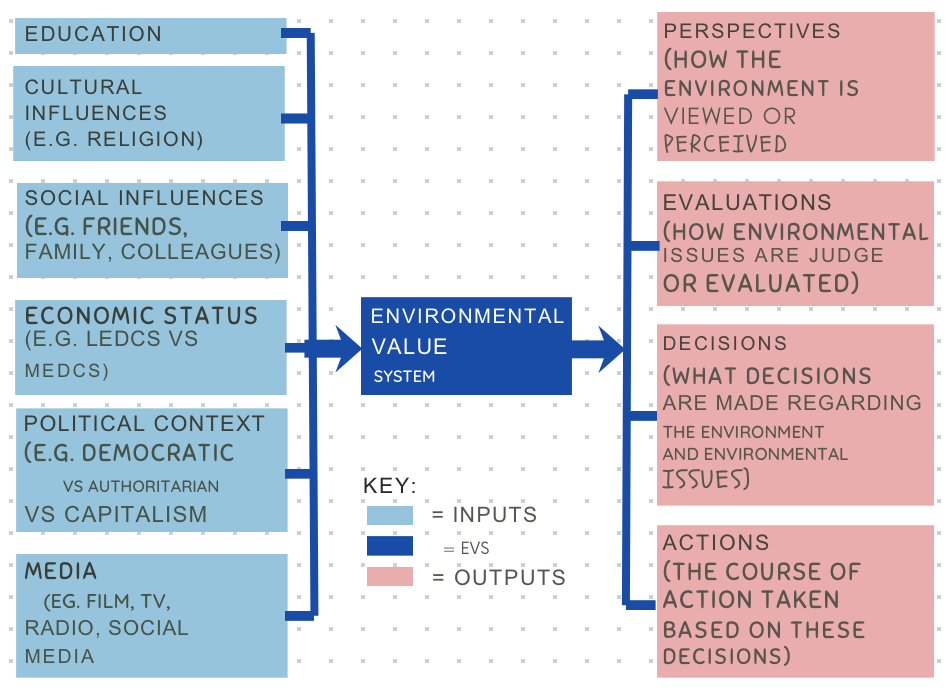
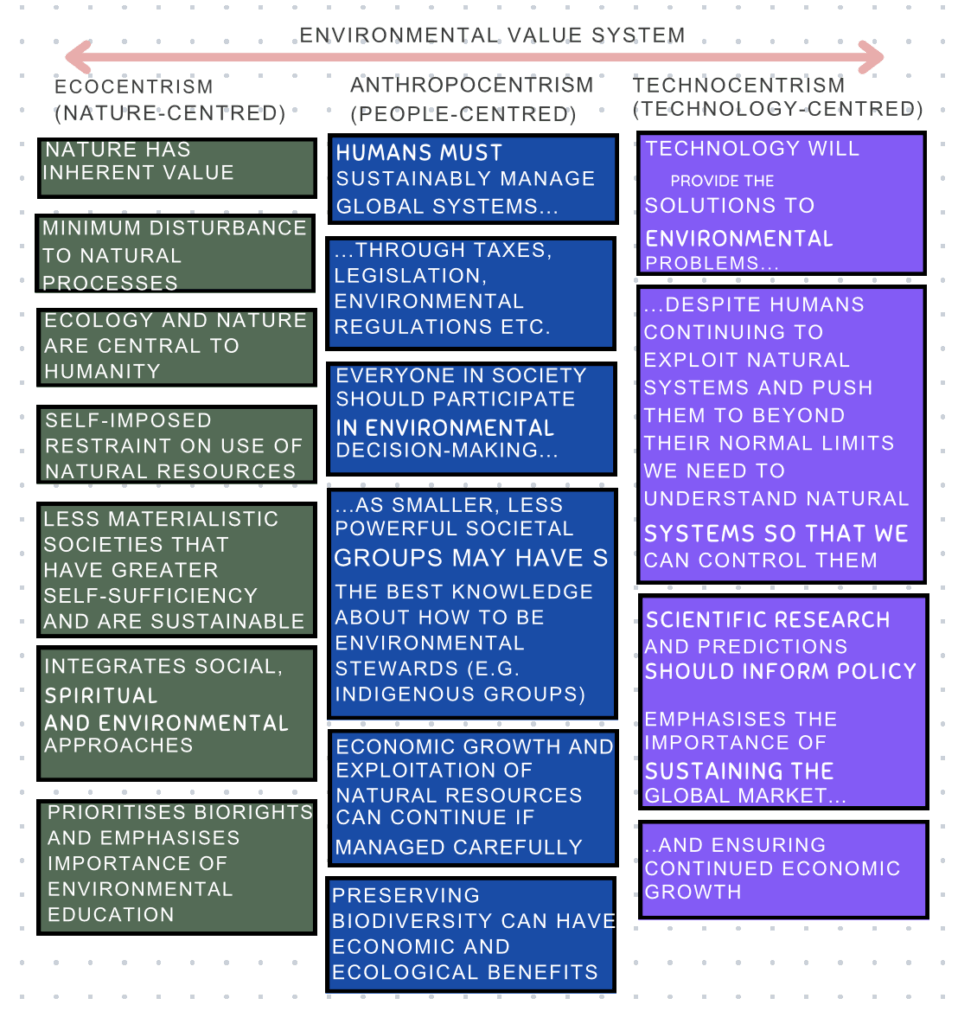
There is a spectrum of EVSs from ecocentric through anthropocentric to technocentric value systems.
Ecocentrism
- Ecocentrism is a philosophical and ethical approach that prioritises the intrinsic value of nature and the environment over human needs and interests
- This approach emphasises that all living organisms and ecosystems have inherent worth and should be protected for their own sake
- Ecocentrism advocates for sustainable practices that maintain the balance and integrity of ecosystems and the natural world, rather than exploiting them for human benefit
- This approach is often associated with environmental movements and conservation efforts that aim to protect biodiversity, ecosystems and natural resources
Anthropocentrism
- Anthropocentrism is a worldview that places human beings at the centre of the universe, prioritising human needs and interests over those of other living beings and the environment
- This approach emphasises that humans have the right to use natural resources and ecosystems for their own benefit
- Although an anthropocentric viewpoint would ideally involve sustainable managing global systems, in reality anthropocentrism often results in unsustainable practices such as overexploitation of natural resources, habitat destruction, and pollution
- This approach only values preserving biodiversity when it can provide economic and ecological advantages to humans
- This approach is often criticised by environmentalists and conservationists for ignoring the intrinsic value of nature and its ecosystems
❤️ CAS Tip: Organize a sustainability audit at school (waste, water, energy) and propose improvements.
Technocentrism
This approach is often criticised by environmentalists for being short-sighted and ignoring the complex and interconnected nature of environmental issues
Technocentrism is a worldview that places technology and human ingenuity at the centre of all problem-solving and decision-making processes, often overlooking the impact on the environment and other living beings
This approach emphasises the use of technology to overcome environmental problems and maintain human well-being
Technocentrism often assumes that all environmental problems can be solved through technological innovation and economic growth, which may lead to neglect of the need for conservation and sustainability
Strengths and Limitations of Contrasting EVSs
| EVS | Advantages | Disadvantages |
| Ecocentrism (Deep ecologists) | Reuses materials so more sustainable Minimises environmental impact by encouraging restraint Better for long-term human wellbeing No need to wait for technology to develop | Conservation can be expensive with no obvious or quick economic return Many countries are still developing economically and argue they should be allowed to continue Difficult to change individual attitudes |
| Technocentrism (Cornucopians) | Substitutes materials so avoids costly industrial change Provides solutions so people are not inconvenienced Allows social and economic progress | Allows even greater rates of resource consumption May give rise to further environmental problems High cost Humans increasingly disconnected from nature |
📌 The Environmental Movement
The environmental movement is the term used to describe humanity’s increasing awareness of the damage we are causing to the environment and the importance of conserving the environmental health of our planet
The movement includes a diverse range of individuals, organisations and initiatives united by a common goal: to address urgent environmental challenges such as climate change, pollution, habitat destruction and species extinction
The movement promotes sustainable development, responsible resource management, conservation of biodiversity and the transition to cleaner, renewable energy sources
This can be achieved by implementing changes in public policy and encouraging changes in our individual behaviours
Through education, advocacy, activism and policy-making, the environmental movement aims to create a more sustainable and resilient future for both humanity and the natural world
Various different factors, including people, books, films and historical events, have been key in the development of the environmental movement
These events and influences have come from many different areas, including:
1. Environmental Activists
2. Literature
3. Media
4. Major environmental disasters
5. International conferences and agreements
6. New technologies
7. Scientific discoveries
Individuals and Environmental Activists
| Individual | Field | Description | Effect on Environmental Movement |
|---|---|---|---|
| Wangarĩ Maathai | Conservation | Founded the Green Belt Movement, advocating for tree planting, conservation, and women’s rights | Mobilised grassroots activism and promoted environmental conservation on a local and globalscale |
| Greta Thunberg | Climate action | Led global youth strikes for climate action, raising awareness and challenging political leaders | Inspired millions worldwide to join climate activism, urging policymakers to take urgent climate action |
| Vandana Shiva | Environmentalism | Advocated for sustainable agriculture and biodiversity conservation, questioning corporate dominance | Raised awareness of the impacts of industrial agriculture and promoted sustainable, community-based alternatives |
| David Attenborough | Conservation | Renowned naturalist and broadcaster, raising awareness of environmental issues through documentaries | Educated and inspired audiences worldwide, fostering greater appreciation and concern for the natural world |
| Jane Goodall | Primatology | Pioneering primatologist, advocating for wildlife conservation and ethical treatment of animals | Advancing our understanding of animal behaviour and conservation, empowering individuals to protect biodiversity and habitats |
Literature
| Author | Year | Work | Description | Effect on Environmental Movement |
|---|---|---|---|---|
| Aldo Leopold | 1949 | A Sand County Almanac | Advocated for a land ethic, promoting conservation and stewardship of the natural world | Influential in shaping modern conservation ethics and inspiring environmental activism |
| Rachel Carson | 1962 | Silent Spring | Outlined the harmful effects of the pesticide DDT passing along food chains to top predators | Led to widespread concern about the dangers of pesticide use and increased awareness of environmental pollution |
| Donella Meadows, Dennis Meadows, Jørgen Randers, William W. Behrens III | 1972 | The Limits to Growth (LTG) | A report, commissioned by the Club of Rome (a global think tank), outlining the effects of a rapidly increasing global population on Earth’s finite natural resources | Increased awareness of the dangers of unsustainable natural resource use (best-selling environmental publication in history) |
| James Lovelock | 1979 | Gaia | The first book to suggest that Earth is like a ‘living organism’ (a self-regulatory system that maintains its climate and biology) | Showed how humanity has the power to upset the delicate balance of the Earth’s self-regulating processes, with potentially deadly consequences |
| Edward Abbey | 1975 | The Monkey Wrench Gang | Novel about eco-sabotage and resistance against environmental destruction, inspiring direct action | Influenced environmental activism by promoting radical tactics and raising awareness of conservation issues |
| Donella Meadows | 1992 | Beyond the Limits | Follow-up to “The Limits to Growth”, exploring strategies for achieving sustainable development | Contributed to discussions on sustainability and influenced policy-making towards more eco-friendly practices |
Media
| Media | Year | Description | Effect on Environmental Movement |
|---|---|---|---|
| An Inconvenient Truth | 2006 | A documentary film of former US Vice President Al Gore giving a lecture on climate change and its consequences | The film got extensive publicity, reaching a huge worldwide audience and triggering a major shift in public opinion in the USA |
| No Impact Man | 2009 | Documentary film following a family’s attempt to live a zero-waste lifestyle in New York City | Raised awareness about individual carbon footprintsand the potential for sustainable living in urban environments |
| Before the Flood | 2016 | Documentary featuring Leonardo DiCaprio exploring climate change impacts and solutions | Raised awareness of climate change issues and advocated for renewable energy and conservation efforts |
| Our Planet | 2019 | Netflix documentary series showcasing Earth’s natural beauty and the impact of human activity | Raised awareness of environmental conservation and the need to protectecosystems and biodiversity |
| Breaking Boundaries | 2021 | Netflix documentary on how humans are pushing Earth beyond the boundaries that have kept the planet stable for the last 10 000 years, narrated by David Attenborough | Highlighted pressing environmental issues and the importance of global cooperation for sustainable solutions |
Major Environmental Disasters
| Event | Year | Description | Effect on Environmental Movement |
|---|---|---|---|
| Minamata disease in Minamata, Japan | 1956 | Chemical factories released toxic methyl mercury into waste water— mercury accumulation in fish and shellfish caused mercury poisoning in local people, with severe symptoms (neurological disorders, paralysis, death, or birth defects in newborns) | Raised awareness of the risks of industrialisation and the need for environmental regulations and checks to be imposed on industries |
| Industrial accident in Bhopal, India | 1984 | Explosion at a pesticide plant—released 42 tonnes of toxic methyl isocyanate gas, killing 10 000 people in the first 72 hours and 25 000 in total | Highlighted industrial risks and lack of safety measures, driving demands for stricter regulations and corporate accountability |
| Chernobyl nuclear meltdown, Soviet Ukraine | 1986 | Nuclear reactor exploded—radioactive fallout covered large areas of Ukraine, Belarus and Russia—336 000 people had to be evacuated and cancer incidence increased in surrounding area | Reinforced society’s fear and negative perceptions surrounding nuclear power, strengthening calls for safer energy alternatives and stricter regulations on nuclear facilities |
| Fukushima nuclear meltdown, Japan | 2011 | Earthquake-generated tsunami hit nuclear power station and caused a meltdown in three of the six reactors—110 000 people evacuated | Intensified global concerns about nuclear safety and encouraged shifts towards renewable energy sources—however, Japan temporarily halted all nuclear power to carry out new safety checks, leading to increased dependence on fossil fuels |
International Conferences and Agreements
| Event | Year | Description | Effect on Environmental Movement |
|---|---|---|---|
| Stockholm Declaration | 1972 | The first major United Nations (UN) conference on international environmental issues, held in Stockholm, led to this Declaration | Influential in setting environmental targets and shaping action at the localand international level |
| Rio Earth Summit | 1992 | UN Conference on Environment and Development, attended by 172 nations—outlined that radical changes in attitudes towards the environment needed to limit the damage to the planet | Had a global impact—led to the adoption of ‘Agenda 21’ (a comprehensive action plan to ensure sustainable development) by over 178 parties |
| Kyoto Protocol | 1997 | An international treaty building on the UN Framework Convention on Climate Change (UNFCCC) that committed state parties to reduce greenhouse gas emissions | 192 parties committed to reducing their emissions of greenhouse gases such as carbon dioxide and methane |
| Rio+20 | 2012 | UN Conference on Sustainable Development, marking the 20th anniversary of the Rio Earth Summit – aimed to secure further political commitment from nations to sustainable development | Helped to assess progress on various internationally agreed targets (e.g. reduction of greenhouse gas emissions) and identify emerging environmental challenges |
| Paris Agreement | 2015 | An international treaty agreed by 195 parties at COP21 – aimed to hold the increase in global average temperature to below 2 °C above pre-industrial levels | 50% cut in greenhouse gas emissions needed by 2030—every country (including developing countries) agreed to set targets and regularlyreport on their progress |
| Glasgow Climate Pact | 2021 | At COP26, an international agreement between 197 countries was reached, which reaffirmed the Paris Agreement’s global temperature goal | First climate deal to explicitly commit to reducing coal use—a late intervention from China and India weakened the pact’s wording to “phasing down” coal (rather than phasing it out) |
| COP27 | 2022 | The 27th United Nations Climate Change conference, held in Sharm El Sheikh, Egypt | Led to the creation of the first loss-and-damage fund and addressed measures to limit global temperature rise |
| COP28 | 2023 | The 28th United Nations Climate Change conference, held in Expo City, Dubai, UAE | The final agreement made at this conference commits signatory countries to move away from carbon energy sources to mitigate climate change effects |
New Technologies
| Development | Description | Effect on Environmental Movement |
|---|---|---|
| Green Revolution | Agricultural advancements increasing crop yields in the mid-20th century, addressing food scarcity | Improved food securityand reduced pressure on natural habitats, but also raised concerns about the environmental impacts of intensive farming practices |
| Enteric fermentation control | Methods to decrease methane emissions from livestock, reducing agriculture’s environmental footprint—strategies may include dietary adjustments, such as altering feed composition to improve digestion efficiency and reduce methane production, or supplementing diets with compounds that inhibit methane-producing microorganisms | Reduces greenhouse gas (methane) emissions from agriculture, mitigating the environmental impact of livestock and lowering climate change impacts |
| Plant-based meats | Innovations creating meat substitutes from plant sources, offering environmentally-friendly alternatives | Reduces demand for animal agriculture, mitigating deforestation, habitat loss and greenhouse gas emissions |
| Electric cars | Vehicles powered by electric motors instead of internal combustion engines, reducing reliance on fossil fuels and emissions of greenhouse gases | Lowers carbon emissions and air pollution, driving the transition to sustainable transportation and energy systems |
Scientific Discoveries
| Discovery | Description | Effect on Environmental Movement |
|---|---|---|
| Pesticide and biocide toxicity | Studies revealing the harmful effects of pesticides and biocides on ecosystems and human health | Increased awareness of environmental risks, leading to regulatory measures, pesticide bans, and adoption of alternative pest control methods |
| Species loss | Research documenting the rapid decline of species diversity globally due to human activities | Raised alarm about biodiversity loss and the extinction crisis, driving conservation efforts and policy actions to protect ecosystems and species |
| Habitat degradation | Investigations highlighting the destruction and fragmentation of natural habitats worldwide | Highlighted the urgent need for habitat conservation and restoration, leading to the establishment of protected areas and restoration initiatives |
| Ocean acidification | Phenomenon of decreasing pHlevels in the Earth’s oceans, mainly due to increased carbon dioxide emissions | Raised concerns about marine ecosystem health and biodiversity, driving research and policy actions to address ocean acidification impacts |
| Climate change impacts | Research documenting the diverse effects of climate change on ecosystems, economies and human societies | Increased understanding of climate change risks and vulnerabilities, motivating adaptation and mitigation efforts to address its impacts |